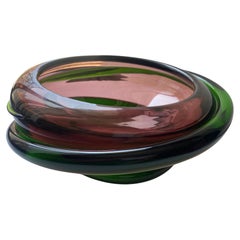
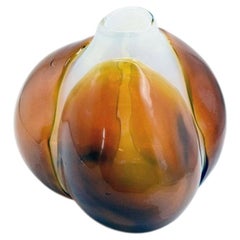
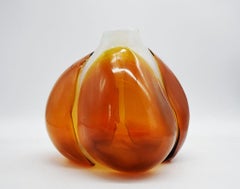
By Claire Falkenstein
Located in Surfside, FL
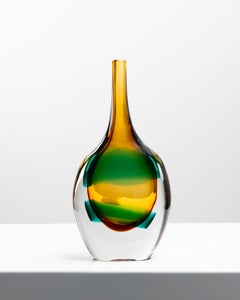
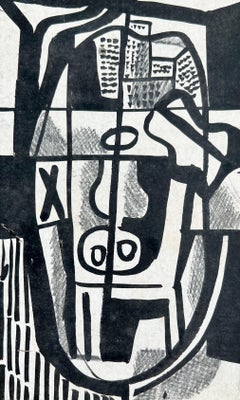
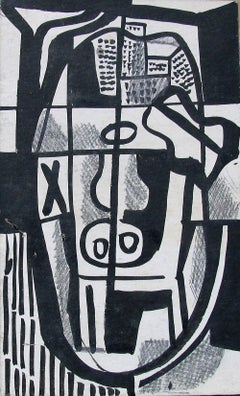
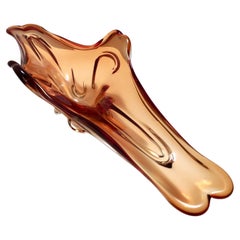
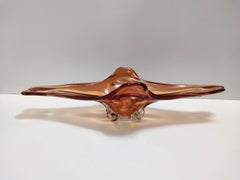
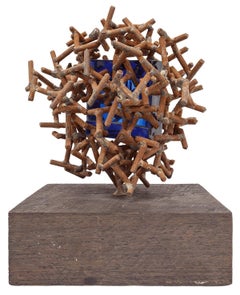
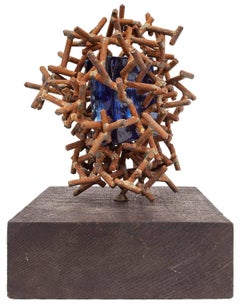
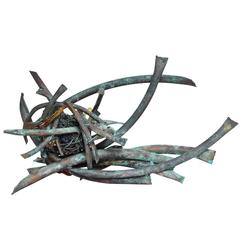
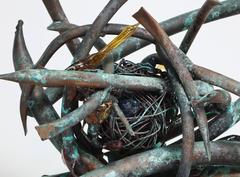
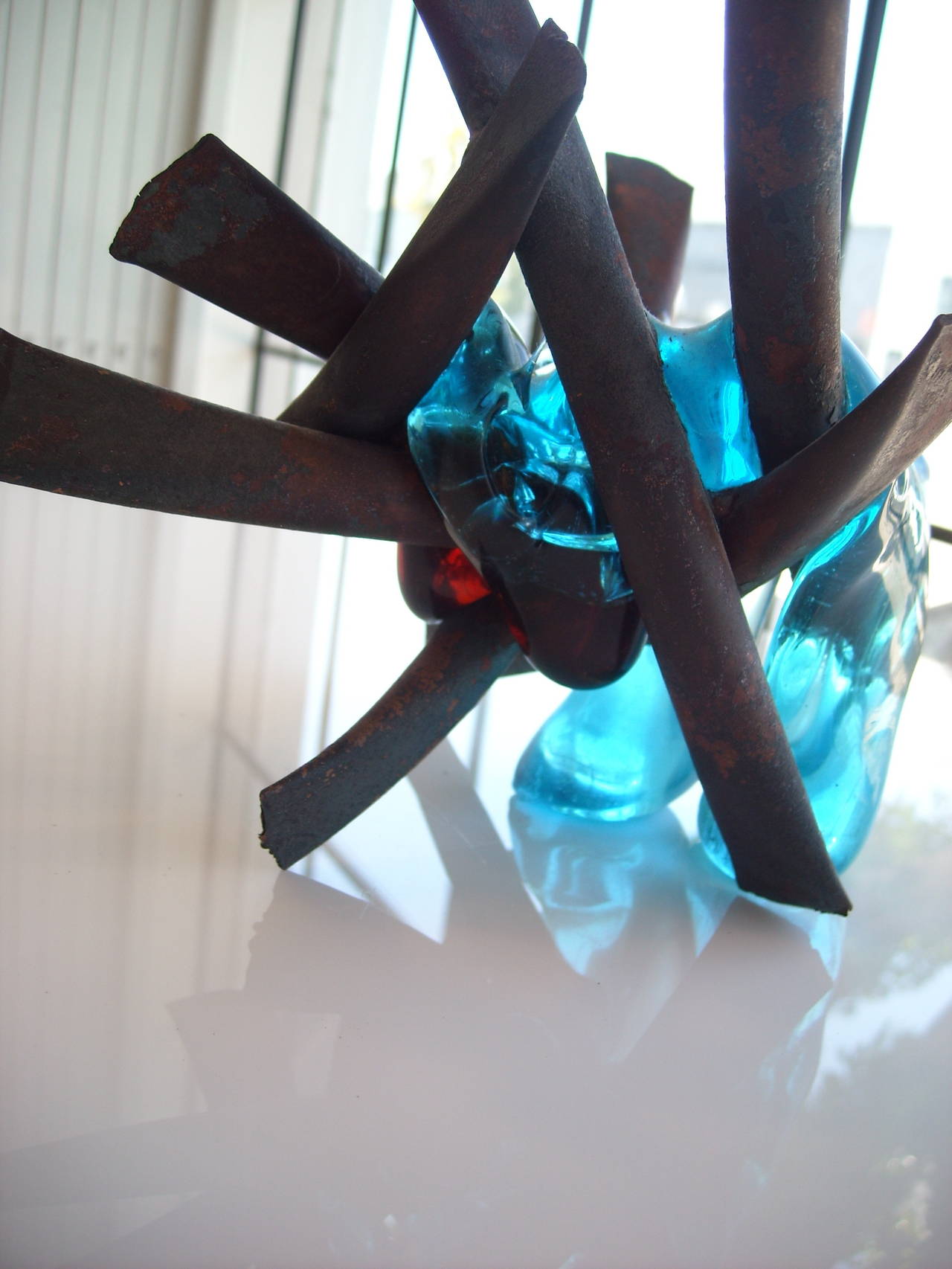
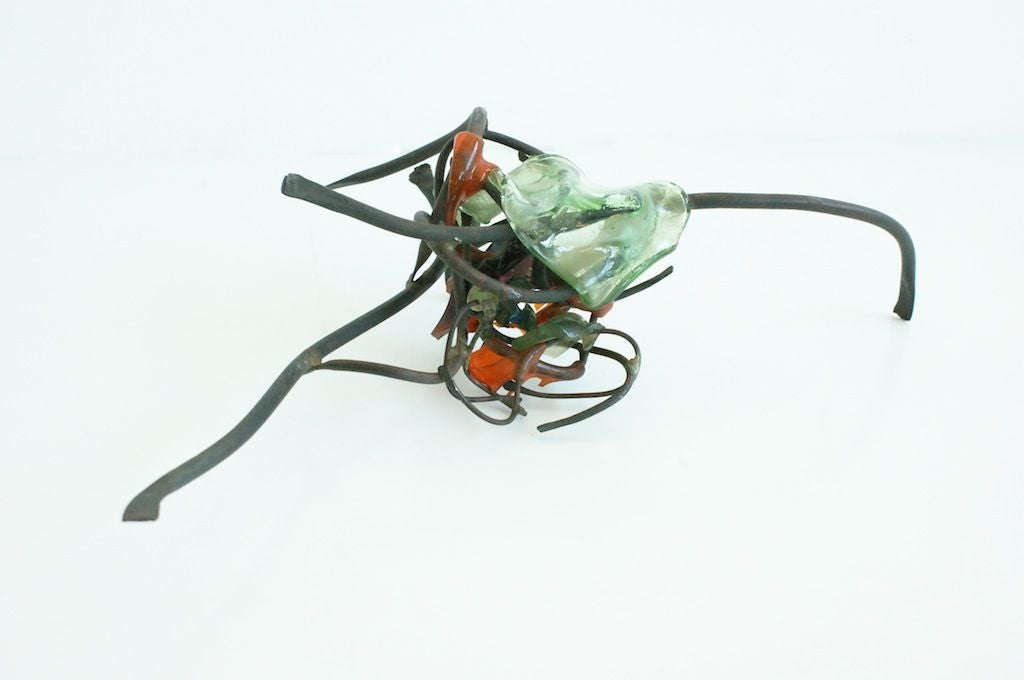
Rust patina to the iron. not attached to the base. not sure if it is original to piece or was just shown that way. the piece is not signed but i do have an email from her dealer "Given the imagery and information provided, we believe the work to have been executed by the hand of Claire Falkenstein. It features the "never ending screen" pattern she worked and reworked in many of her sculptures. She began utilizing that particular construct in the sixties. You can see the pattern, in a flat plane context, when she designed the gates for Peggy Guggenheim's Venice compound in the early 60's.
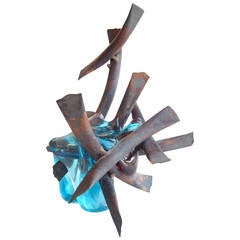
Also, she began using glass with steel or copper in the mid sixties and by the early seventies was producing "fusions", glass melted onto welded metal. This work seems an early predecessor of the fusions.
In our experience with her inventory, most of her small sculptural works are free-standing, not mounted to a base. From the imagery provided, I would think that the base is made of wood and is "younger" than the object itself, yes? Did the previous owner design a base for the object?"
Claire Falkenstein was an American sculptor, painter, printmaker, jewelry designer, and teacher, most renowned for her often large-scale abstract metal and glass public sculptures. Falkenstein was one of America's most experimental and productive twentieth-century artists.
Falkenstein relentlessly explored media, techniques, and processes with uncommon daring and intellectual rigor. Though she was respected among the burgeoning post-World-War-II art scene in Europe and the United States, her disregard for the commodification of art coupled with her peripatetic movement from one art metropolis to another made her an elusive figure.
Falkenstein first worked in the San Francisco Bay Area, then in Paris and New York, and finally in Los Angeles. She was involved with art groups as radical as the Gutai Group in Japan and art autre in Paris and secured a lasting position in the vanguard, which she held until her death in 1997. Falkenstein’s current reputation rests on her sculpture, and her work in three dimensions was often radical and ahead of her time.
As a child, Falkenstein would ride her horse in the dark on the beach to see the sun come up and spend time looking at the shells, rocks, seaweed, and driftwood, and these nature forms inspired her sculpture.
Falkenstein attended the University of California at Berkeley, and graduated in 1930 with a major in art and minors in anthropology and philosophy. She had her first one-woman exhibition, at a San Francisco gallery, even before graduation. Her art education continued in the early 1930s at Mills College, where she took a master class with Alexander Archipenko, and met László Moholy-Nagy and György Kepes.
She taught art classes at various Bay Area locations, such as UC Berkeley Extension, Mills College, and the California Labor School. She also taught at the innovative California School of Fine Arts, alongside abstract expressionists such as Clyfford Still, who would become a close friend and artistic influence, and Richard Diebenkorn. In 1934, she created an abstract fresco at Oakland's Piedmont High School. This was part of the Federal Art Project, WPA, which strongly preferred paintings depicting American scenes, but some abstracts such as this work by Falkenstein were tolerated. During the 1930s she created sculptures from clay...
Category
Mid-20th Century Abstract Claire Falkenstein Furniture