Currier & Ives

American, 1834-1907
Currier and Ives was a prominent American printmaking establishment headquartered in New York operating from 1835 to 1907. Nathaniel Currier (1813-1888) started his business on his own, but later merged with James Merritt Ives (1824-1895), becoming "Currier and Ives" in 1857. They produced and sold hand-colored lithographs which could be produced relatively quickly and cheaply. They called themselves "the Grand Central Depot for Cheap and Popular Prints". The company published around 7,500 lithographs in its 72 years in business.
to
2
26
24
12
10
7
6
2
1
1
1
1
1
1
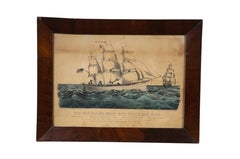
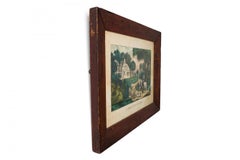
Antique Currier & Ives Nautical Maritime Clipper Ship Lithographs Mahogany Frame

Antique Currier & Ives Nautical Maritime Clipper Ship Lithographs Mahogany Frame

By Currier & Ives

Located in Dayton, OH

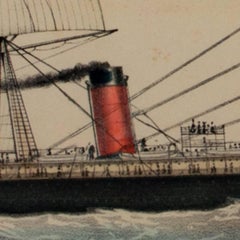
Pair of antique late 19th century Currier & Ives hand colored lithograph prints: "The Miniature Ship Red, White, and Blue - On her Voyage from New York to London, August 1866, with C...

Category

Late 19th Century American Victorian Antique Currier & Ives

Materials

Wood, Paper

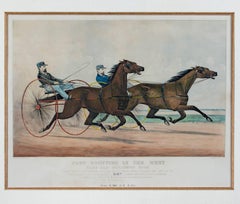
19th century color lithograph horses chariot figures dynamic landscape

19th century color lithograph horses chariot figures dynamic landscape

By Currier & Ives

Located in Milwaukee, WI

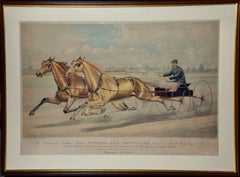
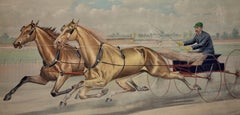
"Fast Trotting in the West (Milwaukee Race)" is an original hand-colored lithograph published by Currier & Ives. It depicts two horses pulling racing carts. The text below the picture reads "Fast Trotting in the West...Lucy and Goldsmith Maid...trotting their closely contested race over the cold spring course Milwaukee, Wis. Sept. 6th 1871...Where Goldsmith Maid won the 2nd heat in 2:17!! The fastest Mile heat in harness on record. Purse $4000 $2500 to 1st $1500 to 2nd horse____ 8 in. in harness. TIME 2:20 1/2 2:17 2:20" 16 3/4" x 26" image 22" x 27 3/4" paper 35 3/4" x 41 7/8" frame Currier & Ives produced their prints in a building at 33 Spruce Street where they occupied the third, fourth and fifth floors. The third floor was devoted to the hand operated printing presses that were built by Nat's cousin, Cyrus Currier, at his shop Cyrus Currier & Sons in Newark, NJ. The fourth floor found the artists, lithographers and the stone grinders...

Category

1870s Currier & Ives

Materials

Lithograph

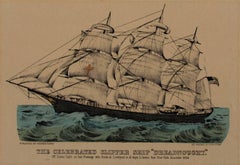
19th century color lithograph seascape boat ship waves maritime landscape

19th century color lithograph seascape boat ship waves maritime landscape

By Currier & Ives

Located in Milwaukee, WI

"The Celebrated Clipper Ship Dreadnought" is an original hand-colored lithograph by Currier & Ives. It depicts a sailing ship. 13 1/4" x 17 1/2" art 19" x 23 1/2" frame Nathaniel Currier was a tall introspective man with a melancholy nature. He could captivate people with his piercing stare or charm them with his sparkling blue eyes. Nathaniel was born in Roxbury, Massachusetts on March 27th, 1813, the second of four children. His parents, Nathaniel and Hannah Currier, were distant cousins who lived a humble yet spartan life. When Nathaniel was eight years old, tragedy struck. Nathaniel’s father unexpectedly passed away leaving Nathaniel and his eleven-year-old brother Lorenzo to provide for the family. In addition to their mother, Nathaniel and Lorenzo had to care for six-year-old sister Elizabeth and two-year-old brother Charles. Nathaniel worked a series of odd jobs to support the family, and at fifteen, he started what would become a life-long career when he apprenticed in the Boston lithography shop of William and John Pendleton. A Bavarian gentleman named Alois Senefelder invented lithography just 30 years prior to young Nat Currier’s apprenticeship. While under the employ of the brothers Pendleton, Nat was taught the art of lithography by the firm’s chief printer, a French national named Dubois, who brought the lithography trade to America. Lithography involves grinding a piece of limestone flat and smooth then drawing in mirror image on the stone with a special grease pencil. After the image is completed, the stone is etched with a solution of aqua fortis leaving the greased areas in slight relief. Water is then used to wet the stone and greased-ink is rolled onto the raised areas. Since grease and water do not mix, the greased-ink is repelled by the moisture on the stone and clings to the original grease pencil lines. The stone is then placed in a press and used as a printing block to impart black on white images to paper. In 1833, now twenty-years old and an accomplished lithographer, Nat Currier left Boston and moved to Philadelphia to do contract work for M.E.D. Brown, a noted engraver and printer. With the promise of good money, Currier hired on to help Brown prepare lithographic stones of scientific images for the American Journal of Sciences and Arts. When Nat completed the contract work in 1834, he traveled to New York City to work once again for his mentor John Pendleton, who was now operating his own shop located at 137 Broadway. Soon after the reunion, Pendleton expressed an interest in returning to Boston and offered to sell his print shop to Currier. Young Nat did not have the financial resources to buy the shop, but being the resourceful type he found another local printer by the name of Stodart. Together they bought Pendleton’s business. The firm ‘Currier & Stodart’ specialized in "job" printing. They produced many different types of printed items, most notably music manuscripts for local publishers. By 1835, Stodart was frustrated that the business was not making enough money and he ended the partnership, taking his investment with him. With little more than some lithographic stones, and a talent for his trade, twenty-two year old Nat Currier set up shop in a temporary office at 1 Wall Street in New York City. He named his new enterprise ‘N. Currier, Lithographer’ Nathaniel continued as a job printer and duplicated everything from music sheets to architectural plans. He experimented with portraits, disaster scenes and memorial prints, and any thing that he could sell to the public from tables in front of his shop. During 1835 he produced a disaster print Ruins of the Planter's Hotel, New Orleans, which fell at two O’clock on the Morning of the 15th of May 1835, burying 50 persons, 40 of whom Escaped with their Lives. The public had a thirst for newsworthy events, and newspapers of the day did not include pictures. By producing this print, Nat gave the public a new way to “see” the news. The print sold reasonably well, an important fact that was not lost on Currier. Nat met and married Eliza Farnsworth in 1840. He also produced a print that same year titled Awful Conflagration of the Steamboat Lexington in Long Island Sound on Monday Evening, January 18, 1840, by which melancholy occurrence over One Hundred Persons Perished. This print sold out very quickly, and Currier was approached by an enterprising publication who contracted him to print a single sheet addition of their paper, the New York Sun. This single page paper is presumed to be the first illustrated newspaper ever published. The success of the Lexington print launched his career nationally and put him in a position to finally lift his family up. In 1841, Nat and Eliza had their first child, a son they named Edward West Currier. That same year Nat hired his twenty-one year old brother Charles and taught him the lithography trade, he also hired his artistically inclined brother Lorenzo to travel out west and make sketches of the new frontier as material for future prints. Charles worked for the firm on and off over the years, and invented a new type of lithographic crayon which he patented and named the Crayola. Lorenzo continued selling sketches to Nat for the next few years. In 1843, Nat and Eliza had a daughter, Eliza West Currier, but tragedy struck in early 1847 when their young daughter died from a prolonged illness. Nat and Eliza were grief stricken, and Eliza, driven by despair, gave up on life and passed away just four months after her daughter’s death. The subject of Nat Currier’s artwork changed following the death of his wife and daughter, and he produced many memorial prints and sentimental prints during the late 1840s. The memorial prints generally depicted grief stricken families posed by gravestones (the stones were left blank so the purchasers could fill in the names of the dearly departed). The sentimental prints usually depicted idealized portraits of women and children, titled with popular Christian names of the day. Late in 1847, Nat Currier married Lura Ormsbee, a friend of the family. Lura was a self-sufficient woman, and she immediately set out to help Nat raise six-year-old Edward and get their house in order. In 1849, Lura delivered a son, Walter Black Currier, but fate dealt them a blow when young Walter died one year later. While Nat and Lura were grieving the loss of their new son, word came from San Francisco that Nat’s brother Lorenzo had also passed away from a brief illness. Nat sank deeper into his natural quiet melancholy. Friends stopped by to console the couple, and Lura began to set an extra place at their table for these unexpected guests. She continued this tradition throughout their lives. In 1852, Charles introduced a friend, James Merritt Ives, to Nat and suggested he hire him as a bookkeeper. Jim Ives was a native New Yorker born in 1824 and raised on the grounds of Bellevue Hospital where his father was employed as superintendent. Jim was a self-trained artist and professional bookkeeper. He was also a plump and jovial man, presenting the exact opposite image of his new boss. Jim Ives met Charles Currier through Caroline Clark, the object of Jim’s affection. Caroline’s sister Elizabeth was married to Charles, and Caroline was a close friend of the Currier family. Jim eventually proposed marriage to Caroline and solicited an introduction to Nat Currier, through Charles, in hopes of securing a more stable income to support his future wife. Ives quickly set out to improve and modernize his new employer’s bookkeeping methods. He reorganized the firm’s sizable inventory, and used his artistic skills to streamline the firm’s production methods. By 1857, Nathaniel had become so dependent on Jims’ skills and initiative that he offered him a full partnership in the firm and appointed him general manager. The two men chose the name ‘Currier & Ives’ for the new partnership, and became close friends. Currier & Ives produced their prints in a building at 33 Spruce Street where they occupied the third, fourth and fifth floors. The third floor was devoted to the hand operated printing presses that were built by Nat's cousin, Cyrus Currier, at his shop Cyrus Currier & Sons in Newark, NJ. The fourth floor found the artists, lithographers and the stone grinders at work. The fifth floor housed the coloring department, and was one of the earliest production lines in the country. The colorists were generally immigrant girls, mostly German, who came to America with some formal artistic training. Each colorist was responsible for adding a single color to a print. As a colorist finished applying their color, the print was passed down the line to the next colorist to add their color. The colorists worked from a master print displayed above their table, which showed where the proper colors were to be placed. At the end of the table was a touch up artist who checked the prints for quality, touching-in areas that may have been missed as it passed down the line. During the Civil War, demand for prints became so great that coloring stencils were developed to speed up production. Although most Currier & Ives prints were colored in house, some were sent out to contract artists. The rate Currier & Ives paid these artists for coloring work was one dollar per one hundred small folios (a penny a print) and one dollar per one dozen large folios. Currier & Ives also offered uncolored prints to dealers, with instructions (included on the price list) on how to 'prepare the prints for coloring.' In addition, schools could order uncolored prints from the firm’s catalogue to use in their painting classes. Nathaniel Currier and James Merritt Ives attracted a wide circle of friends during their years in business. Some of their more famous acquaintances included Horace Greeley, Phineas T. Barnum, and the outspoken abolitionists Rev. Henry Ward, and John Greenleaf Whittier (the latter being a cousin of Mr. Currier). Nat Currier and Jim Ives described their business as "Publishers of Cheap and Popular Pictures" and produced many categories of prints. These included Disaster Scenes, Sentimental Images, Sports, Humor, Hunting Scenes, Politics, Religion, City and Rural Scenes, Trains, Ships, Fire Fighters, Famous Race Horses, Historical Portraits, and just about any other topic that satisfied the general public's taste. In all, the firm produced in excess of 7500 different titles, totaling over one million prints produced from 1835 to 1907. Nat Currier retired in 1880, and signed over his share of the firm to his son Edward. Nat died eight years later at his summer home 'Lion’s Gate' in Amesbury, Massachusetts. Jim Ives remained active in the firm until his death in 1895, when his share of the firm passed to his eldest son, Chauncey. In 1902, faced will failing health from the ravages of Tuberculosis, Edward Currier sold his share of the firm to Chauncey Ives...

Category

1870s Other Art Style Currier & Ives

Materials

Lithograph

19th century color lithograph horses figures dynamic landscape

19th century color lithograph horses figures dynamic landscape

By Currier & Ives

Located in Milwaukee, WI

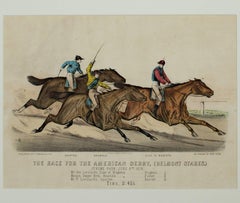
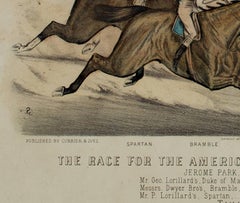
"The Race for the American Derby (Belmont Stakes)" is an original hand-colored lithograph published by Currier & Ives. It depicts three racehorses and their jockeys running in the Belmont Stakes. The caption for this lithograph says, "Spartan. Bramble. Duke of Magenta. Jerome Park, June 8th 1878. Mr. Geo. Lorillard's Duke of Magenta.....Hughes, 1....Messrs.Dwyer Bro's Bramble......Fisher, 2....Mr. P. Lorillard's Spartan.....Barrett, 3..... TIME 2:43 1/2." 12 7/8" x 16 7/8" art 21 7/8" x 25 7/8" frame Currier & Ives produced their prints in a building at 33 Spruce Street where they occupied the third, fourth and fifth floors. The third floor was devoted to the hand operated printing presses that were built by Nat's cousin, Cyrus Currier, at his shop Cyrus Currier & Sons in Newark, NJ. The fourth floor found the artists, lithographers and the stone grinders...

Category

1870s Currier & Ives

Materials

Lithograph

19th century color lithograph seascape boat ship waves maritime landscape

19th century color lithograph seascape boat ship waves maritime landscape

By Currier & Ives

Located in Milwaukee, WI

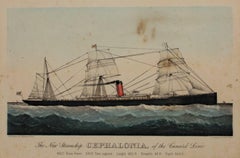
"The New Steamship Cephalonia, of the Cunard Line" is an original hand-colored lithograph by Currier & Ives. It depicts a large sailing steamship. There is a significant stain in the artwork in the upper center. 12" x 16 3/4" art 21" x 26" frame Nathaniel Currier was a tall introspective man with a melancholy nature. He could captivate people with his piercing stare or charm them with his sparkling blue eyes. Nathaniel was born in Roxbury, Massachusetts on March 27th, 1813, the second of four children. His parents, Nathaniel and Hannah Currier, were distant cousins who lived a humble yet spartan life. When Nathaniel was eight years old, tragedy struck. Nathaniel’s father unexpectedly passed away leaving Nathaniel and his eleven-year-old brother Lorenzo to provide for the family. In addition to their mother, Nathaniel and Lorenzo had to care for six-year-old sister Elizabeth and two-year-old brother Charles. Nathaniel worked a series of odd jobs to support the family, and at fifteen, he started what would become a life-long career when he apprenticed in the Boston lithography shop of William and John Pendleton. A Bavarian gentleman named Alois Senefelder invented lithography just 30 years prior to young Nat Currier’s apprenticeship. While under the employ of the brothers Pendleton, Nat was taught the art of lithography by the firm’s chief printer, a French national named Dubois, who brought the lithography trade to America. Lithography involves grinding a piece of limestone flat and smooth then drawing in mirror image on the stone with a special grease pencil. After the image is completed, the stone is etched with a solution of aqua fortis leaving the greased areas in slight relief. Water is then used to wet the stone and greased-ink is rolled onto the raised areas. Since grease and water do not mix, the greased-ink is repelled by the moisture on the stone and clings to the original grease pencil lines. The stone is then placed in a press and used as a printing block to impart black on white images to paper. In 1833, now twenty-years old and an accomplished lithographer, Nat Currier left Boston and moved to Philadelphia to do contract work for M.E.D. Brown, a noted engraver and printer. With the promise of good money, Currier hired on to help Brown prepare lithographic stones of scientific images for the American Journal of Sciences and Arts. When Nat completed the contract work in 1834, he traveled to New York City to work once again for his mentor John Pendleton, who was now operating his own shop located at 137 Broadway. Soon after the reunion, Pendleton expressed an interest in returning to Boston and offered to sell his print shop to Currier. Young Nat did not have the financial resources to buy the shop, but being the resourceful type he found another local printer by the name of Stodart. Together they bought Pendleton’s business. The firm ‘Currier & Stodart’ specialized in "job" printing. They produced many different types of printed items, most notably music manuscripts for local publishers. By 1835, Stodart was frustrated that the business was not making enough money and he ended the partnership, taking his investment with him. With little more than some lithographic stones, and a talent for his trade, twenty-two year old Nat Currier set up shop in a temporary office at 1 Wall Street in New York City. He named his new enterprise ‘N. Currier, Lithographer’ Nathaniel continued as a job printer and duplicated everything from music sheets to architectural plans. He experimented with portraits, disaster scenes and memorial prints, and any thing that he could sell to the public from tables in front of his shop. During 1835 he produced a disaster print Ruins of the Planter's Hotel, New Orleans, which fell at two O’clock on the Morning of the 15th of May 1835, burying 50 persons, 40 of whom Escaped with their Lives. The public had a thirst for newsworthy events, and newspapers of the day did not include pictures. By producing this print, Nat gave the public a new way to “see” the news. The print sold reasonably well, an important fact that was not lost on Currier. Nat met and married Eliza Farnsworth in 1840. He also produced a print that same year titled Awful Conflagration of the Steamboat Lexington in Long Island Sound on Monday Evening, January 18, 1840, by which melancholy occurrence over One Hundred Persons Perished. This print sold out very quickly, and Currier was approached by an enterprising publication who contracted him to print a single sheet addition of their paper, the New York Sun. This single page paper is presumed to be the first illustrated newspaper ever published. The success of the Lexington print launched his career nationally and put him in a position to finally lift his family up. In 1841, Nat and Eliza had their first child, a son they named Edward West Currier. That same year Nat hired his twenty-one year old brother Charles and taught him the lithography trade, he also hired his artistically inclined brother Lorenzo to travel out west and make sketches of the new frontier as material for future prints. Charles worked for the firm on and off over the years, and invented a new type of lithographic crayon which he patented and named the Crayola. Lorenzo continued selling sketches to Nat for the next few years. In 1843, Nat and Eliza had a daughter, Eliza West Currier, but tragedy struck in early 1847 when their young daughter died from a prolonged illness. Nat and Eliza were grief stricken, and Eliza, driven by despair, gave up on life and passed away just four months after her daughter’s death. The subject of Nat Currier’s artwork changed following the death of his wife and daughter, and he produced many memorial prints and sentimental prints during the late 1840s. The memorial prints generally depicted grief stricken families posed by gravestones (the stones were left blank so the purchasers could fill in the names of the dearly departed). The sentimental prints usually depicted idealized portraits of women and children, titled with popular Christian names of the day. Late in 1847, Nat Currier married Lura Ormsbee, a friend of the family. Lura was a self-sufficient woman, and she immediately set out to help Nat raise six-year-old Edward and get their house in order. In 1849, Lura delivered a son, Walter Black Currier, but fate dealt them a blow when young Walter died one year later. While Nat and Lura were grieving the loss of their new son, word came from San Francisco that Nat’s brother Lorenzo had also passed away from a brief illness. Nat sank deeper into his natural quiet melancholy. Friends stopped by to console the couple, and Lura began to set an extra place at their table for these unexpected guests. She continued this tradition throughout their lives. In 1852, Charles introduced a friend, James Merritt Ives, to Nat and suggested he hire him as a bookkeeper. Jim Ives was a native New Yorker born in 1824 and raised on the grounds of Bellevue Hospital where his father was employed as superintendent. Jim was a self-trained artist and professional bookkeeper. He was also a plump and jovial man, presenting the exact opposite image of his new boss. Jim Ives met Charles Currier through Caroline Clark, the object of Jim’s affection. Caroline’s sister Elizabeth was married to Charles, and Caroline was a close friend of the Currier family. Jim eventually proposed marriage to Caroline and solicited an introduction to Nat Currier, through Charles, in hopes of securing a more stable income to support his future wife. Ives quickly set out to improve and modernize his new employer’s bookkeeping methods. He reorganized the firm’s sizable inventory, and used his artistic skills to streamline the firm’s production methods. By 1857, Nathaniel had become so dependent on Jims’ skills and initiative that he offered him a full partnership in the firm and appointed him general manager. The two men chose the name ‘Currier & Ives’ for the new partnership, and became close friends. Currier & Ives produced their prints in a building at 33 Spruce Street where they occupied the third, fourth and fifth floors. The third floor was devoted to the hand operated printing presses that were built by Nat's cousin, Cyrus Currier, at his shop Cyrus Currier & Sons in Newark, NJ. The fourth floor found the artists, lithographers and the stone grinders at work. The fifth floor housed the coloring department, and was one of the earliest production lines in the country. The colorists were generally immigrant girls, mostly German, who came to America with some formal artistic training. Each colorist was responsible for adding a single color to a print. As a colorist finished applying their color, the print was passed down the line to the next colorist to add their color. The colorists worked from a master print displayed above their table, which showed where the proper colors were to be placed. At the end of the table was a touch up artist who checked the prints for quality, touching-in areas that may have been missed as it passed down the line. During the Civil War, demand for prints became so great that coloring stencils were developed to speed up production. Although most Currier & Ives prints were colored in house, some were sent out to contract artists. The rate Currier & Ives paid these artists for coloring work was one dollar per one hundred small folios (a penny a print) and one dollar per one dozen large folios. Currier & Ives also offered uncolored prints to dealers, with instructions (included on the price list) on how to 'prepare the prints for coloring.' In addition, schools could order uncolored prints from the firm’s catalogue to use in their painting classes. Nathaniel Currier and James Merritt Ives attracted a wide circle of friends during their years in business. Some of their more famous acquaintances included Horace Greeley, Phineas T. Barnum, and the outspoken abolitionists Rev. Henry Ward, and John Greenleaf Whittier (the latter being a cousin of Mr. Currier). Nat Currier and Jim Ives described their business as "Publishers of Cheap and Popular Pictures" and produced many categories of prints. These included Disaster Scenes, Sentimental Images, Sports, Humor, Hunting Scenes, Politics, Religion, City and Rural Scenes, Trains, Ships, Fire Fighters, Famous Race Horses, Historical Portraits, and just about any other topic that satisfied the general public's taste. In all, the firm produced in excess of 7500 different titles, totaling over one million prints produced from 1835 to 1907. Nat Currier retired in 1880, and signed over his share of the firm to his son Edward. Nat died eight years later at his summer home 'Lion’s Gate' in Amesbury, Massachusetts. Jim Ives remained active in the firm until his death in 1895, when his share of the firm passed to his eldest son, Chauncey. In 1902, faced will failing health from the ravages of Tuberculosis, Edward Currier sold his share of the firm to Chauncey Ives...

Category

1870s Other Art Style Currier & Ives

Materials

Lithograph

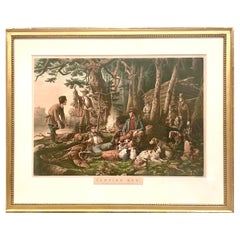
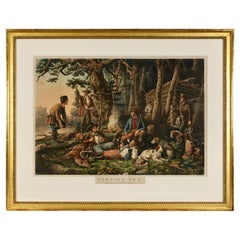
Large Folio N. Currier Colored Lithograph "Camping Out Some of the Right Sort"

Large Folio N. Currier Colored Lithograph "Camping Out Some of the Right Sort"

By Currier & Ives

Located in San Francisco, CA

A large folio hand colored lithograph by Nathaniel Currier (1813-1888) and James Merritt Ives (1824-1895) titled "Camping Out Some of the Right Sort" published by Currier and Ives, New York, 1856. A charming and evocative composition depicting a group of mid-19th century men...

Category

Mid-19th Century American Victorian Antique Currier & Ives

Materials

Paper

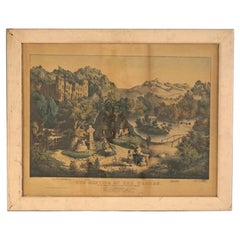
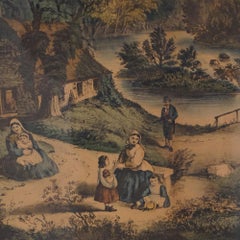
Antique Currier & Ives Print - The Meeting Of The Waters 19thC

Antique Currier & Ives Print - The Meeting Of The Waters 19thC

By Currier & Ives

Located in Big Flats, NY

An antique print by Currier & Ives titled 'The Meeting Of The Waters,' depicting a serene landscape with a castle, river, and figures in the foreground. Currier & Ives were known for...

Category

19th Century Antique Currier & Ives

Materials

Paper

19th century color lithograph seascape boat ship waves maritime landscape

19th century color lithograph seascape boat ship waves maritime landscape

By Currier & Ives

Located in Milwaukee, WI

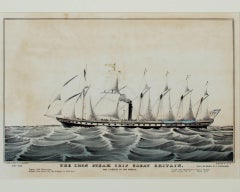
"Iron Steam Ship Great Britain" is an original hand-colored lithographed published by Currier & Ives. It depicts a large British steam ship on the water. The caption below says "3500 Tons. Engine 1000 Horse power. Weight of Iron used in the Ship and Engine is 1500 Tons. THE LARGEST IN THE WORLD. Length from Figurehead to Tafrail 322 Fe3et. Main breadth 50' 6" ... Depth 32' 6" Lieut. Jaf. Hosken R.N. Commander." 8" x 12 3/4" art 17 1/8" x 21 1/2" frame Currier & Ives produced their prints in a building at 33 Spruce Street where they occupied the third, fourth and fifth floors. The third floor was devoted to the hand operated printing presses that were built by Nat's cousin, Cyrus Currier, at his shop Cyrus Currier & Sons in Newark, NJ. The fourth floor found the artists, lithographers and the stone...

Category

1850s Currier & Ives

Materials

Lithograph

Set (4) Nathaniel Currier Lithographs American Country Life--Four Seasons C1855

Set (4) Nathaniel Currier Lithographs American Country Life--Four Seasons C1855

By Currier & Ives

Located in Incline Village, NV

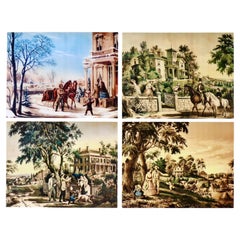
It is rare to have the opportunity to acquire all four of these scenes at once, especially in this very good all original condition; and housed and professionally framed in fine quality and attractive bird's eye maple wooden frames with preservation backing and frontal protective glass (important when dealing with 170 year old lithographs); all are the more rare and desirable large folio sheet examples in fine original color. The larger folios are more rare because they appealed to the wealthier sector of the population and were more expensive, thus fewer were made, albeit, knowing their more discerning customer base, there was more attention given to detail; hand coloring, and quality for example. All examples had been framed and housed in museum quality conservation backing for over 80 years. I have had each one professionally taken apart and inspected visually and examined with a black light and loop; as a result, I guarantee and can attest to the accuracy of my descriptions of each folio. I then had the folios professionally remounted in their original frames with an upgraded preservation backing (see images for viewing original folios out of frame and for confirmation of inspection). When available these lithographs are typically acquired individually, in varying condition, and often unframed. Other examples are often reproductions or "tear out sheets" from coffee table type books. These lithographs have no tears, no touch up paint, and no glued or taped repairs. This iconic and highly desirable set of four lithographs by Nathaniel Currier (1813-1888) dated 1855 from the American Country Life series depicts; Spring "May Morning"; Summer "Summer Evening"; Fall ""October Afternoon"; and Winter "Pleasures of Winter". All four images are produced from the paintings of well known artist Frances (Fanny) Flora (Bond Palmer (1812-1876). She painted typical American scenes of daily American life that were used by Currier for years to come. She was an accomplished artist by the time she migrated to the United States from England, and Currier commissioned her to do the country scenes for this series. Each of the original images are toned lithographs with applied hand painted watercolor. The series of four reflects affluent life styles in each of the four seasons by showcasing grandiose homes and glamorizing the rural way of living as urban areas became more densely populated with the tidal wave and arrival of immigrants. Nathaniel Currier began his lithograph business in 1835 with hand colored images portraying outdoor panoramic, historical, pastoral, and landmark scenes and events, with which the middle class and the wealthy sought to decorate their houses. James Ives (1824-1895) was his accountant) and would join him later in 1857 to help run the business. Each of the hand painted lithographs is embellished with script text in the bottom margin of the folio "Entered according to art of congress in the year 1855 by N. Currier in the clerk's office of the southern district of N.Y." "F.F Palmer...

Category

1850s American Victorian Antique Currier & Ives

Materials

Paper

Nathan Currier Lithograph "October Afternoon" American Country Life Series C1855

Nathan Currier Lithograph "October Afternoon" American Country Life Series C1855

By Currier & Ives

Located in Incline Village, NV

"October Afternoon" Maintains the appropriate markings along with "New York, Published by N. Currier 152 Nassau Street. (The firm was located here in lower Manhattan from 1837-1872) The lithograph illustrates two men and their dog with young son (hunting rifle over shoulder) in tow, returning from the rabbit hunt with their catch being presented to the lady of the house with baby in arms. The gated mansion is in the background while geese float upon the fertile pond in the background. In addition to the Amon Carter Museum in Dallas, an example of "Pleasures of Winter" is in: The Metropolitan Museum of Art (Bequest of Adele S. Colgate, 1962) Museum of Fine Arts Boston (Donated by Lee M. Friedman) The Library of Congress The Yale University Art Gallery (Gift of Mabel Brady Garvan Collection) Dimensions: actual= 16 1/2" h x 23 13/16" w matte= 19 1/2" h x 25 1/4" w folio= 21 1/4" h x 27 3/4" w with frame= 26 1/4" h x 32 1/4" w frame= 1 1/4" burl bird's eye maple It is in very good all original condition; and housed and professionally mounted in a fine quality and attractive bird's eye maple wooden frame with preservation backing and frontal protective glass (important when dealing with 170 year old lithographs); it is the rare and desirable Currier large folio sheet example in fine original color. There is some slight foxing to the cream border and minor fading (see images), The larger folios are more rare because they appealed to the wealthier sector of the population and were more expensive, thus fewer were made, albeit, knowing their more discerning customer base, there was more attention given to detail; hand coloring, and quality for example. This example has been framed and housed in museum quality conservation backing for over 80 years. I have had it professionally taken apart and I inspected the folio visually, and examined it with a black light and loop; as a result, I guarantee and can attest to the accuracy of my description of the lithograph. I then had the folio professionally remounted in it's original frame with an upgraded preservation backing (see images of original folios out of frame and for confirmation of inspection). This lithograph has no tears, no touch up paint, and no glued or taped repairs. This is one of the four iconic and highly desirable set of lithographs made by Nathaniel Currier (1813-1888) dated 1855 from the American Country Life series. They are named; Spring "May Morning"; Summer "Summer Evening"; Fall ""October Afternoon"; and Winter "Pleasures of Winter". The lithograph was produced from the painting of well known artist Frances (Fanny) Flora (Bond Palmer (1812-1876). She painted typical American scenes of daily American life that were used by Currier for years to come. She was an accomplished artist by the time she migrated to the United States from England, and Currier commissioned her to do the country scenes for this series. Each of the original images are toned lithographs with applied hand painted watercolor. The lithograph reflects an affluent life style, showcasing grandiose homes and glamorizing the rural way of living as urban areas became more densely populated with the tidal wave and arrival of immigrants. Nathaniel Currier began his lithograph business in 1835 with hand colored images portraying outdoor panoramic, historical, pastoral, and landmark scenes and events, with which the middle class and the wealthy sought to decorate their houses. James Ives (1824-1895) was his accountant) and would join him later in 1857 to help run the business. The hand painted lithograph is embellished with script text in the bottom margin of the folio "Entered according to art of congress in the year 1855 by N. Currier in the clerk's office of the southern district of N.Y." "F.F Palmer...

Category

1850s Victorian Antique Currier & Ives

Materials

Paper

Nathaniel Currier Lithograph Summer's Evening American Country Life Series C1855

Nathaniel Currier Lithograph Summer's Evening American Country Life Series C1855

By Currier & Ives

Located in Incline Village, NV

"Summer's Evening" folio has the appropriate Currier and Ives' markings along with "New York, Published by N. Currier 152 Nassau Street. (The firm was located here in lower Manhattan from 1837-1872) The lithograph depicts a young well dressed and well to do family overlooking their property as workers tend to the farmland and harvest hay. Note the haystacks and a horse drawn hay wagon. The large and well built farm house stands proudly over the scene with the village in the background. In addition to the Amon Carter Museum in Dallas, an example of "Summer's Evening" is in The Springfield Museum (Massachusetts) Gift of Lenore and Sydney Alpert). Dimensions: actual= 16 1/2" h x 23 13/16" w matte= 19 1/2" h x 25 1/4" w folio= 19 7/8" h x 26" w with frame= 26 1/4" h x 32 1/4" w frame= 1 1/4" burl bird's eye maple It is in very good all original condition; and housed and professionally mounted in a fine quality and attractive bird's eye maple wooden frame with preservation backing and frontal protective glass (important when dealing with 170 year old lithographs); it is the rare and desirable Currier large folio sheet example in fine original color. There is some toning and foxing (see images). The larger folios are more rare because they appealed to the wealthier sector of the population and were more expensive, thus fewer were made, albeit, knowing their more discerning customer base, there was more attention given to detail; hand coloring, and quality for example. This example has been framed and housed in museum quality conservation backing for over 80 years. I have had it professionally taken apart and I inspected the folio visually, and examined it with a black light and loop; as a result, I guarantee and can attest to the accuracy of my description of the lithograph. I then had the folio professionally remounted in it's original frame with an upgraded preservation backing (see images of original folios out of frame and for confirmation of inspection). This lithograph has no tears, no touch up paint, and no glued or taped repairs. This is one of the four iconic and highly desirable set of lithographs made by Nathaniel Currier (1813-1888) dated 1855 from the American Country Life series. They are named; Spring "May Morning"; Summer "Summer Evening"; Fall ""October Afternoon"; and Winter "Pleasures of Winter". The lithograph was produced from the painting of well known artist Frances (Fanny) Flora (Bond Palmer (1812-1876). She painted typical American scenes of daily American life that were used by Currier for years to come. She was an accomplished artist by the time she migrated to the United States from England, and Currier commissioned her to do the country scenes for this series. Each of the original images are toned lithographs with applied hand painted watercolor. The lithograph reflects an affluent life style, showcasing grandiose homes and glamorizing the rural way of living as urban areas became more densely populated with the tidal wave and arrival of immigrants. Nathaniel Currier began his lithograph business in 1835 with hand colored images portraying outdoor panoramic, historical, pastoral, and landmark scenes and events, with which the middle class and the wealthy sought to decorate their houses. James Ives (1824-1895) was his accountant) and would join him later in 1857 to help run the business. The hand painted lithograph is embellished with script text in the bottom margin of the folio "Entered according to art of congress in the year 1855 by N. Currier in the clerk's office of the southern district of N.Y." "F.F Palmer...

Category

1850s American Victorian Antique Currier & Ives

Materials

Paper

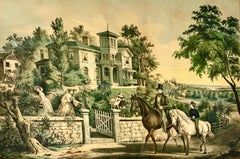
Nathaniel Currier Lithograph "May Morning" American Country Life Series C. 1855

Nathaniel Currier Lithograph "May Morning" American Country Life Series C. 1855

By Currier & Ives

Located in Incline Village, NV

This lithograph portrays a pleasant scene of a man in a top hat atop a handsome dark horse, with a boy riding a white horse (presumably father and son) in front of a country estate, while women gather as they water flowers, and children play with a lamb in the foreground. A man plows a field; while a horse is being groomed near the stable in the background. Afar and to the right is the sea dotted with ships here and there. The folio is mounted on cardboard and set in the matte. It is in very good all original condition; and housed and professionally mounted in a fine quality and attractive bird's eye maple wooden frame with preservation backing and frontal protective glass (important when dealing with 170 year old lithographs); it is the rare and desirable Currier large folio sheet example in fine original color. There is some toning and slight fading, The larger folios are more rare because they appealed to the wealthier sector of the population and were more expensive, thus fewer were made, albeit, knowing their more discerning customer base, there was more attention given to detail; hand coloring, and quality for example. This example has been framed and housed in museum quality conservation backing for over 80 years. I have had it professionally taken apart and I inspected the folio visually, and examined it with a black light and loop; as a result, I guarantee and can attest to the accuracy of my description of the lithograph. I then had the folio professionally remounted in their original frame with an upgraded preservation backing (see images of original folios out of frame and for confirmation of inspection). This lithograph has no tears, no touch up paint, and no glued or taped repairs. This is one of the four iconic and highly desirable set of lithographs made by Nathaniel Currier (1813-1888) dated 1855 from the American Country Life series. They are named; Spring "May Morning"; Summer "Summer Evening"; Fall ""October Afternoon"; and Winter "Pleasures of Winter". The lithograph was produced from the painting of well known artist Frances (Fanny) Flora (Bond Palmer (1812-1876). She painted typical American scenes of daily American life that were used by Currier for years to come. She was an accomplished artist by the time she migrated to the United States from England, and Currier commissioned her to do the country scenes for this series. Each of the original images are toned lithographs with applied hand painted watercolor. The lithograph reflects an affluent life style, showcasing grandiose homes and glamorizing the rural way of living as urban areas became more densely populated with the tidal wave and arrival of immigrants. Nathaniel Currier began his lithograph business in 1835 with hand colored images portraying outdoor panoramic, historical, pastoral, and landmark scenes and events, with which the middle class and the wealthy sought to decorate their houses. James Ives (1824-1895) was his accountant) and would join him later in 1857 to help run the business. The hand painted lithograph is embellished with script text in the bottom margin of the folio "Entered according to art of congress in the year 1855 by N. Currier in the clerk's office of the southern district of N.Y." "F.F Palmer...

Category

1850s American Victorian Antique Currier & Ives

Materials

Paper

American Victorian Landscape of Winter Morning

American Victorian Landscape of Winter Morning

By Currier & Ives

Located in Queens, NY

American Victorian wood framed landscape lithograph of Winter Morning (CURIER & IVES)

Category

19th Century American Victorian Antique Currier & Ives

Nautical water color print 1966 Currier & Ives Panam Airline Menu Cover

Nautical water color print 1966 Currier & Ives Panam Airline Menu Cover

By Currier & Ives

Located in Oklahoma City, OK

This 1966 nautical portrait is of the clipper ship "Sweepstakes". Originally intended as a menu cover for Pan Am Airlines, this piece has never been us...

Category

1960s American Mid-Century Modern Vintage Currier & Ives

Materials

Paper

N. Currier Lithograph" Pleasures of Winter" American Country Life Series C.1855

N. Currier Lithograph" Pleasures of Winter" American Country Life Series C.1855

By Currier & Ives

Located in Incline Village, NV

"Pleasures of Winter" Maintains the appropriate markings along with "New York, Published by N. Currier 152 Nassau Street. (The firm was located here in lower Manhattan from 1837-1872) The lithograph portrays a woman leaving her stately home with her two children, being escorted by two drivers to ride in a double seated horse drawn sleigh. In the background is a snowy field with other houses and a loaded horse drawn timber sleigh. In addition to the Amon Carter Museum in Dallas, an example of "Pleasures of Winter" is in: The Library of Congress The Springfield Museum (Massachusetts) Gift of Lenore and Sydney Alpert) Metropolitan Museum of Art (Gift of Colgate 1962) Museum of Fine Arts Boston (Donated by Lee M. Friedman) Dimensions: actual= 16 1/2" h x 23 13/16" w matte= 19 1/2" h x 25 1/4" w folio= 21 9/16" h x 27 1/2" w with frame= 26 1/4" h x 32 1/4" w frame= 1 1/4" burl bird's eye maple It is in very good all original condition; and housed and professionally mounted in a fine quality and attractive bird's eye maple wooden frame with preservation backing and frontal protective glass (important when dealing with 170 year old lithographs); it is the rare and desirable Currier large folio sheet example in fine original color. There is minor foxing and a tideline upper center (see images). The larger folios are more rare because they appealed to the wealthier sector of the population and were more expensive, thus fewer were made, albeit, knowing their more discerning customer base, there was more attention given to detail; hand coloring, and quality for example. This example has been framed and housed in museum quality conservation backing for over 80 years. I have had it professionally taken apart and I inspected the folio visually, and examined it with a black light and loop; as a result, I guarantee and can attest to the accuracy of my description of the lithograph. I then had the folio professionally remounted in it's original frame with an upgraded preservation backing (see images of original folios out of frame and for confirmation of inspection). This lithograph has no tears, no touch up paint, and no glued or taped repairs. This is one of the four iconic and highly desirable set of lithographs made by Nathaniel Currier (1813-1888) dated 1855 from the American Country Life series. They are named; Spring "May Morning"; Summer "Summer Evening"; Fall ""October Afternoon"; and Winter "Pleasures of Winter". The lithograph was produced from the painting of well known artist Frances (Fanny) Flora (Bond Palmer (1812-1876). She painted typical American scenes of daily American life that were used by Currier for years to come. She was an accomplished artist by the time she migrated to the United States from England, and Currier commissioned her to do the country scenes for this series. Each of the original images are toned lithographs with applied hand painted watercolor. The lithograph reflects an affluent life style, showcasing grandiose homes and glamorizing the rural way of living as urban areas became more densely populated with the tidal wave and arrival of immigrants. Nathaniel Currier began his lithograph business in 1835 with hand colored images portraying outdoor panoramic, historical, pastoral, and landmark scenes and events, with which the middle class and the wealthy sought to decorate their houses. James Ives (1824-1895) was his accountant) and would join him later in 1857 to help run the business. The hand painted lithograph is embellished with script text in the bottom margin of the folio "Entered according to art of congress in the year 1855 by N. Currier in the clerk's office of the southern district of N.Y." "F.F Palmer...

Category

1850s American Victorian Antique Currier & Ives

Materials

Paper

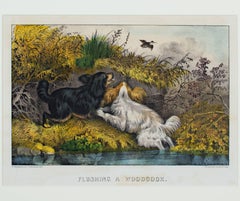
19th century color lithograph dogs bird nature grass pastoral animals

19th century color lithograph dogs bird nature grass pastoral animals

By Currier & Ives

Located in Milwaukee, WI

"Flushing a Woodcock" is an original hand-colored lithograph published by Currier & Ives. It depicts two dogs at the edge of a pond going after a bird that has just flown into the air. 8" x 12 1/2" art 18 1/2" x 22 1/4" frame Currier & Ives produced their prints in a building at 33 Spruce Street where they occupied the third, fourth and fifth floors. The third floor was devoted to the hand operated printing presses that were built by Nat's cousin, Cyrus Currier, at his shop Cyrus Currier & Sons in Newark, NJ. The fourth floor found the artists, lithographers and the stone grinders...

Category

1850s Currier & Ives

Materials

Lithograph

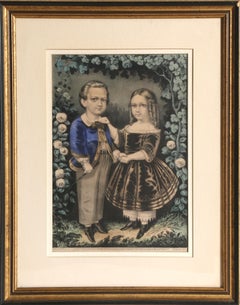
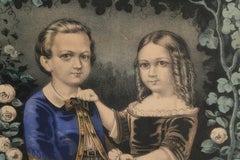
Boy and Girl, Hand-Colored Lithograph by Currier & Ives

Boy and Girl, Hand-Colored Lithograph by Currier & Ives

By Currier & Ives

Located in Long Island City, NY

Artist: Currier and Ives Title: Boy and Girl Year: circa 1863 Medium: Hand-colored lithograph Size: 11 x 8 in. (27.94 x 20.32 cm) Frame Size: 16 x 14 inches

Category

1860s Victorian Currier & Ives

Materials

Lithograph

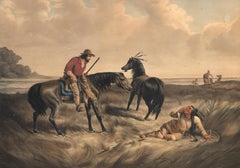
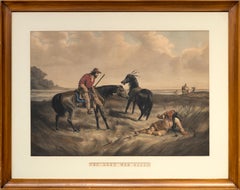
The Last War-Whoop!
The Last War-Whoop!

The Last War-Whoop!

By Currier & Ives

Located in Palm Desert, CA

"The Last War-Whoop!" is a lithograph by Currier & Ives. The framed size is 26 x 32.62 x 1.25 inches. Provenance: Private Collection

Category

Late 19th Century American Realist Currier & Ives

Materials

Lithograph

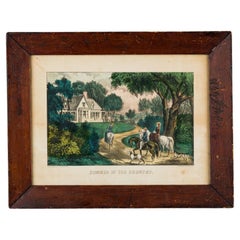
Summer in the Country Lithograph, Framed Antique Art, 19x15 Inches

Summer in the Country Lithograph, Framed Antique Art, 19x15 Inches

By Currier & Ives

Located in Queens, NY

American Victorian wood framed lithograph of riders on path titled Summer in the Country (Currier & Ives)

Category

Late 19th Century American Victorian Antique Currier & Ives

Materials

Wood

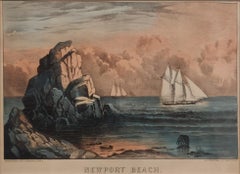
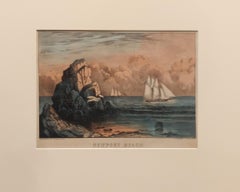
"Newport Beach" Currier & Ives, Hand-Colored Lithograph of Newport Beach

"Newport Beach" Currier & Ives, Hand-Colored Lithograph of Newport Beach

By Currier & Ives

Located in New York, NY

Currier & Ives Newport Beach Hand-colored lithograph Sheet 10 x 13 1/4 inches After undertaking apprenticeships in Boston and Philadelphia, Currier set up a print publishing compan...

Category

Late 19th Century Realist Currier & Ives

Materials

Lithograph

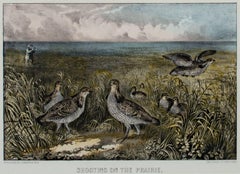
19th century color lithograph birds landscape nature grass sky water figure

19th century color lithograph birds landscape nature grass sky water figure

By Currier & Ives

Located in Milwaukee, WI

"Shooting on the Prairie" is an original hand-colored lithograph by Currier & Ives. It depicts a hunter shooting at fowl in an open field. 8 1/2" x 12 1/2" art 20 1/4" x 23 3/4" frame Nathaniel Currier was a tall introspective man with a melancholy nature. He could captivate people with his piercing stare or charm them with his sparkling blue eyes. Nathaniel was born in Roxbury, Massachusetts on March 27th, 1813, the second of four children. His parents, Nathaniel and Hannah Currier, were distant cousins who lived a humble yet spartan life. When Nathaniel was eight years old, tragedy struck. Nathaniel’s father unexpectedly passed away leaving Nathaniel and his eleven-year-old brother Lorenzo to provide for the family. In addition to their mother, Nathaniel and Lorenzo had to care for six-year-old sister Elizabeth and two-year-old brother Charles. Nathaniel worked a series of odd jobs to support the family, and at fifteen, he started what would become a life-long career when he apprenticed in the Boston lithography shop of William and John Pendleton. A Bavarian gentleman named Alois Senefelder invented lithography just 30 years prior to young Nat Currier’s apprenticeship. While under the employ of the brothers Pendleton, Nat was taught the art of lithography by the firm’s chief printer, a French national named Dubois, who brought the lithography trade to America. Lithography involves grinding a piece of limestone flat and smooth then drawing in mirror image on the stone with a special grease pencil. After the image is completed, the stone is etched with a solution of aqua fortis leaving the greased areas in slight relief. Water is then used to wet the stone and greased-ink is rolled onto the raised areas. Since grease and water do not mix, the greased-ink is repelled by the moisture on the stone and clings to the original grease pencil lines. The stone is then placed in a press and used as a printing block to impart black on white images to paper. In 1833, now twenty-years old and an accomplished lithographer, Nat Currier left Boston and moved to Philadelphia to do contract work for M.E.D. Brown, a noted engraver and printer. With the promise of good money, Currier hired on to help Brown prepare lithographic stones of scientific images for the American Journal of Sciences and Arts. When Nat completed the contract work in 1834, he traveled to New York City to work once again for his mentor John Pendleton, who was now operating his own shop located at 137 Broadway. Soon after the reunion, Pendleton expressed an interest in returning to Boston and offered to sell his print shop to Currier. Young Nat did not have the financial resources to buy the shop, but being the resourceful type he found another local printer by the name of Stodart. Together they bought Pendleton’s business. The firm ‘Currier & Stodart’ specialized in "job" printing. They produced many different types of printed items, most notably music manuscripts for local publishers. By 1835, Stodart was frustrated that the business was not making enough money and he ended the partnership, taking his investment with him. With little more than some lithographic stones, and a talent for his trade, twenty-two year old Nat Currier set up shop in a temporary office at 1 Wall Street in New York City. He named his new enterprise ‘N. Currier, Lithographer’ Nathaniel continued as a job printer and duplicated everything from music sheets to architectural plans. He experimented with portraits, disaster scenes and memorial prints, and any thing that he could sell to the public from tables in front of his shop. During 1835 he produced a disaster print Ruins of the Planter's Hotel, New Orleans, which fell at two O’clock on the Morning of the 15th of May 1835, burying 50 persons, 40 of whom Escaped with their Lives. The public had a thirst for newsworthy events, and newspapers of the day did not include pictures. By producing this print, Nat gave the public a new way to “see” the news. The print sold reasonably well, an important fact that was not lost on Currier. Nat met and married Eliza Farnsworth in 1840. He also produced a print that same year titled Awful Conflagration of the Steamboat Lexington in Long Island Sound on Monday Evening, January 18, 1840, by which melancholy occurrence over One Hundred Persons Perished. This print sold out very quickly, and Currier was approached by an enterprising publication who contracted him to print a single sheet addition of their paper, the New York Sun. This single page paper is presumed to be the first illustrated newspaper ever published. The success of the Lexington print launched his career nationally and put him in a position to finally lift his family up. In 1841, Nat and Eliza had their first child, a son they named Edward West Currier. That same year Nat hired his twenty-one year old brother Charles and taught him the lithography trade, he also hired his artistically inclined brother Lorenzo to travel out west and make sketches of the new frontier as material for future prints. Charles worked for the firm on and off over the years, and invented a new type of lithographic crayon which he patented and named the Crayola. Lorenzo continued selling sketches to Nat for the next few years. In 1843, Nat and Eliza had a daughter, Eliza West Currier, but tragedy struck in early 1847 when their young daughter died from a prolonged illness. Nat and Eliza were grief stricken, and Eliza, driven by despair, gave up on life and passed away just four months after her daughter’s death. The subject of Nat Currier’s artwork changed following the death of his wife and daughter, and he produced many memorial prints and sentimental prints during the late 1840s. The memorial prints generally depicted grief stricken families posed by gravestones (the stones were left blank so the purchasers could fill in the names of the dearly departed). The sentimental prints usually depicted idealized portraits of women and children, titled with popular Christian names of the day. Late in 1847, Nat Currier married Lura Ormsbee, a friend of the family. Lura was a self-sufficient woman, and she immediately set out to help Nat raise six-year-old Edward and get their house in order. In 1849, Lura delivered a son, Walter Black Currier, but fate dealt them a blow when young Walter died one year later. While Nat and Lura were grieving the loss of their new son, word came from San Francisco that Nat’s brother Lorenzo had also passed away from a brief illness. Nat sank deeper into his natural quiet melancholy. Friends stopped by to console the couple, and Lura began to set an extra place at their table for these unexpected guests. She continued this tradition throughout their lives. In 1852, Charles introduced a friend, James Merritt Ives, to Nat and suggested he hire him as a bookkeeper. Jim Ives was a native New Yorker born in 1824 and raised on the grounds of Bellevue Hospital where his father was employed as superintendent. Jim was a self-trained artist and professional bookkeeper. He was also a plump and jovial man, presenting the exact opposite image of his new boss. Jim Ives met Charles Currier through Caroline Clark, the object of Jim’s affection. Caroline’s sister Elizabeth was married to Charles, and Caroline was a close friend of the Currier family. Jim eventually proposed marriage to Caroline and solicited an introduction to Nat Currier, through Charles, in hopes of securing a more stable income to support his future wife. Ives quickly set out to improve and modernize his new employer’s bookkeeping methods. He reorganized the firm’s sizable inventory, and used his artistic skills to streamline the firm’s production methods. By 1857, Nathaniel had become so dependent on Jims’ skills and initiative that he offered him a full partnership in the firm and appointed him general manager. The two men chose the name ‘Currier & Ives’ for the new partnership, and became close friends. Currier & Ives produced their prints in a building at 33 Spruce Street where they occupied the third, fourth and fifth floors. The third floor was devoted to the hand operated printing presses that were built by Nat's cousin, Cyrus Currier, at his shop Cyrus Currier & Sons in Newark, NJ. The fourth floor found the artists, lithographers and the stone grinders at work. The fifth floor housed the coloring department, and was one of the earliest production lines in the country. The colorists were generally immigrant girls, mostly German, who came to America with some formal artistic training. Each colorist was responsible for adding a single color to a print. As a colorist finished applying their color, the print was passed down the line to the next colorist to add their color. The colorists worked from a master print displayed above their table, which showed where the proper colors were to be placed. At the end of the table was a touch up artist who checked the prints for quality, touching-in areas that may have been missed as it passed down the line. During the Civil War, demand for prints became so great that coloring stencils were developed to speed up production. Although most Currier & Ives prints were colored in house, some were sent out to contract artists. The rate Currier & Ives paid these artists for coloring work was one dollar per one hundred small folios (a penny a print) and one dollar per one dozen large folios. Currier & Ives also offered uncolored prints to dealers, with instructions (included on the price list) on how to 'prepare the prints for coloring.' In addition, schools could order uncolored prints from the firm’s catalogue to use in their painting classes. Nathaniel Currier and James Merritt Ives attracted a wide circle of friends during their years in business. Some of their more famous acquaintances included Horace Greeley, Phineas T. Barnum, and the outspoken abolitionists Rev. Henry Ward, and John Greenleaf Whittier (the latter being a cousin of Mr. Currier). Nat Currier and Jim Ives described their business as "Publishers of Cheap and Popular Pictures" and produced many categories of prints. These included Disaster Scenes, Sentimental Images, Sports, Humor, Hunting Scenes, Politics, Religion, City and Rural Scenes, Trains, Ships, Fire Fighters, Famous Race Horses, Historical Portraits, and just about any other topic that satisfied the general public's taste. In all, the firm produced in excess of 7500 different titles, totaling over one million prints produced from 1835 to 1907. Nat Currier retired in 1880, and signed over his share of the firm to his son Edward. Nat died eight years later at his summer home 'Lion’s Gate' in Amesbury, Massachusetts. Jim Ives remained active in the firm until his death in 1895, when his share of the firm passed to his eldest son, Chauncey. In 1902, faced will failing health from the ravages of Tuberculosis, Edward Currier sold his share of the firm to Chauncey Ives...

Category

1870s Other Art Style Currier & Ives

Materials

Lithograph

Related Items
1990
1990

Rebecca Warren1990, 2007

$3,000

H 16 in W 9 in D 3 in

1990

Located in New York, NY

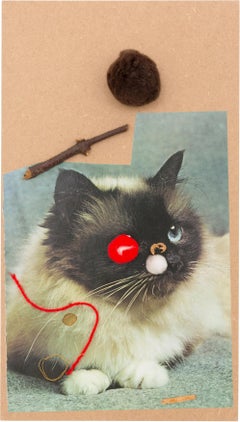
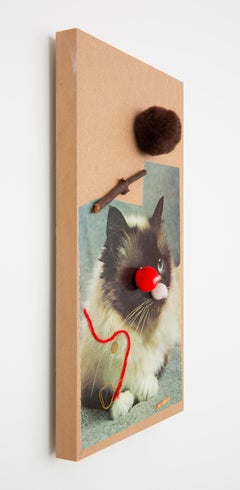
Rebecca Warren 1990 2007 Lithographic print on MDF, with pom-pom, cotton thread, wood shaving, twig, and wood chip 16 x 9 x 3 inches; 41 x 23 x 8 cm Edi...

Category

Early 2000s Contemporary Currier & Ives

Materials

Thread, Wood, Lithograph, Cotton, Mixed Media

Ann Nooney, (Demolition with Windows, NYC)

Ann Nooney, (Demolition with Windows, NYC)

By Ann Nooney

Located in New York, NY

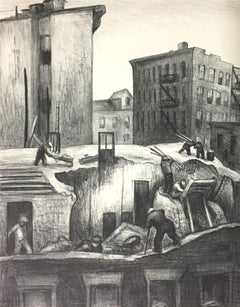
The dimensions are for the image; there are large margins. This lithograph is signed in pencil. A native New Yorker, Ann Nooney (1900-1970) recorded the urban scene while on the Wo...

Category

1930s American Realist Currier & Ives

Materials

Lithograph

America! America!
America! America!

James FetherolfAmerica! America!, 1973

$400

H 22 in W 29.8 in D 0.01 in

America! America!

Located in San Francisco, CA

This artwork titled "America! America" is a color lithograph after noted American artist James Fetherolf, 1925-1994. It is hand signed at the lower rig...

Category

Late 20th Century American Realist Currier & Ives

Materials

Lithograph

The Creation - Bet

The Creation - Bet

Located in Jerusalem, IL

Ten original lithographs, printed by Mourlot Paris in the 1970's. Issued 150 copies numbered and signed. 102/150. Creation was inspired by the Kabalistic conception of the Hebrew Al...

Category

1970s Symbolist Currier & Ives

Materials

Lithograph

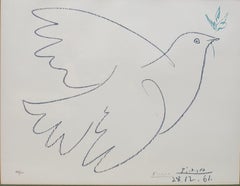
"Dove of Peace" Signed Color Lithograph of Bird Midcentury Modern Classic Cubism

"Dove of Peace" Signed Color Lithograph of Bird Midcentury Modern Classic Cubism

By Pablo Picasso

Located in Austin, TX

Page Size: 20 x 24 in. (visible) Frame size : 47 x 32 in. Signed, bottom right. Numbered, Bottom left: 144/200. COA available upon request. Created by Pablo Picasso in 1961, this ic...

Category

1960s Synthetic Cubist Currier & Ives

Materials

Archival Paper, Pencil, Lithograph

Guernica
Guernica

Pablo PicassoGuernica, 1956

$38,000

H 25.32 in W 51.78 in

Guernica

By Pablo Picasso

Located in Wien, Wien

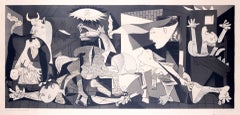
PABLO PICASSO Málaga 1881 – 1973 Mougins “Guernica” 1956 Offset lithograph on paper On the occasion of the exhibition at the Stedelijk Museum, Amsterdam, 1956 “Guernica, with 60 stu...

Category

1950s Currier & Ives

Materials

Lithograph

Robert Rauschenberg Untitled (McGovern) 1972 Signed Lithograph Edition of 75

Robert Rauschenberg Untitled (McGovern) 1972 Signed Lithograph Edition of 75

By Robert Rauschenberg

Located in Minneapolis, MN

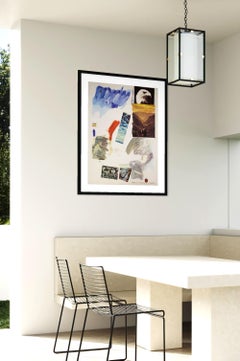
Artist: Robert Rauschenberg Title: Untitled (McGovern) Medium: Offset Lithograph in Colors Edition: 59/75 Image Size: 38.75" × 26.5" Sheet Size: 40" × 30" Year: 1972 Inscription: Sig...

Category

20th Century Currier & Ives

Materials

Paper, Lithograph

Vintage MOMA Francesco Clemente Museum of Modern Art 1986 dream myth poster

Vintage MOMA Francesco Clemente Museum of Modern Art 1986 dream myth poster

By Francesco Clemente

Located in New York, NY

This three-part work spanning 10 feet was printed from the plates of Francesco Clemente’s mythological landscape Untitled A on the occasion of the 1986 MoMA, New York show of Clement...

Category

1980s Surrealist Currier & Ives

Materials

Lithograph, Offset

"Fishing Village" Joe Jones, Mid-Century, American Life, Small Town Scene

"Fishing Village" Joe Jones, Mid-Century, American Life, Small Town Scene

By Joe Jones

Located in New York, NY

Joe Jones Fishing Village, 1949 Signed in pencil lower right margin Lithograph on wove paper Image 9 5/16 x 12 9/16 inches Sheet 12 x 15 15/16 inches From the edition of 250 The initial details of Jones' career are sparse, and this is intentional. The young artist was engaged in a process of self-reinvention, crafting a persona. When he submitted a work to the Sixteen Cities Exhibition at New York City's Museum of Modern Art in 1933, he briefly characterized himself: "Born St. Louis, 1909, self-taught. " Jones intentionally portrayed himself to the art community as an authentic working-class figure, backed by a compelling history. He was the youngest of five children in a family led by a one-armed house painter from St. Louis, a Welsh immigrant, and his German American spouse. At the age of ten, Jones found himself in a Missouri reformatory due to authorities' concerns over his graffiti activities. After completing elementary school, he traveled by freight car to California and back, even being arrested for vagrancy in Pueblo, Colorado. Returning to St. Louis, he attempted to settle down by working alongside his father. Yet, Jones felt a profound restlessness and was drawn toward a more elevated artistic pursuit in his late teenage years. He discovered a local collective of budding artists that formed St. Louis’s "Little Bohemia," sharing a studio and providing mutual support until he managed to secure his own modest workspace in a vacant garage. Jones’s initial creations comprised still lifes, landscapes, and poignant portraits of those close to him. These subjects were not only accessible but also budget-friendly, as hiring models was beyond his means. He depicted himself, his father, mother, and eventually, his wife. In December 1930, at the age of 21, Jones wed Freda Sies, a modern dancer and political activist who was four years older than him. By 1933, Jones had started gaining noteworthy local recognition through a solo exhibition at the Artists’ Guild of Saint Louis. Of the twenty-five paintings on display, one, titled River Front (private collection, previously with Hirschl and Adler Galleries), was selected to illustrate a feature article about his show in The Art Digest (February 15, 1933, p. 9). Shortly before this exhibition, a young surgeon named Dr. Robert Elman took an interest in Jones’s art, purchasing several pieces and forming a group of potential patrons committed to providing the emerging artist with a monthly stipend in exchange for art. This group was officially known as the "Co-operative Art Society," but it was informally dubbed the "Joe Jones Club. " Jones became an active participant in the St. Louis artistic scene, particularly within its bohemian segments. He embraced modernism and was a founding member of the "New Hat" movement in 1931, a playful rebellion against the conservative and traditional mainstream art establishment. The summer of 1933 marked a significant shift in Jones’s journey. Sponsored by a dedicated ally, Mrs. Elizabeth Green, Jones, along with Freda and Green, embarked on an eastward road trip. In Washington, D. C., they explored the Corcoran Gallery of Art, the Freer Gallery (part of the Smithsonian Institution), the Library of Congress, and Mount Vernon. Following this whirlwind of art and American culture, they made their way to New York, where they visited various museums and galleries, including a stop at The New School for Social Research, which featured notable contemporary murals by fellow Missourian Thomas Hart Benton and the politically active Mexican artist, José Clemente Orozco. From June through August, Jones and Freda resided in the artist colony of Provincetown, Massachusetts, later returning home via Detroit to see Diego Rivera’s Detroit Industry mural housed at the Detroit Institute of Fine Arts. While Elizabeth Green allegedly hoped that Jones would refine his artistic skills under the guidance of Charles Hawthorne or Richard Miller in Provincetown, Jones followed a different path. Rather than pursuing conservative mentors, he connected with an engaging network of leftist intellectuals, writers, and artists who dedicated their time to reading Marx and applying his theories to the American landscape. Jones's reaction to the traditional culture of New England was captured in his statement to a reporter from the St. Louis Post Dispatch: “Class consciousness . . . that’s what I got of my trip to New England. Those people [New Englanders] are like the Chinese—ancestor worshipers. They made me realize where I belong” (September 21, 1933). The stark social divisions he witnessed there prompted him to embrace his working-class identity even more fervently. Upon returning to St. Louis, he prominently identified himself as a Communist. This newfound political stance created friction with some of his local supporters. Many of his middle-class advocates withdrew their backing, likely influenced not only by Jones’s politics but also by his flamboyant and confrontational demeanor. In December 1933, Jones initiated a complimentary art class for unemployed individuals in the Old Courthouse of St. Louis, the same location where the Dred Scott case was deliberated and where slave auctions formerly took place. Concurrently, the St. Louis Art League was offering paid courses. Emphasizing the theme of social activism, with a studio adorned with Soviet artwork, Jones’s institution operated for just over a year before being removed from the courthouse by local officials. The school’s political focus and unconventional teaching practices, along with its inclusion of a significant number of African American students during a period marked by rigid racial segregation, certainly contributed to its challenges. Under Jones’s guidance, the class created a large chalk pastel mural on board, measuring 16 by 37 feet, titled Social Unrest in St. Louis. Mural painting posed no challenge for the former housepainter, who was adept at handling large wall surfaces. His first significant commission in St. Louis in late 1931 was a mural that celebrated the city’s industrial and commercial fortitude for the local radio station, KMOX. This mural, aimed at conveying optimism amid severe economic hardship, showcased St. Louis's strengths in a modernist approach. When Jones resumed mural work in late 1933, his worldview had evolved considerably. The mural produced for the school in the courthouse, conceived by Jones, featured scenes of modern St. Louis selected to highlight political messages. Jones had observed the technique of utilizing self-contained scenes to craft visual narratives in the murals he encountered in the East. More locally, this compositional strategy was commonly employed by the renowned Missouri artist...

Category

1940s American Realist Currier & Ives

Materials

Paper, Lithograph

Previously Available Items
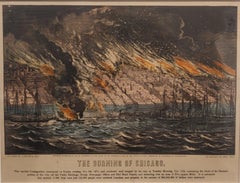
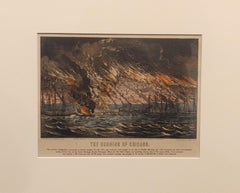
"The Burning of Chicago"  Currier and Ives, Water and Urban Landscape Print

"The Burning of Chicago" Currier and Ives, Water and Urban Landscape Print

By Currier & Ives

Located in New York, NY

Currier & Ives The Burning of Chicago, 1871 Hand-colored lithograph 7 5/16 x 12 11/16 inches After undertaking apprenticeships in Boston and Philadelphia, Currier set up a print pu...

Category

1870s Realist Currier & Ives

Materials

Lithograph

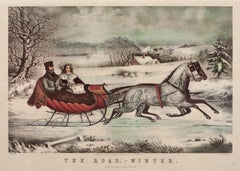
The Road, Winter

Currier & IvesThe Road, Winter

Sold

H 14 in W 18.5 in

The Road, Winter

By Currier & Ives

Located in Columbia, MO

Currier N.Y. The Road, Winter Lithograph 14 x 18.5 inches

Category

19th Century Folk Art Currier & Ives

Materials

Lithograph

19th century color lithograph nature figure winter scene trees snow river

19th century color lithograph nature figure winter scene trees snow river

By Currier & Ives

Located in Milwaukee, WI

"Deer Shooting in the Northern Woods" is an original hand-colored lithograph by Currier & Ives. It depicts a landscape with a hunter aiming his gun at a deer on a winter day. 10" x 14" art 19 1/2" x 23 1/4" frame Nathaniel Currier was a tall introspective man with a melancholy nature. He could captivate people with his piercing stare or charm them with his sparkling blue eyes. Nathaniel was born in Roxbury, Massachusetts on March 27th, 1813, the second of four children. His parents, Nathaniel and Hannah Currier, were distant cousins who lived a humble yet spartan life. When Nathaniel was eight years old, tragedy struck. Nathaniel’s father unexpectedly passed away leaving Nathaniel and his eleven-year-old brother Lorenzo to provide for the family. In addition to their mother, Nathaniel and Lorenzo had to care for six-year-old sister Elizabeth and two-year-old brother Charles. Nathaniel worked a series of odd jobs to support the family, and at fifteen, he started what would become a life-long career when he apprenticed in the Boston lithography shop of William and John Pendleton. A Bavarian gentleman named Alois Senefelder invented lithography just 30 years prior to young Nat Currier’s apprenticeship. While under the employ of the brothers Pendleton, Nat was taught the art of lithography by the firm’s chief printer, a French national named Dubois, who brought the lithography trade to America. Lithography involves grinding a piece of limestone flat and smooth then drawing in mirror image on the stone with a special grease pencil. After the image is completed, the stone is etched with a solution of aqua fortis leaving the greased areas in slight relief. Water is then used to wet the stone and greased-ink is rolled onto the raised areas. Since grease and water do not mix, the greased-ink is repelled by the moisture on the stone and clings to the original grease pencil lines. The stone is then placed in a press and used as a printing block to impart black on white images to paper. In 1833, now twenty-years old and an accomplished lithographer, Nat Currier left Boston and moved to Philadelphia to do contract work for M.E.D. Brown, a noted engraver and printer. With the promise of good money, Currier hired on to help Brown prepare lithographic stones of scientific images for the American Journal of Sciences and Arts. When Nat completed the contract work in 1834, he traveled to New York City to work once again for his mentor John Pendleton, who was now operating his own shop located at 137 Broadway. Soon after the reunion, Pendleton expressed an interest in returning to Boston and offered to sell his print shop to Currier. Young Nat did not have the financial resources to buy the shop, but being the resourceful type he found another local printer by the name of Stodart. Together they bought Pendleton’s business. The firm ‘Currier & Stodart’ specialized in "job" printing. They produced many different types of printed items, most notably music manuscripts for local publishers. By 1835, Stodart was frustrated that the business was not making enough money and he ended the partnership, taking his investment with him. With little more than some lithographic stones, and a talent for his trade, twenty-two year old Nat Currier set up shop in a temporary office at 1 Wall Street in New York City. He named his new enterprise ‘N. Currier, Lithographer’ Nathaniel continued as a job printer and duplicated everything from music sheets to architectural plans. He experimented with portraits, disaster scenes and memorial prints, and any thing that he could sell to the public from tables in front of his shop. During 1835 he produced a disaster print Ruins of the Planter's Hotel, New Orleans, which fell at two O’clock on the Morning of the 15th of May 1835, burying 50 persons, 40 of whom Escaped with their Lives. The public had a thirst for newsworthy events, and newspapers of the day did not include pictures. By producing this print, Nat gave the public a new way to “see” the news. The print sold reasonably well, an important fact that was not lost on Currier. Nat met and married Eliza Farnsworth in 1840. He also produced a print that same year titled Awful Conflagration of the Steamboat Lexington in Long Island Sound on Monday Evening, January 18, 1840, by which melancholy occurrence over One Hundred Persons Perished. This print sold out very quickly, and Currier was approached by an enterprising publication who contracted him to print a single sheet addition of their paper, the New York Sun. This single page paper is presumed to be the first illustrated newspaper ever published. The success of the Lexington print launched his career nationally and put him in a position to finally lift his family up. In 1841, Nat and Eliza had their first child, a son they named Edward West Currier. That same year Nat hired his twenty-one year old brother Charles and taught him the lithography trade, he also hired his artistically inclined brother Lorenzo to travel out west and make sketches of the new frontier as material for future prints. Charles worked for the firm on and off over the years, and invented a new type of lithographic crayon which he patented and named the Crayola. Lorenzo continued selling sketches to Nat for the next few years. In 1843, Nat and Eliza had a daughter, Eliza West Currier, but tragedy struck in early 1847 when their young daughter died from a prolonged illness. Nat and Eliza were grief stricken, and Eliza, driven by despair, gave up on life and passed away just four months after her daughter’s death. The subject of Nat Currier’s artwork changed following the death of his wife and daughter, and he produced many memorial prints and sentimental prints during the late 1840s. The memorial prints generally depicted grief stricken families posed by gravestones (the stones were left blank so the purchasers could fill in the names of the dearly departed). The sentimental prints usually depicted idealized portraits of women and children, titled with popular Christian names of the day. Late in 1847, Nat Currier married Lura Ormsbee, a friend of the family. Lura was a self-sufficient woman, and she immediately set out to help Nat raise six-year-old Edward and get their house in order. In 1849, Lura delivered a son, Walter Black Currier, but fate dealt them a blow when young Walter died one year later. While Nat and Lura were grieving the loss of their new son, word came from San Francisco that Nat’s brother Lorenzo had also passed away from a brief illness. Nat sank deeper into his natural quiet melancholy. Friends stopped by to console the couple, and Lura began to set an extra place at their table for these unexpected guests. She continued this tradition throughout their lives. In 1852, Charles introduced a friend, James Merritt Ives, to Nat and suggested he hire him as a bookkeeper. Jim Ives was a native New Yorker born in 1824 and raised on the grounds of Bellevue Hospital where his father was employed as superintendent. Jim was a self-trained artist and professional bookkeeper. He was also a plump and jovial man, presenting the exact opposite image of his new boss. Jim Ives met Charles Currier through Caroline Clark, the object of Jim’s affection. Caroline’s sister Elizabeth was married to Charles, and Caroline was a close friend of the Currier family. Jim eventually proposed marriage to Caroline and solicited an introduction to Nat Currier, through Charles, in hopes of securing a more stable income to support his future wife. Ives quickly set out to improve and modernize his new employer’s bookkeeping methods. He reorganized the firm’s sizable inventory, and used his artistic skills to streamline the firm’s production methods. By 1857, Nathaniel had become so dependent on Jims’ skills and initiative that he offered him a full partnership in the firm and appointed him general manager. The two men chose the name ‘Currier & Ives’ for the new partnership, and became close friends. Currier & Ives produced their prints in a building at 33 Spruce Street where they occupied the third, fourth and fifth floors. The third floor was devoted to the hand operated printing presses that were built by Nat's cousin, Cyrus Currier, at his shop Cyrus Currier & Sons in Newark, NJ. The fourth floor found the artists, lithographers and the stone grinders at work. The fifth floor housed the coloring department, and was one of the earliest production lines in the country. The colorists were generally immigrant girls, mostly German, who came to America with some formal artistic training. Each colorist was responsible for adding a single color to a print. As a colorist finished applying their color, the print was passed down the line to the next colorist to add their color. The colorists worked from a master print displayed above their table, which showed where the proper colors were to be placed. At the end of the table was a touch up artist who checked the prints for quality, touching-in areas that may have been missed as it passed down the line. During the Civil War, demand for prints became so great that coloring stencils were developed to speed up production. Although most Currier & Ives prints were colored in house, some were sent out to contract artists. The rate Currier & Ives paid these artists for coloring work was one dollar per one hundred small folios (a penny a print) and one dollar per one dozen large folios. Currier & Ives also offered uncolored prints to dealers, with instructions (included on the price list) on how to 'prepare the prints for coloring.' In addition, schools could order uncolored prints from the firm’s catalogue to use in their painting classes. Nathaniel Currier and James Merritt Ives attracted a wide circle of friends during their years in business. Some of their more famous acquaintances included Horace Greeley, Phineas T. Barnum, and the outspoken abolitionists Rev. Henry Ward, and John Greenleaf Whittier (the latter being a cousin of Mr. Currier). Nat Currier and Jim Ives described their business as "Publishers of Cheap and Popular Pictures" and produced many categories of prints. These included Disaster Scenes, Sentimental Images, Sports, Humor, Hunting Scenes, Politics, Religion, City and Rural Scenes, Trains, Ships, Fire Fighters, Famous Race Horses, Historical Portraits, and just about any other topic that satisfied the general public's taste. In all, the firm produced in excess of 7500 different titles, totaling over one million prints produced from 1835 to 1907. Nat Currier retired in 1880, and signed over his share of the firm to his son Edward. Nat died eight years later at his summer home 'Lion’s Gate' in Amesbury, Massachusetts. Jim Ives remained active in the firm until his death in 1895, when his share of the firm passed to his eldest son, Chauncey. In 1902, faced will failing health from the ravages of Tuberculosis, Edward Currier sold his share of the firm to Chauncey Ives. In 1907, faced with competitive pressures from advancements in offset printing and photo engraving, Chauncey closed the venerable lithography business and sold the printing equipment and lithographic stones to his shop foreman, Daniel W. Logan. Nathaniel Currier and James Merritt Ives are laid to rest along with their families at the Greenwood Cemetery...

Category

1860s Other Art Style Currier & Ives
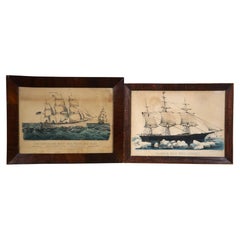
Materials

Lithograph

Antique Late 19th Century Victorian Look at Mama Currier & Ives Lithograph Frame

Antique Late 19th Century Victorian Look at Mama Currier & Ives Lithograph Frame

By Currier & Ives

Located in Dayton, OH

Circa 1870’s antique Currier & Ives colored lithograph print titled “Look at Mama,” featuring a mother showing a portrait of herself to an infant at her shoulder. Measures: 14.75”...
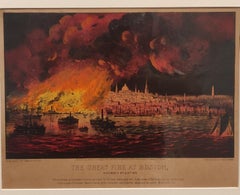
Category

1870s Victorian Antique Currier & Ives
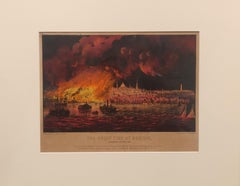
Materials

Paper

Antique Currier & Ives Lithograph Print "The Favorite Horse" Victorian Frame
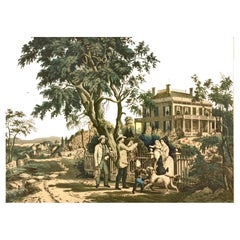
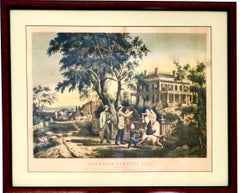
Antique Currier & Ives Lithograph Print "The Favorite Horse" Victorian Frame
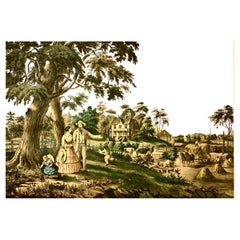
By Currier & Ives
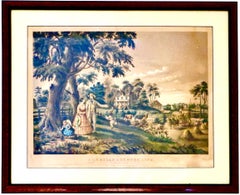
Located in Dayton, OH

Antique lithograph print by Currier and Ives titled “The Favorite Horse” showing a white horse saddled in a stall with a border collie holding a riding c...

Category

19th Century Victorian Antique Currier & Ives
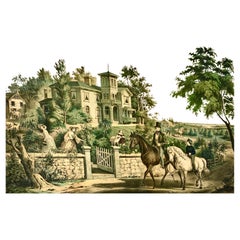
Materials

Paper

1870s Antique Currier & Ives Little White Kitties Into Mischief Lithograph Print
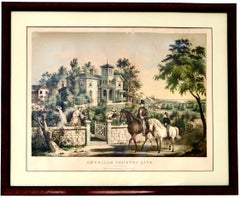
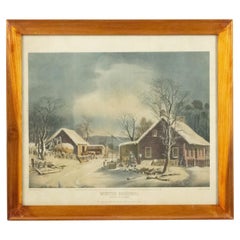
1870s Antique Currier & Ives Little White Kitties Into Mischief Lithograph Print
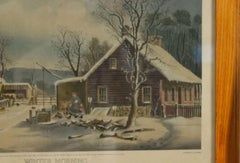
By Currier & Ives
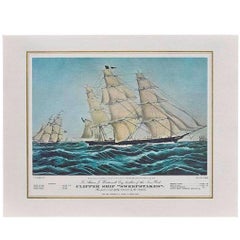
Located in Dayton, OH

Antique 1870s Currier & Ives colored lithograph print titled “Little White Kitties. Into Mischief.” Measures: 14.75” x 0.5” x 10.75” / Sans Frame - 13.375” x 9.5” (Width x Depth x...
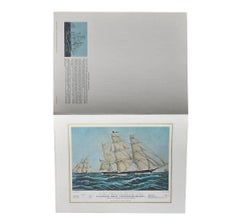
Category

1870s Victorian Antique Currier & Ives
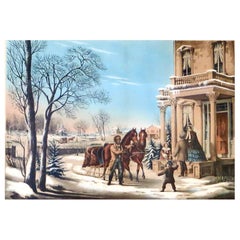
Materials

Paper

1873 Antique Currier & Ives Kitties Kittens Among Roses Lithograph Print
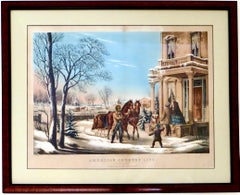
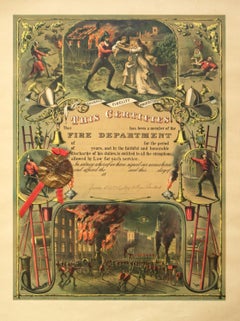
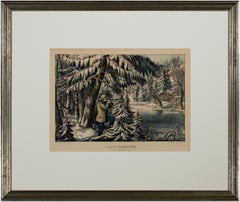
1873 Antique Currier & Ives Kitties Kittens Among Roses Lithograph Print
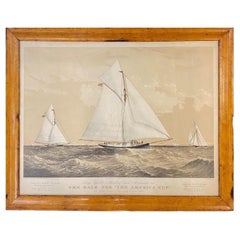
By Currier & Ives

Located in Dayton, OH

Antique 1870s Currier & Ives colored lithograph print titled “Kitties Among the Roses.” Kittens, cats. Measures: 16.25” x 0.5” x 12.5” / sans frame - 13.25” x 9.5” (width x depth ...
Category

1870s Victorian Antique Currier & Ives

Materials

Paper

The Carrier Dove Departure by Currier & Ives Antique Colored Lithograph
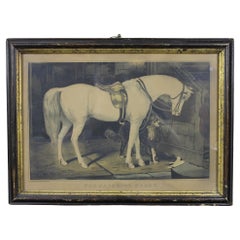

The Carrier Dove Departure by Currier & Ives Antique Colored Lithograph
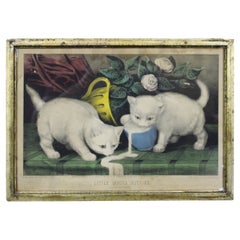
By Currier & Ives

Located in Dayton, OH

Late 19th century Currier & Ives "The Carrier Dove" Departure. Features a young Victorian girl nicely dressed holding a dove with a string around its neck. Features a beveled wood framed...
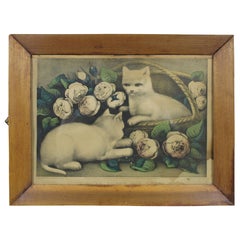
Category

Late 19th Century Late Victorian Antique Currier & Ives

Materials

Paper

Currier & Ives art for sale on 1stDibs.
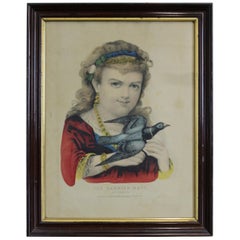
Find a wide variety of authentic Currier & Ives art available for sale on 1stDibs. You can also browse by medium to find art by Currier & Ives in lithograph and more. Not every interior allows for large Currier & Ives art, so small editions measuring 13 inches across are available. Customers who are interested in this artist might also find the work of David Lucas, Philippe Benoist, and Thomas Sidney Cooper. Currier & Ives art prices can differ depending upon medium, time period and other attributes. On 1stDibs, the price for these items starts at $240 and tops out at $22,500, while the average work can sell for $1,950.

Artists Similar to Currier & Ives

Questions About Currier & Ives

  • 1stDibs ExpertFebruary 13, 2024
    Currier and Ives is more than 175 years old. The prominent American printmaking business, headquartered in New York, operated from 1835 to 1907. Nathaniel Currier started his business on his own but later merged with James Merritt Ives, becoming "Currier and Ives" in 1857. They produced and sold hand-colored lithographs, which could be produced relatively quickly and cheaply. Explore a collection of Currier and Ives prints on 1stDibs.
  • 1stDibs ExpertAugust 29, 2024
    To tell if it’s an original Currier & Ives print, get a magnifying glass and study the image up close. If you notice a regular pattern of dots, the piece is likely a reproduction, as the printing techniques used to make originals usually resulted in irregular, non-symmetrical dashes and dots. Next, look at your piece from the side with the naked eye. If the paper appears perfectly smooth and uniform, the print is unlikely to be an original Currier & Ives, which will typically show off variations in luster and texture. When in doubt, have a certified appraiser or knowledgeable art dealer help you with the authentication process. On 1stDibs, shop a selection of Currier & Ives prints.
  • 1stDibs ExpertOctober 30, 2024
    Yes, some Currier and Ives pieces are worth something. The company published around 7,500 lithographs in its 72 years in business, and some, such as The American National Game of Base Ball, have sold for more than $75,000 in the past. Generally, the historical significance, image quality, age and condition of the publisher's prints will determine their worth. A certified appraiser or experienced art dealer can evaluate any prints you own using these criteria and give you an idea of how much they may be worth. Find an assortment of Currier & Ives prints on 1stDibs.
  • 1stDibs ExpertSeptember 9, 2024
    Yes, some Currier and Ives dishes are worth something. Limited edition pieces are most likely to be valuable, and sets often fetch higher prices than individual pieces. Generally, the age, style, type and condition will all play a role in determining the value. A certified appraiser or knowledgeable antique dealer can help you with the valuation process. Find a selection of Currier and Ives art and tableware on 1stDibs.
  • 1stDibs ExpertMarch 22, 2022
    To tell if your Currier and Ives print is real, make sure that the print has the proper information. A genuine print will show the title and the publisher name as either "N. Currier" or "Currier & Ives". You may also find a publication address, a copyright notice and a catalog number on some pieces. You'll find a selection of expertly vetted Currier and Ives print prints on 1stDibs.
  • 1stDibs ExpertSeptember 9, 2024
    How much original Currier & Ives prints are worth depends on their age, image quality, overall condition and other factors. In 2004, a hand-colored version of the 1866 lithograph The American National Game of Base Ball sold for $76,375. The Currier & Ives company published around 7,500 lithographs in its 72 years in business. Pieces that commemorate historical events are often the most highly sought-after among collectors. If you own a Currier & Ives lithograph, a certified appraiser or knowledgeable art dealer can aid you with the valuation process. On 1stDibs, shop a range of Currier & Ives prints.