Cy Twombly Photography

to
2
1
Overall Width
to
Overall Height
to
3
2
1
2
1
2
1
3
2
2
2
1
1
1
1
1
1
1
1
1
1
2
2
20
10,524
2,811
2,500
1,409
1
3
Artist: Cy Twombly
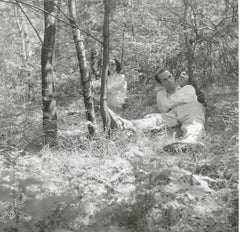
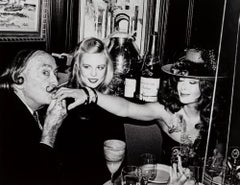
"Earle and Carolyn Brown at the Stevenson's in Brewster" Cy Twombly

"Earle and Carolyn Brown at the Stevenson's in Brewster" Cy Twombly

By Cy Twombly

Located in New York, NY

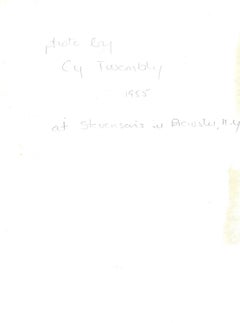
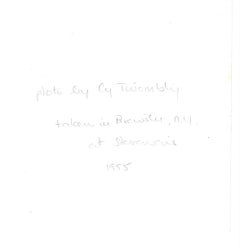
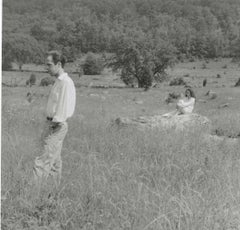
Cy Twombly Earle and Carolyn Brown at the Stevenson's in Brewster, 1955 Identified and inscribed on the reverse by the sitter Carolyn Brown Photograph on paper 8 x 8 inches Provenance Gift of the artist Estate of Carolyn Brown, New York 2025. Cy Twombly gained fame for his art that combined cultural, historical, and poetic elements—particularly those from classical antiquity—with abstract shapes and his distinctive script. Born Edwin Parker Twombly, Jr. on April 25, 1928, in Lexington, Virginia, he began his artistic journey under the guidance of Pierre Daura and Marion Junkin at Washington and Lee University. This initial training was complemented by his formative experiences at the Arts Students League of New York and Black Mountain College, where he established enduring friendships with influential figures like Robert Rauschenberg, John Cage, and Merce Cunningham. A pivotal moment for Twombly was his 1952 trip to Italy and North Africa with Rauschenberg, funded by a grant from the Virginia Museum of Fine Arts. This journey allowed Twombly to engage deeply with the rich cultural history that would inform his future artistic endeavors, leading to the creation of significant early pieces. Twombly made his way back to Italy in 1957 and 1958, during which he presented his first solo exhibition in Italy at Galleria La Tartaruga, owned by Plinio De Martiis. In 1959, he married Luisa Tatiana...

Category

1950s Modern Cy Twombly Photography

Materials

Photographic Paper

Domitilla, No. 2
Domitilla, No. 2

Domitilla, No. 2

By Cy Twombly

Located in New York, NY

Fresson color photograph Edition HC 2 of 2 17 5/8 x 14 inches (sheet) 20 x 22 1/2 (framed) Signed recto Framed with a beveled-face mat with a window opening. Frame has 1-inch depth,...

Category

1990s Contemporary Cy Twombly Photography

Materials

Color

"Earle and Carolyn Brown at the Stevenson's in Brewster" Cy Twombly

"Earle and Carolyn Brown at the Stevenson's in Brewster" Cy Twombly

By Cy Twombly

Located in New York, NY

Cy Twombly Earle and Carolyn Brown at the Stevenson's in Brewster, 1955 Identified and inscribed on the reverse by the sitter Carolyn Brown Photograph on paper 8 x 8 inches Provenance Gift of the artist Estate of Carolyn Brown, New York, 2025. Cy Twombly gained fame for his art that combined cultural, historical, and poetic elements—particularly those from classical antiquity—with abstract shapes and his distinctive script. Born Edwin Parker Twombly, Jr. on April 25, 1928, in Lexington, Virginia, he began his artistic journey under the guidance of Pierre Daura and Marion Junkin at Washington and Lee University. This initial training was complemented by his formative experiences at the Arts Students League of New York and Black Mountain College, where he established enduring friendships with influential figures like Robert Rauschenberg, John Cage, and Merce Cunningham. A pivotal moment for Twombly was his 1952 trip to Italy and North Africa with Rauschenberg, funded by a grant from the Virginia Museum of Fine Arts. This journey allowed Twombly to engage deeply with the rich cultural history that would inform his future artistic endeavors, leading to the creation of significant early pieces. Twombly made his way back to Italy in 1957 and 1958, during which he presented his first solo exhibition in Italy at Galleria La Tartaruga, owned by Plinio De Martiis. In 1959, he married Luisa Tatiana...

Category

1950s Modern Cy Twombly Photography

Materials

Photographic Paper

Related Items
Phillipe Halsman Portrait Photography Lauren Bacall Black and White Framed 1944

Phillipe Halsman Portrait Photography Lauren Bacall Black and White Framed 1944

By Philippe Halsman

Located in Buffalo, NY

The work offered for sale here is an original vintage silver gelatin print hand created by Halsman in 1944 and exhibited at the International Center for Photography. Philippe Halsman was at one point considered the best photo-portraitist in France. He had an incessant interest in faces: “Every face I see seems to hide—and sometimes fleetingly reveal—the mystery of another human being.” Halsman’s photographs of politicians, celebrities, and intellectuals were featured widely in magazines like LIFE and Vogue. His more famous subjects included the likes of Marc Chagall, Le Corbusier, Audrey Hepburn, and Albert Einstein. He also had a 37-year collaboration with Salvador Dalí, which resulted in several famous surrealist series including the “Dalí’s Mustache” portraits...

Category

1940s Modern Cy Twombly Photography

Materials

Photographic Paper, Silver Gelatin, Wood

Franci & Rachael, Intimate photograph of 2 women lying down, Contemporary, Black

Franci & Rachael, Intimate photograph of 2 women lying down, Contemporary, Black

By Ian Sanderson

Located in Sant Cugat del Vallès, Barcelona

An original signed archival pigment print on Hahnemühle Photo Rag® Baryta 315 gsm paper by Scottish artist Ian Sanderson (1951- 2020) titled ‘ Franci and Rachael ‘ who was capture...

Category

1980s Modern Cy Twombly Photography

Materials

Photographic Film, Archival Paper, Photographic Paper, Black and White, ...

Paris Walks III - Contemporary Original Framed Landscape Polaroid Photograph

Paris Walks III - Contemporary Original Framed Landscape Polaroid Photograph

By Pia Clodi

Located in Zürich, CH

Paris Walks III - Contemporary Original Framed Landscape Polaroid Photograph Pia Clodi’s works encompass moments and mementos from her countless walks through cities as well as nat...

Category

2010s Contemporary Cy Twombly Photography

Materials

Archival Paper, Photographic Paper, Polaroid

Blue Ribbon - Portrait Cyanotype Style Film Photographic Print Framed

Blue Ribbon - Portrait Cyanotype Style Film Photographic Print Framed

By Pia Clodi

Located in Zürich, CH

Blue Ribbon - Still Life Black and White Photographic Print Framed Not one to shy away from human representation, Pia Clodi’s more portraiture-like works continually offer the sitte...

Category

21st Century and Contemporary Contemporary Cy Twombly Photography

Materials

Photographic Film, Photographic Paper, Color, Polaroid

Detail of Nk Department Store - Photograph - 1940s

Detail of Nk Department Store - Photograph - 1940s

Located in Roma, IT

Vintage black and white photograph showing the interior of a fashion salon, most probably the NK Department Store (Nordiska Kompaniet) in Sweden. Known as Nodiska Kompaniet, this hi...

Category

1940s Modern Cy Twombly Photography

Materials

Photographic Paper

Detail of Nk Department Store - Photograph - 1940s

Detail of Nk Department Store - Photograph - 1940s

Located in Roma, IT

Vintage black and white photograph showing the interior of a fashion salon, most probably the NK Department Store (Nordiska Kompaniet) in Sweden. Known as Nodiska Kompaniet, this hi...

Category

1940s Modern Cy Twombly Photography

Materials

Photographic Paper

Untitled from "Pia"

Untitled from "Pia"

By Christopher Anderson

Located in New York, NY

Listing includes free shipping in the US and a 14-day return policy. All prints are made to order and will arrive in mint condition directly from Christopher Anderson...

Category

2010s Contemporary Cy Twombly Photography

Materials

Photographic Paper, Archival Paper, Digital, Archival Pigment, Digital P...

Andy Warhol and His Corsets at the Fourth Factory, New York, 1986

Andy Warhol and His Corsets at the Fourth Factory, New York, 1986

By Jonathan Becker

Located in New York, NY

Andy Warhol and his corsets at the fourth factory, New York, 1986 "Andy had to wear corsets ever after he was shot in the abdomen. The ever-devoted Brigid "Polk" Berlin dyed them f...

Category

1980s Contemporary Cy Twombly Photography

Materials

Archival Pigment

Profile of a Zebra (Limited Edition of 5), 40"x60"  - Animal Wall Art

Profile of a Zebra (Limited Edition of 5), 40"x60" - Animal Wall Art

By Viet Chu

Located in New York, NY

New York City based wildlife and street photographer Viet Chu, captured this breathtaking monochrome shot of a profile of a Zebra on a Black background. This image was taken in 2016, in Sayari Camp, Serengeti, Asilia Africa. Chu’s emphasis is to give us a glimpse of an everyday life in the wild, and to inspire us by the beauty and grace of this black and white striped animal. Viet Chu is a world traveler for photographic assignments. He finds beauty in life’s special moments in time, capturing each with his unique photographic style. Chu’s work is a reflection of his journey’s and life experiences. In his approach to capture an image, he utilizes traditional and non-traditional means of lighting. It is then infused with his intuitive sensibility, converging it with emotional intelligence, to create a simple composition of shadows, light, subject and background. His goal is to capture a moment in time that tells a story for the rest of time. Limited Edition of this print, numbered and signed by Viet Chu are available in the sizes below. We ship world-wide and shipping is free. Your choice of one or many artworks will be given the highest standard care and delivery. Limited Edition print orders, due to risk of damage, value and high shipping and insurance costs are not framed. All limited-edition prints are professionally packaged and shipped in sturdy tubes. Animal Wall Art...

Category

2010s Contemporary Cy Twombly Photography

Materials

Archival Pigment

OAS - Vintage Photograph - Mid-20 Century

OAS - Vintage Photograph - Mid-20 Century

Located in Roma, IT

OAS, the vintage photograph is an original photograph realized by an Anonymous photographer Good conditions.

Category

Mid-20th Century Modern Cy Twombly Photography

Materials

Photographic Paper

Previously Available Items
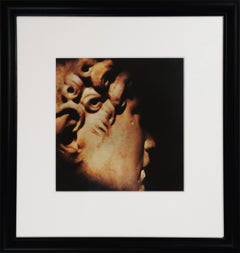
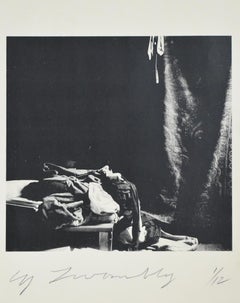
CY TWOMBLY BLACK & WHITE PHOTO PHOTOGRAPHY MID CENTURY 1 OF 12

CY TWOMBLY BLACK & WHITE PHOTO PHOTOGRAPHY MID CENTURY 1 OF 12

By Cy Twombly

Located in San Antonio, TX

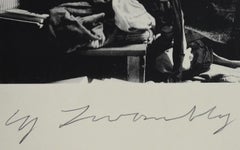
Cy Twombly (1928-2011) Virginia/ New York / Italy Image Size: 16 x 11 Visible inside matboard is 12 x 11 Frame Size: 21.5 x 19 Medium: Photograph Edition 1/12 Signed with the edition number "Black and White" 1954 This is an original. The same photo in the Twombly book is a dry point on cardboard but is unsigned by hand. Cy Twombly (1928-2011) Following is the obituary of the artist by Randy Kennedy, The New York Times, July 5, 2011 Cy Twombly, whose spare, childlike scribbles and poetic engagement with antiquity left him stubbornly out of step with the movements of postwar American art even as he became one of the era's most important painters, died on Tuesday in Rome. He was 83. His death was announced by the Gagosian Gallery, which represents his work. Mr. Twombly had battled cancer for several years. In a career that slyly subverted Abstract Expressionism, toyed briefly with Minimalism, seemed barely to acknowledge Pop art and anticipated some of the concerns of Conceptualism, Mr. Twombly was a divisive artist almost from the start. The curator Kirk Varnedoe, on the occasion of a 1994 retrospective at the Museum of Modern Art, wrote that his work was "influential among artists, discomfiting to many critics and truculently difficult not just for a broad public, but for sophisticated initiates of postwar art as well." The critic Robert Hughes called him "the Third Man, a shadowy figure, beside that vivid duumvirate of his friends Jasper Johns and Robert Rauschenberg." Mr. Twombly's decision to settle permanently in southern Italy in 1957 as the art world shifted decisively in the other direction, from Europe to New York, was only the most symbolic of his idiosyncrasies. He avoided publicity throughout his life and mostly ignored his critics, who questioned constantly whether his work deserved a place at the forefront of 20th century abstraction, though he lived long enough to see it arrive there. It didn't help that his paintings, because of their surface complexity and whirlwinds of tiny detail — scratches, erasures, drips, penciled fragments of Italian and classical verse amid scrawled phalluses and buttocks — lost much of their power in reproduction. But Mr. Twombly, a tall, rangy Virginian who once practiced drawing in the dark to make his lines less purposeful, steadfastly followed his own program and looked to his own muses — often literary ones, like Catullus, Rumi, Pound and Rilke. He seemed to welcome the privacy that came with unpopularity. "I had my freedom and that was nice," he said in a rare interview, with Nicholas Serota, the director of the Tate, before a 2008 survey of his career at the Tate Modern. The critical low point probably came after a widely panned 1964 exhibition at the Leo Castelli Gallery in New York. The artist and writer Donald Judd, who was hostile toward painting in general, was especially damning, calling the show a fiasco. "There are a few drips and splatters and an occasional pencil line," he wrote in a review. "There isn't anything to these paintings." But by the 1980s, with the rise of neo-Expressionism, a generation of younger artists like Jean-Michel Basquiat found inspiration in Mr. Twombly's skittery bathroom-graffiti scrawl. Coupled with rising interest in European artists whose work shared unexpected ground with Twombly's, like Joseph Beuys, the newfound attention brought him a kind of critical favor he had never enjoyed before. And by the next decade, he was highly sought after not only by European museums and collectors, who had discovered his work early on, but also by those back in his homeland who had not known what to make of him two decades before. In 1989, the Philadelphia Museum of Art opened permanent rooms dedicated to his monumental 10-painting cycle, Fifty Days at Iliam, based on Alexander Pope's translation of The Iliad. (Mr. Twombly said that he purposely misspelled Ilium, a Latin name for Troy, with an "a," to refer to Achilles.) That same year, Mr. Twombly's work passed the million dollar mark at auction. In 1995, the Menil Collection in Houston opened a new gallery dedicated to his work, designed by Renzo Piano after a plan by Mr. Twombly himself. Despite this growing acceptance, Mr. Varnedoe still felt it necessary to include an essay in the Modern's newsletter at the time of the retrospective, titled "Your Kid Could Not Do This, and Other Reflections on Cy Twombly." In the only written statement Mr. Twombly ever made about his work, a short essay in an Italian art journal in 1957, he tried to make clear that his intentions were not subversive but elementally human. Each line he made, he said, was "the actual experience" of making the line, adding: "It does not illustrate. It is the sensation of its own realization." Years later, he described this more plainly. "It's more like I'm having an experience than making a picture," he said. The process stood in stark contrast to the detached, effete image that often clung to Mr. Twombly. After completing a work, in a kind of ecstatic state, it was as if the painting existed but he himself barely did anymore: "I usually have to go to bed for a couple of days," he said. Edwin Parker Twombly Jr., was born in Lexington, Va., on April 25, 1928, to parents who had moved to the South from New England. His father, a talented athlete who pitched a summer for the Chicago White Sox and went on to become a revered college swimming coach, was nicknamed Cy, after Cy Young, the Hall of Fame pitcher. The younger Mr. Twombly (pronounced TWAHM-blee) inherited the name, though he was much more bookish than athletic as a child, with stooped shoulders and a high ponderous forehead. He read avidly and, discovering his calling early, he worked from art kits he ordered from the Sears Roebuck catalog. As a teenager, he studied with the Spanish painter Pierre Daura, who had left Europe after the Spanish Civil War and settled in Lexington. Daura's wife, Louise Blair, studied cave paintings and may have sparked Mr. Twombly's early interest in Paleolithic art. In 1947 he attended the Boston Museum School, where German Expressionism was the rage, but Mr. Twombly gravitated to his own interests, like Dada and Kurt Schwitters and particularly to Jean Dubuffet and Alberto Giacometti, two important early influences. He moved back to Lexington in 1949 and studied art at Washington and Lee University, where his talent impressed teachers. By 1950, he was in New York, the recipient of a scholarship to the Art Students League. Later in his life, he cited visiting Willem de Kooning's studio and seeing an Arshile Gorky retrospective at the Whitney Museum of American Art as important moments in his young painting life. But he also came to New York at the heyday of the New York School and was exposed to the work of almost all its giants in the city's galleries. He turned down an offer for a solo show of his paintings at the Art Students League in 1950, saying that he felt it was too early for him. He met Rauschenberg, a fellow student at the league, during his second semester, and Rauschenberg later persuaded Mr. Twombly to enroll at Black Mountain College in North Carolina, which had become a crucible for the American avant-garde, with John Cage, Merce Cunningham, Ray Johnson, Dorothea Rockburne and John Chamberlain among its faculty and students. Mr. Twombly, who studied with Ben Shahn, stayed at the college only briefly and was a bit of an outsider even then. As he told Mr. Serota: "I was always doing my own thing. I always wondered why there are books with photographs of all the artists of that period and I was only in one! I thought: 'Where was I?' " In the summer of 1952, after receiving a grant from the Virginia Museum of Fine Arts, Mr. Twombly traveled to Europe for the first time and met up with Rauschenberg. The two wandered through Italy, North Africa and Spain, an experience that later yielded some of the first paintings to be considered a part of Mr. Twombly's mature work. "Tiznit," made with white enamel house paint and pencil and crayon, with gouges and scratches in the surface, was named for a town in Morocco that he had visited, and the painting's primitivist shapes were inspired by tribal pieces he saw at the ethnographic museum in Rome, as well as by artists like Dubuffet, de Kooning and Franz Kline. The painting, along with another based on tribal motifs, was exhibited in 1953 at Eleanor Ward's Stable Gallery on West 58th Street along with monochromatic paintings by Rauschenberg. The show was generally savaged. (Early this year, the Museum of Modern Art acquired "Tiznit," along with another early work, which Mr. Twombly had kept in his personal collection.) Mr. Twombly was drafted and spent more than a year in the Army, where he was assigned to cryptography work in Washington. On weekends and leaves, he continued to paint and draw, sometimes at night with the lights out to try to lose techniques he had learned in art classes and to express himself more instinctively. After receiving a medical discharge and teaching for a time in Virginia, Mr. Twombly returned to New York and worked in a studio on William Street, near both Rauschenberg and Johns, who helped choose titles for his paintings during this period. Mr. Twombly tried without success for several months to get a grant to go back to Europe and in 1957, with Ward's help, he spent several months in Italy, where he met Tatiana Franchetti...

Category

1950s Modern Cy Twombly Photography
Materials

Drypoint

Cy Twombly photography for sale on 1stDibs.

Find a wide variety of authentic Cy Twombly photography available for sale on 1stDibs. Much of the original work by this artist or collective was created during the 1990s and is mostly associated with the contemporary style. Not every interior allows for large Cy Twombly photography, so small editions measuring 23 inches across are available. Customers who are interested in this artist might also find the work of Arthur Elgort, Peter Beard, and William Wegman. Cy Twombly photography prices can differ depending upon medium, time period and other attributes. On 1stDibs, the price for these items starts at $30,000 and tops out at $30,000, while the average work can sell for $30,000.
Questions About Cy Twombly Photography
  • 1stDibs ExpertApril 5, 2022
    Born in 1928, Cy Twombly was an American painter, sculptor and photographer, and was a key figure in 20th century art. He used combinations of painting and drawing techniques in his work, etched scribbles, repetitive lines, and words and graffiti. Shop a selection of Cy Twombley art from some of the world’s top art dealers on 1stDibs.
  • 1stDibs ExpertMarch 15, 2024
    You can see Cy Twombly’s paintings in a number of locations. The Museum Brandhorst in Munich, Germany, holds one of the largest collections of the American artist's work. In the U.S., you can find Cy Twombly paintings in the collections of the Museum of Modern Art in New York City, New York; the Milwaukee Art Museum in Milwaukee, Wisconsin; and the Art Institute of Chicago in Chicago, Illinois. On 1stDibs, find a selection of Cy Twombly art.
  • 1stDibs ExpertApril 5, 2022
    Yes, Cy Twombly did use oil paint, although his method was quite unique. He would run his fingers in the paint to create channels, and would then use oil paint in ‘globs’. House paint overtop would then merge the paints into a completed piece. Shop a selection of Cy Twombly’s pieces from some of the world’s top art dealers on 1stDibs.