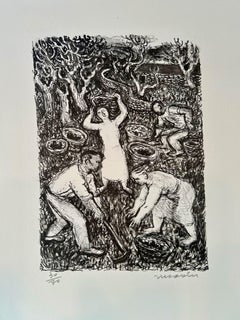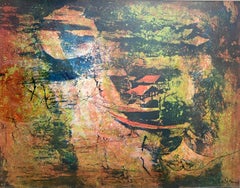
Dang Lebadong Art

Vietnamese, 1922-2015
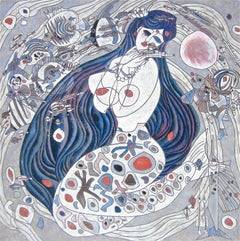
During World War 2, Lebadang was part of the force of “Indochinese workers” most of whom were forcibly recruited by the French state to work in arms and munitions factories, replacing the French workers mobilized into the army. Alone and without resources he survived for a time in wartime France, and enrolled for a course in painting given by M. Espinasse and sculpture lessons given by M. Manin at the “École des beaux-arts” (School of Fine Arts) in Toulouse. In the sculpture studio he made a very lifelike bust of one of his fellow-students and a bare female foot which already showed a sureness of design and a control of volume. There, he was to find the real France, the warmth of friendship, the solidarity and that French culture which had always fascinated him.In June 1948 he gained his diploma and won a competition for designing advertisements. With this money, he travelled to Paris. Lebadang left for Paris, attracted to the city by its cultural effervescence. Those post-war years were a Bohemian period, in the Latin Quarter, the rue du Chat-qui-Pêche and the rue Mouffard which were the subjects of many paintings. He had a studio in the rue de la Montagne-Sainte-Geneviève where he painted one of his first self-portraits in oil, using a range of grey and blues on raw linen. During the fifites Lebadang held his first exhibitions, in Paris and in the provinces, which were well received in the press. In 1958, the artist discovered lithography in the Arts-Litho studio, and regularly attended the studios of Fernand Mourlot and Jacques Desjobert. He held his third exhibition at the Galerie Cézanne at Cannes, and gave an exhibition of his new works in the Galerie Au Seuil Étroit in Paris. In the same year, the Château de la Napoule near Cannes organized an exhibition of his works. In the following years, galleries in Paris and in the French provinces hosted numerous exhibitions (Galerie Pierre Hautot, rue du bac, Galerie Bonaparte, rue Bonaparte, Galerie Fontaine, avenue Victor Hugo, Galerie Minage in Montpellier). In the sixties, England (the Frost and Reed Gallery in London), Germany, Switzerland (Leandro Gallery at Lausanne) and Norway (Spektrum Gallery and the Lundt University at Bergen) welcomed his works, opening the way to the United States and interested collectors there. He had his last exhibition at the “Galerie Au Seuil Étroit” at Paris and new exhibition at the “Galerie Sources” at Aix-en-Provence. In 1966, the Cincinnati Art Museum, in Ohio, produced the first exhibition dedicated to his work in the United States. In the same year he exhibited at the Newman Contemporary Art Gallery in Philadelphia in Pennsylvania.
to
1
2
Overall Width
to
Overall Height
to
3
1
2
2
1
1
1
3
3
10,186
2,809
2,503
1,398
2
1
Artist: Dang Lebadong
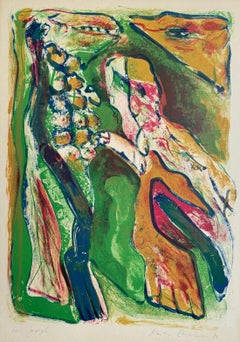
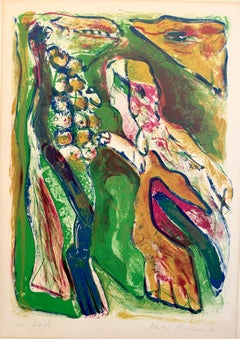
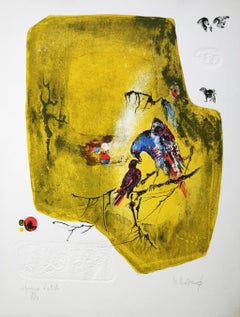
Birds on a Branch original lithograph Dang Lebadang

Birds on a Branch original lithograph Dang Lebadang

By Dang Lebadong

Located in Paonia, CO

Birds on a Branch is a limited edition lithograph ( VI/XXI ) in excellent condition and is signed in pencil by the artist. Three blue and red birds sitting on a branch with a background in yellow and some black. Dang Lebadang...

Category

20th Century Abstract Dang Lebadong Art

Materials

Lithograph
Cheval dans la Montagne original limited ed. lithograph Dang Ledadang

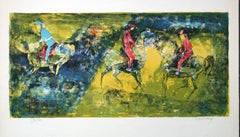
Cheval dans la Montagne original limited ed. lithograph Dang Ledadang

By Dang Lebadong

Located in Paonia, CO

Cheval dans la Montagne shows three riders in a background of greens and blues. Original lithograph signed in pencil. Limited edition 99/120 and in excellent condition. paper size 20.50 x 29.50 image 13 x 27.25 Vietnamese artist Dang Lebadang...

Category

20th Century Dang Lebadong Art

Materials

Lithograph
Related Items
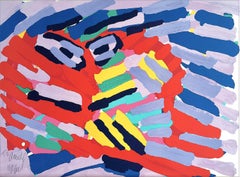
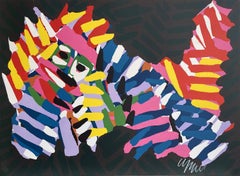
ONCE I WAS THE SUN Signed Lithograph, Abstract Face, Hot Pink Blue Yellow Red

ONCE I WAS THE SUN Signed Lithograph, Abstract Face, Hot Pink Blue Yellow Red

By Karel Appel

Located in Union City, NJ

ONCE I WAS THE SUN is a limited edition lithograph by the Dutch artist Karel Appel printed using hand lithography techniques on archival printmaking paper, 100% acid free. ONCE I WAS...

Category

1970s Abstract Dang Lebadong Art

Materials

Lithograph
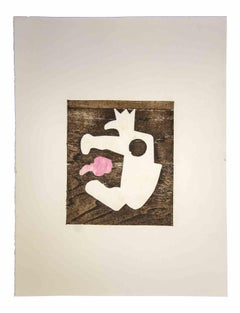
Composition - Original Etching by Leo Guida - 1970s

Leo GuidaComposition - Original Etching by Leo Guida - 1970s, 1970s

$168Sale Price|30% Off

H 19.69 in W 13.78 in D 0.04 in

Composition - Original Etching by Leo Guida - 1970s

By Leo Guida

Located in Roma, IT

Composition is an original etching realized by Leo Guida in 1970s. Good condition. Mounted on a white cardboard passpartout (50x35). Not signed and not dated. Leo Guida (1992 - ...

Category

1970s Abstract Dang Lebadong Art

Materials

Etching

Keith Haring Tony Shafrazi gallery 1982 (set of 4 printed works)

Keith Haring Tony Shafrazi gallery 1982 (set of 4 printed works)

By Keith Haring

Located in NEW YORK, NY

Keith Haring Tony Shafrazi 1982: set of 6 printed works: A set of six, individual, double-sided lithographic inserts from the seminal, spiral bound 1982 Keith Haring Tony Shafrazi ca...

Category

1980s Pop Art Dang Lebadong Art

Materials

Lithograph, Offset

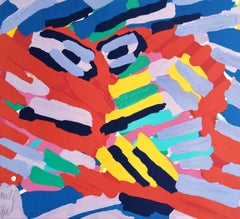
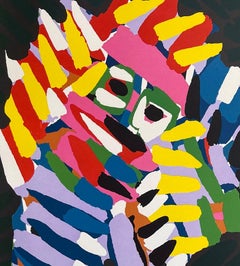
ORANGE PERSONNAGE Signed Lithograph, Abstract Cat Portrait, Bold Color Collage

ORANGE PERSONNAGE Signed Lithograph, Abstract Cat Portrait, Bold Color Collage

By Karel Appel

Located in Union City, NJ

Orange Personnage is an original limited edition lithograph by the Dutch artist Karel Appel printed using hand lithography techniques on archival Arches printmaking paper, 100% acid ...

Category

1980s Abstract Dang Lebadong Art

Materials

Lithograph
Modern Black and White Abstract Tropical Village Landscape Woodcut Print

Modern Black and White Abstract Tropical Village Landscape Woodcut Print

Located in Houston, TX

Modern black and white abstract woodcut print. The piece features lush trees and foliage growing in a yard behind a house. There are three central figures standing next to a pole and...

Category

20th Century Abstract Dang Lebadong Art

Materials

Woodcut

Rare 1923 Cubist Reuven Rubin Woodcut Woodblock Kabbalah Print Israeli Judaica

Rare 1923 Cubist Reuven Rubin Woodcut Woodblock Kabbalah Print Israeli Judaica

By Reuven Rubin

Located in Surfside, FL

This is from the original first edition 1923 printing. there was a much later edition done after these originals. These are individually hand signed in pencil by artist as issued. This listing is for the one print. the other documentation is included here for provenance and is not included in this listing. The various images inspired by the Jewish Mysticism and rabbis and mystics of jerusalem and Kabbalah is holy, dramatic and optimistic Rubin succeeded to evoke the spirit of life in Israel in those early days. They are done in a modern art style influenced by German Expressionism, particularly, Ernst Barlach, Ernst Ludwig Kirchner, and Franz Marc, as introduced to Israel by Jakob Steinhardt, Hermann Struck and Joseph Budko. Reuven Rubin 1893 -1974 was a Romanian-born Israeli painter and Israel's first ambassador to Romania. Rubin Zelicovich (later Reuven Rubin) was born in Galati to a poor Romanian Jewish Hasidic family. He was the eighth of 13 children. In 1912, he left for Ottoman-ruled Palestine to study art at Bezalel Academy of Art and Design in Jerusalem. Finding himself at odds with the artistic views of the Academy's teachers, he left for Paris, France, in 1913 to pursue his studies at the École Nationale Supérieure des Beaux-Arts. He was of the well known Jewish artists in Paris along with Marc Chagall and Chaim Soutine, At the outbreak of World War I, he was returned to Romania, where he spent the war years. In 1921, he traveled to the United States with his friend and fellow artist, Arthur Kolnik. In New York City, the two met artist Alfred Stieglitz, who was instrumental in organizing their first American show at the Anderson Gallery. Following the exhibition, in 1922, they both returned to Europe. In 1923, Rubin emigrated to Mandate Palestine. Rubin met his wife, Esther, in 1928, aboard a passenger ship to Palestine on his return from a show in New York. She was a Bronx girl who had won a trip to Palestine in a Young Judaea competition. He died in 1974. Part of the early generation of artists in Israel, Joseph Zaritsky, Arieh Lubin, Reuven Rubin, Sionah Tagger, Pinchas Litvinovsky, Mordecai Ardon, Yitzhak Katz, and Baruch Agadati; These painters depicted the country’s landscapes in the 1920s rebelled against the Bezalel school of Boris Schatz. They sought current styles in Europe that would help portray their own country’s landscape, in keeping with the spirit of the time. Rubin’s Cezannesque landscapes from the 1920s were defined by both a modern and a naive style, portraying the landscape and inhabitants of Israel in a sensitive fashion. His landscape paintings in particular paid special detail to a spiritual, translucent light. His early work bore the influences of Futurism, Vorticism, Cubism and Surrealism. In Palestine, he became one of the founders of the new Eretz-Yisrael style. Recurring themes in his work were the bible, the prophet, the biblical landscape, folklore and folk art, people, including Yemenite, Hasidic Jews and Arabs. Many of his paintings are sun-bathed depictions of Jerusalem and the Galilee. Rubin might have been influenced by the work of Henri Rousseau whose naice style combined with Eastern nuances, as well as with the neo-Byzantine art to which Rubin had been exposed in his native Romania. In accordance with his integrative style, he signed his works with his first name in Hebrew and his surname in Roman letters. In 1924, he was the first artist to hold a solo exhibition at the Tower of David, in Jerusalem (later exhibited in Tel Aviv at Gymnasia Herzliya). That year he was elected chairman of the Association of Painters and Sculptors of Palestine. From the 1930s onwards, Rubin designed backdrops for Habima Theater, the Ohel Theater and other theaters. His biography, published in 1969, is titled My Life - My Art. He died in Tel Aviv in October 1974, after having bequeathed his home on 14 Bialik Street and a core collection of his paintings to the city of Tel Aviv. The Rubin Museum opened in 1983. The director and curator of the museum is his daughter-in-law, Carmela Rubin. Rubin's paintings are now increasingly sought after. At a Sotheby's auction in New York in 2007, his work accounted for six of the ten top lots. Along with Yaacov Agam and Menashe Kadishman he is among Israel's best known artists internationally. Education 1912 Bezalel Academy of Arts and Design, Jerusalem 1913-14 École des Beaux Arts, Paris and Académie Colarossi, Paris Select Group Exhibitions Eged - Palestine Painters Group Eged - Palestine Painters Group, Allenby Street, Tel Aviv 1929 Artists: Chana Orloff, Abraham Melnikoff, Rubin, Reuven Nahum Gutman, Sionah Tagger,Arieh Allweil, Jewish Artists Association, Levant Fair, Tel Aviv, 1929 Artists: Ludwig Blum,Eliyahu Sigad, Shmuel Ovadyahu, Itzhak Frenel Frenkel,Ozer Shabat, Menahem Shemi...

Category

1920s Abstract Dang Lebadong Art

Materials

Woodcut

Rare 1923 Cubist Reuven Rubin Woodcut Woodblock Fisherman Print Israeli Judaica

Rare 1923 Cubist Reuven Rubin Woodcut Woodblock Fisherman Print Israeli Judaica

By Reuven Rubin

Located in Surfside, FL

This is from the original first edition 1923 printing. there was a much later edition done after these originals. These are individually hand signed in pencil by artist as issued. This listing is for the one print. the other documentation is included here for provenance and is not included in this listing. The various images inspired by the Jewish Mysticism and rabbis and mystics of jerusalem and Kabbalah is holy, dramatic and optimistic Rubin succeeded to evoke the spirit of life in Israel in those early days. They are done in a modern art style influenced by German Expressionism, particularly, Ernst Barlach, Ernst Ludwig Kirchner, and Franz Marc, as introduced to Israel by Jakob Steinhardt, Hermann Struck and Joseph Budko. Reuven Rubin 1893 -1974 was a Romanian-born Israeli painter and Israel's first ambassador to Romania. Rubin Zelicovich (later Reuven Rubin) was born in Galati to a poor Romanian Jewish Hasidic family. He was the eighth of 13 children. In 1912, he left for Ottoman-ruled Palestine to study art at Bezalel Academy of Art and Design in Jerusalem. Finding himself at odds with the artistic views of the Academy's teachers, he left for Paris, France, in 1913 to pursue his studies at the École Nationale Supérieure des Beaux-Arts. He was of the well known Jewish artists in Paris along with Marc Chagall and Chaim Soutine, At the outbreak of World War I, he was returned to Romania, where he spent the war years. In 1921, he traveled to the United States with his friend and fellow artist, Arthur Kolnik. In New York City, the two met artist Alfred Stieglitz, who was instrumental in organizing their first American show at the Anderson Gallery. Following the exhibition, in 1922, they both returned to Europe. In 1923, Rubin emigrated to Mandate Palestine. Rubin met his wife, Esther, in 1928, aboard a passenger ship to Palestine on his return from a show in New York. She was a Bronx girl who had won a trip to Palestine in a Young Judaea competition. He died in 1974. Part of the early generation of artists in Israel, Joseph Zaritsky, Arieh Lubin, Reuven Rubin, Sionah Tagger, Pinchas Litvinovsky, Mordecai Ardon, Yitzhak Katz, and Baruch Agadati; These painters depicted the country’s landscapes in the 1920s rebelled against the Bezalel school of Boris Schatz. They sought current styles in Europe that would help portray their own country’s landscape, in keeping with the spirit of the time. Rubin’s Cezannesque landscapes from the 1920s were defined by both a modern and a naive style, portraying the landscape and inhabitants of Israel in a sensitive fashion. His landscape paintings in particular paid special detail to a spiritual, translucent light. His early work bore the influences of Futurism, Vorticism, Cubism and Surrealism. In Palestine, he became one of the founders of the new Eretz-Yisrael style. Recurring themes in his work were the bible, the prophet, the biblical landscape, folklore and folk art, people, including Yemenite, Hasidic Jews and Arabs. Many of his paintings are sun-bathed depictions of Jerusalem and the Galilee. Rubin might have been influenced by the work of Henri Rousseau whose naice style combined with Eastern nuances, as well as with the neo-Byzantine art to which Rubin had been exposed in his native Romania. In accordance with his integrative style, he signed his works with his first name in Hebrew and his surname in Roman letters. In 1924, he was the first artist to hold a solo exhibition at the Tower of David, in Jerusalem (later exhibited in Tel Aviv at Gymnasia Herzliya). That year he was elected chairman of the Association of Painters and Sculptors of Palestine. From the 1930s onwards, Rubin designed backdrops for Habima Theater, the Ohel Theater and other theaters. His biography, published in 1969, is titled My Life - My Art. He died in Tel Aviv in October 1974, after having bequeathed his home on 14 Bialik Street and a core collection of his paintings to the city of Tel Aviv. The Rubin Museum opened in 1983. The director and curator of the museum is his daughter-in-law, Carmela Rubin. Rubin's paintings are now increasingly sought after. At a Sotheby's auction in New York in 2007, his work accounted for six of the ten top lots. Along with Yaacov Agam and Menashe Kadishman he is among Israel's best known artists internationally. Education 1912 Bezalel Academy of Arts and Design, Jerusalem 1913-14 École des Beaux Arts, Paris and Académie Colarossi, Paris Select Group Exhibitions Eged - Palestine Painters Group Eged - Palestine Painters Group, Allenby Street, Tel Aviv 1929 Artists: Chana Orloff, Abraham Melnikoff, Rubin, Reuven Nahum Gutman, Sionah Tagger,Arieh Allweil, Jewish Artists Association, Levant Fair, Tel Aviv, 1929 Artists: Ludwig Blum,Eliyahu Sigad, Shmuel Ovadyahu, Itzhak Frenel Frenkel,Ozer Shabat, Menahem Shemi, First Exhibition of ''Hever Omanim'' First Exhibition of ''Hever Omanim'' Steimatzky Gallery, Jerusalem 1936 Artists: Gutman, Nachum Holzman, Shimshon Mokady, Moshe Sima, Miron Rubin, Reuven Steinhardt, Jakob Ben Zvi, Zeev Ziffer, Moshe Allweil, Arieh Group Exhibition Group Exhibition Katz Art Gallery, Tel Aviv 1939 Artists: Avni, Aharon Holzman, Shimshon Gliksberg, Haim Gutman, Nachum Ovadyahu, Shmuel Shorr, Zvi Schwartz, Chaya Streichman, Yehezkel Tagger, Sionah Rubin, Reuven A Collection of Works by Artists of the Land of Israel A Collection of Works by Artists of the Land of Israel The Bezalel National Museum, Jerusalem 1940 Artists: Shemi, Menahem Rubin, Reuven Avni, Aharon Mokady, Moshe Jonas, Ludwig Steinhardt, Jakob Ticho, Anna Krakauer, Leopold Gutman, Nachum Budko, Joseph Ardon, Mordecai Sima, Miron Castel, Moshe Pann, Abel Struck, Hermann Gur Arie, Meir Ben Zvi, Zeev Litvinovsky, Pinchas Artists in Israel for the Defense, Tel Aviv Museum of Art, Helena Rubinstein Pavilion, Tel Aviv 1967 Artists: Avraham Binder, Motke Blum, (Mordechai) Samuel Bak, Yosl Bergner, Nahum Gilboa, Jean David, Marcel Janco, Lea Nikel, Jacob Pins, Esther Peretz...

Category

1920s Abstract Dang Lebadong Art

Materials

Woodcut

MOMA Print Retrospective 1981 Vintage Lithograph Poster, Flying Creatures, Waves

MOMA Print Retrospective 1981 Vintage Lithograph Poster, Flying Creatures, Waves

By Pierre Alechinsky

Located in Union City, NJ

MOMA Print Retrospective 1981 is an original hand drawn lithographic poster printed on 100% acid free paper created by Pierre Alechinsky in 1981 for his retrospective exhibition at T...

Category

1980s Abstract Dang Lebadong Art

Materials

Lithograph
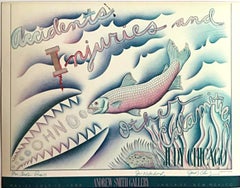
Desert Series B
Desert Series B

Ruth LeafDesert Series B, c.1990

$650

H 22 in W 29.75 in D 0.01 in

Desert Series B

By Ruth Leaf

Located in San Francisco, CA

This artwork titled "Desert Series B" c.1990, is an original colors monoprint aquatint on Wove paper by noted American artist Ruth Leaf, 1923-2015. It is hand signed, titled and numb...

Category

Late 20th Century Abstract Expressionist Dang Lebadong Art

Materials

Aquatint, Monoprint

Mythologia Moderna II

Man RayMythologia Moderna II, 1969

$2,338

H 38.5 in W 32 in D 1.15 in

Mythologia Moderna II

By Man Ray

Located in San Francisco, CA

Artist: Man Ray (American, 1890-1976) Title: Mythologia Moderna II Year: 1969 Medium: Color lithograph Edition: numbered 46/175 in pencil Paper: Arches watermarked Image siz...

Category

Mid-20th Century Dada Dang Lebadong Art

Materials

Lithograph
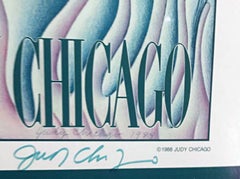
Composition - Original Etching by Leo Guida - 1970s

Leo GuidaComposition - Original Etching by Leo Guida - 1970s, 1970s

$168Sale Price|30% Off

H 19.69 in W 13.78 in D 0.04 in

Composition - Original Etching by Leo Guida - 1970s

By Leo Guida

Located in Roma, IT

Composition is an original etching realized by Leo Guida in 1970s. Good condition. Mounted on a white cardboard passpartout (50x35). Not signed and not dated. Leo Guida (1992 -...

Category

1970s Abstract Dang Lebadong Art

Materials

Etching

Assemblee des Rabbins et Notables.. original lithograph by Theo Tobiasse

Assemblee des Rabbins et Notables.. original lithograph by Theo Tobiasse

By Théo Tobiasse

Located in Paonia, CO

Assemblee des Rabbins et Notables au 16 siecle  dans un village de Lithuanie is an original artist proof ( E. A. ) lithograph by  Theo Tobiasse (b.1927 -2012) , an internationally successful French painter, engraver, illustrator, and sculptor. He grew up in Paris during the Nazi occupation. His work has great depth and originality as he seeks to express the inner world of man.  Perhaps the hardships he and his family endured helped define his artistic expression. He has had many exhibitions around the world, in Paris at the Drouant gallery, in Geneva, Montreal or Tokyo, then London, Zurich, Lauzanne, Los Angeles, Kyiv. He also had a solo exhibition in New York and many more shows world wide over the years.  A visit to Jerusalem in 1970 brought him closer to his Jewish origins. He created his first stained glass windows on the theme of “Jewish Holidays” for the Jewish Community Center in Nice and a monumental oil on canvas entitled Que tes tentes sont belles, ô Jacob (1982). He traveled and immersed himself in the cultures he encountered, the jazz of New Orleans, Mexican archaeological sites and Native American totems. In New York, he met Elie Wiesel...

Category

1970s Abstract Expressionist Dang Lebadong Art

Materials

Lithograph
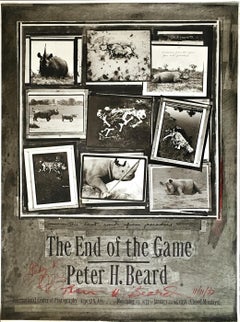
Dang Lebadong art for sale on 1stDibs.

Find a wide variety of authentic Dang Lebadong art available for sale on 1stDibs. You can also browse by medium to find art by Dang Lebadong in lithograph and more. Much of the original work by this artist or collective was created during the 20th century and is mostly associated with the abstract style. Not every interior allows for large Dang Lebadong art, so small editions measuring 1 inch across are available. Customers who are interested in this artist might also find the work of Katherine Chang Liu, Stephen Edlich, and Kimber Smith. Dang Lebadong art prices can differ depending upon medium, time period and other attributes. On 1stDibs, the price for these items starts at $450 and tops out at $850, while the average work can sell for $850.

Artists Similar to Dang Lebadong