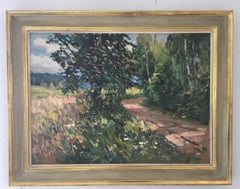
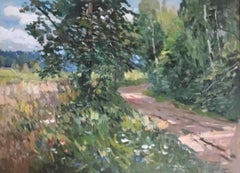
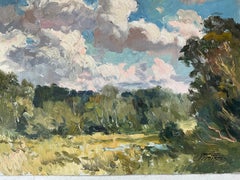
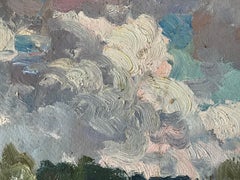
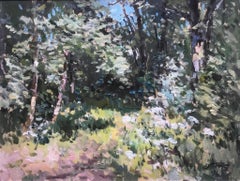
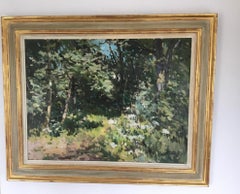
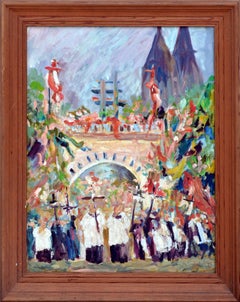
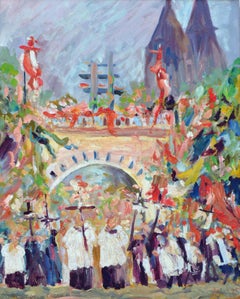
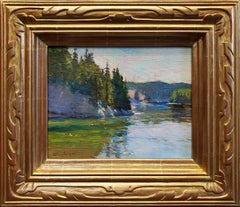
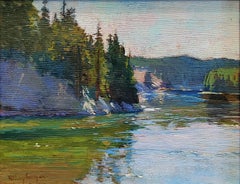
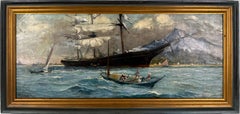
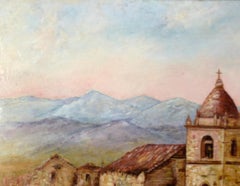
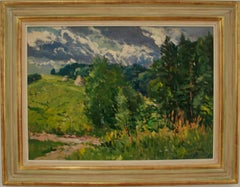
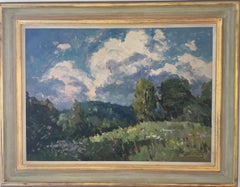
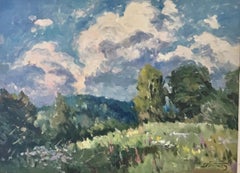
By Edgar Vinters
Located in Pollenca, Illes Baleares
Born in Riga, Edgars Vinters was the only child of the facade and decoration painter Hermanis Vinters (1874–1939) and his wife Anna, née Kalniņa, (1879–1953). As a ten-year-old boy he met with the popular pastelist Voldemārs Irbe, who detected the boy’s talent, taught him the basics of pastel painting and opened his eyes to the beauty of nature in its so-called minor details. From 1935 on, he wrote small articles for children's and youth magazines, which he illustrated with pen and ink drawings and linocuts.[2] With the money he made, he contributed to the school fee for the commercial college he attended until 1940, after a change of school.
Resulting from contact he made with the painter Hugo Kārlis Grotuss, from 1937 Vinters changed his painting style. Grotuss encouraged him to give up ‘the dark phase’ he was in through Irbe, to use brighter primers and to show more briskness and colours in his paintings. A porcelain factory engaged him to paint a series of porcelain plates
for president Kārlis Ulmanis.
After he had taken his high-school-diploma, he joined the Latvian Art Academy and until 1944 studied under the professors Jānis Kuga, Leo Svemps, Jānis Cielavs, Valdemārs Tone, Jānis Annuss, Kārlis Miesnieks und Vilhelms Purvītis. In 1944, Vinters had to drop out of his studies; he was drafted for the service in the Latvian Legion and deployed near Toruń on the Vistula River. In 1945 he was taken prisoner of war by the Soviet Army and deported to a POW camp near Moscow. There Russian officers...
Category
21st Century and Contemporary Impressionist Edgar Vinters Paintings