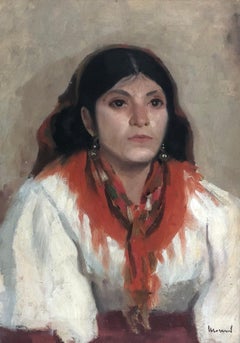
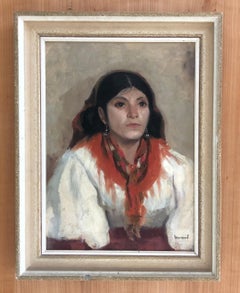
Spanish girl with headscarf
By Édouard Morerod
Located in Genève, GE
Work on cardboard Beige wooden frame 56.5 x 43.5 x 4 cm
Category
Early 20th Century Édouard Morerod Paintings
Materials
Oil
Spanish girl with headscarf
By Édouard Morerod
Located in Genève, GE
Work on cardboard Beige wooden frame 56.5 x 43.5 x 4 cm
Oil
$37,416
H 31.34 in W 26.38 in D 1.97 in
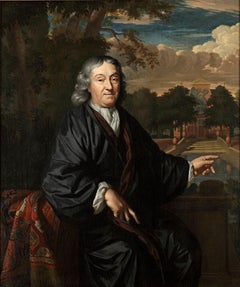
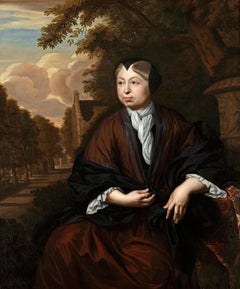
Male and female portrait, both in silk kimono, possibly textile dealers
By Christoffel Lubieniecki
Located in Amsterdam, NL
CHRISTOFFEL LUBIENIECKI (1659-1729) Pair of portraits of a gentleman and a lady, both in silk kimono, before a country house (circa 1680) Indistinctly signed “C.......” on a box under the man’s left hand Oil on canvas, 79.5 x 67 cm each Both sitters are portrayed wearing a silk “Japanese” coat. During the second half of the seventeenth the Japanese silk coat, an adapted Japanese kimono, became a real vogue in the Dutch elite. The exclusive Dutch trade contacts with Japan can explain the popularity of the kimono-style silk coats in the Netherlands. Everybody who could afford one, dressed in such a fashionable and comfortable coat and, like the present sitters, some proud owners had themselves portrayed in a “Japanese” coat often together with an oriental carpet to underline their standing and international connections. These portraits are the work of the Polish-born portraitist Christoffel Lubieniecki (also known as Lubienitski, Lubinitski or Lubiniecki) Lubieniecki was first trained in Hamburg under Julian Stuhr and after 1675 in Amsterdam under Adriaen Backer and Gerard de Lairesse. He specialized in landscapes, generally of an Italianate character, and in portraits. The loving execution of these contented burghers, enjoying the garden vistas of their country house, places him alongside Amsterdam portraitists such as Constantijn Netscher and Michiel van Musscher...
Canvas, Oil
$24,303
H 29.53 in W 38.98 in
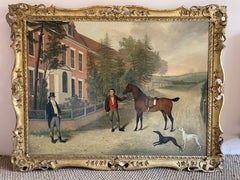
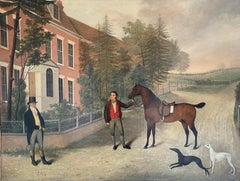
19th Century American School - Gentleman with Groom, Horse and Hounds by a House
Located in London, GB
AMERICAN SCHOOL (CIRCA 1840) A Gentleman with Groom, Horse and Greyhounds outside a Country House Oil on canvas Framed 75 by 99 cm., 29 ½ by 39 in. (frame size 87 by 113 cm., 34 ¼...
Oil
$5,333
H 56 in W 37 in D 3 in
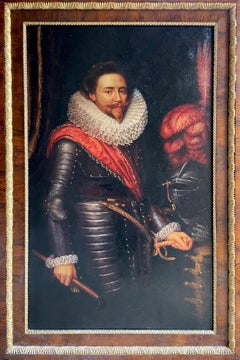
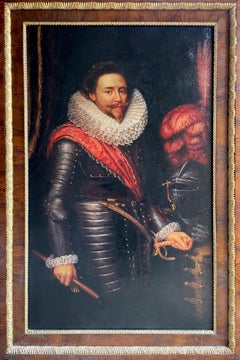
Portrait of Prince of Orange-Nassau" - After Michael Jansz. (Modern)
Located in Uppingham, GB
"Portrait of Frederick Hendrick, Prince of Orange-Nassau" - After Michael Jansz. van Miereveldt Dutch Golden Age royalty copy oil on canvas of van Miereveldt's iconic portrait. Excep...
Oil

$8,334Sale Price|25% Off
H 51.19 in W 33.47 in D 1.19 in
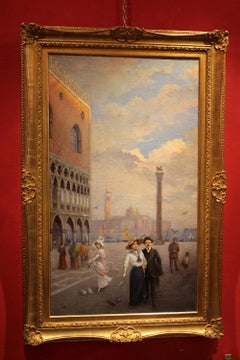
Venice Landscape Italian Oil on Canvas Painting in Gilt Wood Frame, Belle Epoque
Located in Firenze, IT
This delightful turn of the century (early 20th century) oil on canvas painting represents an Italian landscape with one of the most famous squares in the world: Piazza San Marco in ...
Canvas, Oil
Self-Portrait
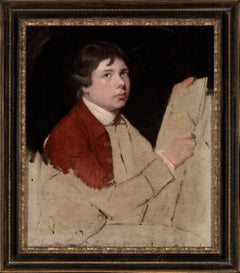
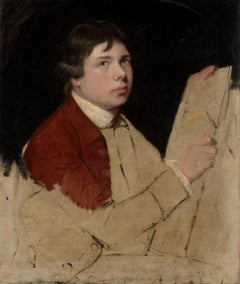
By John Hamilton Mortimer
Located in London, GB
Oil on canvas 30 x 25 ⅛ inches; 762 x 638 mm Verso: after Sir Joshua Reynolds, a self-portrait Not signed Painted c. 1758 Collections: Philip Gell (1775–1842), Hopton Hall, Derbyshire; By inheritance at Hopton Hall to his daughter, Isabella, who married William Pole Thornhill, who renounced Hopton and its contents in favour of his kinsman, Henry Chandos-Pole-Gell (1829–1902); By descent to his son, Brigadier General Harry Chandos-Pole-Gell (1872–1934), who sold Hopton Hall in 1918 and moved the family to Newnham Hall, Northamptonshire; By descent to his son, Lt Colonel John Chandos-Pole (1909–1993), Newnham Hall; Thence by descent until 2015, when acquired By descent to 2015; Lowell Libson & Jonny Yarker Ltd. Literature: Algernon Graves and Walter V. Cronin, A History of the works of Sir Joshua Reynolds P.R.A., London, 1901, IV, p. 1394. David Manning...
Canvas, Oil
$16,877
H 57 in W 47 in D 4 in
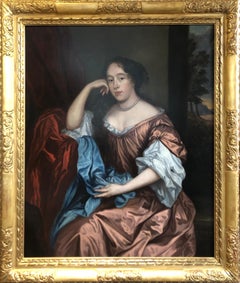
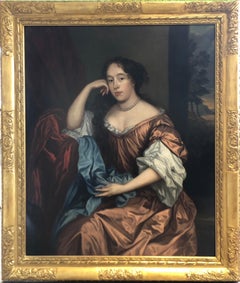
Portrait of a Lady, After Sir Peter Lely (1610-1680) Oil Painting
By After Sir Peter Lely
Located in Uppingham, GB
Oil Painting After Sir Peter Lely (1610-1680) Portrait of a Lady Housed in a Lely gold Leaf Frame. Peter Lely: In 1647 he became a member of the Pain...
Oil
$169,619
H 94.49 in W 85.44 in D 1.19 in
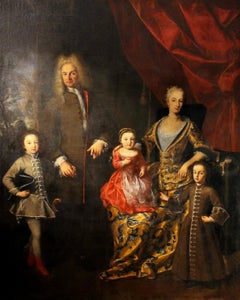
Oil on Canvas Painting Portrait of the Italian Noble Family of Zanardi Count
By Lucia Casalini Torelli
Located in Firenze, IT
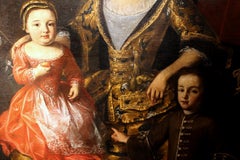
This museum quality old master oil on canvas formal portrait painting depicting the family of the Count Zanardi is signed by the artist- the female painter Lucia Casalini Torelli- and published in a book dedicated to Casalini Torelli’s workshop and academy. This palatial masterpiece artwork comes directly from the ancient Villa Maraini Guerrieri - Palidano di Gonzaga (Mantua), an historic Italian heritage building owned by the descendants of the family portrayed for more than two centuries, until 1998. The big scale of this oil on canvas masterpiece painting states the relevance of Lucia Casalini Torelli as a painter. The present artwork is a formal family portrait painting that aim to introduce the characters depicted according to their social role in the society. The noble family is all gathered under a loggia overlooking a park, the landscape in the background is partially covered by a beautiful red cloth on the right side. The father stands up and holds the hand of his eldest son, proudly introducing his future heir. The son wears a light-blue dress and red boots, he is depicted in a serious pose holding a black tricorn hat under his arm and a rapier sword on his belt. The mother wears an elegant gold and dark green brocade dress, she is sitting with her youngest daughter on her knees while her second son is by her side. The little daughter wears a lovely long red and dress with white lace and holds an apple on her hand. The son stands next to his mother and is dressed in a brown priestly clothes. This palatial old masters piece was probably painted in 1740 due to the similarities with Cardinal Doria’ s portrait, now on display at the Doria Palace Museum, the official residence of the Prince of Genoa. The painting features original canvas (“prima tela”) and antique original patina, it is in excellent overall condition considering the age, use and its large scale. A formal detailed condition report and the results of the inspection with the UV lamp accompanied by photos is available on request. As well as for its exceptional quality and quite perfect state of conservation, this painting is particularly important and even more valuable both for the artist who painted it and for its absolutely exclusive provenance. Lucia painted the most prominent and powerful noble families of her time, the location of these paintings is unknown to the art market as it is extremely likely that the portraits are still kept in private collections. Furthermore, Lucia was one of the most appreciated artists of her time, so important that she was admitted as a member of the academy at a time when women were forbidden to attend these studies. In 1706, Felice Torelli...
Canvas, Oil
$5,135
H 62.25 in W 43.5 in D 3 in
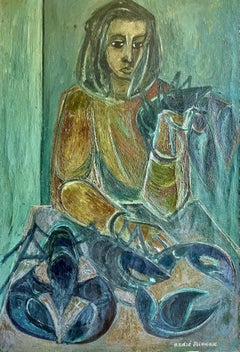
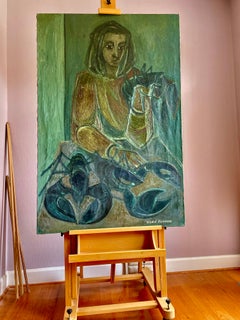
"Femme et Homards" (Woman with Lobsters), 1948 -André Minaux (French, 1923-1986)
By Andre Minaux
Located in Berlin, MD
Behold a mid-century marvel by André Minaux, a titan of the French School whose stylized Social Realist visions continue to captivate the art world. Painted in 1948, “Femme et Homard...
Cotton Canvas, Oil
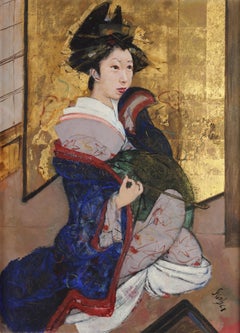
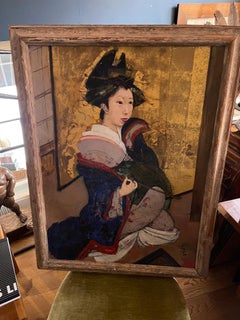
Portrait of a Geisha
By Roland Strasser
Located in Amsterdam, NL
Roland Strasser (1895-1974) "Japanese Geisha" Signed lower right Oil and gold leaf on canvas, measures: 76 x 46 cm In fine white-wash wood frame. ...
Gold Leaf
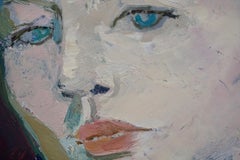
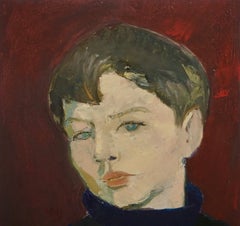
"L'Enfant Au Foulard Violet” The Child With The Purple Scarf.
By René Genis
Located in Berlin, MD
Rene Genis (French 1922-2004) "L'Enfant Au Foulard Violet” The Child With The Purple Scarf. A beautiful portrait of a young man in a purple scarf against...
Oil, Laid Paper
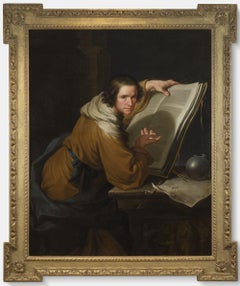

Sir Charles Frederick
Located in London, GB
Oil on canvas 50 x 40 inches; 127 x 101.6 cm Framed dimensions: 151.5 x 127 cm Inscribed on plinth: ‘VOTIS X ET XX’ Not signed Painted c.1748 Collections: Christie’s London, 23rd December 1954, lot.272; J. Singer; Somerville & Simpson Ltd, London, by 1985; The Matthiesen Gallery, London; Richard Feigen, New York; Matthew Rutenberg, New York to 2019; Lowell Libson and Jonny Yarker Ltd. Literature: Stella Rudolph, La Pittura del’ 700 a Roma, Milan, 1983, reproduced pl.133; Jacob Simon, Handel, a celebration of his life and times 1685-1759, exh. cat. London, (National Portrait Gallery), 1985, no.196; Catherine Whistler, Baroque & Later Paintings in the Ashmolean Museum, London, 2016, pp.102-105, reproduced p.104 Exhibited: London, National Portrait Gallery, Handel, a celebration of his life and times 1685-1759, 1985-86, no.196, reproduced p.198 This powerful portrait of the antiquarian and courtier Sir Charles Frederick was completed in 1748 by the Roman painter Andrea Casali. Frederick, as comptroller of the royal laboratory, one of the ‘great officers’ of the Board of Ordinance at Woolwich, had just been responsible for the famed pyrotechnic display celebrating the Peace of Aix-la-Chapelle: the so-called ‘Royal Fireworks’ for which George Frederick Handel composed music. Casali’s portrait pays tribute to Frederick’s role as comptroller of the royal laboratory, showing him with a firing diagram and mortar, it also points to Frederick’s interests as an antiquarian with the inclusion of antique relief. Casali had first met Frederick in Rome in 1738, where he had painted his portrait, Frederick subsequently encouraged Casali to travel to London. This probably accounts for the unusual format; rather than a modern man of science, Casali casts Frederick as an alchemist bent on some mystic discovery, as such, it is one of the most unusual portraits of the period. Andrea Casali was a pupil of Sebastiano Conca and then of Francesco Trevisani, who recommended him to the Spanish court in 1736. He enjoyed some success in Rome as a painter of frescoes and altarpieces, notably a large cycle of Scenes from the Life of St Dominic at the cloister of S. Sisto Vecchio, for which he was made a Knight of the Golden Spur in 1729. Casali began painting Grand Tourist portraits in Rome around 1738. His first portrait of Sir Charles Frederick is dated that year Ashmolean Museum, Oxford), it casts Frederick as a focused scholar, showing him seated at an elaborately carved console table, hard at work. In common with other Grand Tour portraiture of the period, Casali includes a famous Roman landmark in the background, in this case the façade of the Pantheon. Horace Walpole noted that it was thanks to the encouragement of ‘Mr Frederick and his Friends at Rome’ that Casali travelled to London in 1741. Charles Frederick was a fascinating Augustan polymath. Born at Fort St George, Madras, where his father, Sir Thomas Frederick, was governor, he successively matriculated at New College, Oxford (1725), was called to the Middle Temple (1728), became a Fellow of the Royal Society (1731) and Director of the Society of Antiquaries (1735). His interests were wide ranging. Frederick was an amateur architect, he designed the monument to Lucy, Lady Lyttleton, in Hagley Church and the monument to Thomas Miller, bishop of Waterford, in Highclere church, Hampshire. He was a numismatist and collector of antiquities, as well as an amateur scientist. It was in the last capacity that he was appointed comptroller of the royal laboratory at Woolwich and clerk of the deliveries in 1746, this was the most junior of the ‘great officers’ who made up the membership of the royal Board of Ordnance. This appointment came through the good offices of the master-general of the Ordnance, a fellow antiquarian, John, 2nd Duke of Montagu. As comptroller, Frederick was responsible for the fireworks celebration of the treaty of Aix-la-Chapelle, for which Handel composed his celebrated music. As Horace Walpole wrote to his cousin, Henry Seymour Conway: ‘Charles Frederick has turned all his virtu into fireworks, and, by his influence with the Ordnance has prepared such a spectacle for the proclamation of Peace as is to surpass all its predecessors of bouncing memory. It is to open with a concert of fifteen hundred hands, and conclude with so many thousand crackers all set to music, that all the men killed in the war are to be wakened with a crash, as if it was the day of judgement, and fall a-dancing, like the troops in the Rehearsal. I wish you could see him making squibs of his papillotes, and bronzed over with a patina of gunpowder, and talking himself still hoarser on the superiority that his fireworks will have over the Roman naumachia.’ Performed in Green Park, the fireworks were mounted on a temporary structure designed by the architect Giovanni Niccolò Servandoni decorated by Adrea Soldi and Casali. Casali’s second portrait of Frederick was completed following the success of the firework display. In this remarkable image, we discover Frederick at work, dressed in almost monastic garb, pouring over an impossibly large tome propped on an antique altar. The altar is identifiable as a Roman relief depicting Victory writing on a shield, the original is at Villa Medici in Rome, but was engraved by Pietro Santi Bartoli...
Canvas, Oil
$993
H 13.39 in W 11.03 in
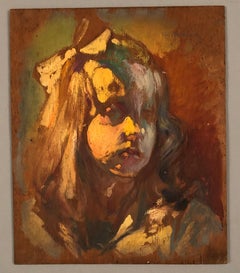
Portrait of the grand daughter of the artist. Oil on panel. Signed.
By Jules Pierre van Biesbroeck
Located in Paris, FR
Portrait study of the grand daughter of the artist. Oil on panel. Signed. Unframed. This work will be recorded in the catalogue raisonné of the...
Oil