Edward Chávez was descended from the early-day Spanish settlers in the present-day American Southwest. He was born into a sheep ranching family of twelve in Ocaté near Wagonmound in northeastern New Mexico. When he was five-year-old, an unusually hard winter wiped out all of the family’s livestock and assets, necessitating relocation to Red Lion in northeastern Colorado, where the family earned a meager livelihood working in the local sugar beet fields. Chávez later recalled: "From childhood, I knew only poverty and deprivation, and hard struggle and laboring to eke out a subsistence by one’s own hands out of rebelling earth and certainly a resisting society." His parents encouraged him and his siblings to exceed their immediate limitations through learning, discovery and adventure. He attended Junior High School in Sterling, Colorado, where his teachers supported his initial desire to become an artist. When his family moved to Denver in 1932, he completed his secondary education at East High School. He credited his art teacher, Helen Perry, for her key role in advancing his career as an artist, as she also did for two other students, Jenne and Ethel Magafan, later his wife and sister-in-law, respectively. They all benefited from her guidance and art instruction, enhanced by her attendance at the School of the Art Institute of Chicago and study in Paris with French Cubist painter and sculptor, André Lhote. She also introduced Chávez and the Magafans to artist Frank Mechau of Glenwood Springs, Colorado, who acquainted them with the contemporary French and American painting he had encountered during his earlier three-year sojourn in Paris. When Chávez graduated from the East High School in 1935, he became apprenticed to Mechau who that year had become affiliated with the Broadmoor Art Academy (succeeded a year later by the Colorado Springs Fine Arts Center). In addition to assisting him with his Federal mural projects in the 1930s, as did the Magafans, Chávez studied with Boardman Robinson, director of the Fine Arts Center and himself a recognized muralist, as well as with faculty members Arnold Blanch and Peppino Mangravite.
As a native of New Mexico, Chávez, like the Magafans, embraced Mechau’s artistic approach of universalizing a specific locale in his work. Mechau likewise shared with them the compositional qualities and palette of early Renaissance artists, Paolo Uccello and Piero della Francesca. They informed Chávez’s murals painted under the U.S. Treasury Department's Section of Painting and Sculpture for post offices in Geneva, Nebraska (Building a Sod House, 1941) and Center, Texas (Logging Scene, 1941). In 1937, he and Jenne Magafan collaborated on a decorative map for the Glenwood Springs post office. In the late 1930s, under one of the Federal art programs, Chávez painted two murals of Western life at West High School in Denver where they can still be seen. As a participant in the Depression-era Federal Art Projects, he created several lithographs including El Izquierdo (1939). Following the attack on Pearl Harbor, Hawaii, in December 1941, he was inducted into the U.S. Army and initially stationed at Fort Warren, Wyoming. For its Service Club, he executed Indian of the Plains (1942), a large egg tempera mural on plywood measuring 20 by 45 feet, as well as several other murals at the U.S. Army locations in the United States and overseas in Recife, Brazil. He later served as a military art correspondent recording war activities for the U.S. government archives. In 1942, he won third prize in the Life Magazine art competition for men in the armed services. For Christmas that year, he was one of 10 artist-servicemen who made holiday cards published by the American Artists Group.
Following his military discharge after World War II, Chávez relocated to the art community Woodstock, New York, joining his wife, Jenne Magafan, who had recently moved there from California with her twin sister. Woodstock attracted several artists whom he and the Magafans previously had known in Colorado Springs, including Arnold Blanch, Doris Lee and Yasuo Kuniyoshi. In 1947, Chávez received several awards for his work, indicative of the recognition accorded him soon after settling in the East: Pepsi-Cola’s Fourth Annual Exhibition —"Paintings of the Year," Associated American Artists Lithograph Competition, and the Albany Print Club. In 1948, Abbott Laboratories commissioned him to do a series of paintings on the state of American Indian health and medicine for the company’s publication, What’s New. To gather material, he traveled to three reservations: the Chippewas of Red Lake in Minnesota, the Sioux Cheyenne in South Dakota and the Shoshones and Arapahoes in Wind River, Wyoming. His paintings were later exhibited at the Smithsonian Institution in Washington, D.C. In 1948, art professionals nominated him for a Louis Comfort Tiffany Foundation Award, allowing him to visit Mexico. It deepened his connection with Spanish/Mexican culture, enabling him to see firsthand the work of the Mexican Mural School artists Diego Rivera, José Clemente Orozco and David Alfaro Siqueiros that later influenced his work. The trip also resulted in a stronger, brighter palette reflected in his Modernist Desert Still Life (1948) dominated by a deer skull highlighted against large desert rocks. The painting also documents the gradual post-war evolution of his work to a more abstract style.
In 1951, he won a Fulbright Grant allowing him and his wife to paint in Italy for the year. Shortly after their return, he lost her to an unexpected cerebral hemorrhage. His contact with contemporary European art in Italy further reinforced his referentially Abstract style as noted by The New York Times art critic, Howard Devree, in the review of his one-man show at the Ganso Gallery in New York in 1953. In the context of the rapid post-World War II development of the Abstract art, Chávez produced Geometric Abstract (1952), a small multi-media drawing of various interlocking geometric shapes highlighted on a grid-like structure with red, black and gray. In connection with his increasingly abstract work in the 1970s and 1980s, he noted, "I must always begin with the very definite subject matter, something I have seen or felt or experienced. [My painting], although abstract in style, is also based on my personal experiences with nature, not with people specifically, but with nature, including people, then it's transferred into abstract terms for me." He also described the transferral process: "If I begin with an idea or a subject matter, it is only the point of take-off from which to venture into an unknown. From then on it is a process of discovery in terms of the chosen medium or material. If in the process the original image is lost-so be it. I must allow it to grow and change and develop in whatever way it must." Often he preceded his painting with a "succession of drawings in black and white, brief statements of my theme, expressing only the essentials in masses of light and dark."
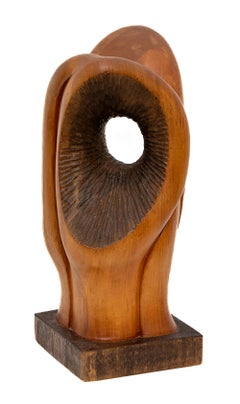
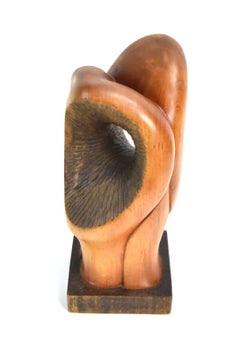
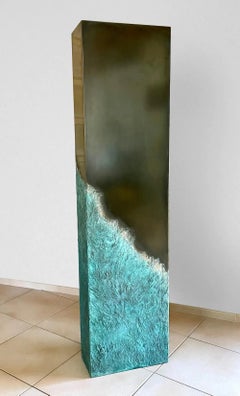
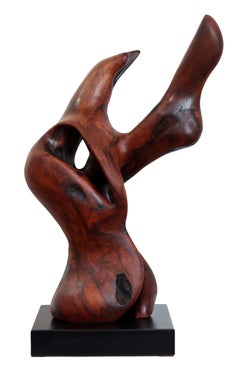
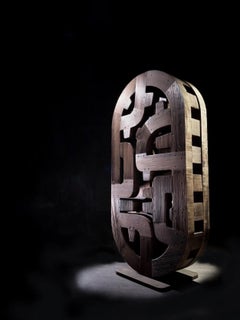
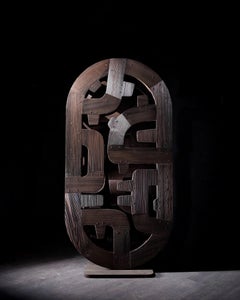
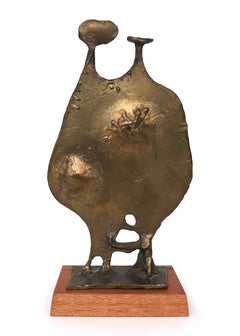
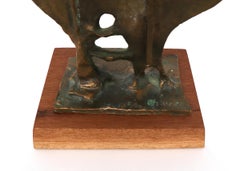
Although he spent the last 50 years of his professional career based in Woodstock, New York, he primarily drew upon the imagery of his native New Mexico and the Rocky Mountain West, where he had spent the first half of his life. In the summers he traveled to New Mexico, Utah and Colorado absorbing and sketching the landscape. It became the subject of his strong, bright abstract paintings with titles such as Mojave (Mojave Desert), Green River (Utah), Arroyo Hondo (near Taos, New Mexico), Chaco (Chaco Culture National Historical Park, New Mexico), Enchanted Mesa (near Acoma Pueblo, New Mexico), Ocaté (Chávez’s birthplace) and Gunnison (Black Canyon of the Gunnison, Colorado). Along with his post-war easel paintings, Chávez created several referentially abstract and abstract sculptures in bronze, steel and wood. One of his earliest pieces in this genre was a life-size bronze crucifix he fashioned in 1950 for the Episcopal Chapel in Woodstock. In the 1960s, he created several Abstract sculptures in black walnut, followed by largely Abstract bronzes during the following two decades. Some relate to ancient mythology, such as Icarus, while others are linked to specific geographical locations, such as Chama and Ocaté. Several bronzes explore Native American subjects, including Ouray (1977, 5 edition of 50). Referencing the 19th-century Ute Indian Chief Ouray who lived in southwest Colorado, it is a small standing piece with a slightly protruding shape in the center possibly alluding to an animal-skin Indian shield.
In 1977, Chávez sculpted a large standing totem, likewise titled Ouray, in black walnut. He treated the 19th-century mining town of Telluride, Colorado, which is a small bronze sculpture, Telluride III (c. 1980). He was inspired by the still-visible vestiges of the timber mining structures that began decaying in the mountains around the town following the 1893 Silver Crash and World War I. Chávez also was known as a fine craftsman for his unusual jewelry exhibited in the 1950s at the Woodstock Guild of Craftsmen. He also taught a class in jewelry making at the Guild as well as courses on the approach to design through materials in the 1960s. He likewise served as an instructor of drawing and painting at the Art Students League in New York (1954) and its summer school in Woodstock, New York (1955–58). He also was visiting professor of art at Colorado College in Colorado Springs (1959), assistant professor of art at Syracuse University in New York (1960–61) and instructor in art at Dutchess Community College in Poughkeepsie, New York (1963), and at the Albany Institute of Art in Albany, New York. He was Artist in Residence at the Huntington Museum of Art in West Virginia and lectured at Vassar College. He was an honorary member of the National Society of Mural Painters and served as chairman of the Woodstock Artists Association and a member of its Board of Trustees. A recipient of the Childe Hassam Purchase Award from the American Academy of Arts and Letters (1953), he also won the Albany Institute of Art Sculpture award (1965), and the Felton Sculpture award from the Silvermine Guild of Artists (1977). In recognition of his professional accomplishments, Chávez was made an Associate of the National Academy of Design in New York in 1970 and an Academician two years later.