Emil Crisand after Frederick Berger Art

to
3
Overall Width
to
Overall Height
to
3
3
3
1
1
1
1
1
1
3
3
9,958
2,750
1,376
1,369
Artist: Emil Crisand after Frederick Berger
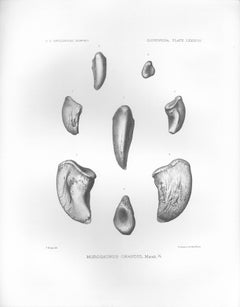
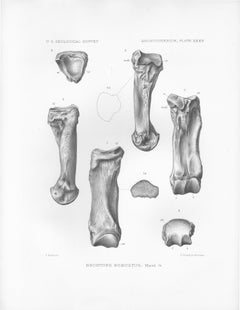
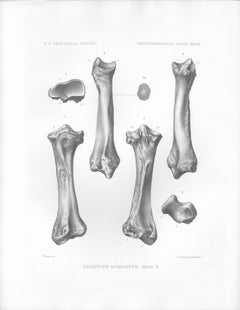
Brontops Robustus, antique Como Bluff dinosaur bone lithograph print
By Emil Crisand after Frederick Berger
Located in Melbourne, Victoria
'Brontops Robustus, Marsh 1/4' Lithograph by Emil Crisand after the drawing by Frederick Berger, under the supervision of Othniel Charles Marsh. Depicts dinosaur fossil...
Category

Late 19th Century Naturalistic Emil Crisand after Frederick Berger Art

Materials

Lithograph

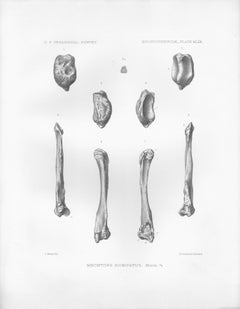
Brontops Robustus, antique Como Bluff dinosaur bone lithograph print
By Emil Crisand after Frederick Berger
Located in Melbourne, Victoria
'Brontops Robustus, Marsh 1/4' Lithograph by Emil Crisand after the drawing by Frederick Berger, under the supervision of Othniel Charles Marsh. Depicts dinosaur fossil...
Category

Late 19th Century Naturalistic Emil Crisand after Frederick Berger Art

Materials

Lithograph

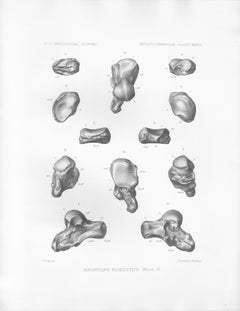
Brontops Robustus, antique Como Bluff dinosaur bone lithograph print
By Emil Crisand after Frederick Berger
Located in Melbourne, Victoria
'Brontops Robustus, Marsh 1/4' Lithograph by Emil Crisand after the drawing by Frederick Berger, under the supervision of Othniel Charles Marsh. Depicts dinosaur fossil...
Category

Late 19th Century Naturalistic Emil Crisand after Frederick Berger Art

Materials

Lithograph

Related Items
A Family of Moorhens & Lilly Pad: A 19th C. Hand-colored Lithograph by Gould
By John Gould and Henry Constantine Richter
Located in Alamo, CA
This is an original 19th century hand-colored folio-sized lithograph entitled "Gallinula Chloropus" (Moorhen) by John Gould, published in his "Birds of Great Britain", published in London between 1862 and 1873. The print, which was drawn by Gould and Henry Richter and lithographed by Walter & Cohn, depicts a family of Moorhens, including two adults and six babies in a beautiful landscape. The adults are in the water and the babies are lying on the leaves a flowering lilly pad. This striking Gould hand-colored moorhen family lithograph is augmented with gum-arabic paint. The sheet measures 14.88" high and 21.75" wide. It is in excellent condition, other than a spot in the upper portion of the right margin and two small spots at the edge of the lower margin on the left. The original descriptive text pages from Gould's 19th century publication are included. There are several other unframed Gould hummingbird lithographs available on our 1stdibs and InCollect storefronts. Two or more of these striking lithographs would make an attractive display grouping. A discount is available for purchase of a set depending on the number. These additional Gould hummingbirds may be viewed by typing Timeless Intaglio...
Category

Mid-19th Century Naturalistic Emil Crisand after Frederick Berger Art

Materials

Lithograph

Whaling – Vintage Monumental Zoology Lithograph
Located in Myrtle Beach, SC
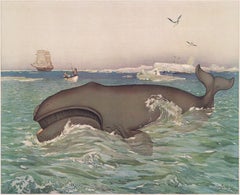
Joseph Fleischmann, 'Whaling' (Hartingers Wandtafeln: Zoologie T. XXXII), monumental vintage color lithograph, 1900. Signed in the matrix, lower right. A superb, beautifully nuanced impression, on cream wove paper, the full sheet with margins (1 1/2 to 2 3/16 inches), in very good condition. Sheet size 28 x 38 1/2 inches (711 x 978 mm). The full sheet, unmounted and unmatted—shipped carefully rolled and protected. Rendering by A. Berger after Joseph Fleischmann. Published by Carl Gerold’s Son, Vienna, 1900. This Artic whaling scene depicts a Greenland whale in the foreground pursued by whalers. A whaling ship is seen in the background and at right, another whale among icebergs with seagulls overhead. The print by Albert Berger...
Category

Early 1900s Naturalistic Emil Crisand after Frederick Berger Art
Materials

Lithograph

Black-throated Diver: Original 1st Edition Hand-colored Audubon Bird Lithograph
By John James Audubon
Located in Alamo, CA
This is an original rare and collectible first edition John James Audubon hand colored royal octavo lithograph entitled "Black-throated Diver", No. 96, Plate 477, from Audubon's "Bir...
Category

Mid-19th Century Naturalistic Emil Crisand after Frederick Berger Art
Materials

Lithograph

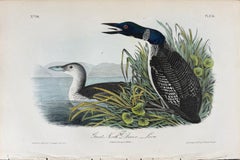
Great North Diver Bird: Original 19th C. 1st Ed. Audubon Hand-colored Lithograph
By John James Audubon
Located in Alamo, CA
This is an original rare and extremely collectible first edition John James Audubon hand-colored royal octavo lithograph entitled "Great North Diver or Loon", No. 96, Plate 476, from...
Category

Mid-19th Century Naturalistic Emil Crisand after Frederick Berger Art
Materials

Lithograph

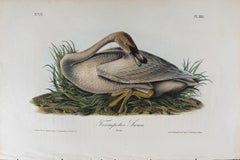
Trumpeter Swan: An Original 1st Edition Hand Colored Audubon Bird Lithograph
By John James Audubon
Located in Alamo, CA
This is an original rare and extremely collectible first edition John James Audubon hand-colored royal octavo lithograph entitled "Trumpeter Swan, Young", No. 77, Plate 383, from Aud...
Category

Mid-19th Century Naturalistic Emil Crisand after Frederick Berger Art
Materials

Lithograph

Rough-legged Buzzard: 19th C. Hand-colored Lithograph by J. Gould & Edward Lear
By Edward Lear
Located in Alamo, CA
This is an original 19th century hand-colored folio-sized lithograph entitled "Archibuteo Lagopus" (Rough-Legged Buzzard) by John Gould and Edward Lear, from Gould's "Birds of Great Britain", published in London between 1862 and 1873. The print depicts an adult Rough-Legged Buzzard perched on a branch of a tree looking to the left. This beautiful framed Gould hand-colored lithograph is presented in a gold-colored wood frame and cream-colored French mat, embellished by a gold-colored fillet. The frame measures 33" high, 25.5" wide and 1.25" thick. It is in excellent condition There are several other unframed Gould bird lithographs available on our 1stdibs and InCollect storefronts. Two or more of these striking lithographs would make an attractive display grouping. A discount is available for purchase of a set depending on the number. These additional Gould hummingbirds may be viewed by typing Timeless Intaglio in the 1stdibs or InCollect search field to be taken to our storefront. John Gould (1804-1881]) was an English ornithologist and artist. He, like his American contemporary John James Audubon, published a number of books on birds in the mid 19th century, illustrated by hand-colored lithographs. His wife and fellow artist, Elizabeth Gould, and several other artists including Edward Lear and Henry Constantine Richter produced lithographs for his various publications. He has been considered the father of bird study in Australia and the Gould League in Australia is named after him. Charles Darwin referenced Gould’s work in his book, "On the Origin of Species" and Gould named a bird after Darwin; "Darwin's finches". Gould began his career in London as a taxidermist, but in 1827 became the first curator and conservator at the museum of the Zoological Society of London. In this position naturalists brought him collections of birds from all over the world. He began creating drawings and eventually hand-colored lithographs with his wife and Edward Lear, which were the basis for his first publications. Darwin brought him specimens from the Galapagos Islands, including 12 species of finches which had never been described. In 1838, Gould and his wife travelled to Australia and their work led to the seven volume publication of “The Birds of Australia”. Gould had a fascination for hummingbirds and collected specimens of 320 varieties before ever seeing a live hummingbird on a trip to the United States in 1857. He eventually published “A Monograph of the Trochilidae, or Family of Humming-birds". Other large publications include: "The Birds of Europe"," A Monograph of the Ramphastidae, or Family of Toucans”, “A Synopsis of the Birds of Australia, and the Adjacent Islands”, “A Monograph of the Odontophorinae, or Partridges of America”, “The Birds of Asia”, “The Birds of Great Britain” and "The Birds of New Guinea and the Adjacent Papuan Islands, including many new species recently discovered in Australia". John Gould (1804-1881) was a British ornithologist and illustrator who is best known for his monumental work, "The Birds of Europe," published between 1832 and 1837. Gould was born in Lyme Regis, Dorset, England, and began working as a taxidermist and natural history dealer in London in the 1820s. In 1827, Gould was appointed the first curator and preserver of birds at the Zoological Society of London, where he began to build his collection of specimens and began to study the birds of the world. He published his first monograph, "A Century of Birds from the Himalaya Mountains," in 1831, which included 80 plates of Himalayan birds. Gould continued to publish numerous volumes on the birds of the world throughout his life, including "The Birds of Australia" (1840-1848) and "The Birds of Great Britain" (1862-1873). His works were highly regarded for their accuracy and detail, and he was one of the most prominent ornithologists of his time. In addition to his work as an ornithologist, Gould was also a successful businessman, and he used his profits to fund expeditions and to support the scientific community. He was elected a Fellow of the Royal Society in 1843, and he was awarded the Royal Medal...
Category

Mid-19th Century Naturalistic Emil Crisand after Frederick Berger Art
Materials

Lithograph

Curlew Bird and Charleston, SC: Original 1st Ed. Audubon Hand-colored Lithograph
By John James Audubon
Located in Alamo, CA
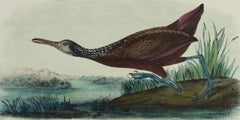
This is an original rare and extremely collectible first edition John James Audubon hand colored lithograph entitled "Long-billed Curlew", No. 71, Plate 355, from Audubon's "Birds of...
Category

Mid-18th Century Naturalistic Emil Crisand after Frederick Berger Art
Materials

Lithograph

Japan Australia's Overseas Airline Qantas original vintage travel poster
By Harry Rogers
Located in Spokane, WA
Original large format Qantas Japan Australia's Overseas Airline vintage travel poster. This antique poster is archival linen backed and in very fine condition. This image was al...
Category

1950s Naturalistic Emil Crisand after Frederick Berger Art
Materials

Lithograph

Nasiterna Pygmae
By John Gould
Located in Missouri, MO
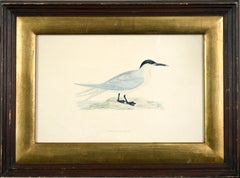
John Gould (British, 1804-1881) Nasiterna Pygmae c. 1849-1861 Hand Colored Lithograph Image Size: approx 19.5 x 13.5 inches Framed Size: 27 3/8 x 21 1/2 inches John Gould was an English ornithologist and bird artist. The Gould League in Australia was named after him. His identification of the birds now nicknamed "Darwin's finches" played a role in the inception of Darwin's theory of evolution by natural selection. Gould's work is referenced in Charles Darwin's book, On the Origin of Species. Gould was born in Lyme Regis, Dorset, the son of a gardener, and the boy probably had a scanty education. Shortly afterwards his father obtained a position on an estate near Guildford, Surrey, and then in 1818 became foreman in the Royal Gardens of Windsor. He was for some time under the care of J T Aiton, of the Royal Gardens of Windsor. The young Gould started training as a gardener, being employed under his father at Windsor from 1818 to 1824, and he was subsequently a gardener at Ripley Castle in Yorkshire. He became an expert in the art of taxidermy, and in 1824 he set himself up in business in London as a taxidermist, and his skill led to him becoming the first Curator and Preserver at the museum of the Zoological Society of London in 1827. Gould's position brought him into contact with the country's leading naturalists, and also meant that he was often the first to see new collections of birds given to the Society. In 1830 a collection of birds arrived from the Himalayas, many not previously described. Gould published these birds in A Century of Birds from the Himalaya Mountains (1830-1832). The text was by Nicholas Aylward Vigors, and the illustrations were lithographed by Gould's wife Elizabeth, daughter of Nicholas Coxen of Kent. This work was followed by four more in the next seven years including Birds of Europe in five volumes - completed in 1837, with the text written by Gould himself, edited by his clerk Edwin Prince. Some of the illustrations were made by Edward Lear as part of his Illustrations of the Family of Psittacidae in 1832. Lear however was in financial difficulty, and he sold the entire set of lithographs to Gould. The books were published in a very large size, imperial folio, with magnificent coloured plates. Eventually 41 of these volumes were published with about 3000 plates. They appeared in parts at £3 3s. a number, subscribed for in advance, and in spite of the heavy expense of preparing the plates, Gould succeeded in making his ventures pay and in realizing a fortune. In 1838 he and his wife moved to Australia to work on the Birds of Australia and shortly after his return to England, his wife died in 1841. When Charles Darwin presented his mammal and bird specimens collected during the second voyage of HMS Beagle to the Geological Society of London at their meeting on 4 January 1837, the bird specimens were given to Gould for identification. He set aside his paying work and at the next meeting on 10 January reported that birds from the Galápagos Islands, which Darwin had thought were blackbirds, "gross-bills" and finches were in fact "a series of ground Finches which are so peculiar" as to form "an entirely new group, containing 12 species." This story made the newspapers. In March, Darwin met Gould again, learning that his Galápagos "wren" was another species of finch and the mockingbirds he had labeled by island were separate species rather than just varieties, with relatives on the South American mainland. Subsequently Gould advised that the smaller southern Rhea specimen that had been rescued from a Christmas dinner...
Category

Mid-19th Century Naturalistic Emil Crisand after Frederick Berger Art
Materials

Lithograph

Bolivian Rainbow Hummingbirds: A Framed 19th C. Hand-colored Lithograph by Gould
By John Gould and Henry Constantine Richter
Located in Alamo, CA
This is an original framed 19th century hand-colored folio-sized lithograph entitled "Diphogena Aurora" (Bolivian Rainbow Hummingbirds) by John Gould, from his "Monograph of the Trochilidae, or Family of Hummingbirds", published in London in 1853. The print depicts two Bolivian Rainbow hummingbirds feeding on the nectar of small flowers on a branch. This striking framed Gould hand-colored lithograph is presented in a antiqued gold frame, a gold-colored fillet, and a light tan French mat, embellished with a mint-colored broad band. The frame measures 32" high, 25.5" wide and 1.25" thick. The hand-coloring is enhanced by the use of gum-arabic paint on the hummingbirds heads and necks, giving them an iridescent appearance. The descriptive text page from Gould's original publication is included. It is affixed to the back of the frame in a clear sleeve. The piece is in excellent condition. There are several other unframed Gould bird lithographs available on our 1stdibs and InCollect storefronts. Two or more of these striking lithographs would make an attractive display grouping. A discount is available for purchase of a set depending on the number. These additional Gould hummingbirds may be viewed by typing Timeless Intaglio in the 1stdibs or InCollect search field to be taken to our storefront. John Gould (1804-1881]) was an English ornithologist and artist. He, like his American contemporary John James Audubon, published a number of books on birds in the mid 19th century, illustrated by hand-colored lithographs. His wife and fellow artist, Elizabeth Gould, and several other artists including Edward Lear and Henry Constantine Richter produced lithographs for his various publications. He has been considered the father of bird study in Australia and the Gould League in Australia is named after him. Charles Darwin referenced Gould’s work in his book, "On the Origin of Species" and Gould named a bird after Darwin; "Darwin's finches". Gould began his career in London as a taxidermist, but in 1827 became the first curator and conservator at the museum of the Zoological Society of London. In this position naturalists brought him collections of birds from all over the world. He began creating drawings and eventually hand-colored lithographs with his wife and Edward Lear, which were the basis for his first publications. Darwin brought him specimens from the Galapagos Islands, including 12 species of finches which had never been described. In 1838, Gould and his wife travelled to Australia and their work led to the seven volume publication of “The Birds of Australia”. Gould had a fascination for hummingbirds and collected specimens of 320 varieties before ever seeing a live hummingbird on a trip to the United States in 1857. He eventually published “A Monograph of the Trochilidae, or Family of Humming-birds". Other large publications include: "The Birds of Europe"," A Monograph of the Ramphastidae, or Family of Toucans”, “A Synopsis of the Birds of Australia, and the Adjacent Islands”, “A Monograph of the Odontophorinae, or Partridges of America”, “The Birds of Asia”, “The Birds of Great Britain” and "The Birds of New Guinea and the Adjacent Papuan Islands, including many new species recently discovered in Australia". John Gould (1804-1881) was a British ornithologist and illustrator who is best known for his monumental work, "The Birds of Europe," published between 1832 and 1837. Gould was born in Lyme Regis, Dorset, England, and began working as a taxidermist and natural history dealer in London in the 1820s. In 1827, Gould was appointed the first curator and preserver of birds at the Zoological Society of London, where he began to build his collection of specimens and began to study the birds of the world. He published his first monograph, "A Century of Birds from the Himalaya Mountains," in 1831, which included 80 plates of Himalayan birds. Gould continued to publish numerous volumes on the birds of the world throughout his life, including "The Birds of Australia" (1840-1848) and "The Birds of Great Britain" (1862-1873). His works were highly regarded for their accuracy and detail, and he was one of the most prominent ornithologists of his time. In addition to his work as an ornithologist, Gould was also a successful businessman, and he used his profits to fund expeditions and to support the scientific community. He was elected a Fellow of the Royal Society in 1843, and he was awarded the Royal Medal...
Category

Mid-19th Century Naturalistic Emil Crisand after Frederick Berger Art
Materials

Lithograph

Barn Owl Family: A Framed Original 19th C. Hand-colored Lithograph by Gould
By John Gould and Henry Constantine Richter
Located in Alamo, CA
This is a framed original 19th century hand-colored folio-sized lithograph entitled “Strix Flammea” (Barn Owl) by John Gould, from his "Birds of Great Britain", published in London between 1862 and 1873. The print depicts an adult Barn Owl perched on a log its three baby owls to the left. Another adult owl in the background on the right, presumably a male, watches over his family. There are leaves on the right contributing to this pleasant landscape composition. This striking framed Gould...
Category

Mid-19th Century Naturalistic Emil Crisand after Frederick Berger Art
Materials

Lithograph

Honey Buzzard Bird: A Framed Original 19th C. Hand-colored Lithograph by Gould
By John Gould and Henry Constantine Richter
Located in Alamo, CA
This is a framed original 19th century hand-colored folio-sized lithograph entitled “Pernis Apivorus (The Honey Buzzard) by John Gould, plate 6 in volume 1 of his "Birds of Great Britain", published in London between 1862 and 1873. The print depicts an adult Honey Buzzard perched on a branch of a leafy tree in the foreground and three others in the background. The bird in the foreground has an insect in its beak and others are in flight on the right This striking framed Gould...
Category

Mid-19th Century Naturalistic Emil Crisand after Frederick Berger Art
Materials

Lithograph

Previously Available Items
Brontops Robustus, antique Como Bluff dinosaur bone lithograph print
By Emil Crisand after Frederick Berger
Located in Melbourne, Victoria
'Brontops Robustus, Marsh 1/4' Lithograph by Emil Crisand after the drawing by Frederick Berger, under the supervision of Othniel Charles Marsh. Depicts dinosaur fossil...
Category

Late 19th Century Naturalistic Emil Crisand after Frederick Berger Art
Materials

Lithograph

Brontops Robustus, antique Como Bluff dinosaur bone lithograph print
By Emil Crisand after Frederick Berger
Located in Melbourne, Victoria
'Brontops Robustus, Marsh 1/4' Lithograph by Emil Crisand after the drawing by Frederick Berger, under the supervision of Othniel Charles Marsh. Depicts dinosaur fossil...
Category

Late 19th Century Naturalistic Emil Crisand after Frederick Berger Art
Materials

Lithograph

Emil Crisand After Frederick Berger art for sale on 1stDibs.

Find a wide variety of authentic Emil Crisand after Frederick Berger art available for sale on 1stDibs. You can also browse by medium to find art by Emil Crisand after Frederick Berger in lithograph and more. Not every interior allows for large Emil Crisand after Frederick Berger art, so small editions measuring 12 inches across are available. Emil Crisand after Frederick Berger art prices can differ depending upon medium, time period and other attributes. On 1stDibs, the price for these items starts at $150 and tops out at $150, while the average work can sell for $150.

Recently Viewed

View All