Emil Crisand after Frederick Berger Art

to
3
Overall Width
to
Overall Height
to
3
3
3
1
1
1
1
1
1
3
3
10,917
2,844
2,494
1,424
Artist: Emil Crisand after Frederick Berger
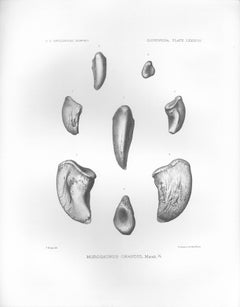
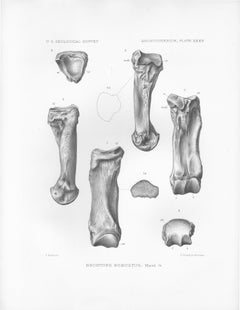
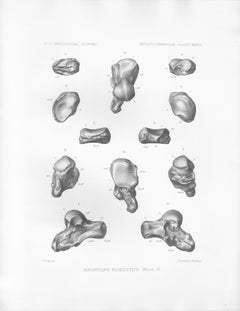
Brontops Robustus, antique Como Bluff dinosaur bone lithograph print

Brontops Robustus, antique Como Bluff dinosaur bone lithograph print

By Emil Crisand after Frederick Berger

Located in Melbourne, Victoria

'Brontops Robustus, Marsh 1/4' Lithograph by Emil Crisand after the drawing by Frederick Berger, under the supervision of Othniel Charles Marsh. Depicts dinosaur fossil...

Category

Late 19th Century Naturalistic Emil Crisand after Frederick Berger Art

Materials

Lithograph
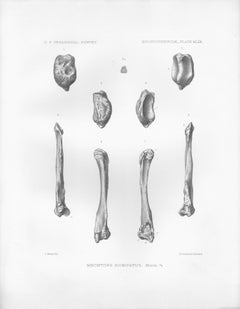
Brontops Robustus, antique Como Bluff dinosaur bone lithograph print

Brontops Robustus, antique Como Bluff dinosaur bone lithograph print

By Emil Crisand after Frederick Berger

Located in Melbourne, Victoria

'Brontops Robustus, Marsh 1/4' Lithograph by Emil Crisand after the drawing by Frederick Berger, under the supervision of Othniel Charles Marsh. Depicts dinosaur fossil...

Category

Late 19th Century Naturalistic Emil Crisand after Frederick Berger Art

Materials

Lithograph
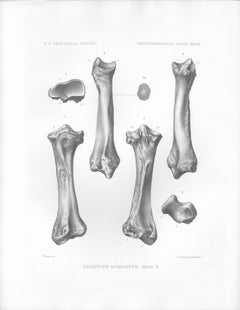
Brontops Robustus, antique Como Bluff dinosaur bone lithograph print

Brontops Robustus, antique Como Bluff dinosaur bone lithograph print

By Emil Crisand after Frederick Berger

Located in Melbourne, Victoria

'Brontops Robustus, Marsh 1/4' Lithograph by Emil Crisand after the drawing by Frederick Berger, under the supervision of Othniel Charles Marsh. Depicts dinosaur fossil...

Category

Late 19th Century Naturalistic Emil Crisand after Frederick Berger Art

Materials

Lithograph
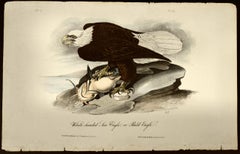
Related Items
Red-breasted Merganser: An Original 19th C. Audubon Hand-colored Bird Lithograph

Red-breasted Merganser: An Original 19th C. Audubon Hand-colored Bird Lithograph

By John James Audubon

Located in Alamo, CA

This is an original John James Audubon hand-colored lithograph entitled "Red-breasted Merganser, 1. Male 2. Female", No. 83, Plate 412 from Audubon's "Birds of America, lithographed,...

Category

Late 19th Century Naturalistic Emil Crisand after Frederick Berger Art

Materials

Lithograph
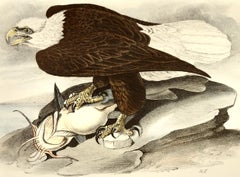
Phasianus colchicus
Phasianus colchicus

Phasianus colchicus

By Joseph Wolf

Located in Columbia, MO

Joseph Wolf Lithograph c.1940

Category

Mid-20th Century Naturalistic Emil Crisand after Frederick Berger Art

Materials

Lithograph

Green Painted Sea Shell Lithograph Edition 33 of 34

Green Painted Sea Shell Lithograph Edition 33 of 34

By Frances Nail

Located in Houston, TX

Green shell lithograph of a cone shell. Print is edition 33 of 34. Signed and dated by the artist along with titled. Print is framed in a golden frame...

Category

1970s Naturalistic Emil Crisand after Frederick Berger Art

Materials

Lithograph

Phasianus torquatus
Phasianus torquatus

Phasianus torquatus

By Joseph Wolf

Located in Columbia, MO

Joseph Wolf Lithograph c.1940

Category

Mid-20th Century Naturalistic Emil Crisand after Frederick Berger Art

Materials

Lithograph

Snowy Owl
Snowy Owl

Snowy Owl

By John James Audubon

Located in Columbia, MO

John James Audubon was born in Haiti in 1785. Most of his childhood was spent in France, where he first took interest in birds and drawing. He came to the U.S. at age 18, and made ma...

Category

1840s Naturalistic Emil Crisand after Frederick Berger Art

Materials

Lithograph

Japan Australia's Overseas Airline Qantas original vintage travel poster

Japan Australia's Overseas Airline Qantas original vintage travel poster

By Harry Rogers

Located in Spokane, WA

Original large format Qantas Japan Australia's Overseas Airline vintage travel poster. This antique poster is archival linen backed and in very fine condition. This image was al...

Category

1950s Naturalistic Emil Crisand after Frederick Berger Art

Materials

Lithograph

The Birds of America "Bell's Vireo" Plate 485

The Birds of America "Bell's Vireo" Plate 485

By John James Audubon

Located in Columbia, MO

Hand-colored lithograph 1st ed. Royal Octavo Master printer: J.T. Bowen John James Audubon was born in Haiti in 1785. Most of his childhood was spent in ...

Category

1840s Naturalistic Emil Crisand after Frederick Berger Art

Materials

Lithograph

A Lying Animal - Original Lithograph by F. Specht - 1880

A Lying Animal - Original Lithograph by F. Specht - 1880

By Friedrich Specht 1

Located in Roma, IT

A Lying Animal is a black and white print realized by Friedrich Specht in 1880. Lithograph on dark paper. Original Title: Derendet. Dated 1880, p.24. Signed by the artist on the r...

Category

1870s Naturalistic Emil Crisand after Frederick Berger Art

Materials

Lithograph

Cangaroos in Danger - Lithograph by F. Specht - 1879

Cangaroos in Danger - Lithograph by F. Specht - 1879

By Friedrich Specht 1

Located in Roma, IT

Cangaroos in Danger is a black and white lithograph realized by Friedrich Specht in 1879. Image dimensions: 19,7 x 13,7 cm. Original Title: Am Auftralifchen "Bufch". Dated 1879 an...

Category

1870s Naturalistic Emil Crisand after Frederick Berger Art

Materials

Lithograph

Nasiterna Bruijni
Nasiterna Bruijni

Nasiterna Bruijni

By John Gould

Located in Missouri, MO

John Gould (British, 1804-1881) Nasiterna Bruijni c. 1849-1861 Hand Colored Lithograph Image Size: approx 19.5 x 13.5 inches Framed Size: 27 3/8 x 21 1/2 inches John Gould was an English ornithologist and bird artist. The Gould League in Australia was named after him. His identification of the birds now nicknamed "Darwin's finches" played a role in the inception of Darwin's theory of evolution by natural selection. Gould's work is referenced in Charles Darwin's book, On the Origin of Species. Gould was born in Lyme Regis, Dorset, the son of a gardener, and the boy probably had a scanty education. Shortly afterwards his father obtained a position on an estate near Guildford, Surrey, and then in 1818 became foreman in the Royal Gardens of Windsor. He was for some time under the care of J T Aiton, of the Royal Gardens of Windsor. The young Gould started training as a gardener, being employed under his father at Windsor from 1818 to 1824, and he was subsequently a gardener at Ripley Castle in Yorkshire. He became an expert in the art of taxidermy, and in 1824 he set himself up in business in London as a taxidermist, and his skill led to him becoming the first Curator and Preserver at the museum of the Zoological Society of London in 1827. Gould's position brought him into contact with the country's leading naturalists, and also meant that he was often the first to see new collections of birds given to the Society. In 1830 a collection of birds arrived from the Himalayas, many not previously described. Gould published these birds in A Century of Birds from the Himalaya Mountains (1830-1832). The text was by Nicholas Aylward Vigors, and the illustrations were lithographed by Gould's wife Elizabeth, daughter of Nicholas Coxen of Kent. This work was followed by four more in the next seven years including Birds of Europe in five volumes - completed in 1837, with the text written by Gould himself, edited by his clerk Edwin Prince. Some of the illustrations were made by Edward Lear as part of his Illustrations of the Family of Psittacidae in 1832. Lear however was in financial difficulty, and he sold the entire set of lithographs to Gould. The books were published in a very large size, imperial folio, with magnificent coloured plates. Eventually 41 of these volumes were published with about 3000 plates. They appeared in parts at £3 3s. a number, subscribed for in advance, and in spite of the heavy expense of preparing the plates, Gould succeeded in making his ventures pay and in realizing a fortune. In 1838 he and his wife moved to Australia to work on the Birds of Australia and shortly after his return to England, his wife died in 1841. When Charles Darwin presented his mammal and bird specimens collected during the second voyage of HMS Beagle to the Geological Society of London at their meeting on 4 January 1837, the bird specimens were given to Gould for identification. He set aside his paying work and at the next meeting on 10 January reported that birds from the Galápagos Islands, which Darwin had thought were blackbirds, "gross-bills" and finches were in fact "a series of ground Finches which are so peculiar" as to form "an entirely new group, containing 12 species." This story made the newspapers. In March, Darwin met Gould again, learning that his Galápagos "wren" was another species of finch and the mockingbirds he had labeled by island were separate species rather than just varieties, with relatives on the South American mainland. Subsequently Gould advised that the smaller southern Rhea specimen that had been rescued from a Christmas dinner...

Category

1850s Naturalistic Emil Crisand after Frederick Berger Art

Materials

Lithograph

Nasiterna Pygmae
Nasiterna Pygmae

Nasiterna Pygmae

By John Gould

Located in Missouri, MO

John Gould (British, 1804-1881) Nasiterna Pygmae c. 1849-1861 Hand Colored Lithograph Image Size: approx 19.5 x 13.5 inches Framed Size: 27 3/8 x 21 1/2 inches John Gould was an English ornithologist and bird artist. The Gould League in Australia was named after him. His identification of the birds now nicknamed "Darwin's finches" played a role in the inception of Darwin's theory of evolution by natural selection. Gould's work is referenced in Charles Darwin's book, On the Origin of Species. Gould was born in Lyme Regis, Dorset, the son of a gardener, and the boy probably had a scanty education. Shortly afterwards his father obtained a position on an estate near Guildford, Surrey, and then in 1818 became foreman in the Royal Gardens of Windsor. He was for some time under the care of J T Aiton, of the Royal Gardens of Windsor. The young Gould started training as a gardener, being employed under his father at Windsor from 1818 to 1824, and he was subsequently a gardener at Ripley Castle in Yorkshire. He became an expert in the art of taxidermy, and in 1824 he set himself up in business in London as a taxidermist, and his skill led to him becoming the first Curator and Preserver at the museum of the Zoological Society of London in 1827. Gould's position brought him into contact with the country's leading naturalists, and also meant that he was often the first to see new collections of birds given to the Society. In 1830 a collection of birds arrived from the Himalayas, many not previously described. Gould published these birds in A Century of Birds from the Himalaya Mountains (1830-1832). The text was by Nicholas Aylward Vigors, and the illustrations were lithographed by Gould's wife Elizabeth, daughter of Nicholas Coxen of Kent. This work was followed by four more in the next seven years including Birds of Europe in five volumes - completed in 1837, with the text written by Gould himself, edited by his clerk Edwin Prince. Some of the illustrations were made by Edward Lear as part of his Illustrations of the Family of Psittacidae in 1832. Lear however was in financial difficulty, and he sold the entire set of lithographs to Gould. The books were published in a very large size, imperial folio, with magnificent coloured plates. Eventually 41 of these volumes were published with about 3000 plates. They appeared in parts at £3 3s. a number, subscribed for in advance, and in spite of the heavy expense of preparing the plates, Gould succeeded in making his ventures pay and in realizing a fortune. In 1838 he and his wife moved to Australia to work on the Birds of Australia and shortly after his return to England, his wife died in 1841. When Charles Darwin presented his mammal and bird specimens collected during the second voyage of HMS Beagle to the Geological Society of London at their meeting on 4 January 1837, the bird specimens were given to Gould for identification. He set aside his paying work and at the next meeting on 10 January reported that birds from the Galápagos Islands, which Darwin had thought were blackbirds, "gross-bills" and finches were in fact "a series of ground Finches which are so peculiar" as to form "an entirely new group, containing 12 species." This story made the newspapers. In March, Darwin met Gould again, learning that his Galápagos "wren" was another species of finch and the mockingbirds he had labeled by island were separate species rather than just varieties, with relatives on the South American mainland. Subsequently Gould advised that the smaller southern Rhea specimen that had been rescued from a Christmas dinner...

Category

Mid-19th Century Naturalistic Emil Crisand after Frederick Berger Art

Materials

Lithograph

Superb Craspedophora Alberti Bird lithographed by the ornithologists Gould

Superb Craspedophora Alberti Bird lithographed by the ornithologists Gould

By John and Elizabeth Gould

Located in Milan, IT

This plate is unique because of the bird species' unmistakable beauty and the great scientific and artistic skill with which Elisabeth and Jhon Gould rendered it. The price quoted h...

Category

Late 19th Century Naturalistic Emil Crisand after Frederick Berger Art

Materials

Lithograph
Previously Available Items
Brontops Robustus, antique Como Bluff dinosaur bone lithograph print

Brontops Robustus, antique Como Bluff dinosaur bone lithograph print

By Emil Crisand after Frederick Berger

Located in Melbourne, Victoria

'Brontops Robustus, Marsh 1/4' Lithograph by Emil Crisand after the drawing by Frederick Berger, under the supervision of Othniel Charles Marsh. Depicts dinosaur fossil...

Category

Late 19th Century Naturalistic Emil Crisand after Frederick Berger Art

Materials

Lithograph
Brontops Robustus, antique Como Bluff dinosaur bone lithograph print

Brontops Robustus, antique Como Bluff dinosaur bone lithograph print

By Emil Crisand after Frederick Berger

Located in Melbourne, Victoria

'Brontops Robustus, Marsh 1/4' Lithograph by Emil Crisand after the drawing by Frederick Berger, under the supervision of Othniel Charles Marsh. Depicts dinosaur fossil...

Category

Late 19th Century Naturalistic Emil Crisand after Frederick Berger Art

Materials

Lithograph
Emil Crisand After Frederick Berger art for sale on 1stDibs.

Find a wide variety of authentic Emil Crisand after Frederick Berger art available for sale on 1stDibs. You can also browse by medium to find art by Emil Crisand after Frederick Berger in lithograph and more. Not every interior allows for large Emil Crisand after Frederick Berger art, so small editions measuring 12 inches across are available. Emil Crisand after Frederick Berger art prices can differ depending upon medium, time period and other attributes. On 1stDibs, the price for these items starts at $150 and tops out at $150, while the average work can sell for $150.