By Edouard Dammouse, Ernest Chaplet
Located in Palm Beach, FL
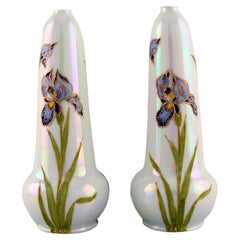
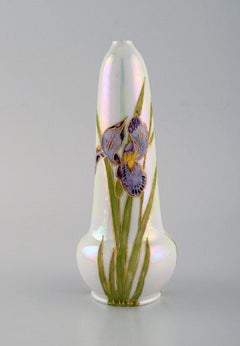
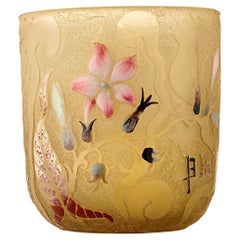
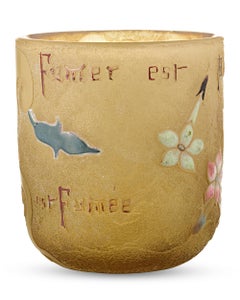
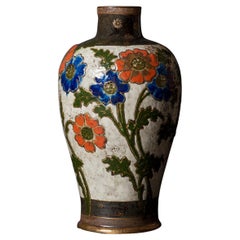
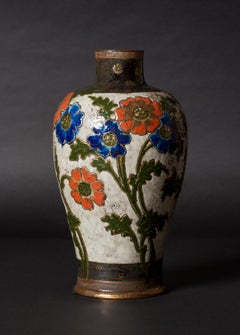
Poppies, golden-accented in analagous colors of blue and orange, creep up their leafy green stalks which sag from the heavy weight of the flowers. Like tired heavy-lidded eyes, the poppies symbolize hypnos’ sleep-inducing effects. Dammouse’s somnific symbolism evokes an other-worldly dream-like state and acts as a vehicle to tap into the imagination. Much more than a pretty face, or a pretty vase, this is a sublime piece of art, and Dammouse makes clear the influence of Braquemond and others by employing this Symbolist style. Beaudelaire’s credo that “Beauty must contain the absolute and the particular, the eternal and the transitory” aptly applies. Created while both Chaplet and Edouard Dammouse were employed by Haviland & Co. at its Paris location, this vase is a prime example of Chaplet’s early creative output of matte brown stoneware. Both artists demonstrate a strong link and affinity for Japonisme in the vase’s traditional form and in the painterly approach Dammouse brings to the enamel glaze. His treatment of enhancing the floral decoration with gold detailing calls to mind Kintsugi aesthetic principles. Affixed to the vase’s underside is its original label indicating it was sold at the chic A la Paix, a Parisian gallery located on the prestigious Avenue de l’Opera which opened in 1891, specializing in glass and ceramic objects of art.
Ernest Chaplet (1835-1907) Not only was Chaplet France’s premier studio ceramist, the example he set of personally creating a ceramic object from the conceptual phase through modeling, firing and glazing - constantly reaching for new and innovative modes of expression and technique - elevated the notion of a ceramist from artisan to Artist. While Director of Production for Haviland & Co., Chaplet expanded their focus from porcelain into stoneware production and developed the barbotine method of painting earthenware with liquid clay as well as conducted extensive research in glaze techniques. He was awarded a Gold Medal in 1889 at Paris’ l’Exposition Universelle for his revolutionary sang de boeuf glaze. That same year, Chaplet opened his own atelier in Choisy-le-Roi where he continued to produce avant-garde stoneware and support younger talent.
Edouard Dammouse (1850-1903) Trained as a painter, Paris born Edouard Dammouse studied under Felix Bracquemond, Ernest Chaplet’s predecessor at Haviland & Co.‘s Auteuil studio. Edouard followed his brother, Albert, and Chaplet to Haviland’s Paris...
Category
1890s French Art Nouveau Antique Ernest Chaplet Furniture