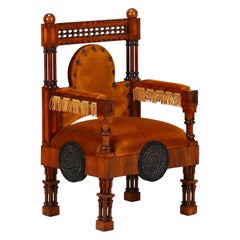
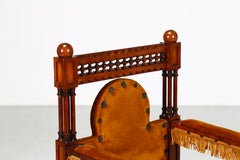
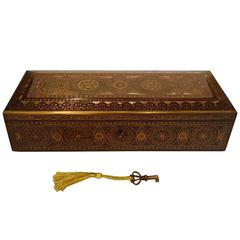
By Eugenio Quarti
Located in Madrid, ES
Eugenio Quarti 1867-1929
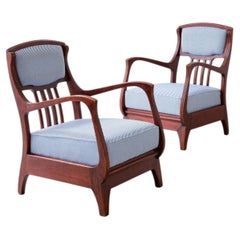
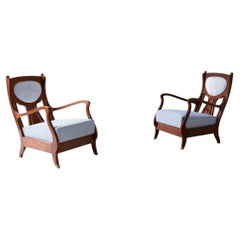
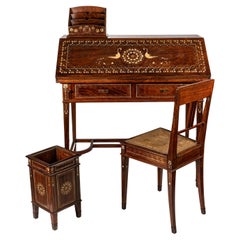
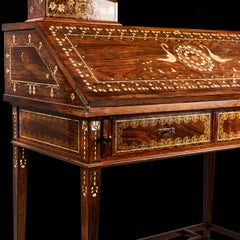
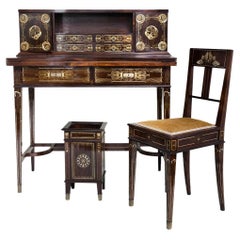
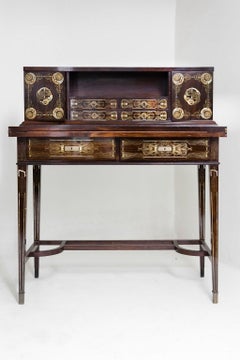
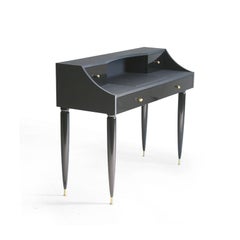
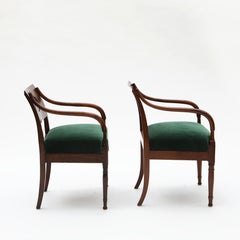
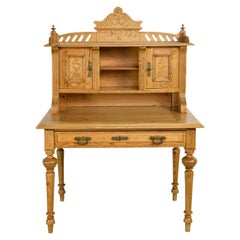
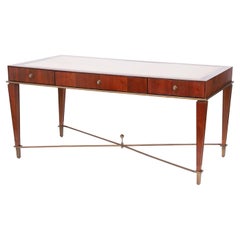
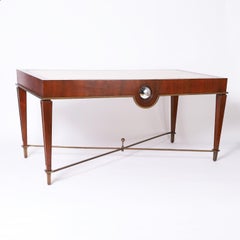
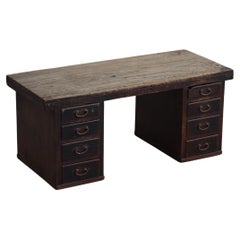
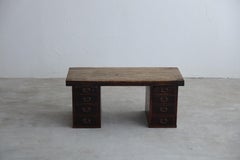
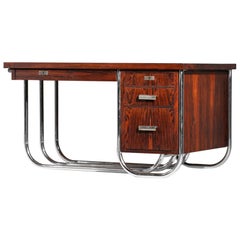
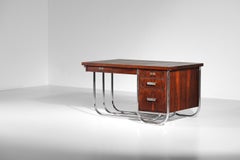
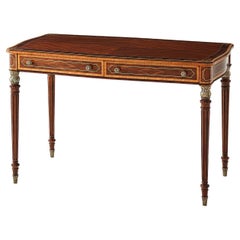
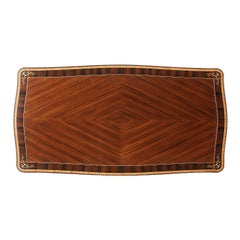
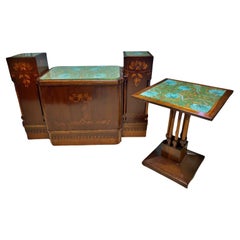
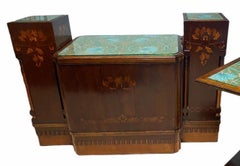
desk with twin table decorated with floral inlays
Eugenio Quarti, "prince of cabinetmakers", was born in 1867 in Villa d'Almè, a small town in the province of Bergamo, to a family dedicated to wood crafts.
Bruno Munari At the age of 14, his father sent him to Paris, where he worked as an apprentice in a cabinet-making workshop. At the end of the 1980s, dell'800 returned to Italy and settled in Milan, where he worked, for a short time, with Carlo Bugatti.
In the same year, he will open his own workshop in via Donizetti.
The first pieces of furniture they draw and produce are clearly derived from Bugattiana.
Vittore Grubicy de DragonDal 1894, the year in which he participated in the international exhibition in Antwerp and in the international workers' exhibition in Milan, in 1898 Eugenio Quarti developed a personal idea of ??modernist furniture, thanks also to the spurs of Vittore Grubicy, freeing himself definitely from the stylistic heritage of Bugattian and find new ways to define a totally personal style. In the same year he participated in the Turin exhibition featuring predominantly dark wood modernist furniture decorated with "inlays" of metal, ivory, tortoise and mother-of-pearl; he is now totally free from the stylistic elements of the past, establishing himself as an artist with a unique and formed personality.
Precious wood furnishings such as teak, mahogany, rosewood, maracaibo, walnut, natural or stained maple are enriched with subtle inlays, metallic strands and precious materials, distributed to follow and highlight profiles. Inside which decorative motifs of stylized plants or animals are inserted.
In 1900 he participated in the international exhibition in Paris, where he received the coveted "Grand Prix" jury prize.
Launched with undisputed success, he sees that his clientele is growing more and more within the aristocracy and upper bourgeoisie; The furniture produced is increasingly luxurious and very expensive.
Once the workshop in via Donizetti remains, he opens a new one of 100 square meters in via Palermo, where he remains until 1904.
From this moment on, Eugenio Quarti, who produces exclusively isolated pieces to be included in already finished furniture contexts, begins a production aimed at creating complete environments that are often complex and grandiose.
At the end of 1904, Quarti moved to a new factory designed by Luigi Conconi, in Carlo Poma street. Here, gradually and in a typical business perspective of the moment, from the beginning to a production that establishes the objective of a progressive expansion of customers; He proposes, along with luxurious and precious furniture, also a more economical and mass production.
From 1906 he introduced geometric elements in the decorations, light and dark chessboard inlays and hemispheres in wood or glass with a clear Viennese allusion. After the first decade of the century are the furniture for important Milanese houses and the Camparino bar in the Galleria Vittorio Veneto II, where, in 1923, he will replace the old furniture still linked to the Empire style with his furniture. A deep and significant restyling operation that he sees a close collaboration with Angiolo d'Andrea and Alessandro Mazzuccotelli.
He died six years later, leaving the management of the company to his son Mario (1901-1974), who inherited the company from his father and restructured it. In the 30s of the 900s, the "Quarti - Mobili d'arte" will have about 200 employees.
Undoubtedly, Eugenio Quarti, one of the great Italian cabinetmakers of the 20th century, worked with the most prestigious architects of his time.
Giuseppe Sommaruga, Luigi Broggi, Alfredo Campanini, just to name a few.
He also worked as a decorator, designing complete furniture for public and private buildings. It was he who designed the furniture for the Palazzo Castiglioni in Milan, the Villa Carosio in Baveno, the Grand Hotel and Casinò in San Pellegrino Terme, and the Hungaria Palace Hotel on the Lido in Venice. However, he also disdained less important orders such as the furniture for the Villa Mariani in Bordighera, the residence of the painter Pompeo Mariani...
Category
Late 19th Century Italian Art Deco Antique Furniture