Fanny Rabel Paintings

to
1
Overall Width
to
Overall Height
to
1
1
1
1
1
1
1
1
2
757
752
732
671
1
1
Artist: Fanny Rabel
Fanny Rabel Figurative Oil Painting Soulful, Prayerful

Fanny Rabel Figurative Oil Painting Soulful, Prayerful

By Fanny Rabel

Located in Detroit, MI

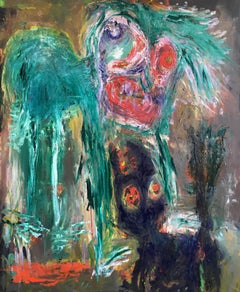
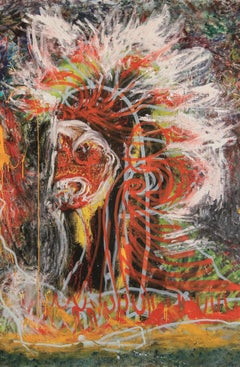
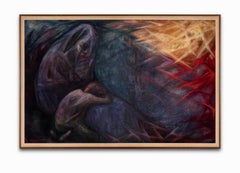
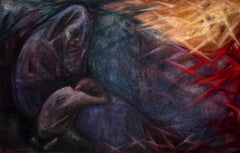
SALE ONE WEEK ONLY UNTITLED by Fanny Rabel a Mexican artist who was born in Poland in 1922 is a soul wrenching work depicting among other things, the children killed by Nazi bombing in Spain during the Second World War. The lavender and purple surrounding the seated female figure and the kneeling child suggest both grief for the innocents' deaths and the prayers being offered for an end to the carnage. The bright gold and red can be read as either explosions or the hopeful light of redemption after death. Like Picasso's Guernica from 1937, this painting from 1965 can stand as a powerful anti-war statement. Numerous key galleries and museums such as Morton Auctions, Cerro de Mayka have featured Fanny Rabel's work in the past. Her anti-Nazi and anti-Fascism politics resulted in her participation in a mural called Retrato de la Burguesía in 1940 for the Sindicato Mexicano de Electricistas building on Alfonso Caso Street in Mexico City. Rabel met a group of exiled Spaniards in Mexico along with Antonio Pujol, who invited her to take part in a mural project headed by him, David Alfaro Siqueiros, Joseph Renau, Luis Arenal, Antonio Rodríguez Luna and Miguel Prieto. The artist died in 2008. Fanny Rabel born August 27, 1922, in Poland born Fanny Rabinovich, was a Polish-born Mexican artist who is considered to be the first modern female muralist and one of the youngest associated with the Mexican muralism of the early to the mid-20th century. She and her family arrived in Mexico in 1938 from Europe and she studied art at the Escuela Nacional de Pintura, Escultura y Grabado "La Esmeralda", where she met and became friends with Frida Kahlo. She became the only female member of “Los Fridos” a group of students under Kahlo’s tutelage. She also worked as an assistant and apprentice to Diego Rivera and David Alfaro Siqueiros, painting several murals of her own during her career. The most significant of these is "Ronda en el tiempo" at the Museo Nacional de Antropología in Mexico City. She also created canvases and other works, with children often featured in her work, and was one of the first of her generation to work with ecological themes in a series of works begun in 1979. She is considered to be the first female muralist in Mexico. She was an assistant to Diego Rivera while he worked on the frescos for the National Palace and an apprentice to David Alfaro Siqueiros. Her most important mural is Ronda en el tiempo located in the Museo Nacional de Antropología, which was created from 1964 to 1965. She also created murals at the Unidad de Lavaderos Público de Tepalcatitlán (1945), Sobrevivencia, Alfabetización in Coyoacán in 1952 Sobrevivencia de un pueblo at the Centro Deportivo Israelita (1957) Hacia la salud for the Hospital Infantil de México (1982), La familia mexicana at the Registro Público de la Propiedad (1984) (which Rabel preferred to title Abolición de la propiedad privada) and at the Imprenta Artgraf. In collaboration with other artists, she participated in the creation of the murals at the La Rosita pulque bar (disappeared) and at the Casa de la Madre Soltera. She entered the Escuela Nacional de Pintura, Escultura y Grabado "La Esmeralda" shortly after it was established in 1942, taking classes with José Chávez Morado, Feliciano Peña and Frida Kahlo, with whom she became close friends. She changed her last name from Rabinovich to Rabel during her career. Rabel married urologist Jaime Woolrich and had two children Abel and Paloma Woolrich, both of whom became actors. The first exhibition of her work was in 1945 with twenty-four oils, thirteen drawings, and eight engravings at the Liga Popular Israelita with Frida Kahlo writing the presentation. In 1955, she had an individual exhibition at the Salón de la Plástica Mexicana. She had a large exhibition at the Museum of the Palacio de Bellas Artes to commemorate a half-century of her work. Her last exhibition was in 2007 at the Universidad Autónoma Metropolitana. Her work can be found in collections in over fifteen countries including those of the New York Public Library, the Library of Congress in Washington, D.C., the Royal Academy of Denmark, the National Library in Paris, the Casa de las Américas in Havana, the Benemérita Universidad Autónoma de Puebla and the Museo de Arte Moderno in Mexico City. A retrospective of her work after her death called Retrospectiva in Memoriam, Fanny Rabel (1922-2008) was held at the Museum of the Universidad Popular Autónoma del Estado de Puebla . She is considered to be the first modern female muralist in Mexico although she also did significant work in painting, engraving, drawing, and ceramic sculpture. Her work has been classified as poetic Surrealism, Neo-expressionism and is also considered part of the Escuela Mexicana de Pintura (the dominant art movement of the early to mid 20th century in Mexico) as one of the youngest muralists to be associated with it along with Arnold Belkin and José Hernández Delga. Rabel was more drawn to depicting mankind’s pain rather than happiness, sharing other Mexican muralists' concerns about social injustice. However, she stated to Leopoldo Méndez that she could not create combative works, with clenched fists and fierce faces, and she wanted to leave the Taller de Gráfica Popular. Méndez convinced her to stay, saying that more tender images are important to political struggle as well. Children with Mexican faces...

Category

1960s Expressionist Fanny Rabel Paintings

Materials

Oil, Canvas

Related Items
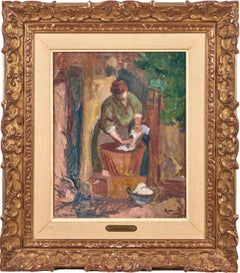
Maximilien Luce (French, 1858-1941) Femme Lavant le Linge

Maximilien Luce (French, 1858-1941) Femme Lavant le Linge

By Maximilien Luce

Located in Dallas, TX

MAXIMILIEN LUCE (French, 1858-1941) Femme Lavant le Linge Estate stamped signature 'Luce' (lower right) Oil on canvas Canvas: 16 1/4 x 13 in. (41.3 x 33.0 cm) framed: 25 1/4 x 22 x 1...

Category

1890s Expressionist Fanny Rabel Paintings

Materials

Canvas, Oil

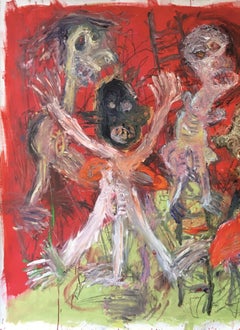
Parnassus madness-Julien Wolf, 21st Century, Contemporary Expressionist Painting

Parnassus madness-Julien Wolf, 21st Century, Contemporary Expressionist Painting

By Julien Wolf

Located in Paris, FR

Oil on canvas 2018 Signed Unique work Julien Wolf is a French painter born in 1981 in Strasbourg, France. In 2007, he graduated from the DNSEP Art section at the Strasbourg Decora...

Category

2010s Expressionist Fanny Rabel Paintings

Materials

Canvas, Oil

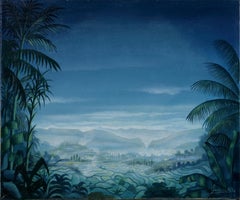
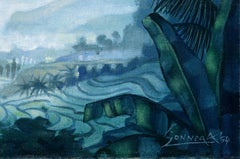
Sawah Landscape
Sawah Landscape

Auke SonnegaSawah Landscape, 1954

$21,607

H 19.89 in W 23.82 in D 1.97 in

Sawah Landscape

Located in Amsterdam, NL

A sawah landscape, Sumatra Signed and dated 'Sonnega '54' (lower right), and annotated 'Voor Jan de Bas 1-1-1970 / R de Bas' (on the reverse) oil on canvas, 50,5x60,5 cm Provenance: - Collection Pieter de Bas (1909-1979) Mr de Bas was head of the MULO school and acting head of the HBS school in Medan. Thence by descent to the present owner. Exhibited: - Hotel de Boer, Medan 1954, where acquired by the first owner. The light I observed everywhere was of a special quality, fluorescent blue, shone from nowhere but radiated from every point, oddly with great depth and intensity. The light in an entirely different dimension came from nowhere and went nowhere shimmering with the glow of a bright blue jewel. The most important thing I discovered was of being omnipresent and able to understand everything at the same time, yes I could fathom creation completely. Auke Sonnega, born March 9, 1910 in Leeuwarden, known as the painter, primarily of young Balinese men and women. Originally raised in the reformed denomination, the parents of Auke apparently practised theosophy and their children, including Auke were taught these principles. The talent for drawing revealed itself at an early stage which in 1926 lead to a 4-year study of textile design at the Academy for Art and Craft in Amsterdam. He completed the academy in 1930 and worked in a carpet factory in Twente until 1934 and then followed in his sister Aafje’s footsteps leaving the Netherlands to go to the Dutch East Indies where in 1935 he started working as a graphic designer with an advertising bureau in Batavia. He was able to travel through Java and Bali on the motorbike that he brought with him from Europe, and was paid for his travelogue, enhanced with his own photo’s which appeared in several Dutch newspapers and magazines. In the 1930’s two Europeans, Walter Spies and Rudolf Bonnet...

Category

Mid-20th Century Expressionist Fanny Rabel Paintings

Materials

Canvas, Oil

Toujours la Vie Recommence

Edouard GoergToujours la Vie Recommence, 1958

$3,500

H 24.41 in W 21.03 in D 1.58 in

Toujours la Vie Recommence

By Edouard Goerg

Located in Saint Amans des cots, FR

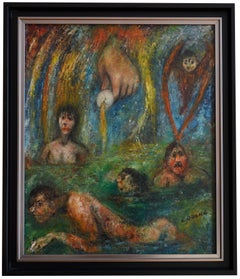
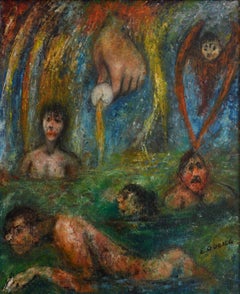
Oil on canvas by Edouard Goerg (1893-1969), France, 1958. Life is always the same. Acquired in 2017 from the personal collection of Edouard Goerg. Measurements : with frame : 62.5x53.4 cm - 24.6x21 inches, without frame : 55x46 cm - 21.7x18.1 inches, format 10F. Signed "E.Goerg" (see photo). Preserved by the painter, then by his family since his death in 1969, this painting appeared in 2017. Entitled "Always life begins again", it is a crepuscular work. Testamentary one could say, so much the statement which is made there is definitive. The fact that he kept it until his death tends to consolidate this vision. Far from the empty looks and death faces of the rebellious era of sarcastic expressionism, the terrifying and compassionate testimony of the Spanish war, and the post-WWII flower women, we are dealing here with a a form of reasonable abdication, but honest. This idea that although everything changes, nothing changes. Changed times, actors, ideas, the same comedy occupies the society. Having given up the idea of ​​changing the latter, Goerg accepts the fact that the only alternative is to stay there or get lost. But stay afloat with his values, completely independent, whatever the cost is. This work is similar to La Vie Recommence of 1935, reproduced on page 54 of Gaston Diehl's book devoted to the painter (Éditions de Clermont, 1947). On the latter, the artist depicts his vision of life, from birth to death, made of hope, fear, cruelty, resignation and fatality. 23 years later, Toujours La Vie Recommence shows us the road traveled by the painter. It is no longer a matter of denunciation, but ultimately of acceptance of reality and the difficulty of staying there yourself. The admirer of Hieronymus Bosch gives us an inspired composition. The hand of God, the only expression of physical beauty in this work, comes down from heaven to give life. Symbolically, it holds an egg that dispenses the element from which the human protagonists find their birth, and in which they move and tangle more than they impose. Beautiful allegory of society. Four characters, two women and two men evolve in this societal marigot. The man in the foreground, ruddy face, evolves with ease. His body is supple, flexible, adaptable. The woman on the left observes him with admiration. Obviously, this man is in his place and causes rapture. The right man with massive shoulders and wrapped, shows a physical maladjustment to the activity he is doing. He struggles to stay afloat, his face expresses effort, even exhaustion. But he assumes. He does with what he has, with what he is. The other woman shows him the greatest indifference. What is not the case of the demonic archangel (recurrent in the works of Bosch) with the stunted body, who leads the dance and holds this character, we understand the painter, under his control as to have fun. As this character cannot change bodies, Goerg cannot change values. He does it with. Had he not said to the critic Roger Brielle: "Independents, sensitive and just men, that's what we must strive to stay in this world in disarray". Goerg will have come to narrative expressionism to give us a balance sheet allegory of his deep self and his condition. Édouard Goerg is one of the major artists of his generation. Coming from a Champagne family, he was born in Sidney, Australia, in 1893, during a professional stay of his father. After passing through London, he arrives in Paris at the age of seven. At twenty, between 1913 and 1914, he studieds painting at the Académie Ranson with Maurice Denis and Paul Sérusier. He travels to Italy and India. Mobilized in 1914, he is sent to Artois, then to Argonne. From 1920, he exhibits at the Salon des Independants, then at the Salon d'Automne where he joins with Laboureur. At Berthe Weil, in 1924, he participates in the exhibitions of the Gromaire group, a prelude to a series of exhibitions in Paris (Berthe Weill, Bernheim Jeune), as in Brussels (Le Centaure). Goerg illustrates books including Table of the beyond by F.Boutet. In 1928, he meets Paul Guillaume who exhibits his works in Boston and the Art Institute of Chicago. He continues to show his works, satires of the bourgeois manners, at Bernheim Jeune, then at Lucie Krogh. In 1934, he travels to Belgium and Holland where he paints surrealist paintings that will be exhibited at Jeanne Castel. In 1935-1936, he meets Aragon, who opened the doors of the houses of the cultures created by the Association of Writers and Revolutionary Artists. The Spanish war and the Second World War mark it deeply. He must protect his daughter and his Jewish women...

Category

1950s Expressionist Fanny Rabel Paintings

Materials

Canvas, Oil

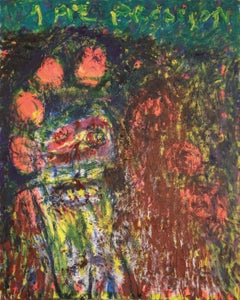
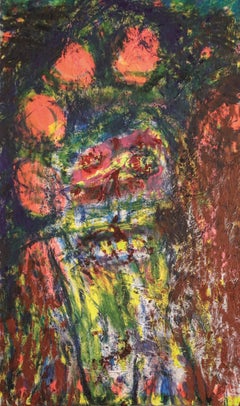
First pressure Julien Wolf Contemporary art painting expressionnist colour

First pressure Julien Wolf Contemporary art painting expressionnist colour

By Julien Wolf

Located in Paris, FR

OIl paint on canvas Hand-signed on the back by the artist “At first glance, we are invited to a colorful carnival. Everything is movement here! As if Julien Wolf had tried to captur...

Category

2010s Expressionist Fanny Rabel Paintings

Materials

Canvas, Oil

Supper is not over ! - Julien Wolf, Contemporary Expressionist Painting

Supper is not over ! - Julien Wolf, Contemporary Expressionist Painting

By Julien Wolf

Located in Paris, FR

Oil on canvas 2019 Signed Unique work Julien Wolf is a French painter who was born in Strasbourg in 1981, France. In 2007, he graduated and obtained the DNSEP Art and Decorative Art section...

Category

2010s Expressionist Fanny Rabel Paintings

Materials

Canvas, Oil

A small picodon ? Julien Wolf Contemporary Expressionist Painting

A small picodon ? Julien Wolf Contemporary Expressionist Painting

By Julien Wolf

Located in Paris, FR

Oil on canvas 2017 Signed Unique work Julien Wolf is a French painter born in 1981 in Strasbourg, France. In 2007, he graduated from the DNSEP Art section at the Strasbourg Decora...

Category

2010s Expressionist Fanny Rabel Paintings

Materials

Canvas, Oil

The mermaid buoy Julien Wolf Contemporary art painting expressionnist red yellow

The mermaid buoy Julien Wolf Contemporary art painting expressionnist red yellow

By Julien Wolf

Located in Paris, FR

Oil paint on canvas Hand signed on the back by the artist “At first glance, we are invited to a colorful carnival. Everything is movement here! As if Julien Wolf had tried to captur...

Category

2010s Expressionist Fanny Rabel Paintings

Materials

Canvas, Oil

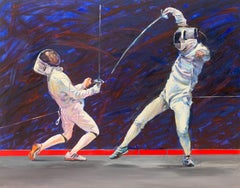
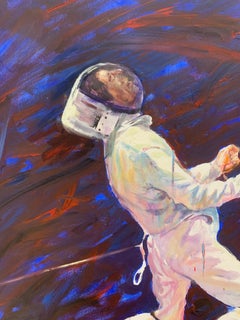
Fencers. Figurative Oil Painting, Olympic Games, Sport, Realistic, Polish artist

Fencers. Figurative Oil Painting, Olympic Games, Sport, Realistic, Polish artist

By Dorota Zych-Charaziak

Located in Warsaw, PL

The painting shows sword fighting, which is one of the official sports of the Olympic Games. The fencing fights have a spectacular character, perfectly captured in the painting by Do...

Category

2010s Expressionist Fanny Rabel Paintings

Materials

Canvas, Oil

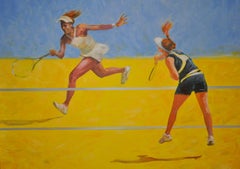
Tennis. Figurative Oil Painting, Olympic Games, Sport, Realistic, Polish artist

Tennis. Figurative Oil Painting, Olympic Games, Sport, Realistic, Polish artist

By Dorota Zych-Charaziak

Located in Warsaw, PL

The painting shows two tennis players which is one of the official sports of the Olympic Games. The tennis match has a spectacular character and dynamics well captured in the paintin...

Category

2010s Expressionist Fanny Rabel Paintings

Materials

Canvas, Oil

Fanny Rabel paintings for sale on 1stDibs.

Find a wide variety of authentic Fanny Rabel paintings available for sale on 1stDibs. You can also browse by medium to find art by Fanny Rabel in canvas, fabric, oil paint and more. Much of the original work by this artist or collective was created during the 1960s and is mostly associated with the Expressionist style. Not every interior allows for large Fanny Rabel paintings, so small editions measuring 66 inches across are available. Customers who are interested in this artist might also find the work of Joseph Solman, Béla Czóbel, and Bernard Harmon. Fanny Rabel paintings prices can differ depending upon medium, time period and other attributes. On 1stDibs, the price for these items starts at $24,500 and tops out at $24,500, while the average work can sell for $24,500.