Filippo De Pisis More Art

to
4
1
Overall Width
to
Overall Height
to
5
3
2
1
3
2
5
4
57
328
231
120
117
5
Artist: Filippo De Pisis
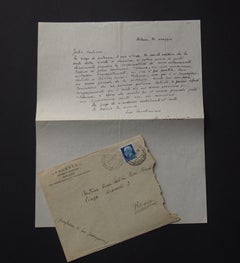
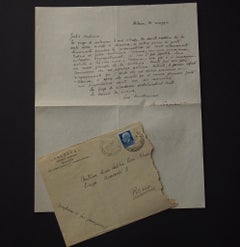
Autograph Letter by Filippo de Pisis - 1934
By Filippo De Pisis
Located in Roma, IT
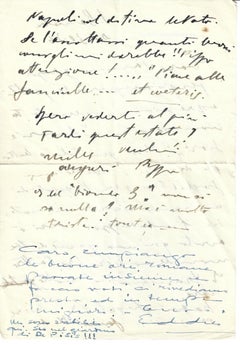
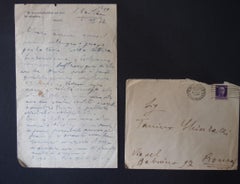
Autograph Letter Signed by de Pisis - "Love and Flowers" to Gaetano Chiurazzi. Venice, February 10th 1934. In Italian. With stamps and postmarks. Very good condition, with minor aging signs. Original envelope included. Perfectly readable, on ivory color paper and on letterhead "et spiritualis unctio". With autograph notes signed in blue ink at the end of the back, by an undefined author. An affectionate greeting letter written with a rapid calligraphy and in a cryptical way, with quotations understandable only within the friendship relationship between the poet-artist of "Loves and Flowers" and the Italian gallerist, Gaetano Chiurazzi (Naples,1899 - Rome,1967), best-known as "Tanino". De Pisis is today best-known for his cityscapes, metaphysically-inspired maritime scenes, and still lifes, especially those depicting flowers. His work has a particularly airy quality, and is laden with a sort of pathetic pleasure. This letter demonstrates how de Pisis spent his life: between Rome, Paris and Venice, living a very extravagant lifestyle; he had a pet parrot named Coco, and in Venice he was one of a handful of residents at the time who used a gondola. He had two personal gondoliers on 24 hour duty, who wore black-and-gold livery. Filippo de Pisis (born Luigi Filippo Tibertelli, Ferrara 1896 – Brugherio 1956) When he was 20 years old, the young painter from Ferrara had a meeting that changed his life. During his military service, he met the "Dioscuri", the brothers De Chirico and then Carrà. He was sure impressed by their way of seeing painting and, at the beginning, shared the metaphysical style. After a short stay in Rome and Paris, at the beginning of the 1920's, he started to rework his style, made of suggestions and original subjects, where the pictorial line is fragmented and, therefore, defined by Eugenio Montale as "fly-paw painting". The friendship with Julius Evola...
Category

1930s Filippo De Pisis More Art

Materials

Paper, Ink

Autograph Letter Signed by Filippo de Pisis - 1947
By Filippo De Pisis
Located in Roma, IT
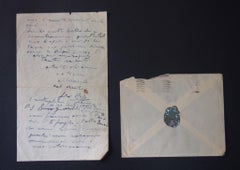
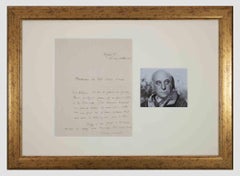
A Autograph Letter Signed by Filippo de Pisis accompanies a b/w photographic portrait (cm 11 x 9) of the young Italian artist, with his Basque-hat on his head, smoking a pipe and with his parrot on his shoulder. This composition, in perfect condition, is mounted under passepartout, plexiglass, and gilded frame (cm 40.5 x 2 x 54.5). The manuscript is addresses to Gaetano Chiurazzi. Venice, January 20th 1947. One page, single-sided. On letterhead paper “Ne nous embarbouillons pas dans les métaphores” (Balzac). cm 23 x 14.5. In 16°. In Italian. Signed “F. de Pisis”. Excellent condition, except for usual folds. Perfectly readable An affectionate greeting letter written with a rapid calligraphy by the artist had just returned to Italy, to Venice, after a short stay in Paris, with the first symptoms of a disease that will lead him to death. The artist writes to his friend, the Italian gallerist, Gaetano Chiurazzi (Naples,1899- Rome,1967), best-known as "Tanino". This letter will be delivered to Tanino by a great admirer and collector of de Pesis. A manuscript demonstrates how de Pisis spent his life: between Rome, Paris and Venice, living a very extravagant lifestyle; he had a pet parrot named Coco, and in Venice he was one of a handful of residents at the time who used a gondola. He had two personal gondoliers on 24-hour duty, who wore black-and-gold livery. Filippo de Pisis (born Luigi Filippo Tibertelli, Ferrara 1896 – Brugherio 1956) When he was 20 years old, the young painter from Ferrara had a meeting that changed his life. During his military service, he met the "Dioscuri", the brothers De Chirico and then Carrà. He was sure impressed by their way of seeing painting and, at the beginning, shared the metaphysical style. After a short stay in Rome and Paris, at the beginning of the 1920's, he started to rework his style, made of suggestions and original subjects, where the pictorial line is fragmented and, therefore, defined by Eugenio Montale as "fly-paw painting". The friendship with Julius Evola...
Category

1940s Modern Filippo De Pisis More Art

Materials

Paper

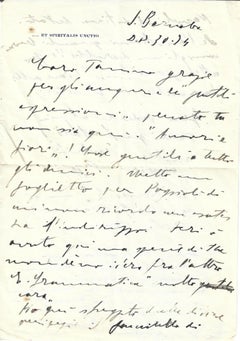
Autograph Letter Signed by Alberto Savinio - 1934
By Filippo De Pisis
Located in Roma, IT
Colonna Review - A.L.S. is a Autograph Letter Signed by Alberto Savinio to the Countess A.L Pecci-Blunt. Milan, May 21st 1934. In Italian. One page, single-sided. Excellent conditio...
Category

1930s Filippo De Pisis More Art

Materials

Paper, Ink

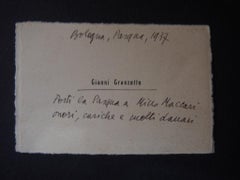
Happy Easter Card by Gianni Granzotto - 1937
By Filippo De Pisis
Located in Roma, IT
Happy Easter Card by Gianni Granzotto, to the Countess Anna Laetitia Pecci-Blunt. Bologna, Easter, 1937. In Italian. One page, single-sided. With wishing autograph notes by a great...
Category

1930s Filippo De Pisis More Art

Materials

Paper, Ink

Autograph Letter Signed by Filippo de Pisis - 1947
By Filippo De Pisis
Located in Roma, IT
Le Foglie – A.L.S. is a Autograph Letter Signed by Filippo de Pisis to Gaetano Chiurazzi. Milan, June 3rd 1947. One page, double-side. On letterhead paper “Ne nous embarbouillons pas dans les métaphores” (Balzac). In Italian. Very good condition, with minor aging signs. Original envelope included, with lacquer wax. An affectionate greeting letter written with a rapid calligraphy written by the artist had just return to Italy with the first symptoms of an illness will lead to his death. The artist demands to his friend and Italian gallerist, Gaetano Chiurazzi (Naples,1899- Rome,1967), best-known as "Tanino", to lead him his oil on canval “Le Foglie”, exhibited at his popular gallery, “Le Vetrine di Chiurazzi”, in Via del Babbuino, Rome. De Pisis is today best-known for his cityscapes, metaphysically-inspired maritime scenes, and still lifes, especially those depicting flowers. His work has a particularly airy quality, and is laden with a sort of pathetic pleasure. This letter demonstrates how de Pisis spent his life: between Rome, Paris and Venice, living a very extravagant lifestyle; he had a pet parrot named Coco, and in Venice he was one of a handful of residents at the time who used a gondola. He had two personal gondoliers on 24-hour duty, who wore black-and-gold livery. Filippo de Pisis (born Luigi Filippo Tibertelli, Ferrara 1896 – Brugherio 1956) When he was 20 years old, the young painter from Ferrara had a meeting that changed his life. During his military service, he met the "Dioscuri", the brothers De Chirico and then Carrà. He was sure impressed by their way of seeing painting and, at the beginning, shared the metaphysical style. After a short stay in Rome and Paris, at the beginning of the 1920's, he started to rework his style, made of suggestions and original subjects, where the pictorial line is fragmented and, therefore, defined by Eugenio Montale as "fly-paw painting". The friendship with Julius Evola...
Category

1940s Filippo De Pisis More Art

Materials

Paper, Ink

Related Items
Coisa Linda.
By Beatriz Milhazes
Located in New York, NY
MILHAZES, Beatriz. Coisa Linda. Unpaginated. Illustrated with 34 hand-printed screen prints and a unique collage. 4to., bound in original decorated blue and gold cloth, yellow paper spine in a yellow cloth slipcase. New York: Library Council of The Museum of Modern Art, 2002. The first book published in "Contemporary Editions" by the Library Council of the Museum of Modern Art. This exquisite book was created by contemporary Brazilian artist Beatriz Milhazes. Each copy contains thirty-four hand-printed screenprints by Milhazes, and a unique collage. The screenprints are printed in forty colors and are bound in a hand-printed cover, all created by Milhazes in collaboration with the printmaker Jean-Paul Russell...
Category

Early 2000s Modern Filippo De Pisis More Art

Materials

Paper

Coisa Linda.
Coisa Linda.
$8,500
H 12.13 in W 12.13 in D 0.88 in
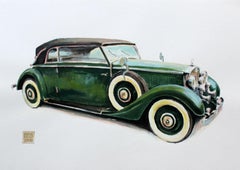
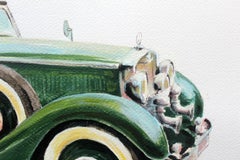
Citroen 15CV - Contemporary Watercolor & Ink Painting, Vintage Car, Realistic
By Mariusz Szałajdewicz
Located in Warsaw, PL
Mariusz Szalajdewicz (b. 1974) Studied at the Faculty of Architecture at Warsaw University of Technology, where he mastered the drawing skill. Architect and urbanist, illustrator.
Category

21st Century and Contemporary Realist Filippo De Pisis More Art

Materials

Paper, Ink, Watercolor

Mercedes W18 - XXI Century, Contemporary Watercolor & Ink Painting, Vehicle, Car
By Mariusz Szałajdewicz
Located in Warsaw, PL
Mariusz Szalajdewicz (b. 1974) Studied at the Faculty of Architecture at Warsaw University of Technology, where he mastered the drawing skill. Architect and urbanist, illustrator. ...
Category

21st Century and Contemporary Realist Filippo De Pisis More Art

Materials

Paper, Ink, Watercolor

Rare 1950s Vintage Syndicated Ink Drawing Cartoon Strip Susie Q Smith Comic Art
Located in Surfside, FL
SUSIE Q. SMITH Medium: Newspaper comics Distributed by: King Features Syndicate First Appeared: 1945 Creators: Linda and Jerry Walter 5.5 X 19.5 Dated August 13, 1954 in top right corner. Like her contemporaries, Aggie Mack, Candy and Patsy Walker (before her conversion to a superhero), Susie Q. Smith was a female Archie-type — not exactly an imitator, because Archie, who had started only four years earlier, hadn't yet become popular enough to spawn imitators, but part of his genre. She attended high school, where her teachers often seemed unreasonable to her, interacted with the opposite gender in a typically adolescent way, and her parents didn't completely understand her. And she was cute and perky as only a teenage girl can be. Susie was the star of a comic strip distributed by King Features, the biggest of the comic strip syndicates, whose other offerings have ranged from Jackys Diary to Prince Valiant. King launched the strip in both daily and Sunday form in 1945. Daily, she was only in a panel at first, but it expanded into a full, multi-panel strip on February 7, 1953. In a very odd turn of events, in 1953 the Walters chose to leave King Features behind and hitch their wagon at the McNaught Syndicate. The creators were Harold "Jerry" Walter and his wife, Linda. Jerry was also responsible for Jellybean Jones, who has nothing to do with Jughead Jones's young sister, a modern-day addition to the Archie cast of characters. Together, they did The Lively Ones during the 1960s. Though each was capable of doing both major jobs in comic strip production, their usual working method was for Jerry to dream up the ideas and write the dialog, while Linda did the artwork. The Walters also collaborated on a series of Susie Q. Smith comic books for Dell Comics. Instead of reprinting newspaper strips, these ran new stories by the Walters. Between 1951 and '54, four issues were published as part of the Four Color Comics series, where many minor comic strips, including Dotty Dripple, Timmy and Rusty Riley had found a home. It had no other media spin-offs. Susie Q. Smith had a respectable run in the newspapers, but it ended in 1959. Jerry Walter (1915 - 2007) was an abstract expressionist artist whose output of energetic and colorful paintings were the products of the rich artistic milieu of post-war New York City. He was born Harold Frank Walter in Mount Pleasant, Iowa on November 25, 1915. After graduating from Colgate University in 1937, Walter moved to New York City, where he studied drawing and painting at the New School and the Art Students’ League. Before concentrating seriously on his art, he spent several years as a successful copywriter and idea man for the advertising agencies of J. Walter Thompson, McCann Ericson, and BBDO. During this time, he also worked as a syndicated cartoonist. Collaborating with his wife, Linda, his best-known series was Susie Q. Smith, which first appeared in 1945 and described as a “female Archie type.” Very popular, the cartoon was later the subject of a series of comic books published from 1951 to 1954. After serving in the United States Army for three years during World War II, Walter began to paint seriously. He ascribed his earliest artistic influence to Joan Miró, whose Dog Barking at the Moon (1926) he viewed when he was twelve, the year he published his first cartoon. Walter later wrote that jazz, “the first native expression of so-called modernism” was a strong influence on his work. During the later 1940s, Walters spent time at the Research Studio in Maitland, Florida. Founded in 1937 by artist and architect J. André Smith and supported by the philanthropist Mary Curtis Bok, the Research Studio was a lively colony that hosted prominent artists, including Milton Avery, Ralston Crawford, and Doris Lee. While at the Studio, Walter’s work was purchased by Frank Crowninshield. A founding trustee of the Museum of Modern Art and editor of Vanity Fair, Crowinshield was a noted collector; his collection included important works by Pablo Picasso, Marc Chagall, Henri Matisse, Edgar Degas, George Bellows, and Pierre Bonnard. Returning to New York after his time at the Studio, Walter became an active member of the New York school of the abstract expressionist movement, and in the summer of 1956, Walter exhibited 13 paintings and a selection of drawings at New York’s Chase Gallery. The adroit manipulation of both color and composition evident in his work shows the influence of Abstract Expressionism, particularly Willem de Kooning, Arshile Gorky, and Hans Hofmann. illustrator and female cartoonist Linda Walter was the talented female mind behind the beloved "Susie Q. Smith" comic strip. She played an instrumental role in shaping the cultural landscape through her vibrant illustrations. Known for the timeless charm of the "Susie Q. Smith" comic strip, Linda's artistry brought joy and laughter to countless readers during the 1950s and continues to resonate with fans across generations. She was part of the Woodstock artists community. from Women in Comics: Linda Walter was the artist of newspaper strip Susie Q. Smith, which was written by her husband, Jerry. It was syndicated by King Features Syndicate and ran from 1945 to 1959. The Walters also contributed original Susie Q. Smith stories to Dell's Four Color comic books from 1951 to 1954. From 1964-1965, they created a singled panel comic called The Lively Ones. Vintage Golden Age of Comics era. The Golden Age of Comic Books describes an era in the history of American comic books from 1938 to 1956. During this time, modern comic books were first published and rapidly increased in popularity. The superhero archetype was created. Between 1939 and 1941 Detective Comics (DC) and its sister company, All-American Publications, introduced popular superheroes such as Batman and Robin, Wonder Woman, the Flash, Green Lantern, Doctor Fate, the Atom, Hawkman, Green Arrow and Aquaman. Timely Comics, the 1940s predecessor of Marvel Comics, had million-selling titles featuring the Human Torch, the Sub-Mariner, and Captain America. Another notable series was The Spirit by Will Eisner. Dell Comics' non-superhero characters (particularly the licensed Walt Disney animated-character comics) outsold the superhero comics of the day. The publisher featured licensed movie and literary characters such as Mickey Mouse, Donald Duck, Roy Rogers and Tarzan. Additionally, MLJ's introduction of Archie Andrews in Pep Comics #22 (December 1941) gave rise to teen humor comics, with the Archie Comics...
Category

1950s American Modern Filippo De Pisis More Art

Materials

Paper, Ink

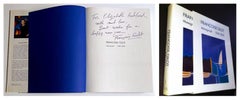
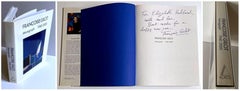
Francoise Gilot Monograph 1940-2000 (hand signed and inscribed to famed actress)
By Françoise Gilot
Located in New York, NY
Françoise Gilot Francoise Gilot Monograph 1940-2000 (hand signed and warmly inscribed to renowned actress), 2000 Hardback monograph in a slipcase, hand signed and inscribed by Franco...
Category

Early 2000s Modern Filippo De Pisis More Art

Materials

Paper, Ink, Mixed Media, Lithograph, Offset

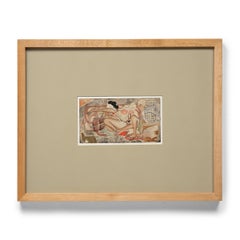
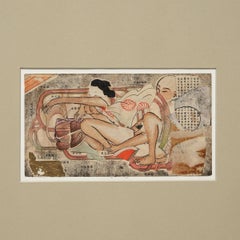
"The Embrace (Shunga Study), " Mixed Media Collage
By Michael Thompson
Located in Chicago, IL
Based in Chicago, IL, contemporary artist Michael Thompson creates unique kites, collages and mixed media works assembled from material fragments of past and present collected in his...
Category

21st Century and Contemporary Abstract Filippo De Pisis More Art

Materials

Paper, Ink

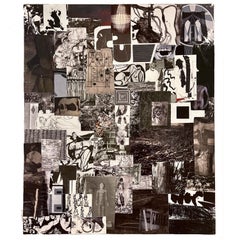
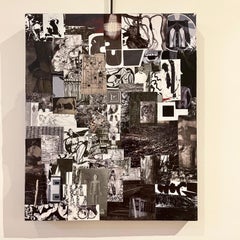
Black & White Collage on Board w. a Touch of Red
By (After) Robert Rauschenberg
Located in Hudson, NY
Really well done collage in black and white with a few subtle touches of deep red. Collage is done on a box board and ready to hang.
Category

20th Century Modern Filippo De Pisis More Art

Materials

Paint, Paper, Glue, Board, Magazine Paper

Black & White Collage on Board w. a Touch of Red
$600 Sale Price
20% Off
H 24 in W 20 in D 1.88 in
Monograph: Strangeland (Hand signed, dated and inscribed by Tracey Emin)
By Tracey Emin
Located in New York, NY
Tracey Emin Strangeland (Hand signed, dated and inscribed by Tracey Emin), 2005 Hardback monograph with dust jacket (hand signed, dated and inscribed for Ann by Tracey Emin) Hand sig...
Category

Early 2000s Pop Art Filippo De Pisis More Art

Materials

Paper, Ink, Mixed Media, Lithograph, Offset

Welcome ... 1994. Paper, ink. 18x25.3 cm
Located in Riga, LV
Welcome ... 1994. Paper, ink. 18x25.3 cm Illustrated in the magazine "School and Family" in 1994.
Category

1990s Modern Filippo De Pisis More Art

Materials

Paper, Ink

Welcome ...  1994. Paper, ink. 18x25.3 cm
$172 Sale Price
20% Off
H 7.09 in W 9.97 in D 0.04 in
Bechtold Original Vintage Exhibition Poster
By Erwin Bechtold
Located in London, GB
Bechtold Original vintage 1978 Oversize size gallery exhibitions poster. 35.1 x 50.1 cm Sold as seen rolled - excellent condition. Exhibition detailed : Bechtold 10 Aiguaforts i...
Category

1980s Modern Filippo De Pisis More Art

Materials

Archival Paper

Vintage Golden Age Syndicated Ink Drawing Cartoon Strip Susie Q Smith Comic Art
Located in Surfside, FL
SUSIE Q. SMITH Medium: Newspaper comics Distributed by: King Features Syndicate First Appeared: 1945 Creators: Linda and Jerry Walter 6.5 X 19.5 Like her contemporaries, Aggie Mack, Candy and Patsy Walker (before her conversion to a superhero), Susie Q. Smith was a female Archie-type — not exactly an imitator, because Archie, who had started only four years earlier, hadn't yet become popular enough to spawn imitators, but part of his genre. She attended high school, where her teachers often seemed unreasonable to her, interacted with the opposite gender in a typically adolescent way, and her parents didn't completely understand her. And she was cute and perky as only a teenage girl can be. Susie was the star of a comic strip distributed by King Features, the biggest of the comic strip syndicates, whose other offerings have ranged from Jackys Diary to Prince Valiant. King launched the strip in both daily and Sunday form in 1945. Daily, she was only in a panel at first, but it expanded into a full, multi-panel strip on February 7, 1953. In a very odd turn of events, in 1953 the Walters chose to leave King Features behind and hitch their wagon at the McNaught Syndicate. The creators were Harold "Jerry" Walter and his wife, Linda. Jerry was also responsible for Jellybean Jones, who has nothing to do with Jughead Jones's young sister, a modern-day addition to the Archie cast of characters. Together, they did The Lively Ones during the 1960s. Though each was capable of doing both major jobs in comic strip production, their usual working method was for Jerry to dream up the ideas and write the dialog, while Linda did the artwork. The Walters also collaborated on a series of Susie Q. Smith comic books for Dell Comics. Instead of reprinting newspaper strips, these ran new stories by the Walters. Between 1951 and '54, four issues were published as part of the Four Color Comics series, where many minor comic strips, including Dotty Dripple, Timmy and Rusty Riley had found a home. It had no other media spin-offs. Susie Q. Smith had a respectable run in the newspapers, but it ended in 1959. Jerry Walter (1915 - 2007) was an abstract expressionist artist whose output of energetic and colorful paintings were the products of the rich artistic milieu of post-war New York City. He was born Harold Frank Walter in Mount Pleasant, Iowa on November 25, 1915. After graduating from Colgate University in 1937, Walter moved to New York City, where he studied drawing and painting at the New School and the Art Students’ League. Before concentrating seriously on his art, he spent several years as a successful copywriter and idea man for the advertising agencies of J. Walter Thompson, McCann Ericson, and BBDO. During this time, he also worked as a syndicated cartoonist. Collaborating with his wife, Linda, his best-known series was Susie Q. Smith, which first appeared in 1945 and described as a “female Archie type.” Very popular, the cartoon was later the subject of a series of comic books published from 1951 to 1954. After serving in the United States Army for three years during World War II, Walter began to paint seriously. He ascribed his earliest artistic influence to Joan Miró, whose Dog Barking at the Moon (1926) he viewed when he was twelve, the year he published his first cartoon. Walter later wrote that jazz, “the first native expression of so-called modernism” was a strong influence on his work. During the later 1940s, Walters spent time at the Research Studio in Maitland, Florida. Founded in 1937 by artist and architect J. André Smith and supported by the philanthropist Mary Curtis Bok, the Research Studio was a lively colony that hosted prominent artists, including Milton Avery, Ralston Crawford, and Doris Lee. While at the Studio, Walter’s work was purchased by Frank Crowninshield. A founding trustee of the Museum of Modern Art and editor of Vanity Fair, Crowinshield was a noted collector; his collection included important works by Pablo Picasso, Marc Chagall, Henri Matisse, Edgar Degas, George Bellows, and Pierre Bonnard. Returning to New York after his time at the Studio, Walter became an active member of the New York school of the abstract expressionist movement, and in the summer of 1956, Walter exhibited 13 paintings and a selection of drawings at New York’s Chase Gallery. The adroit manipulation of both color and composition evident in his work shows the influence of Abstract Expressionism, particularly Willem de Kooning, Arshile Gorky, and Hans Hofmann. illustrator and female cartoonist Linda Walter was the talented female mind behind the beloved "Susie Q. Smith" comic strip. She played an instrumental role in shaping the cultural landscape through her vibrant illustrations. Known for the timeless charm of the "Susie Q. Smith" comic strip, Linda's artistry brought joy and laughter to countless readers during the 1950s and continues to resonate with fans across generations. She was part of the Woodstock artists community. from Women in Comics: Linda Walter was the artist of newspaper strip Susie Q. Smith, which was written by her husband, Jerry. It was syndicated by King Features Syndicate and ran from 1945 to 1959. The Walters also contributed original Susie Q. Smith stories to Dell's Four Color comic books from 1951 to 1954. From 1964-1965, they created a singled panel comic called The Lively Ones. Vintage Golden Age of Comics era. The Golden Age of Comic Books describes an era in the history of American comic books from 1938 to 1956. During this time, modern comic books were first published and rapidly increased in popularity. The superhero archetype was created. Between 1939 and 1941 Detective Comics (DC) and its sister company, All-American Publications, introduced popular superheroes such as Batman and Robin, Wonder Woman, the Flash, Green Lantern, Doctor Fate, the Atom, Hawkman, Green Arrow and Aquaman. Timely Comics, the 1940s predecessor of Marvel Comics, had million-selling titles featuring the Human Torch, the Sub-Mariner, and Captain America. Another notable series was The Spirit by Will Eisner. Dell Comics' non-superhero characters (particularly the licensed Walt Disney animated-character comics) outsold the superhero comics of the day. The publisher featured licensed movie and literary characters such as Mickey Mouse, Donald Duck, Roy Rogers and Tarzan. Additionally, MLJ's introduction of Archie Andrews in Pep Comics #22 (December 1941) gave rise to teen humor comics, with the Archie Comics...
Category

1950s American Modern Filippo De Pisis More Art

Materials

Paper, Ink

Emily Mason The Fifth Element, HB Book, Hand signed and inscribed by Emily Mason
By Emily Mason
Located in New York, NY
Emily Mason The Fifth Element (Hand signed and inscribed by Emily Mason), 2009 Hardback monograph with dust jacket (Hand signed, dated and inscribed by Emily Mason) Hand signed in marker directly underneath the title; inscribed to Kevin and dated 2013 top right by Emily Mason 10 1/2 × 9 × 1 inches Provenance Signed for the present owner at the artist's opening at the David Findlay...
Category

Early 2000s Abstract Filippo De Pisis More Art

Materials

Paper, Ink, Mixed Media, Lithograph, Offset

Previously Available Items
Autograph Postcard Signed by Filippo de Pisis - 1953
By Filippo De Pisis
Located in Roma, IT
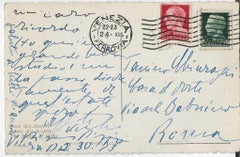
Autograph Postcard Signed by de Pisis to Tanino Chiurazzi. Venice, December 24th 1953. In Italian. With stamps and postmarks. Perfect condition, except for a light yellowing of the paper on the front. An affectionate greetings card addressed to the Italian gallerist, Gaetano Chiurazzi (Naples,1899- Rome,1967). Filippo de Pisis (Ferrara, 1896 - Brugherio, 1956). At age 20, the young painter from Ferrara had a meeting that changed his life. During his military service, he met the "Dioscuri", the brothers De Chirico and then Carrà. He was sure impressed by their way of seeing painting and, at the beginning, shared the metaphysical style. After a short stay in Rome and Paris, at the beginning of the 1920's, he started to rework his style, made of suggestions and original subjects, where the pictorial line is fragmented and, therefore, defined by Eugenio Montale as "fly-paw painting" . The friendship with Julius Evola...
Category

1950s Modern Filippo De Pisis More Art

Materials

Paper, Ink

Filippo De Pisis more art for sale on 1stDibs.

Find a wide variety of authentic Filippo De Pisis more art available for sale on 1stDibs. You can also browse by medium to find art by Filippo De Pisis in paper, ink and more. Much of the original work by this artist or collective was created during the 20th century and is mostly associated with the modern style. Not every interior allows for large Filippo De Pisis more art, so small editions measuring 5 inches across are available. Customers who are interested in this artist might also find the work of Fabrizio Clerici, Alberto Martini, and Carlo Carrà. Filippo De Pisis more art prices can differ depending upon medium, time period and other attributes. On 1stDibs, the price for these items starts at $201 and tops out at $446, while the average work can sell for $334.

Still Thinking About These?

All Recently Viewed