Frank Hyde Art

British, 1849-1937

Frank Hyde was born in Surrey in 1849 and spent a large amount of time in London during his youth. His father had been in the army but retired to live the life of a gentleman upon inheriting the family seat, Hyde End Manor in Berkshire. Hyde, however, would later inherit and sell the Manor. As a young man, Hyde trained as an artist at the Royal Academy, London and his subsequent career revealed striking artistic versatility. Hyde’s subjects varied from the portrayal of real, dramatic events to comic characters commissioned by the card manufacturer Raphael Tuck. Starting out as a 1st Lieutenant in the Royal Engineers, Hyde moved on to begin his career as a war artist during the Franco-Prussian war of 1870–71, producing drawings for The Graphic, an illustrated weekly publication. Hyde married Constance Mary Louise Felgate in 1876, but she died less than a year later. While he traveled extensively throughout his life after Constance's death, he purchased a villa in Capri where he met Rosina Ferrara, whom he used as a model and John Singer Sargent, with whom he shared a studio. Hyde is perhaps best known for his paintings of Capri (one of which we are going to have on display) and model Ferrara. Ferrara would become Sargent’s muse after Hyde introduced the two. Hyde married Florence Ellen Louise Rowley in 1881, with daughter, Mina, was born in 1882 and son, Francis, in 1884. Francis would later become a Captain during the First World War. Hyde and Florence divorced in 1887 and she died in 1890. Hyde never remarried and chose to live in Petts Wood Cottage, Stockbury, near Sittingbourne from 1913 until his death in 1937. Hyde painted three Maidstone/Queen’s Own Royal West Kent Regiment related pieces which form part of the museum collection, two of which will be on display for the Coming Home exhibition. The ‘Arrival of a Convey of Wounded Soldiers at Maidstone East Station, 1916’, upon which the exhibition is based, captured the imagination of Maidstone and was bought by public subscription in 1918. This fee was added to the £30 already raised by Frank Hyde from the exhibiting of another of his paintings to raise funds for those left disabled by the war. Hyde later painted and sold Trones Wood to help further this cause. The paintings by Hyde were also used to help raise funds for The British League of Help to assist the communities in northern France that had been devastated by the fighting.

to
2
1
Overall Width
to
Overall Height
to
3
2
2
1
3
2
2
1
3
3
1
1
3
10,096
2,779
1,379
1,375
2
2
1
Artist: Frank Hyde
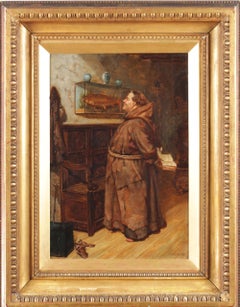
19th century oil painting of a monk admiring a fish by Frank Hyde
By Frank Hyde
Located in York, GB
19th century oil on canvas painting of a monk admiring a fish in a glass display cabinet holding a book behind his back, Probably the bible. By the well known artist Frank Hyde . ...
Category

19th Century Old Masters Frank Hyde Art

Materials

Oil

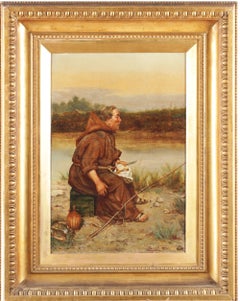
19th century oil painting of a monk fishing by Frank Hyde
By Frank Hyde
Located in York, GB
19th century oil on canvas painting of a monk sitting on the river bank with a sandwich on his knee and a fishing rod to the side A very peaceful scene by the well known artist Frank...
Category

19th Century Old Masters Frank Hyde Art

Materials

Oil

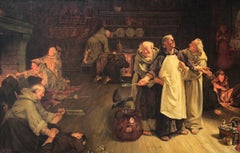
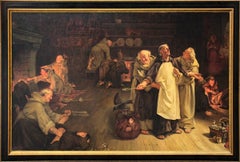
A Conundrum in the Kitchen
By Frank Hyde
Located in Missouri, MO
Frank Hyde (British 1849-1937) "A Conundrum in the Kitchen" c. 1900 Oil on Canvas Signed Lower Left Image: 37.5 x 57.5 inches Framed: 44 x 64.5 inches From the Maidstone Museum, UK: Hyde was born in Surrey in 1849 and spent a large amount of time in London during his youth. His father had been in the army but retired to live the life of a gentleman upon inheriting the family seat, Hyde End Manor in Berkshire. Hyde, however, would later inherit and sell the Manor. As a young man, Hyde trained as an artist at the Royal Academy, London, and his subsequent career revealed striking artistic versatility. His subjects varied from the portrayal of real, dramatic events to comic characters commissioned by the card manufacturer Raphael Tuck. Starting out as a 1st Lieutenant in the Royal Engineers, Hyde moved on to begin his career as a war artist during the Franco-Prussian war of 1870-71, producing drawings for ‘The Graphic’, an illustrated weekly publication. Hyde married Constance Mary Louise Felgate in 1876, but she died less than a year later. While he travelled extensively throughout his life after Constance’s, death Hyde purchased a villa in Capri where he met Rosina Ferrara, whom he used as a model, and John Singer Sargent, with whom he shared a studio. Hyde is perhaps best known for his paintings of Capri...
Category

1890s Realist Frank Hyde Art

Materials

Canvas, Oil

Related Items
Study Of A Head
By Artus Wolfort
Located in Paris, Île-de-France
Artus WOLFAERTS (1581-1641) Study of a head Oil on paper, transferred on panel. 39,5 x 29 cm Unsigned Provenance Private collection, France Firstly thought to be from Rubens’s S...
Category

17th Century Old Masters Frank Hyde Art

Materials

Oil, Laid Paper

Study Of A Head
Study Of A Head
$9,014
H 15.56 in W 11.42 in
Portrait of an Old Bearded Man
Located in Stockholm, SE
We are pleased to offer a captivating portrait, most likely painted in the late 18th century, attributed to an artist within the circle of Christian Wilhelm Ernst Dietrich. This oil ...
Category

Late 18th Century Old Masters Frank Hyde Art
Materials

Oil, Wood Panel

Old Master Oil on Wood 17th Century Flemish Netherlands Holland
Located in Eltville am Rhein, DE
Dutch Master 17th Century Farmer at the Well with Goats and Cows Oil on Wood Size: approx. 48 x 63 cm Frame: 68 x 83 cm Age-related condition, old restorations (see photos) Viewing...
Category

17th Century Old Masters Frank Hyde Art

Materials

Oil

Shepherd with Sheep, Cows and a Goat in a Landscape by Jan Frans Soolmaker
Located in Stockholm, SE
This painting depicts a pastoral scene that is attributed to the artist Jan Frans Soolmaker, an artist known for his Italianate landscapes and scenes that often feature equestrian and Arcadian elements. The painting is not signed but is attributed to Soolmaker, relating it to a known signed work by the artist that was sold at Sotheby’s London in 1999. The scene is suffused with the warm glow of a setting or rising sun, casting a soft light that is characteristic of Soolmaker’s landscapes. It shows a shepherd guiding a group of cattle across a shallow stream, with the animals taking center stage in the composition. The animals are rendered with careful attention to their forms and the play of light on their bodies, which is a hallmark of Soolmaker's work. The landscape is composed of a rocky terrain with trees and shrubbery, creating a sense of depth and natural beauty that invites the viewer to explore the scene further. The background suggests a vast, open landscape with distant mountains, which adds to the Italianate feel of the painting. The sky is dramatic, with clouds catching the light of the sun, contributing to the overall serene yet dynamic atmosphere of the work. The provenance of the painting is notable, having been in the possession of significant historical figures such as Swedish Prince Fredrik Adolf, and later The collection of Pär Ulmgren, The collection of Gösta Stenman, and Engineer and politician Gustaf Henry Hansson. Potential buyers have the option of choosing between a newly made gold frame or an older brown frame, which allows for personalization in how the work is presented. Soolmaker’s work is often compared to that of Dutch painter Nicolaes Berchem, whose style he emulated. Soolmaker's landscapes reflect a similar sensitivity to light and composition, making his works sought after for their beauty and historical significance. Despite the smaller body of work left by Soolmaker, due to his short career, his paintings are valued for their craftsmanship and the legacy of the artist’s brief but impactful contribution to the Dutch Italianate landscape genre. Information: Jan Frans Soolmaker (Flanders 1635‑1685) Shepherd with Sheep...
Category

17th Century Old Masters Frank Hyde Art

Materials

Canvas, Oil

17th Century Memento Mori Vanitas Skull Old Master Oil Ex-Christie’s
Located in Yardley, PA
This wonderful 17th-century French School vanitas painting is a meditation on mortality and the transience of earthly pleasures. The composition centers on a finely rendered human sk...
Category

17th Century Old Masters Frank Hyde Art

Materials

Canvas, Oil

Period Marine Landscape Credited to Warren Sheppard
By Warren W. Sheppard
Located in Roma, IT
This beautiful painting, due to its very high quality of execution, style and era, can be referred to the great artist Warren Sheppard, who specialized in seascapes. Of great evocati...
Category

19th Century Old Masters Frank Hyde Art

Materials

Canvas, Oil

Flemish Early 17th Century Old Master Oil on Panel Painting Hunting Scene 1620
Located in Portland, OR
A highly important Flemish Old Master oil painting by Peter Van Lint (1609-1690), titled "Preparing for the Hunt", the painting is dated & signed by the artist, 1620. The painting wa...
Category

1620s Old Masters Frank Hyde Art

Materials

Oil, Panel

“Manchester Terrier, 1854” 19th Century Dog Portrait in Landscape Ex-Bonhams Oil
By George Armfield
Located in Yardley, PA
A fantastic example of George Armfield’s renowned portraits of dogs. This work depicts a Manchester Terrier excitedly standing outside a rabbit hole on the edge of a forest. The ter...
Category

1850s Realist Frank Hyde Art

Materials

Canvas, Oil

Robert White "Modern Mythology" 2021 Oil with Anatomical Realism & Surreal Edge
Located in Miami, FL
ROBERT KENNETH WHITE – "MODERN MYTHOLOGY" ⚜ Oil on canvas ⚜ Hand signed lower right ⚜ Frameless display SURREALISM MEETS CONTEMPORARY PORTRAITURE In “Modern Mythology,” Robert Kenne...
Category

2010s Realist Frank Hyde Art

Materials

Canvas, Oil

Portrait of a Lady, Mrs Wray in a Silk Dress & Pink Wrap c.1698, Oil on canvas
By Michael Dahl
Located in London, GB
Portrait of a Lady, Mrs Wray in a Silk Dress & Pink Wrap c.1698 Circle of Michael Dahl (1659-1743) This delightful work, presented by Titan Fine Art, is a fine example of British po...
Category

17th Century Old Masters Frank Hyde Art

Materials

Cotton Canvas, Oil

Shipping in Stormy Waters, Attributed to Italian Artist Francesco Guardi
By Francesco Guardi
Located in Stockholm, SE
The splendour of the tragic sea Francesco Guardi and maritime painting in Venetian art No Venetian painter was a stranger to the sea. After all, Venice was not only one of the most prominent ports of the Mediterranean, but indeed a city literally submerged in the ocean from time to time. Curiously however, the famous Venetian school of painting showed little interest in maritime motifs, favouring scenes from the iconic architecture of the city rather than seascapes. That is why this painting is a particularly interesting window into not only the painter Francesco Guardi himself – but to the significance of the element of water in art history, in absence as well as in the centre of attention. Whether it be calm, sunny days with stunning views of the palaces alongside the canals of Venice or – more rarely – stormy shipwrecking tragedies at sea, water as a unifying element is integral to the works of painter Francesco Guardi (1712–1793). During his lifetime, Venetian art saw many of its greatest triumphs with names like Tiepolo or Canaletto gaining international recognition and firmly establishing Venice as one of the most vibrant artistic communities of Europe. While the city itself already in the 18th century was something of an early tourist spot where aristocrats and high society visited on their grand tour or travels, the artists too contributed to the fame and their work spread the image of Venice as the city of romance and leisure to an international audience, many of whom could never visit in person. Still today, the iconic image of Venice with its whimsical array of palaces, churches and other historic buildings is much influenced by these artists, many of whom have stood the test of time like very well and remain some of the most beloved in all of art history. It was not primarily subtility, intellectual meanings or moral ideals that the Venetian art tried to capture; instead it was the sheer vibrancy of life and the fast-paced city with crumbling palaces and festive people that made this atmosphere so special. Of course, Venice could count painters in most genres among its residents, from portraiture to religious motifs, history painting and much else. Still, it is the Vedutas and views of the city that seems to have etched itself into our memory more than anything else, not least in the tradition of Canaletto who was perhaps the undisputed master of all Venetian painters. Born into his profession, Francesco lived and breathed painting all his life. His father, the painter Domenico Guardi (1678–1716) died when Francesco was just a small child, yet both he and his brothers Niccolò and Gian Antonio continued in their fathers’ footsteps. The Guardi family belonged to the nobility and originated from the mountainous area of Trentino, not far from the Alps. The brothers worked together on more challenging commissions and supported each other in the manner typical of family workshops or networks of artists. Their sister Maria Cecilia married no other than the artist Giovanni Battista Tiepolo himself, linking the family to the most renowned Venetian name of the time. During almost a decade, Guardi worked in the studio of Michele Giovanni Marieschi, sometimes simply known as Michiel, a painted similar in both style and motif. Canaletto is, however, the artist Guardi is most often compared to since they shared a mutual fascination for depicting the architecture and cityscape of Venice. During the course of his career, Guardi tried his hand in many different genres. He was as swift in painting landscapes, Vedutas of Venice, sacred motifs, interiors and architectural compositions as he was in a number of other motifs. His style is typical of the Venetian school but also distinct and personal once we look a little closer. There is an absolute certainty in the composition, the choice of which sometimes feels like that of a carefully calculated photograph – yet it is also very painterly, in the best sense of the word: fluid, bold, sensitive and full of character. The brushwork is rapid, intense, seemingly careless and extraordinarily minute at the same time; fresh and planned in a very enjoyable mixture. His interiors often capture the breath-taking spacious glamour of the palaces and all their exquisite decor. He usually constructed the motif through remarkably simple, almost spontaneous yet intuitively precise strokes and shapes. The result was a festive, high-spirited atmospheric quality, far away from the sterile and exact likeness that other painters fell victim to when trying to copy Canaletto. The painting here has nothing of the city of Venice in it. On the contrary, we seem to be transported far away into the solitary ocean, with no architecture, nothing to hold on to – only the roaring sea and the dangerous cliffs upon which the ships are just moments away from being crushed upon. It is a maritime composition evoking both Flemish and Italian precursors, in the proud tradition of maritime painting that for centuries formed a crucial part of our visual culture. This genre of painting is today curiously overlooked, compared to how esteemed and meaningful it was when our relationship to the sea was far more natural than it is today. When both people and goods travelled by water, and many nations and cities – Venice among them – depended entirely on sea fare, the existential connection to the ocean was much more natural and integrated into the imagination. The schools and traditions of maritime art are as manifold as there are countries connected to the sea, and all reflect the need to process the dangers and wonders of the ocean. It could symbolize opportunity, the exciting prospects of a new countries and adventures, prospering trade, beautiful scenery as well as war and tragedy, loss of life, danger and doom. To say that water is ambivalent in nature is an understatement, and these many layers were something that artists explored in the most wondrous ways. Perhaps it takes a bit more time for the modern eye to identify the different nuances and qualities of historic maritime paintings, they may on first impression seem hard to differentiate from each other. But when allowing these motifs to unfold and tell stories of the sea in both fiction and reality – or somewhere in between – we are awarded with an understanding of how the oceans truly built our world. In Guardi’s interpretation, we see an almost theatrically arranged shipwrecking scene. No less than five ships are depicted right in the moment of utter disaster. Caught in a violent storm, the waves have driven them to a shore of sharp cliffs and if not swallowed by the waves, crushing against the cliffs seems to be the only outcome. The large wooden ships are impressively decorated with elaborate sculpture, and in fact relics already during Guardi’s lifetime. They are in fact typical of Dutch and Flemish 17th century ships, giving us a clue to where he got the inspiration from. Guardi must have seen examples of Flemish maritime art, that made him curious about these particular motifs. One is reminded of Flemish painters like Willem van de Velde and Ludolf Backhuysen, and this very painting has indeed been mistakenly attributed to Matthieu van Plattenberg...
Category

18th Century Old Masters Frank Hyde Art
Materials

Canvas, Oil

Robert Kenneth White "Soft Gaze" Signed 2010 Tonalist Female Figure in Oil
Located in Miami, FL
ROBERT KENNETH WHITE – "SOFT GAZE" ⚜ Oil on canvas ⚜ Hand signed lower right ⚜ Frameless display TONAL FIGURE STUDY IN QUIET CONTEMPLATION In Soft Gaze, Robert Kenneth White present...
Category

2010s Realist Frank Hyde Art
Materials

Canvas, Oil

Frank Hyde art for sale on 1stDibs.

Find a wide variety of authentic Frank Hyde art available for sale on 1stDibs. You can also browse by medium to find art by Frank Hyde in canvas, fabric, oil paint and more. Not every interior allows for large Frank Hyde art, so small editions measuring 65 inches across are available. Customers who are interested in this artist might also find the work of John Horace Hooper, Alfred Munnings, and Andrew Grant Kurtis.

Still Thinking About These?

All Recently Viewed