General Idea More Art

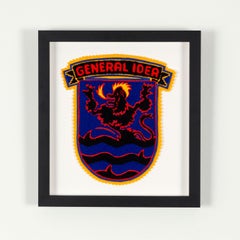
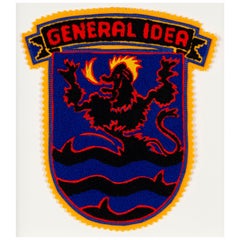
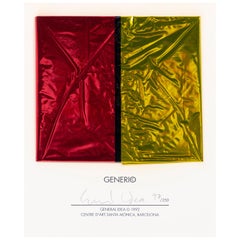
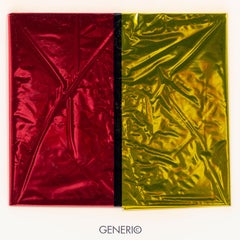
General Idea was commissioned by the Toronto Stock Exchange to install a work/mural. Shortly after the TSX published two prints, a lithograph poster and a limited edition print. However, most of the edition was destroyed/thrown away, when they moved from the trading floor at the TD Centre to their offices. As a result, the work has almost achieved mythological status amongst General Idea collectors.

to
1
1
Overall Width
to
Overall Height
to
2
2
1
1
1
1
1
1
1
1
32
294
226
124
117
Artist: General Idea
Mylar Balloon
Mylar Balloon

Mylar Balloon

By General Idea

Located in Toronto, Ontario

General Idea was founded in 1967 in Toronto by AA Bronson (b. 1946), Felix Partz (1945-1994), and Jorge Zontal (1944-1994). Over the course of 25 years, they made a significant contr...

Category

1990s Conceptual General Idea More Art

Materials

Plastic, Mylar

Nine Lives
Nine Lives

Nine Lives

By General Idea

Located in Toronto, Ontario

General Idea was founded in 1967 in Toronto by AA Bronson (b. 1946), Felix Partz (1945-1994), and Jorge Zontal (1944-1994). Over the course of 25 years, they made a significant contr...

Category

1990s Modern General Idea More Art

Materials

Nylon, Screen

Related Items
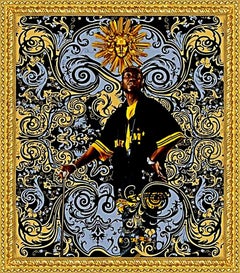
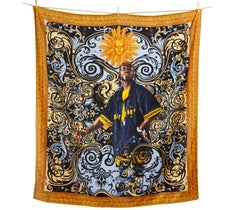
Kehinde Wiley - Andries Stilte Lt. Ed oversized Towel Wall Hanging 70" x 60"

Kehinde Wiley - Andries Stilte Lt. Ed oversized Towel Wall Hanging 70" x 60"

By Kehinde Wiley

Located in New York, NY

Kehinde Wiley Andries Stilte oversized beach towel, 2008 Silkscreen on 100% Cotton Large Beach Towel or hanging tapestry 70 × 60 inches Edition of 2000 In original packaging with ta...

Category

Early 2000s Contemporary General Idea More Art

Materials

Cotton, Mixed Media, Screen

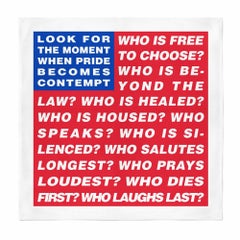
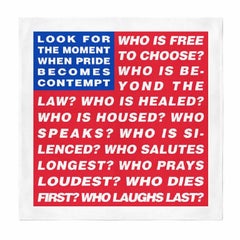
Untitled (Flag), Bandana (Limited timed release)

Untitled (Flag), Bandana (Limited timed release)

By Barbara Kruger

Located in Washington , DC, DC

Barbara Kruger's powerful interpretation of the American flag is screen printed onto a large cotton bandana. These were a limited timed released where they were only sold for about a...

Category

21st Century and Contemporary Contemporary General Idea More Art

Materials

Cotton, Screen

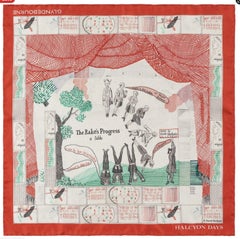
David Hockney - The Rake's Progress 100% Silk British Pocket Scarf, bespoke box

David Hockney - The Rake's Progress 100% Silk British Pocket Scarf, bespoke box

By David Hockney

Located in New York, NY

David Hockney The Rake's Progress Silk Pocket Scarf, ca. 2020 100% silk scarf made in Italy and printed in the UK, held in the original presentation box 16 1/10 × 16 1/10 inches Bear...

Category

2010s Pop Art General Idea More Art

Materials

Silk, Screen

Milwaukee Handicraft Project WPA

Milwaukee Handicraft Project WPA

Located in Los Angeles, CA

Milwaukee Handicraft Project, Applied Design Blockprinted Textiles Volume VI Supplement, c. 1935 - 1942, twelve block printed designs on linen, images are various sizes, each is mounted in its original folder which measures 24 x 19 inches, all bear the Milwaukee Handicraft Project label, various designers, including Barbara Warren (1915 - 2005) ("Checkered Flower" and perhaps others), includes original portfolio binder The Milwaukee Handicraft Project (MHP) was the most prolific and successful of the decorative arts projects of the Works Progress Administration (WPA). It served as a model for many other similar projects across the United States and attracted the attention of thought leaders as diverse as Frank Lloyd Wright and First Lady Eleanor Roosevelt. Designed with the dual goals of providing work for underprivileged women and the creation of well-designed household objects, the MHP began in 1935 under the direction of Elsa Ulbricht...

Category

1930s American Modern General Idea More Art

Materials

Textile, Linen, Linocut, Woodcut

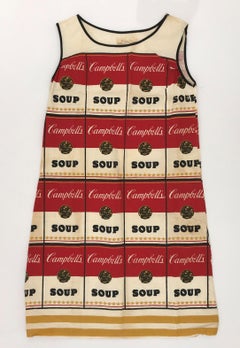
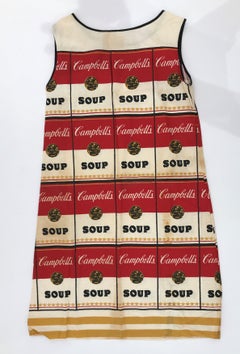
The souper dress
The souper dress

Andy WarholThe souper dress, 1966

$25,000

H 37.8 in W 22.84 in

The souper dress

By Andy Warhol

Located in Jerusalem, IL

A wonderful piece of unknown edition by Andy Warhol. A silkscreen print on a Cellulose and Cotton dress. Fearing the artist's trade mark Campbell's soup can. In very good condition.

Category

1960s Pop Art General Idea More Art

Materials

Textile, Screen

Sol Lewitt, Geometric Abstraction Louis Vuitton 100% Silk Scarf, Limited Ed. 250

Sol Lewitt, Geometric Abstraction Louis Vuitton 100% Silk Scarf, Limited Ed. 250

By Sol LeWitt

Located in New York, NY

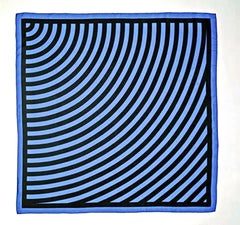
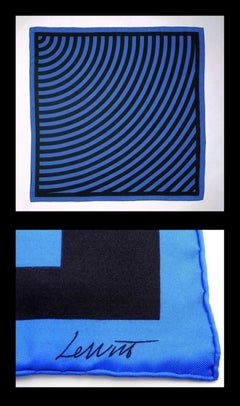
Sol LeWitt Limited Edition Geometric Abstraction Silk Scarf, ca. 1987 Limited Edition Silkscreen on 100% Italian silk scarf/shawl Signed on the fabric with artist's printed signature...

Category

1980s Abstract Geometric General Idea More Art

Materials

Silk, Screen

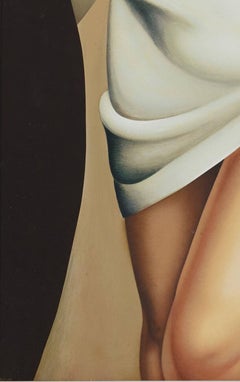
Art Deco Serigraph, Edition 176/195, The Model, 1957

Art Deco Serigraph, Edition 176/195, The Model, 1957

By Tamara de Lempicka

Located in OPOLE, PL

Tamara de Lempicka (1894-1980) - The Model, 1957 Silkscreen / Serigraph from 1996. The edition of 195, numbered 176/195 in gold felt-tip pen in the lower right corner. Estate blin...

Category

2010s Modern General Idea More Art

Materials

Screen

Paper Ball 100% Silk Scarf w/tag designed by Alexander Calder, Estate authorized

Paper Ball 100% Silk Scarf w/tag designed by Alexander Calder, Estate authorized

By Alexander Calder

Located in New York, NY

Alexander Calder (after) Paper Ball, 2001 100% silkscreen on silk scarf 33 inches × 35 inches - fully opened (unfolded) Unframed Published by Powerball, with special authorization from the Estate of Alexander Calder In 1949 Calder was commissioned by the New York firm Laverne Originals to create two designs for use as fabric and wallpaper. This design - Paint Ball, a beautiful silk scarf...

Category

Mid-20th Century Abstract Geometric General Idea More Art

Materials

Silk, Screen, Fabric

Mid Century Modern Handmade Wool Belgian Art Aubusson Tapestry Mary Dambiermont

Mid Century Modern Handmade Wool Belgian Art Aubusson Tapestry Mary Dambiermont

By Mary Dambiermont

Located in Surfside, FL

Mary Dambiermont (Belgian, 1932-1983) Rythme Solaire Hand woven wool tapestry Woven at Ateliers Chaudoir et marque de Bruxelles Mounted in a wood frame Mary Dambiermont (Belgian,...

Category

Late 20th Century Modern General Idea More Art

Materials

Tapestry

Untitled Shirt

Untitled Shirt

By Roy Lichtenstein

Located in New York, NY

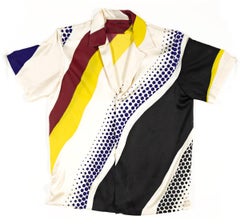
Color screenprint on silk sateen shirt. With the artist's signature and date screenprinted and numbered 3/100 in ink, on the label. Printed by the Fabric Workshop, Philadelphia. Publ...

Category

1970s Pop Art General Idea More Art

Materials

Silk, Screen

Previously Available Items
Le Fin
Le Fin

General IdeaLe Fin, 1988

Sold

H 9 in W 8.25 in

Le Fin

By General Idea

Located in Toronto, Ontario

In 1967, General Idea was founded in Toronto by AA Bronson (b. 1946), Felix Partz (1945-1994), and Jorge Zontal (1944-1994). Over the course of 25 years, they made a significant cont...

Category

1980s Conceptual General Idea More Art

Materials

Textile

Lucre
Lucre

General IdeaLucre, 1989

Sold

H 9 in W 8.25 in

Lucre

By General Idea

Located in Toronto, Ontario

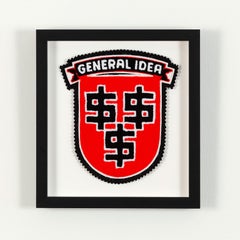
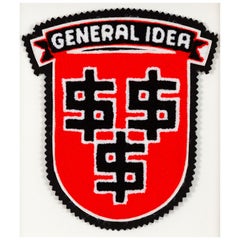
In 1967, General Idea was founded in Toronto by AA Bronson (b. 1946), Felix Partz (1945-1994), and Jorge Zontal (1944-1994). Over the course of 25 years, they made a significant contribution to postmodern and conceptual art in Canada and beyond. General Idea was both prolific and multi-disciplinary long before it became de rigueur. Together, they worked across photography, sculpture, painting, mail art, video, installation, multiples, and performance. The group also made a significant number of unconventional editioned works and was inspired by the idea of the anti-art object. Thematic continuity was a key element in General Idea's work. Early on they introduced talismans or logos that they would revisit and re-envision, including skulls, ziggurats, and poodles. They were particularly interested in (European) crests used for centuries to represent a city, district, or even a creative or professional guild. General Idea both appropriated and reinterpreted existing crests (often by replacing a lion with a poodle) as well as creating crests that were entirely of their own imagination. Between 1988 and 1989, General Idea created 8 chenille crests with some of their most iconic motifs. These crests recalled their traditional European antecedents and the aesthetics of high-school sports teams and varsity jackets. "Lucre" features a trio of stylized dollar signs completed in a palette of crimson red, black, and white. It is possible that the dollar signs are personified in what seems to be a pseudo self-portrait, a recurring trope throughout General Idea's oeuvre that envisions the trio in campy, cartoonish, or absurd renditions of group self-portraits. While these crests were intended to be an unlimited edition, according to the General Idea Editions catalog raisonné, less than 100...

Category

1980s Conceptual General Idea More Art
Materials

Textile

Eye of the Beholder
Eye of the Beholder

Eye of the Beholder

By General Idea

Located in Toronto, Ontario

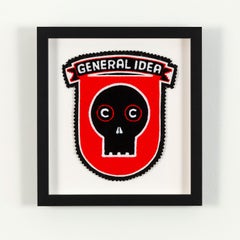
In 1967, General Idea was founded in Toronto by AA Bronson (b. 1946), Felix Partz (1945-1994), and Jorge Zontal (1944-1994). Over the course of 25 years, they made a significant contribution to postmodern and conceptual art in Canada and beyond. General Idea was both prolific and multi-disciplinary long before it became de rigueur. Together, they worked across photography, sculpture, painting, mail art, video, installation, multiples, and performance. The group also made a significant number of unconventional editioned works and was inspired by the idea of the anti-art object. Thematic continuity was a key element in General Idea's work. Early on they introduced talismans or logos that they would revisit and re-envision, including skulls, ziggurats, and poodles. This work, with it's stylized cartoon skull (with copyright symbol eyes) is one of these logos or mascots that make several appearances in their oeuvre. Click here to see another example of this skull. General Idea was particularly interested in (European) crests used for centuries to represent a city, district, or even a creative or professional guild. They both appropriated and reinterpreted existing crests in addition to creating ones entirely of their own imagination. Between 1988 and 1989, General Idea produced 8 chenille crests with some of their most iconic motifs. These crests recalled their traditional European antecedents and the aesthetics of high-school sports teams and varsity jackets. "Eye of the Beholder" features a single stylized skull completed in General Idea's signature palette of crimson red, black, and white. The skull motif epitomizes their campy, cartoonish, or absurd emblems. While these crests were intended to be an unlimited edition, according to the General Idea Editions catalog raisonné, less than 100...

Category

1980s Conceptual General Idea More Art
Materials

Textile

When Fur Flies
When Fur Flies

When Fur Flies

By General Idea

Located in Toronto, Ontario

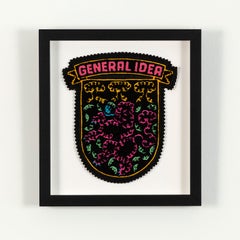
In 1967, General Idea was founded in Toronto by AA Bronson (b. 1946), Felix Partz (1945-1994), and Jorge Zontal (1944-1994). Over the course of 25 years, they made a significant contribution to postmodern and conceptual art in Canada and beyond. General Idea was both prolific and multi-disciplinary long before it became de rigueur. Together, they worked across photography, sculpture, painting, mail art, video, installation, multiples, and performance. The group also made a significant number of unconventional editioned works and were inspired by the idea of the anti-art object. Thematic continuity was a key element in General Idea's work. Early on they introduced talismans or logos that they would revisit and re-envision, including skulls, ziggurats, and poodles. They were particularly interested in (European) crests used for centuries to represent a city, district, or even a creative or professional guild. General Idea both appropriated and reinterpreted existing crests (often by replacing a lion with a poodle) as well as creating crests that were entirely of their own imagination. Between 1988 and 1989, General Idea created 8 chenille crests with some of their most iconic motifs. These crests recalled their traditional European antecedents and the aesthetics of high-school sports teams and varsity jackets. "When the Fur Flies" is the most colorful and curious example from the series. A pink poodle, which appears almost as a curly abstraction, mimics the lion's pose often seen in traditional European iconography. Behind the famous General Idea mascot are stylized three yellow mushroom clouds. This design is a classic General Idea; subversive, zany, queer, and mischievous. While these crests were intended to be an unlimited edition, according to the General Idea Editions catalog raisonné, less than 100...

Category

1980s Conceptual General Idea More Art
Materials

Textile

Ouroboros
Ouroboros

General IdeaOuroboros, 1988

Sold

H 9 in W 8.25 in

Ouroboros

By General Idea

Located in Toronto, Ontario

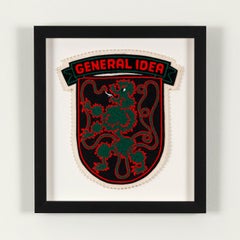
In 1967, General Idea was founded in Toronto by AA Bronson (b. 1946), Felix Partz (1945-1994), and Jorge Zontal (1944-1994). Over the course of 25 years, they made a significant contribution to postmodern and conceptual art in Canada and beyond. General Idea was both prolific and multi-disciplinary long before it became de rigueur. Together, they worked across photography, sculpture, painting, mail art, video, installation, multiples, and performance. The group also made a significant number of unconventional editioned works and was inspired by the idea of the anti-art object. Thematic continuity was a key element in General Idea's work. Early on they introduced talismans or logos that they would revisit and re-envision, including skulls, ziggurats, and poodles. They were particularly interested in (European) crests used for centuries to represent a city, district, or even a creative or professional guild. General Idea both appropriated and reinterpreted existing crests (often by replacing a lion with a poodle) as well as creating crests that were entirely of their own imagination. Between 1988 and 1989, General Idea created 8 chenille crests with some of their most iconic motifs. These crests recalled their traditional European antecedents and the aesthetics of high-school sports teams and varsity jackets. "Ouroboros" features General Idea's most famous mascot, the poodle, who mimics the lion's pose often seen in traditional European iconography. Entangled in the twists and curls of its tail, the poodle appears to be consuming the tip of it, embodying the full 'ouroboros' or circle of life. Completed in a menacing palette of black, forest green, and electric red, this design is a classic General Idea; subversive, zany, and mischievous. While these crests were intended to be an unlimited edition, according to the General Idea Editions catalog raisonné, less than 100...

Category

1980s Conceptual General Idea More Art
Materials

Textile

Phoenix with a P
Phoenix with a P

Phoenix with a P

By General Idea

Located in Toronto, Ontario

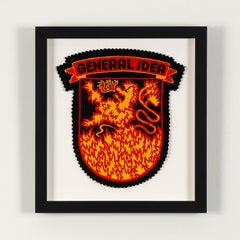
In 1967, General Idea was founded in Toronto by AA Bronson (b. 1946), Felix Partz (1945-1994), and Jorge Zontal (1944-1994). Over the course of 25 years, they made a significant contribution to postmodern and conceptual art in Canada and beyond. General Idea was both prolific and multi-disciplinary long before it became de rigueur. Together, they worked across photography, sculpture, painting, mail art, video, installation, multiples, and performance. The group also made a significant number of unconventional editioned works and was inspired by the idea of the anti-art object. Thematic continuity was a key element in General Idea's work. Early on they introduced talismans or logos that they would revisit and re-envision, including skulls, ziggurats, and poodles. They were particularly interested in (European) crests used for centuries to represent a city, district, or even a creative or professional guild. General Idea both appropriated and reinterpreted existing crests (often by replacing a lion with a poodle) as well as creating crests that were entirely of their own imagination. Between 1988 and 1989, General Idea created 8 chenille crests with some of their most iconic motifs. These crests recalled their traditional European antecedents and the aesthetics of high-school sports teams and varsity jackets. In this variation of the mythological phoenix, a poodle with fierce claws and a dragon's fire breath emerges from stylized flames that mirror the animal's fur. This blend of camp, kitsch, and historical iconography epitomizes General Idea. While these crests were intended to be an unlimited edition, according to the General Idea Editions catalog raisonné, less than 100...

Category

1980s Conceptual General Idea More Art
Materials

Textile

Post Mortem
Post Mortem

General IdeaPost Mortem, 1988

Sold

H 9 in W 8.25 in

Post Mortem

By General Idea

Located in Toronto, Ontario

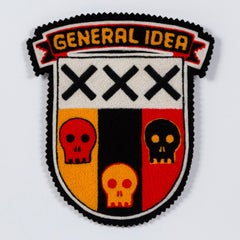
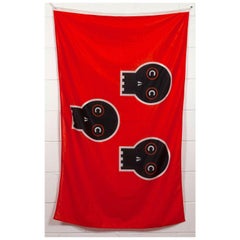
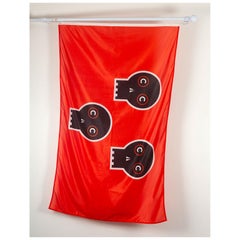
In 1967, General Idea was founded in Toronto by AA Bronson (b. 1946), Felix Partz (1945-1994), and Jorge Zontal (1944-1994). Over the course of 25 years, they made a significant contribution to postmodern and conceptual art in Canada and beyond. General Idea was both prolific and multi-disciplinary long before it became de rigueur. Together, they worked across photography, sculpture, painting, mail art, video, installation, multiples, and performance. The group also made a significant number of unconventional editioned works and was inspired by the idea of the anti-art object. Thematic continuity was a key element in General Idea's work. Early on they introduced talismans or logos that they would revisit and re-envision, including skulls, ziggurats, and poodles. They were particularly interested in (European) crests used for centuries to represent a city, district, or even a creative or professional guild. General Idea both appropriated and reinterpreted existing crests (often by replacing a lion with a poodle) as well as creating crests that were entirely of their own imagination. Between 1988 and 1989, General Idea created 8 chenille crests with some of their most iconic motifs. These crests recalled their traditional European antecedents and the aesthetics of high-school sports teams and varsity jackets. "Post Mortem" features a trio of stylized skulls completed in an alternating palette of saffron, crimson red, and black. The triple skull motif recurs throughout their oeuvre and stands as an iconic example of their campy, cartoonish, or absurd renditions of group self-portraits. While these crests were intended to be an unlimited edition, according to the General Idea Editions catalog raisonné, less than 100...

Category

1980s Conceptual General Idea More Art
Materials

Textile

General Idea more art for sale on 1stDibs.
Find a wide variety of authentic General Idea more art available for sale on 1stDibs. You can also browse by medium to find art by General Idea in fabric, nylon, screen print and more. Much of the original work by this artist or collective was created during the 1990s and is mostly associated with the modern style. Not every interior allows for large General Idea more art, so small editions measuring 39 inches across are available. Customers who are interested in this artist might also find the work of Carlo Carrà, Haren Das, and Gobardhan Ash. General Idea more art prices can differ depending upon medium, time period and other attributes. On 1stDibs, the price for these items starts at $1,480 and tops out at $1,480, while the average work can sell for $1,480.