George Henry Hall Art

American, 1825-1913

George Henry Hall was a popular and highly esteemed American artist, “in his time . . . the best-known specialist of still life in the mid-nineteenth century” (William H. Gerdts, Painters of the Humble Truth: Masters of American Still Life, 1801–1939 [1981], p. 93). Born in Manchester, New Hampshire, Hall was initially a self-taught portrait and genre painter, working in Boston from 1842 to 1849. He began to exhibit at the Boston Athenaeum in 1846 and showed there regularly through 1868. In 1848, Hall extended his patronage circle to New York City, selling three pictures to the American Art-Union. He began, as well, a mentoring correspondence with Andrew Warner, the influential Corresponding secretary of the Art-Union. Although Hall hoped to travel to Italy to hone his artistic skills, at Warner’s urging he amended his plan and agreed to study at the academy in Düsseldorf, Germany, which was becoming an important training ground for American painters. (For a discussion of American artists at Düsseldorf, see The High Museum of Art, Atlanta, Georgia, The Düsseldorf Academy and the Americans: An Exhibition of Drawings and Watercolors, exhib. cat. [1972]. For an early reference in the literature to the Hall/Warner correspondence, see Patricia Hills, “The Genre Painting of Eastman Johnson: The Sources and Development of His Style and Themes,” [Ph.D dissertation, New York University, 1973; Garland Pub., 1977], pp. 27–31.) Emanuel Leutze, a German-born American artist with strong ties to the Art-Union, had been among the first Americans to go to Düsseldorf, arriving in 1841. Richard Caton Woodville, another protégé of the Art Union, studied in Düsseldorf in 1845–46. In 1849, John Godfrey Boker opened his Düsseldorf Gallery in New York City, putting the merits of the German school front and center before the American art public. More than offering just encouragement, the Art-Union (presumably with Warner’s warm advocacy) subsidized Hall’s German study with the purchase of seven canvases in 1849. Hall traveled to Europe with his good friend, Eastman Johnson, who, at Hall’s urging, also solicited patronage from the Art-Union, and was rewarded by the purchase of two of his crayon drawings. Hall and Johnson sailed for Europe in August 1849, landing in Antwerp and making their way to Düsseldorf.

Hall remained in Düsseldorf for one year, moved to Paris for further study, and then went on to Rome before returning to New York in 1852. Although the Art-Union ceased operations in 1852, Hall settled in New York and exhibited his European-inspired genre and figure paintings (along with an occasional portrait) at the National Academy of Design, where he was elected an associate academician. In 1857, Hall showed Sweet Peas: A Study from Nature at the N.A.D. and A Study of Sweet Peas at the Boston Athenaeum, the first records of his exhibiting the still-life subjects for which he was to become well-known. As the subtitle “A Study from Nature” indicates, Hall’s early still-life work was influenced by the painting aesthetic of “truth to nature,” the rallying cry of the English art critic and arbiter of taste, John Ruskin. Hall’s still life paintings of the 1850s and 1860s are precisely drawn and colored evocations of fruits and flowers, very much consistent with the style of the American Pre-Raphaelites. (See Linda S. Ferber and William H. Gerdts, The New Path: Ruskin and the American Pre-Raphaelites, exhib. cat. [New York: Brooklyn Museum of Art, 1985] for the most recent and thorough discussion of this subject.)

Hall exhibited energetically throughout his career and was a constant presence in the major annual exhibitions of his day. In addition to The Boston Athenaeum, the American Art Union, and the National Academy of Design, Hall also showed at the Pennsylvania Academy of the Fine Arts, Philadelphia, from 1853; the Brooklyn Art Association, New York, from 1861; The Boston Art Club, in 1881 and 1889; the Art Institute of Chicago, in 1888; and in London, at Grosvenor Gallery, in 1889 and 1890. In 1868 he was elected an academician at the National Academy of Design, taking an active role there as treasurer and as a member of the governing council at various times. He also belonged to the Century Club in New York City and frequently exhibited his pictures there, where they were seen by the artistic and literary elite of the time.

In the 1860s, Hall concentrated on still-life painting, a choice that appears to have been very financially rewarding. The Cosmopolitan Art Journal singled Hall out in a March 1860 article, “The Dollars and Cents of Art,” noting the handsome prices the artist was receiving for his still-life paintings (as cited in William H. Gerdts, op. cit., p. 93). Like a number of American artists, Hall periodically sold groups of his canvases in consolidated sales in order to raise money for foreign travel. In 1860, for example, Hall sold 143 paintings, many of them works that he had exhibited at the National Academy of Design, which realized sufficient money to support him in Spain for a number of years. On April 18, 1863, the New York Evening Post reported that “the sale at auction of the pictures of George W. [sic] Hall shows that the fine arts are not languishing” (transcript in Hirschl & Adler archives). Thus, even in the darkest days of the Civil War, Hall realized over $7,000 from a group of works whose images included both still-life and European genre subjects. In 1865, Hall did even better, raising over $12,000 in a sale of “seventy-five small but carefully elaborated fruit and flower pieces” (Henry Tuckerman, Book of the Artists [1867], p. 482).

Though never an expatriate, Hall demonstrated by his frequent and lengthy trips a great zest for the life of an American artist in Europe. He spent an accumulated twenty one years of his career on the Continent, primarily in Spain and Italy. In 1872, Hall went to Italy and lived for a year in Rome before marrying a woman from Capri. In 1875 and 1876, he traveled to Egypt and Palestine, extending his search for exotic subject matter and fanciful bric-a-brac to satisfy American tastes. Hall returned to Italy for a four-year stay in 1883. During this trip he established a close friendship with two expatriate American painters who were themselves best friends, Elihu Vedder and Charles Caryl Coleman. Coleman had owned a villa on Capri since 1880.

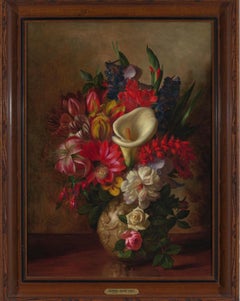
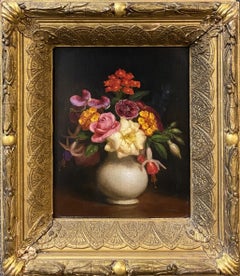
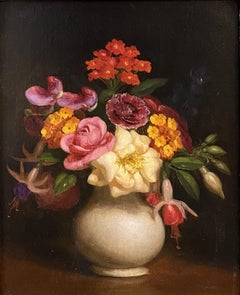
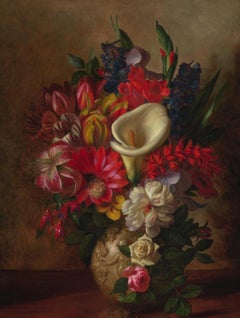
In the decade of the 1870s Hall resumed figure and genre work, while continuing his successful career as a still-life painter. In addition to extensive travel, he established studio/residences both in New York City and in the Catskill mountains. Beginning in 1867, Hall spent summers in the Catskills, near the village of Palenville. From 1874 to 1883, he was a tenant at the famous Studio Building on West 10th Street in Greenwich Village, the center of New York City art life. In Palenville, Hall contributed to the local color by covering the chimney of his studio cottage with tiles he brought home from Spain, a design choice sufficiently idiosyncratic and exotic that the Hall cottage became one of the local tourist attractions. When Hall painted Still Life of Flowers in a White Vase in 1860, he was enjoying his first crest of popularity as a still-life painter. Here Hall puts these lovely and delicate flowers into a porcelain case and places them on his characteristic polished wood table, offering the viewer an image of grace, elegance and simple domestic charm.

(Biography provided by Hirschl & Adler)
to
2
7
7
5
3
1
1
Water Lilies
Water Lilies

Water Lilies

By George Henry Hall

Located in Bryn Mawr, PA

Water Lilies, 1881 Oil on canvas, 7 1/2 x 12 inches (19.1 x 30.5 cm) Framed dimensions: 16 1/8 x 21 1/8 inches Signed and dated lower left: Geo. Henry Hall '81 George Henry Hall was...

Category

1880s Hudson River School George Henry Hall Art

Materials

Canvas, Oil

Still Life with Flowers in a White Vase

Still Life with Flowers in a White Vase

By George Henry Hall

Located in Milford, NH

A finely detailed still life with flowers in a white vase by American artist George Henry Hall (1925-1913). Hall was born in Manchester, NH, and began his career as an artist at the ...

Category

Mid-19th Century George Henry Hall Art

Materials

Canvas, Oil

Mid-19th Century Signed Oil Painting of Raspberries Still Life

Mid-19th Century Signed Oil Painting of Raspberries Still Life

By George Henry Hall

Located in Fredericksburg, VA

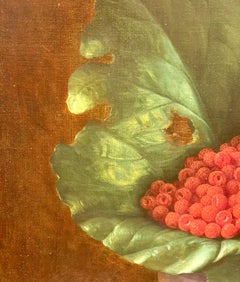
Raspberries by George Henry Hall is a striking and beautifully refined still life painted in 1865, demonstrating the artist’s extraordinary attention to texture, color, and compositi...

Category

Mid-19th Century George Henry Hall Art

Materials

Board, Oil

Victorian Arrangement Oil Painting on Canvas, Signed, 1864, Framed

Victorian Arrangement Oil Painting on Canvas, Signed, 1864, Framed

By George Henry Hall

Located in Bryn Mawr, PA

Victorian Arrangement, 1864 Oil on canvas 27 x 20 inches (68.6 x 50.8 cm) Framed dimensions: 32 x 24 3/4 inches Signed and dated lower right: G.H. Hall / 1864 Provenance Private col...

Category

1860s Victorian George Henry Hall Art

Materials

Canvas, Oil

Raspberries, Peonies with a Basket

Raspberries, Peonies with a Basket

By George Henry Hall

Located in Saratoga Springs, NY

George Henry Hall (1825–1913) "Raspberries & Peonies with Basket" Signed lower right and dated 1862 & 63 Oil on board Sight size: 10.5 × 13.75 in. Frame size: 19 x 22 in. Frame: P...

Category

1860s Hudson River School George Henry Hall Art

Materials

Oil, Board

Cherubs
Cherubs

George Henry HallCherubs, 1875

$3,000Sale Price|64% Off

Cherubs

By George Henry Hall

Located in Wilton Manors, FL

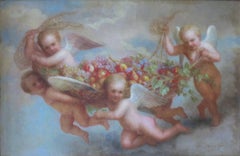
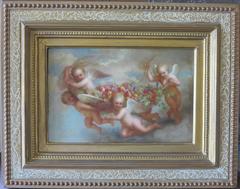
George Henry Hall (1825-1913). Cupids, 1875. Oil on canvas, 6 x 9.25 inches; 10 x 13.25 inches framed. Original frame with label verso. Excellent condition with no damage or restoration. Signed and dated lower right. Price on request Biography: Birth place: Manchester, NH Addresses: Primarily in NYC from 1852 Profession: Still-life, genre, portrait painter Studied: between 1849-52 in Paris and Rome; and Düsseldorf Royal Acad. with Eastman Johnson Exhibited: PAFA, 1853-68; Royal Acad., British Inst., Suffolk Street Gal., all in London, 1858-74; Brooklyn AA, 1861-81; NAD, 1862-1900; AIC, 1888; Boston AC, 1881, 1889 Member: ANA, 1853; NA, 1868; Century Assn. Work: MMA; BM; BMFA Comments: Best known for his still-lifes, he specialized in detailed and vividly colored fruit and flower...

Category

19th Century Realist George Henry Hall Art

Materials

Canvas, Oil

Signed Original George Henry Hall Oil Painting

Signed Original George Henry Hall Oil Painting

By George Henry Hall

Located in Sag Harbor, NY

American Artist George Henry Hall was born on September 21, 1825 in Boston, Massachusetts. Hall opened a studio in New York City in 1852. The Smithsonian deems him to be "one of the ...

Category

1860s Spanish Antique George Henry Hall Art

Materials

Canvas

Related Items
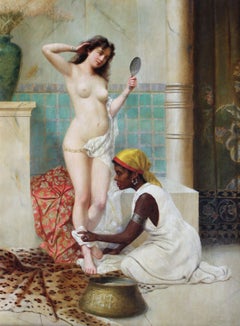
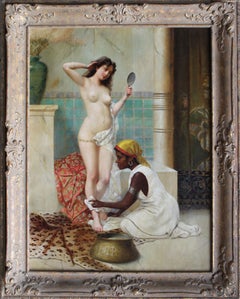
The Bath. Late 19th Century. Oil on canvas, 61x46 сm

The Bath. Late 19th Century. Oil on canvas, 61x46 сm

Located in Riga, LV

Vinsent G. Stiepevich (1841 - 1910) Russian and American artist. Emigrated to New York in 1878, where he lived in Brooklyn, Vincent Stiepevich was noted for his realist painting style of portrait, figure and genre subjects, especially in Harem and Orientalist* settings. Memberships in New York included the Artists Fund Society* the Brooklyn Art Association*, 1878-82, 1891; National Academy of Design*, 1878-91; Pennsylvania Academy of the Fine Arts* annual, 1885, 1888-91; Boston Art...

Category

Late 19th Century Realist George Henry Hall Art

Materials

Canvas, Oil

19th Century pair of still life oil paintings of fruit and flowers

19th Century pair of still life oil paintings of fruit and flowers

By Oliver Clare

Located in Nr Broadway, Worcestershire

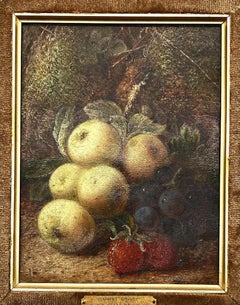
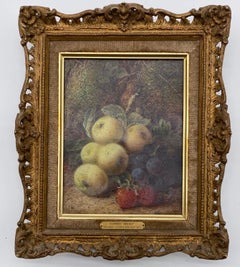
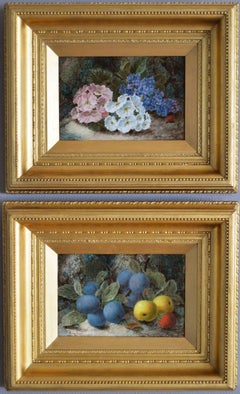
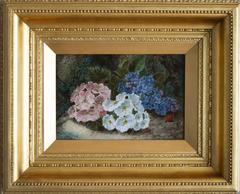
***PLEASE NOTE: EACH PAINTING INCLUDING THE FRAME MEASURES 13 INCHES X 16 INCHES*** Oliver Clare British, (1853-1927) Still Life of Fruit & Still Life of Flowers Oil on canvas, pair, both signed & dated ‘92 Image size: 6 inches x 9 inches (each) Size including frame: 13 inches x 16 inches (each) An appealing pair of still life paintings by Oliver Clare. The first painting shows primroses and lilac blossom next to a red berry. In the second, damsons can be seen next to apples and a strawberry. Oliver Clare was born in Birmingham in 1853, the son of the flower artist George Clare (1839-1890) and his wife Elizabeth Bowen. His brother Vincent Clare (1856-1917) also became an artist and both would have received tuition from their father who influenced their style and subject matter. At the age of 18 he enlisted as a soldier in the Kings Own regiment, but gave this up to become a full time artist. Like his father, Clare specialised in still life paintings, containing fruit and garden flowers, often on mossy banks. Sometime after 1871, he moved to London where he married Emma Mary Webb...

Category

19th Century Victorian George Henry Hall Art

Materials

Canvas, Oil

"Merc Power" (2019) by Sheri Farabaugh, Still Life Oil Painting

"Merc Power" (2019) by Sheri Farabaugh, Still Life Oil Painting

By Sheri Farabaugh

Located in Denver, CO

"Merc Power" (2019) by Sheri Farabaugh (United States Based) is a handmade still life oil painting that depicts a scene on a lake, with a closeup of a boat engine in deep blue waters...

Category

2010s Impressionist George Henry Hall Art

Materials

Oil, Board

"Still Life" by Cornelis Le Mair 31 x 24 inch Oil on Board

"Still Life" by Cornelis Le Mair 31 x 24 inch Oil on Board

By Cornelis Le Mair

Located in Atlanta, GA

Item is in excellent condition and has only been displayed in a gallery setting. Item includes frame; framed dimensions are approximately 31 x 38 inches. Cornelis le Mair is truly a renaissance man, encompassing all disciplines of the arts. He enjoys painting, drawing, writing, architecture, sculpture, and interior design. Le Mair was born in Eindhoven, The Netherlands in 1944. He began drawing and painting at the young age of five and while in kindergarten, he was often made to show his paintings in other classes even though he was shy about doing so. “When I could not play outside because of bad weather, I would sit in my bedroom and would draw.” His early art studies were widely influenced by the Rembrandt exhibit in the Rijksmuseum (1956) that he attended with his father. There le Mair was inspired by the Old Masters and “the desire to unravel all the mysteries hidden under the cracked varnish” began. Already having painted a lifesize copy of “The Nightwatch” on the wall of his bedroom, le Mair was continually driven by the Rembrandt exhibit. He began to experiment with resins, pigments and oils in order to hone and perfect the technique of the old masters. He studied drawings and paintings and early on developed the feeling of color and composition. After completing high school, he worked for a short period as a designer of woven fabrics. Although his heart desired to paint, he enjoyed having a pencil and brush in hand and a case full of art books and says, “This treasure of inspiring information took me further on track to the traditional trade.” At this same time, le Mair’s artistic endeavors led him to learn the art of music. First learning to play the guitar from friends, he began performing at youth centers. This love of music expanded into him learning to play the mandolin, turning lye, banjo, and bagpipes. Just after his eighteenth birthday, le Mair was accepted into military service where his lack of conforming led him to a maximum solitary confinement sentence. After a month in training, the army physician and le Mair agreed that he was born to be an artist and released le Mair from military services. Once he returned home, with the encouragement from his parents, le Mair began his art schooling at the Art Academy (Kustacademie) in ‘s-Hertogenbosch, The Netherlands. There he found that the school was geared for modernism and after painting a portrait of a fellow classmate, his teachers advised le Mair to look for a school where the traditional ideas were still taught. Longing to study the classical arts, he applied and was accepted to the Academy of Fine Arts (Koninklijke Kunstacademie) in Antwerp, Belgium in 1965. After studying under Professor Victor Dolphijn, le Mair graduated cum laude in portrait and figure paintings in 1968. He was then promoted to study as a student of the Higher Institute, a structure at a higher university level where he studied under Rik Slabbinck...

Category

21st Century and Contemporary Victorian George Henry Hall Art

Materials

Oil, Board

"Grand Manan" Harrison Bird Brown, Maine Landscape, Hudson River School Seascape

"Grand Manan" Harrison Bird Brown, Maine Landscape, Hudson River School Seascape

By Harrison Bird Brown

Located in New York, NY

Harrison Bird Brown (1831 - 1915) Grand Manan Oil on canvas 12 x 20 inches Signed with initials lower left Harrison Bird Brown was born in 1831 in Portland, Maine, and is best known for his White Mountain landscapes and marine paintings of Maine's Casco Bay...

Category

Late 19th Century Hudson River School George Henry Hall Art

Materials

Canvas, Oil

19th Century Vintage Still Life Painting by Vincent Clare. Victorian art.

19th Century Vintage Still Life Painting by Vincent Clare. Victorian art.

By Vincent Clare

Located in PARIS, FR

Conditions: Very good overall condition. Edge right, visible under UV Light, minor retouching (5mm). The frame is period frame original baring stickers from Galleries in London. Di...

Category

Late 19th Century Victorian George Henry Hall Art

Materials

Oil

19th century English study of Apples and fruit on a ledge

19th century English study of Apples and fruit on a ledge

By William Hughes

Located in Woodbury, CT

William Hughes British, 19th Century Study of Apples, circa 1870 Oil on panel Monogrammed lower right A finely observed and intimate still life by William Hughes, painted circa 1870, depicting a small grouping of apples arranged upon a simple wooden surface. Executed with quiet restraint and technical assurance, the composition reflects the enduring appeal of Victorian still life painting, where humble subjects are elevated through careful observation and painterly sensitivity. The apples, shown attached to a slender branch with leaves, are rendered with particular attention to texture and natural variation. Subtle transitions of colour—soft greens, warm russets, and touches of golden ochre—capture the ripeness and individuality of each fruit. The surfaces are delicately modelled, with highlights and imperfections thoughtfully described, lending the work both realism and charm. Set against a rich, dark background, the fruit is brought into sharp relief, a compositional device that enhances both depth and focus. The contrast between the illuminated forms and the shadowed ground creates a sense of quiet drama, while the horizontal line of the wooden ledge anchors the composition with stability and balance. Hughes’ handling is confident yet controlled, combining fine brushwork with a painterly softness that avoids excessive detail. The leaves and stems are treated with a lighter touch, providing a natural counterpoint to the more solid forms of the apples. This balance between precision and atmosphere is characteristic of well-executed 19th-century British still life painting...

Category

1870s Victorian George Henry Hall Art

Materials

Oil, Wood Panel

Victorian Still Life Oil Painting of Fruit Peaches Grapes on Platter

Victorian Still Life Oil Painting of Fruit Peaches Grapes on Platter

Located in Cirencester, Gloucestershire

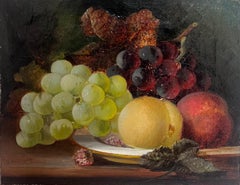
Still Life of Fruit by Frederick J Stanier (1830-c.1912) oil on canvas, unframed canvas: 8.25 x 10 inches provenance: private collection, England condition: a few minor scuffs and m...

Category

19th Century Victorian George Henry Hall Art

Materials

Oil, Canvas

“Quebec City, 1853” Panoramic Landscape View, Cityscape, Canada Signed Oil

“Quebec City, 1853” Panoramic Landscape View, Cityscape, Canada Signed Oil

By Edmund C. Coates

Located in Yardley, PA

“Quebec City, 1853” by Edmund C. Coates (American, 1816-1871). A luminous 19th-century view of Quebec City by the American painter Edmund C. Coates, known for his detailed Hudson Ri...

Category

1850s Hudson River School George Henry Hall Art

Materials

Canvas, Oil

“Lake in the Adirondacks” by Levi Wells Prentice 19th C. American Landscape

“Lake in the Adirondacks” by Levi Wells Prentice 19th C. American Landscape

By Levi Wells Prentice

Located in Yardley, PA

About this work: “Lake in the Adirondacks” by Levi Wells Prentice (American, 1851-1935). A charming and finely detailed Adirondacks landscape by Prentice. This composition looks out...

Category

Late 19th Century Hudson River School George Henry Hall Art

Materials

Canvas, Oil

Previously Available Items
George Henry Hall, Oil on Canvas, 1892

George Henry Hall, Oil on Canvas, 1892

Sold

H 39 in W 34 in D 2 in

George Henry Hall, Oil on Canvas, 1892

By George Henry Hall

Located in Long Island City, NY

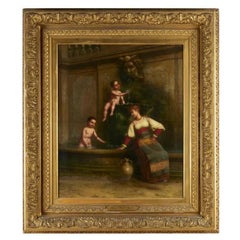
George Henry Hall, oil on canvas, 1892, George Henry Hall (American, 1825-1913), Woman with Children in Fountain, signed "Geo Henry Hall" and dated...

Category

Late 19th Century North American Antique George Henry Hall Art

Materials

Canvas

George Henry Hall art for sale on 1stDibs.

Find a wide variety of authentic George Henry Hall art available for sale on 1stDibs. You can also browse by medium to find art by George Henry Hall in canvas, fabric, oil paint and more. Not every interior allows for large George Henry Hall art, so small editions measuring 14 inches across are available. Customers who are interested in this artist might also find the work of Catherine Koenig, Kirsten Savage, and Raymond Bonilla. George Henry Hall art prices can differ depending upon medium, time period and other attributes. On 1stDibs, the price for these items starts at $3,000 and tops out at $3,000, while the average work can sell for $3,000.