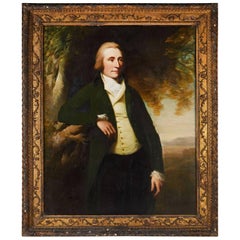
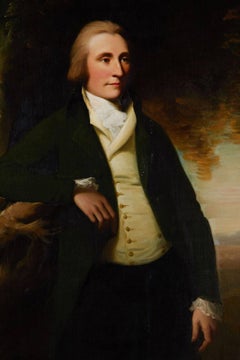
George Romney Art

English, 1734-1802

George Romney is best known as one of British society’s foremost portrait painters of the 18th century, rivaling other widely acknowledged portraitists such as Thomas Gainsborough and Joshua Reynolds.

Born in 1734 in Dalton-on-Furness, Romney was the son of a cabinetmaker. In 1755, he began his artistic career as an apprentice to portrait painter Christopher Steele before traveling to northern England to establish a painting studio in Kendal. Romney’s talent in portraiture proved fruitful. By 1762, he had made enough money to set up a studio in London, where he became renowned for an “ability to paint flattering images regardless of personality.” 

During the 1760s, Romney had hoped to become a history painter but was unsuccessful. To refine and improve his technique, he traveled to Rome in 1773, where he spent two years studying the Old Masters, including Titian, Correggio and Raphael. While there, he was also influenced by the works of Swiss painter Henry Fuseli.  

Upon his return to London, in 1775, and with his newly honed painting style, Romney became even more popular among the British aristocracy and nobility. Although his primary aspiration was to make a living as a historical painter, Romney was in demand as a portraitist. His favorite subjects were children and women, particularly his muse, Emma Hart — who later became Lady Hamilton and mistress of Admiral Lord Nelson. Romney painted several Romantic portraits and drew many sketches of Lady Hamilton, whom he considered to represent the ideal of feminine beauty.

In his later years, Romney produced several portraits and drawings of Shakespearean subjects for John Boydell’s Shakespeare Gallery in 1790. 

Romney’s figurative works, portraits and prints are held in collections of numerous major museums and galleries, including the National Portrait Gallery in London, the National Gallery of Canada in Ottawa, the Metropolitan Museum of Art and the Frick Collection in New York. In 2002, an exhibition commemorating the bicentenary of Romney’s death was organized by the National Museums Liverpool in partnership with the National Portrait Gallery and the Huntington Library, Art Collections and Gardens in San Marino, California. 

On 1stDibs, find a range of original George Romney drawings, paintings and prints.

to
1
7
3
7
7
3
3
2
1
1
1
1
1
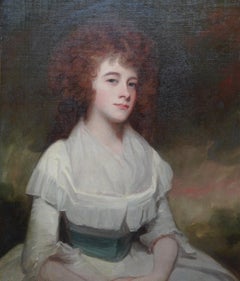
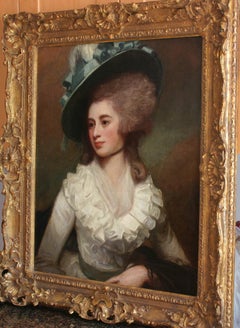
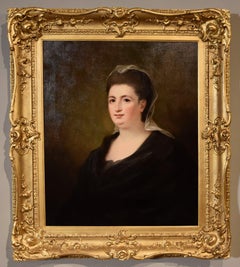
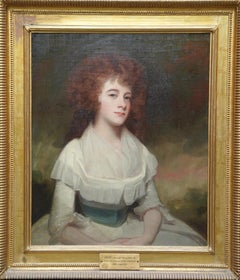
Portrait of Anne Evelyn - British 18thC Old master oil painting excellent prov.

Portrait of Anne Evelyn - British 18thC Old master oil painting excellent prov.

By George Romney

Located in Hagley, England

This stunning British 18th century Old Master portrait oil painting, with exceptional provenance, is by noted artist George Romney. It was painted in 1788, commissioned by James Evelyn of Felbridge as it is of his younger daughter Anne, aged 20 years old. James was a Doctor of Law and Anne's mother was his second wife, Jane. Felbridge house, Anne's home, was in the village of Godstone in Surrey. This superb oil painting is a seated portrait of Anne, wearing a white dress with a green sash, her forearms exposed and her hands in her lap. Anne is blessed with the most wonderful long auburn curly hair and is visually stunning. Her body is partly turned away from the artist/viewer and she is slightly gazing down at us with confident, clear eyes. Anne is pictured in a landscape with a dramatic sky behind her. Romney's brushwork on her dress, hair and the background is superb. The delicate detailing of her facial features is also stunning. Sometimes Old Master portraits can be a little staid, but this one of Anne with her wild auburn hair and bold look is just magnificent. This is a fantastic example of George Romney's work and of an 18th century British Old Master with exceptional detailed provenance. Name plate states: Anne, younger daughter of James Evelyn of Fellbridge Esq. 1788, aged 20. Romney. Provenance. With Charles Cecil Cope Jenkinson, 3rd Earl of Liverpool (1784-1851) With The Hon. Henry Berkeley Portman (1860-1923), Later 3rd Viscount Portman; with Emma, Viscountess Portman (1862-1929) By 1926; with her daughter Lady Moyra Dawson-Damer (1897-1962) Thence by family descent. Painted in 1788. There are various labels verso. Mentioned in Lord Hawkesbury's Catalogues of Portraits at Compton Place and at Buxted Park, in Sussex, 1903, p.18, no. 3, at Buxted Park, as in the 'Dining Room, South Wall'. Further Bibliography: Gower (R. S.) Romney, London, 1904, p. 175 Kidson (Alex) George Romney, A Complete Catalogue of his Paintings, New Haven and London: Yale University Press, 2015, I, p. 205, no. 422 (illus).Ward (Humphrey) and Roberts (William) Romney: A Biographical and Critical Essay, London: T Agnew & Sons, 1904, p. 51 Condition. Oil on canvas. Image size 30 inches by 24 inches and in good condition. Frame. Housed in an ornate gilt frame with name plate, 37 inches by 31 inches and in good condition. George Romney (1734-1802) was born in Dalton-on-Furness, Lancashire, on 15 December 1734, the third of the eleven children of John Romney and Anne Simpson. Leaving school at the age of eleven, he worked for eight years in his father's cabinetmaking workshop before being apprenticed to a local painter, Christopher Steele, with whom he served for two years, from 1755 to 1757, in Kendal, York, and Lancaster. He married a Kendal girl, Mary Abbot...

Category

1780s Old Masters George Romney Art

Materials

Oil

Portrait of Lady Caroline Price

Portrait of Lady Caroline Price

By George Romney

Located in Miami, FL

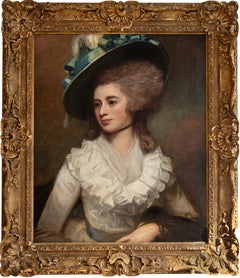
DESCRIPTION: Perhaps the best Romney in private hands. If Vogue Magazine existed in the late 18th century, this image of Lady Caroline Price would be ...

Category

1970s Old Masters George Romney Art

Materials

Oil, Canvas

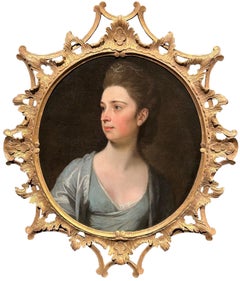
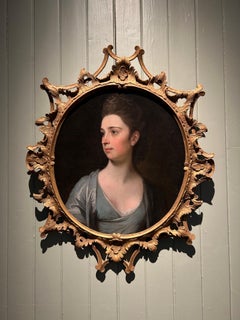
Portrait of Lady Anne Dutton, Oil on canvas, 18th English Century Painting

Portrait of Lady Anne Dutton, Oil on canvas, 18th English Century Painting

By George Romney

Located in London, GB

Oil on canvas, unsigned Image size: 22 x 20 inches (22.75 x 51 cm) Pierced gilt carved frame Provenance Commissioned by James Lenox Dutton (1713-1777) Sherborne House, Dorset Family descent This half-length portrait shows the sitter with her head and eyes looking over her shoulder, to the right. She is dressed in a delicate blue dress and blue shawl with her hair tied up away from her face. The composition of the painting is simple but effective; the woman stands out and is the undeniable focus of the viewer's attention. George Romney's artistic style is characterised by its focus on the beauty and elegance of human forms. Here, one can appreciate his ability to capture the delicacy of facial features and the soft textures of clothing. In addition, Romney has used a soft and diffuse brushstroke technique that creates a light and soft effect in the work. The dark and diffused background highlights the young woman's figure even more, creating an effect of depth and realism. The sitter of this painting is likely Anne Dutton, the daughter of James Lenox Dutton and Jane Bond. Anne Dutton (1743-1821) was the 13 x great great granddaughter of King Edward III, and married politician Samuel Blackwell. Anne sat for portraits by Francis Cotes which bear a striking resemblance to this portrait, and her father was a known patron of Romney. George Romney Romney was a fashionable portrait painter of late 18th-century English society. In his portraits Romney avoided delving into the character or sensibilities of the sitter. His great success with his society patrons depended largely on just this ability for dispassionate flattery. Line rather than colour dominates; the flowing rhythms and easy poses of Roman classical sculpture underlie the smooth patterns of his compositions. From 1755 to 1757 Romney was the pupil of Christopher Steele, an itinerant portrait and genre painter. Romney’s career began when he toured the northern English counties painting portraits for a few guineas each. In 1762 he went to London. His history painting The Death of General Wolfe won him an award from the Society of Arts; nonetheless he turned almost immediately to portrait painting. In 1764 he paid his first visit to Paris, where he was befriended by Joseph Vernet. Romney especially admired the work of Nicolas Le Sueur, whose use of the antique strongly appealed to him. In 1773 he went to Italy for two years, where he studied Raphael’s Stanze frescoes in Rome, Titian’s paintings...

Category

18th Century George Romney Art

Materials

Canvas, Oil

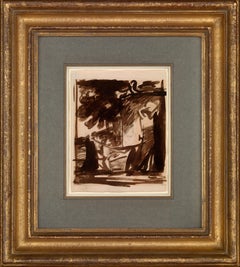
18th century ink study for the Leveson-Gower Children

18th century ink study for the Leveson-Gower Children

By George Romney

Located in London, GB

Collections: J. Goodfriend, USA. Brown wash and pencil on laid paper Framed dimensions: 13.25 x 11.75 inches This powerful drawing was made at the time that Romney was painting the famous group portrait of the Gower Children now in Abbot Hall Art Gallery, Kendal. Romney was a bold and incisive draughtsman who made numerous rich brown ink studies, principally for historical compositions; by contrast, comparatively few studies linked directly to his portraits survive. The existence of a group of studies for the Gower Children underscores its importance to Romney. The sitters were the five youngest of the eight children of Granville, 2nd Earl Gower who, at the time the portrait was commissioned, was President of the Council in Lord North’s government and one of the best-connected and most influential people in England. The present drawing which is a large scale treatment of the composition in its final form perfectly distils Romney’s conceit: the younger children dancing whilst their elder sister, in the guise of a Bacchante plays the tambourine. The bold and dramatic study underlines both the artistic confidence and classical grandeur Romney gained during his trip to Italy between 1773 and 1775. The commission from Granville, 2nd Earl Gower to paint five of his children came shortly after Romney’s Continental tour. The initial idea, as represented by the present drawing, seems to have been to paint Lady Anne, the figure on the right of the composition playing the tambourine, who was the youngest of Gower’s first four children by his second wife Lady Louisa Egerton and who married the Rev. Edward Vernon Harcourt, later Archbishop of York, with three of her younger half-siblings by Gower’s third wife, Lady Susanna Stewart: at the left Lady Georgina, who became Countess of St Germans following her marriage to the Hon. William Eliot; at the right Lady Charlotte Sophia, later Duchess of Beaufort and in the centre Lady Susanna, later Countess of Harrowby. Romney added a fifth child to the finished portrait, Gower’s son: Lord Granville, later created Viscount Granville and Earl Granville. In Italy Romney had produced a large number of studies of classical antiquities and old master paintings. The commission from Gower offered Romney the opportunity to explore a complex multi-figural group, putting into practice the kind of ambitious classical quotations that Reynolds was currently exploiting. In 1773 Reynolds had completed the remarkable group portrait of the Montgomery Sisters, now in the Tate Gallery, London, which showed them adorning a herm of the Roman god Hymen; the composition used a garland to link the three figures who were shown in classical costume dancing at the foot of a Roman sculpture. Scholars have long pointed to a similar sources for the two compositions: the works of Nicolas Poussin. Whilst the Montgomery Sisters is based, in part, on a Bacchanal now in the Musée des Beaux-Arts, the Gower Children has always been associated with Poussin’s Dance to the Music of Time, now in the Wallace Collection, London. It seems more likely that Romney was looking to an antique source in the form of the Borghese Dancers, a Roman relief, then in Palazzo Borghese in Rome. Romney would have seen the relief of interlocking, dancing maidens and would also have known Guido Reni’s Aurora...

Category

18th Century Old Masters George Romney Art

Materials

Ink, Pencil

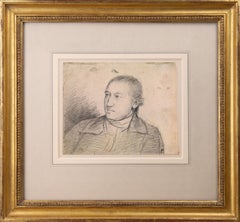
18th century portrait drawing of the Rev. William Atkinson

18th century portrait drawing of the Rev. William Atkinson

By George Romney

Located in London, GB

Collections: Henry Scipio Reitlinger (1882-1950); Private collection, UK to 2019 Framed dimensions: 14.50 x 15.38 inches This drawing is one of only two known portrait drawings by Romney (as opposed to preliminary studies for portraits) and is dated by Alex Kidson as being executed no later than 1769. It is likely that the present drawing was originally part of a sketchbook, now largely dismembered (Abbot Hall Art Gallery, Kendal), which Kidson notes, contained some of Romney’s most beautiful early drawings. This drawing, and a second sheet formerly with Andrew Wyld, have been identifying as depicting the Rev. William Atkinson...

Category

18th Century Old Masters George Romney Art

Materials

Pencil

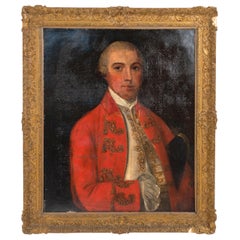
English Georgian Man in Red Coat Portrait

English Georgian Man in Red Coat Portrait

By George Romney

Located in Queens, NY

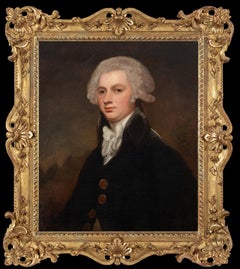
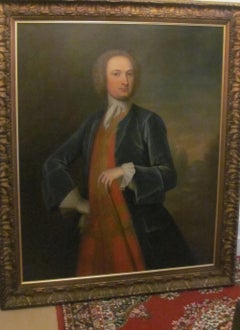
English Georgian gilt framed oil painting portrait of man in red coat with vest (att: Geo. Romney)

Category

20th Century British Georgian George Romney Art

Materials

Paint

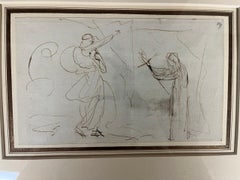
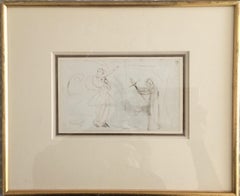
Expulsion of Adam and Eve, Circa 1770, Signed Pen and Ink Drawing

Expulsion of Adam and Eve, Circa 1770, Signed Pen and Ink Drawing

By George Romney

Located in New York, NY

Pen and ink drawing on laid paper by British Master George Romney. The expulsion of Adam and Eve from the Garden of Eden, circa 1770 The Royal Academy in London has a collection of pen and ink drawings on laid paper by George Romney which appear to be from the same period. This is double sided work which causes a shadow on the front. Provenance: Collection of Alfred de Pass The Truro Museum, Cornwall, England Christopher Powney, London Private Collection, CT Christopher Powney of Berwick Fine Art, dated 25 August 1967, authenticated this work. The original letter is included on back of the framed work. Christopher Powney was a London fine art dealer known for his expertise in British Drawings. He is recognized by the British Museum as a London art dealer...

Category

Early 1800s Old Masters George Romney Art

Materials

Pen, Laid Paper, Ink

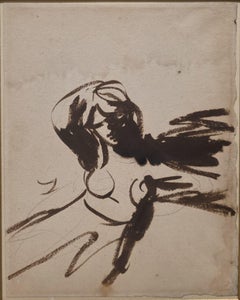
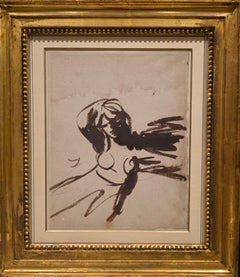
Reclining nude, possibly Emma Hart

Reclining nude, possibly Emma Hart

By George Romney

Located in Stamford, GB

This beautifully fluid ink and brush drawing was made by George Romney in the 1780s and may well relate to the powerful sequence of portraits of Emma Hamilton, in various mythologica...

Category

18th Century George Romney Art

Materials

Pencil, Ink

Related Items
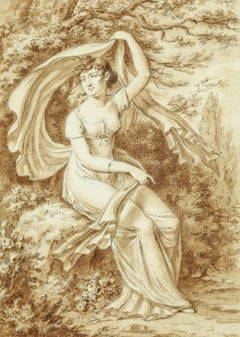
Jean-Henri Cless (1774-1812) Portrait of a young woman, signed drawing

Jean-Henri Cless (1774-1812) Portrait of a young woman, signed drawing

Located in Paris, FR

Jean-Henri Cless (1774-1812) Portrait of a young woman in a landscape signed "Cless fec" for fecit on the lower left Brown ink and brown ink wash on paper Size of the sheet : 31.5 x 22 cm Size of the motive : 24.5 x 17 cm very simply framed under glass without actual frame 32 x 22.5 cm This pre...

Category

Early 1800s Old Masters George Romney Art

Materials

Pencil, Ink

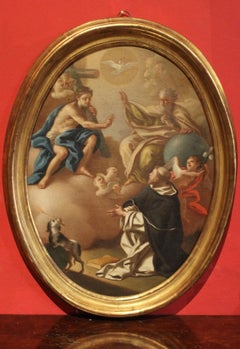
Italian 18th Century Oval Religious Oil on Canvas Painting with Saint Dominic

Italian 18th Century Oval Religious Oil on Canvas Painting with Saint Dominic

By Francesco de Mura

Located in Firenze, IT

This beautiful Italian 18th Century old masters oil painting on oval canvas with giltwood frame is attributed to Solimena and features a religious scene. In this splendid oval-shaped painting are depicted Saint Dominic...

Category

18th Century Old Masters George Romney Art

Materials

Canvas, Oil

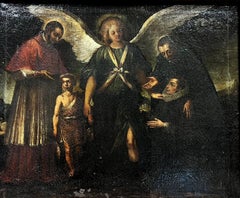
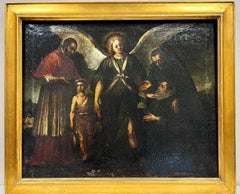
Fine Italian Old Master Oil Painting Angel & Saints Appearing to Figures

Fine Italian Old Master Oil Painting Angel & Saints Appearing to Figures

Located in Cirencester, Gloucestershire

Artist/ School: Italian Old Master, 18th century Title: Angel and Saints appearing to figures, one dressed in a white ruff collar. Medium: oil on canvas...

Category

Early 18th Century Old Masters George Romney Art

Materials

Canvas, Oil

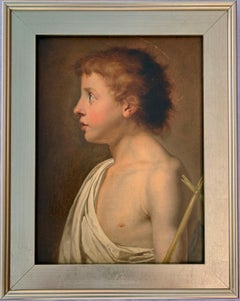
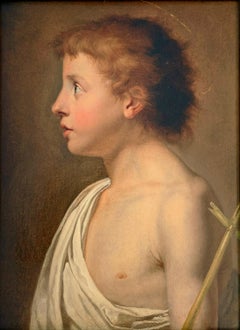
18th Century European Portrait of an Angel, Oil on Canvas

18th Century European Portrait of an Angel, Oil on Canvas

$5,625Sale Price|25% Off

H 19 in W 14.25 in D 3 in

18th Century European Portrait of an Angel, Oil on Canvas

Located in SANTA FE, NM

18th Century European Portrait of an Angel, Oil on Canvas Unsigned 19 x 14 1/4 inches This lovely and sensitively painting has been examined by a professional restorer who was forme...

Category

18th Century Old Masters George Romney Art

Materials

Canvas, Oil

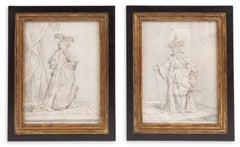
Costume drawings for ‘Ambassadeur de Siam’ and ‘La Sultana Reine’

Costume drawings for ‘Ambassadeur de Siam’ and ‘La Sultana Reine’

Located in Amsterdam, NL

Joseph-Marie Vien (1716-1809) ‘Ambassadeur de Siam’ and ‘La Sultana Reine’ Both titled lower centre, the drawing of the ambassador inscribed with colours intended for the prints, e...

Category

Mid-18th Century Old Masters George Romney Art

Materials

Paper, Pencil

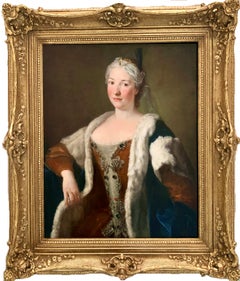
18th century French Old Master Portrait of a woman in oriental costume

18th century French Old Master Portrait of a woman in oriental costume

Located in Aartselaar, BE

French 18th century old master portrait of a majestic lady dressed "à la Turque" The sitter at the viewer with a kind and enigmatic smile and twinkling eyes. She looks elegant and kind, yet also has an intelligent and determined aura, reflecting the character of someone who is in charge of her own life and destiny. De Silvestre paid great attention to her spectacular outfit, which is striking in its portrayal of the sumptuous fabrics and their decorative richness. She is wearing a luxurious royal blue robe à la...

Category

1740s Old Masters George Romney Art

Materials

Canvas, Oil

Large 18th Century European Oil Painting Portrait of Noble Lady Lace Collars

Large 18th Century European Oil Painting Portrait of Noble Lady Lace Collars

Located in Cirencester, Gloucestershire

Portrait of a Noble Lady European School, 18th century oil on canvas, framed framed: 37.5 inches canvas: 30 x 24.5 inches provenance: private collection, France condition: very good ...

Category

18th Century Old Masters George Romney Art

Materials

Oil, Canvas

Portrait of a Gentleman, David Erskine, 13th Laird of Dun, Wearing Armour c.1700

Portrait of a Gentleman, David Erskine, 13th Laird of Dun, Wearing Armour c.1700

Located in London, GB

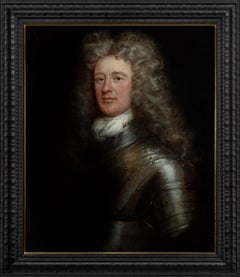
The gentleman in this exquisite oil on canvas portrait, presented by Titan Fine Art, is shown with the grandiloquence characteristic of the English School of painting. He is portray...

Category

17th Century Old Masters George Romney Art

Materials

Oil, Canvas

ALLEGORICAL SCENE - Giovanni Faliero - Italy  Oil on Canvas Painting

ALLEGORICAL SCENE - Giovanni Faliero - Italy Oil on Canvas Painting

By Giovanni Faliero

Located in Napoli, IT

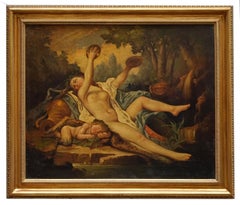
Allegorical Scene - Giovanni Faliero Italia 2009 - Oil on canvas cm. 90x110. This beautiful oil on canvas is the personal reinterpretation of the magnificent painting “Bacchant playing the Cymbals” by Jean-Simon Berthélemy, a French painter of the 18th century. Here we admire a mythological scene showing a naked bacchant playing cymbals next to a wooded stream, with a small sleeping faun...

Category

Early 2000s Old Masters George Romney Art

Materials

Canvas, Oil

large 18th century portrait gentleman oil on canvas

large 18th century portrait gentleman oil on canvas, 18th century

$7,563Sale Price|44% Off

H 58.27 in W 47.64 in D 2.37 in

large 18th century portrait gentleman oil on canvas

Located in York, GB

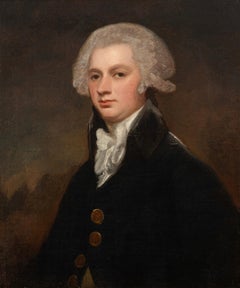
A fine, imposing 18th century portrait of an unknown aristocrat,housed in a gilt frame The artist is also unidentified but certainly a talented hand, in the circle of one of the fine old masters of the period. Unsigned The size overall is 148 x 121 cm whilst the painting is 128 x 101 cm In overall good condition the frame at the bottom has bowed slightly The painting has been checked whilst being cleaned and has not been affected in any way . SHIPPING Free delivery to mainland uk ,worldwide shipping available please email for quote Delivery usually within 14 working days, insured please provide telephone/email details for courier. All taxes/customs etc to be paid for by purchaser. RETURNS (The Consumer Contracts Regulations) Whilst we are sure that you will be extremely happy with your purchase, if for any reason you are not, then you are entitled to return the item to us for a refund. For all purchases made you are entitled to return the item(s) for a period of up to 14 days following receipt by you or a representative indicated by you. Please contact us to confirm that you are returning the item(s) and the reason for doing so. Upon receipt of the item(s) we will refund the purchase price via your original payment method...

Category

18th Century Old Masters George Romney Art

Materials

Oil

Italian School, 16th Century, Study of figures

Italian School, 16th Century, Study of figures

Located in Paris, Île-de-France

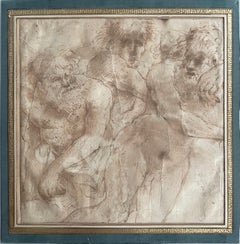
Italian School, 16th Century Studies of Figures Pen and ink on paper, 23 × 24 cm Unsigned A finely executed sheet presenting vigorous figure studies, drawn with assured pen strok...

Category

16th Century Old Masters George Romney Art

Materials

Ink

Rare Jacobean Portrait on Panel Lady Elizabeth Wheeler née Cole 1623 Historical

Rare Jacobean Portrait on Panel Lady Elizabeth Wheeler née Cole 1623 Historical

By Cornelius Johnson

Located in London, GB

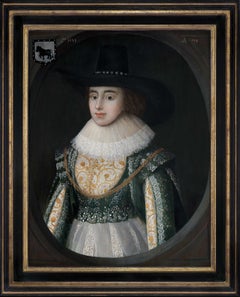
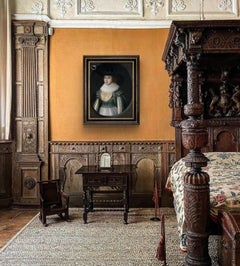
A Rare Jacobean Portrait of Lady Elizabeth Wheeler (née Cole), 1623 Attributed to Cornelius Johnson (1593–1661) This remarkably rare early oil on panel, presented by Titan Fine Art, has emerged as far more than an anonymous “Portrait of a Lady.” Preserved in outstanding condition—its surface retaining exceptional clarity in the lace and textiles—it has only recently been reunited with the identity of its sitter: Elizabeth Cole (1607–1670), later Lady Elizabeth Wheeler, a Westminster gentlewoman whose later life brought her into intimate royal service as laundress for His Majesty’s person. That combination—high quality, uncommon survival, a newly identified sitter, and a life that intersects directly with the last acts of Charles I—places this portrait in a category of genuine rarity. It is not simply a beautiful Jacobean likeness; it is a rediscovered historical document - legible and compelling. The sitter is presented half-length against a dark ground, enclosed within a painted sculpted oval surround that functions like an architectural frame. This device, fashionable in the 1620s, concentrates the viewer’s attention and heightens the sense of social presentation: the sitter appears both physically and symbolically “set apart,” as if viewed through a refined aperture. The portrait’s immediate power, however, lies in the costume—an ensemble of striking modernity for c. 1623 and rendered with a precision that survives with remarkable crispness. She wears a deep green gown—a fitted overgown with open sleeves—over a finely embroidered linen jacket (a stiffened bodice/waistcoat garment). The sleeves form pronounced “wings” at the shoulder, a structurally assertive fashion detail of the early 1620s that enlarges the silhouette and signals sophistication. Beneath the green overlayer, the white linen jacket is richly ornamented in gilt embroidery. The goldwork is arranged as scrolling foliate forms—looping, curling tendrils punctuated by seed-like stippling—organised into balanced compartments across the bodice and sleeves. The motifs read as stylised botanical forms with rounded fruit-like terminals and leaf elements: not literal naturalism, but controlled abundance. The technique is described with extraordinary intelligence, mimicking couched metallic thread through patterned, “stitched” marks, while tiny dots and short dashes create a lively tactile shimmer. This embroidered jacket sits above a newly fashionable high-waisted, sheer apron or overskirt. The translucent fabric falls in soft vertical folds and is articulated with narrow lace-edged bands, giving the skirt a crisp rhythm of alternating sheer and patterned strips. At the neck, a fine ruff frames the face: a disciplined structure of pleated linen finished with delicate lace. Draped diagonally across the torso are long gold chains, painted to suggest weight and metallic gleam; they function both as ornament and as a further signifier of status. The cumulative effect is controlled luxury: she is not overloaded with jewels, but clothed in textiles whose cost and craftsmanship speak unmistakably. The recent sitter’s identification rests on heraldic and genealogical analysis: the arms shown on the painting correspond to those recorded for several families in armorial sources, but when the lines of descent are tested against survival and chronology, the viable bearer by 1623 resolves to Cole, and—crucially—to the London branch. That resolution matters because it anchors the portrait to a very specific social world: London/Westminster civic gentry and Crown administration, the milieu in which portraiture served as both self-fashioning and social instrument. The recent identification of the sitter (the London Cole branch of the family) is not merely genealogical; it has direct implications for authorship. A London-based mercantile or civic-gentry family would have ready access to leading immigrant artists, familiarity with heraldic display conventions, and the means to commission oil on panel, still standard among Netherlandish-trained painters. In that context, the portrait’s age inscription and date become especially revealing. The painting states the sitter to be nineteen years of age. Yet Elizabeth Cole’s birth in 1607 suggests she would be younger if the portrait is dated as early as 1623. The key insight is that the “incorrect” age is best understood not as a mistake but as a deliberate social adjustment, a performative statement rather than a documentary one. The most persuasive explanation is strategic. Portraits of high-status unmarried women were frequently made in connection with marriage negotiations. In the early 1620s, Elizabeth’s future husband, William Wheeler, was resident abroad at Middelburg in Zeeland in the Dutch Republic. If a portrait was intended to support or facilitate a match with an educated, ambitious man—“a man of learning and letters,” —then presenting a seventeen-year-old as nineteen would subtly reposition her as more mature and more nearly a peer in age, Wheeler being around twenty-two. The portrait thus becomes an instrument of alliance, not merely a likeness: an image designed to persuade, reassure, and elevate. This reading aligns perfectly with the period’s wider conditions. The early 1620s in England were charged with anxiety and expectation: James I’s later reign was marked by court faction, diplomatic tension, and the pressures of European conflict. The so-called “art market” was inseparable from these dynamics. Portraiture flourished because it served multiple functions: it fixed lineage, advertised alliance, signalled readiness for marriage, and projected the stability of elite households in an uncertain world. For Westminster families whose power came through office, portraiture was also a declaration of belonging—proof that administrative elites possessed the cultural polish traditionally associated with older aristocratic rank. Elizabeth’s later life vindicates the portrait’s impression of steadiness. Although no record survives of her marriage ceremony to William Wheeler, wills suggest she had married him by the mid-1630s, and there are strong grounds—consistent with the portrait’s implications—for a union already in place by the early 1630s, possibly earlier. Wheeler himself rose rapidly. By 1639 he held a manor at Westbury Leigh in Wiltshire and sought letters of denization due to overseas birth, enabling him to stand as Member of Parliament for Westbury. He leased the principal manor of Westbury the following year, coinciding with his election. In government service he became Remembrancer of the Exchequer and held office across regime change, a testament to administrative skill and political pragmatism. It is Elizabeth, however, who makes this portrait exceptional. She became laundress for His Majesty’s person, responsible for the washing and oversight of the King’s personal linen—an office that, despite its domestic description, required unusual trust, discretion, and access. Her role becomes visible in 1643 when she was granted a warrant signed by the Speaker of the House of Commons to follow the King to Oxford with her servant after the outbreak of the Civil War. She continued to serve during the King’s captivity after 1646, and at Carisbrooke Castle in 1647 she and her maid were implicated in smuggling secret correspondence to and from Charles I, in service of escape plans. After the King’s failed attempt to escape in March 1648, she was removed—yet the King’s trust persisted: he was permitted to send her remaining jewels in an ivory casket...

Category

17th Century Old Masters George Romney Art
Materials

Oil, Panel

Previously Available Items
18th Century, English Portrait

18th Century, English Portrait

By George Romney

Located in Los Angeles, CA

Large, softly painted, oil-on-canvas portrait of a British nobleman from the circle of important English artist, George Romney (1734-1802). The piece ...

Category

Late 18th Century George Romney Art
Materials

Canvas, Oil

George Romney art for sale on 1stDibs.

Find a wide variety of authentic George Romney art available for sale on 1stDibs. You can also browse by medium to find art by George Romney in oil paint, paint, canvas and more. Much of the original work by this artist or collective was created during the 18th century and is mostly associated with the Old Masters style. Not every interior allows for large George Romney art, so small editions measuring 5 inches across are available. Customers who are interested in this artist might also find the work of George Morland, Sir Godfrey Kneller, and Studio of Sir Peter Lely. George Romney art prices can differ depending upon medium, time period and other attributes. On 1stDibs, the price for these items starts at $150 and tops out at $1,495,000, while the average work can sell for $12,178.

Artists Similar to George Romney

Questions About George Romney Art
  • 1stDibs ExpertApril 5, 2022
    George Romney studied under Christopher Steel from 1755-1757. Romney then went on to become one of the most fashionable portrait artists of his day. You can shop a selection of George Romney’s pieces from some of the world’s top art dealers on 1stDibs.