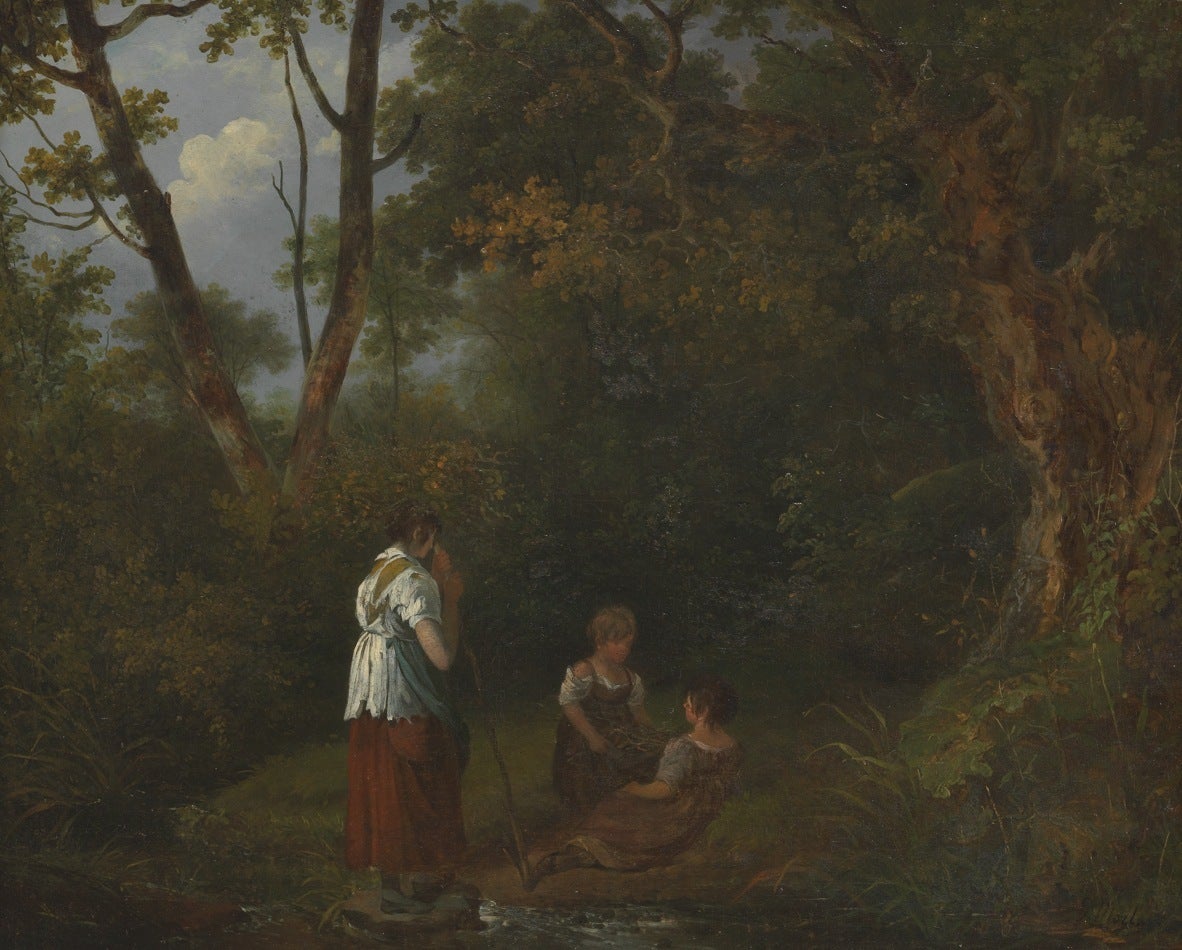
George Morland Art

English, 1763-1804
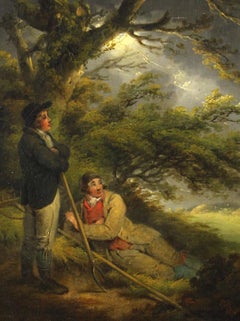
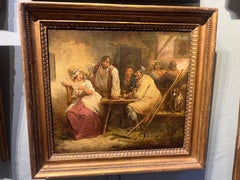
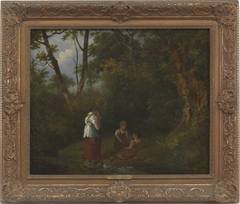
George Morland (26 June 1763 in London – 29 October 1804 in Brighton) was an English painter. His early work was influenced by Francis Wheatley but after the 1790s he came into his own style. His best compositions focus on rustic scenes: farms and hunting; smugglers and gypsies; and rich, textured landscapes informed by Dutch Golden Age painting.
to
4
3
1
Overall Width
to
Overall Height
to
8
8
7
1
6
4
2
2
2
2
1
1
1
1
1
5
3
2
1
1
9
10,159
2,807
2,503
1,398
6
4
4
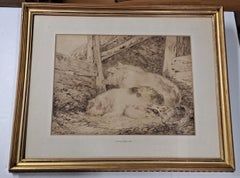
Artist: George Morland
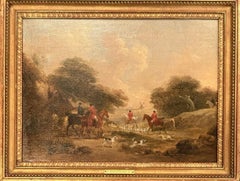
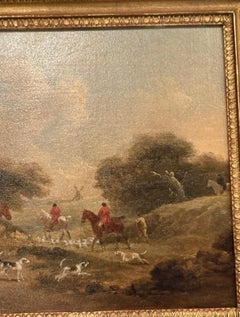
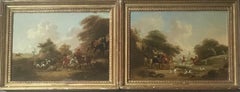
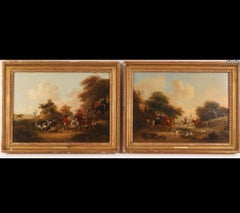
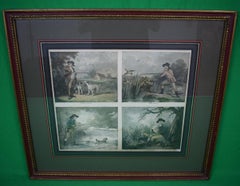
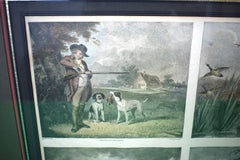
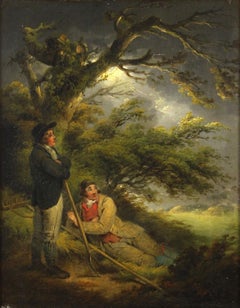
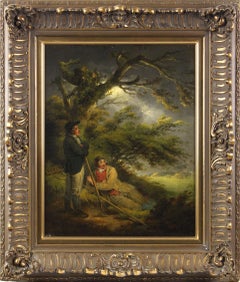
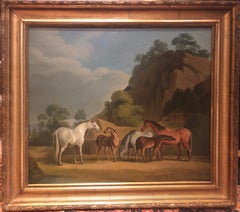
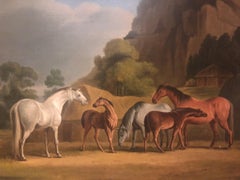
“Pair of Hunt Scenes, Oil on Canvas”

“Pair of Hunt Scenes, Oil on Canvas”

By George Morland

Located in Warren, NJ

This is 2 original oil paintings. Both are beautiful pieces. each lined and with craquelure; Meet by the Farmhouse with a chip in the paint along the left edge and an abrasion along ...

Category

18th Century George Morland Art

Materials

Oil

Family Group
Family Group

Family Group

By George Morland

Located in Fairlawn, OH

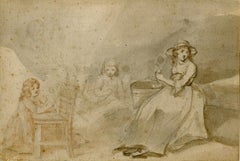
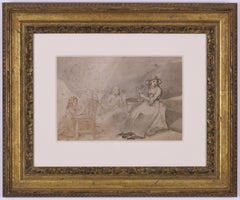
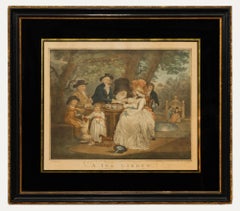
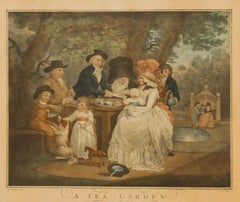
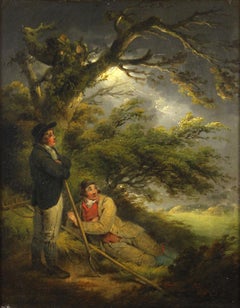
Family Group Drawing in Chinese white, sepia and bistre ink, c. 1790 Signed lower left: G. Morland (see photo) The present work appears to be a preliminary study for two Morland paintings where the artist uses portions of this preliminary study in finished exhibition paintings. The strongest association is with the painting entitled The Cottage Door (1790), now in the collection of Royal Holloway College, University of London. Morland uses the same small girl (on left side of this sheet) holding a doll on a chair in the exact same pose. The second painting entitled The Tea Garden (Tate Gallery, London, c. 1790) incorporates similar poses and gestures of the three other figure studies on this sheet. Provenance: Colnaghi, London (Stock # D25924, see photo) Maynard Walker Gallery, New York ( see photo of label) Davis Galleries, New York, their Eagle stamp and stock number (see photo) Ms. Gloria Kaplan (1930-2011) New York City Regarding Maynard Walker: Maynard Walker New York Times obit: "Maynard Walker, an art dealer in New York City for nearly 40 years who was among the first to show the works of leading American regionalist painters, died of pneumonia Tuesday at St. Joseph's Hospital in Carbondale, Pa. He was 89 years old and lived in Lake Ariel, Pa. In 1933, while working at the Ferargil Gallery in New York, Mr. Walker organized an exhibition for the Kansas City Art Institute that for the first time brought together the work of the regionalist painters Grant Wood, Thomas Hart Benton and John Steuart Curry. After Mr. Walker opened his own gallery, at 108 East 57th Street, in 1935, these artists joined him and showed regularly there. The gallery was also among the first to show the work of George Grosz, the German painter and caricaturist, who moved to the United States in 1932. The gallery moved to 117 East 57th Street after the war." Condition: Aging to paper Slight fading to ink Tiny spotting in image All consistent with the age of the drawing Image size: 6 3/8 x 9 1/2 inches Frame size: 14 1/4 x 17 1/4 inches George Morland was born in London on 26 June 1763. He was the son of Henry Robert Morland, and grandson of George Henry Morland, said by Cunningham to have been lineally descended from Sir Samuel Morland, while other biographers go so far as to say that he had only to claim the baronetcy in order to get it. Morland began to draw at the age of three years, and at the age of ten (1773) his name appears as an honorary exhibitor of sketches at the Royal Academy. He continued to exhibit at the Free Society in 1775 and 1776, and at the Society of Artists in 1777, and then again at the Royal Academy in 1778, 1779 and 1780. His talents were carefully cultivated by his father, who was accused of stimulating them unduly with a view to his own profit, shutting the child up in a garret to make drawings from pictures and casts for which he found a ready sale. The boy, on the other hand, is said to have soon found a way to make money for himself by hiding some of his drawings, and lowering them at nightfall out of his window to young accomplices, with whom he used to spend the proceeds in frolic and self-indulgence. It has been also asserted that his father, discovering this trick, tried to conciliate him by indulgence, humouring his whims and encouraging his low tastes. He was set by his father to copy pictures of all kinds, but especially of the Dutch and Flemish masters. Among others he copied Fuseli's Nightmare and Reynolds's Garrick between Tragedy and Comedy. He was also introduced to Sir Joshua Reynolds, and obtained permission to copy his pictures, and all accounts agree that before he was seventeen he had obtained considerable reputation not only with his friends and the dealers, but among artists of repute. A convincing proof of the skill in original composition which he had then attained is the fine engraving. It is said that before his apprenticeship to his father came to an end, in 1784, Romney offered to take him into his own house, with a salary of £300, on condition of his signing articles for three years. But Morland, we are told, had had enough of restraint, and after a rupture with his father he set up on his own account in 1784 or 1785 at the house of a picture dealer, and commenced that life which, in its combination of hard work and hard drinking, is almost without a parallel. Morland soon became the mere slave of the dealer with whom he lived. His boon companions were "ostlers, potboys, horse jockeys, moneylenders, pawnbrokers, punks, and pugilists." In this company the handsome young artist swaggered, dressed in a green coat, with large yellow buttons, leather breeches, and top boots. "He was in the very extreme of foppish puppeyism", says Hassell; "his head, when ornamented according to his own taste, resembled a snowball, after the model of Tippey Bob, of dramatic memory, to which was attached a short, thick tail, not unlike a painter's brush." His youth and strong constitution enabled him to recover rapidly from his excesses, and he not only employed the intervals in painting, but at this time, or shortly afterwards, taught himself to play the violin. He made also an effort, and a successful one, to free himself from his task-master, and escaped to Margate, where he painted miniatures for a while. In 1785 he paid a short visit to France, whither his fame had preceded him, and where he had no lack of commissions. Returning to London, he lodged in a house at Kensal Green, on the road to Harrow, near William Ward, intercourse with whose family seems for a time to have had a steadying influence. It resulted in his marriage with Miss Anne Ward...

Category

1790s English School George Morland Art
Materials

Ink

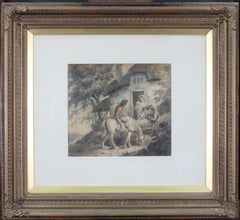
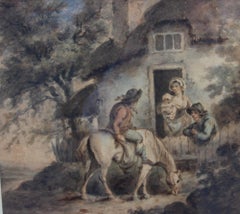
Conversation at the gate

Conversation at the gate

By George Morland

Located in Douglas, Isle of Man

George Morland 1763-1804, was an English painter who was influenced by the painter Francis Wheatley , landscapes. After 1790 he had developed his own style of painting adopting rusti...

Category

18th Century George Morland Art

Materials

Watercolor, Paper

Related Items
Cattle in a rural landscape with castle ruins and a church

Cattle in a rural landscape with castle ruins and a church

By John Varley

Located in Middletown, NY

Pen and ink and watercolor on wove paper laid down to board, 3 5/8 x 6 3/8 inches (93 x 163 mm), the full sheet. With an illigible signature in brown ink in the lower right corner, r...

Category

Early 19th Century English School George Morland Art
Materials

Ink, Watercolor

Pair of Blue Birds - Abstract Folk Art Inspired Botanical Painting on Raw Canvas

Pair of Blue Birds - Abstract Folk Art Inspired Botanical Painting on Raw Canvas

Located in Los Angeles, CA

Meredith Walker’s "Pair of Blue Birds" is a striking example of contemporary folk art that merges whimsical symbolism with bold abstraction. This original acrylic and gouache paintin...

Category

2010s Contemporary George Morland Art

Materials

Canvas, Acrylic, Gouache

West 14th Street at Sunset, Oil Painting

West 14th Street at Sunset, Oil Painting

By Nick Savides

Located in San Francisco, CA

Artist Comments
"This painting was inspired by the dramatic lighting and shadows receding into West 14th Street at sunset," says artist Nick Savid...

Category

21st Century and Contemporary American Realist George Morland Art

Materials

Oil

Rustic Romance, Oil Painting

Rustic Romance, Oil Painting

By Lisa Elley

Located in San Francisco, CA

Artist Comments
This painting draws inspiration from the architecture of quintessential Italian villages. The sunlight accentuates the stone walls and shutters, while a pot o...

Category

21st Century and Contemporary Impressionist George Morland Art

Materials

Oil

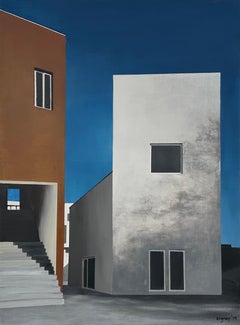
Shadow of a Tree on Facade, Original Painting

Shadow of a Tree on Facade, Original Painting

Located in San Francisco, CA

Artist Comments
Two modern buildings, one raw sienna, and the other white, stand side by side against a deep blue sky. The daylight in the background contrasts with the struc...

Category

21st Century and Contemporary Realist George Morland Art

Materials

Acrylic

1950's French Impressionist Oil Fishing Boats Anchored Beach Estuary

1950's French Impressionist Oil Fishing Boats Anchored Beach Estuary

Located in Cirencester, Gloucestershire

Etaples Simone Forge 1950's French Impressionist oil on board unframed board: 13 x 16 inches inscribed verso Provenance: private collection, Paris Condition: overall good and sound...

Category

Mid-20th Century Impressionist George Morland Art

Materials

Oil

1930's French Impressionist Harbor Scene with Boats and Billowing Sails

1930's French Impressionist Harbor Scene with Boats and Billowing Sails

Located in Cirencester, Gloucestershire

Harbor Scene Simone Forge 1930's French Impressionist oil on board unframed board: 13 x 16 inches Provenance: private collection Condition: great condition For more any more info...

Category

Early 19th Century Impressionist George Morland Art

Materials

Oil

A Day of Discovery, Oil Painting

A Day of Discovery, Oil Painting

By Onelio Marrero

Located in San Francisco, CA

Artist Comments
Artist Onelio Marrero captures a father and son discussing artwork in a gallery at the Metropolitan Museum of Art. He loves visiting museums as much for the pat...

Category

21st Century and Contemporary Impressionist George Morland Art

Materials

Oil

Drawing of a decorative iron screen housed in the Louvre.

Drawing of a decorative iron screen housed in the Louvre.

Located in Middletown, NY

A Grand Tour study of a decorative object at the Louvre. English School, early 20th century Graphite on light wove paper, 9 1/4 x 6 inches (235 x 152 mm), the full sheet. In very goo...

Category

Early 20th Century English School George Morland Art
Materials

Handmade Paper, Graphite

Previously Available Items
The Farrier
The Farrier

The Farrier

By George Morland

Located in Stoke, Hampshire

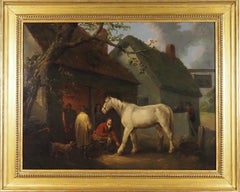
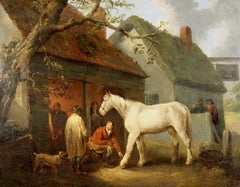
George Morland (1762-1804) The Farrier Signed and dated 'G Morland, 1793' lower left Oil on canvas Canvas Size - 27 5/8 x 36 in Framed Size - 35 x 43 in Geo...

Category

18th Century Old Masters George Morland Art

Materials

Oil

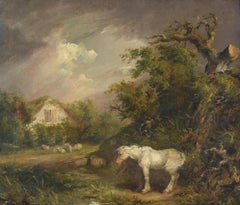
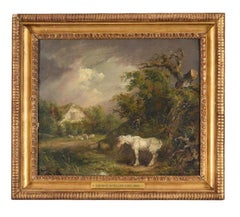
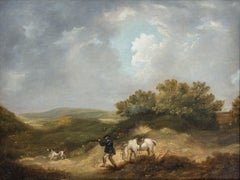
A white horse sheltering from a storm

A white horse sheltering from a storm

By George Morland

Located in Stoke, Hampshire

George Morland (1763-1804) A white horse sheltering from a storm Oil on canvas Painting Size 11 3/8 x 13 3/4 in George Morland was born in June 1763. An English painter, mainly of s...

Category

18th Century English School George Morland Art
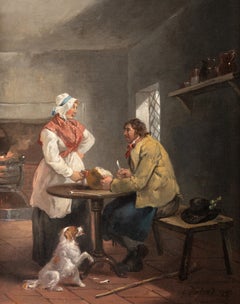
Materials

Oil

George Morland, Figures drinking outside an Inn

George Morland, Figures drinking outside an Inn

By George Morland

Located in Harkstead, GB

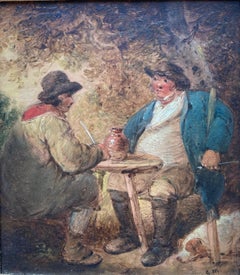
A charming rustic scene with figures drinking outside a tavern. Painted on a lovely old oak panel with labels and a wax seal. George Morland (1763-1804) Figures outside an Inn Oil on panel With seal and labels to the reverse 7 x 6 inches 10 x 9 inches including the frame George Morland (26 June 1763 in London – 29 October 1804 in Brighton) was an English painter. His early work was influenced by Francis Wheatley but after the 1790s he came into his own style. His best compositions focus on rustic scenes: farms and hunting; smugglers and gypsies; and rich, textured landscapes informed by Dutch Golden...

Category

Late 19th Century Old Masters George Morland Art
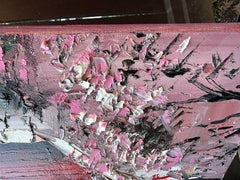
Materials

Oil, Wood Panel

GEORGE MORLAND R.A. - ORIGINAL OIL CANVAS - BOATS HEADING OUT ISLE OF WIGHT

GEORGE MORLAND R.A. - ORIGINAL OIL CANVAS - BOATS HEADING OUT ISLE OF WIGHT

By George Morland

Located in Marlow, Buckinghamshire

A beautiful original oil on canvas by George Morland R.A. the important english landscape and figure painter who worked din the 18th century. This large canvas depicts boats heading ...

Category

18th Century Old Masters George Morland Art
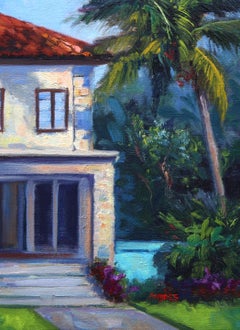
Materials

Oil

Barn Interior With Horses & Figures, circa 1800

Barn Interior With Horses & Figures, circa 1800

By George Morland

Located in Blackwater, GB

Barn Interior With Horses & Figures, circa 1800 by GEORGE MORLAND (1763-1804) sales to $190,000 Large 18th Century English Barn interior scene with farm workers and various horses entering at the end of the days work, oil on canvas by George Morland. Excellent condition for its age, signed top right on the rag covering the window. Leading example of the artists work, presented in a good frame ready to hand and professionally relined and restretched (will not need any conservation for another 50 years). Rare leading example of the artists work. Measurements: 46" x 36" framed approx GEORGE MORLAND 1763-1804 George Morland was born in London on 26 June 1763. He was the son of Henry Robert Morland and grandson of George Henry Morland. He began to draw at the age of three and at the age of ten his name appears as an honorary exhibitor of sketches at the Royal Academy. He continued to exhibit at the Free Society in 1775 and 1776, and at the Society of Artists in 1777 before exhibiting again at the Royal Academy in 1778, 1779 and 1780. His talents were carefully cultivated by his father, who was accused of stimulating them unduly with a view to his own profit, shutting the child in a garret to make drawings from pictures and casts for which he found a ready sale. The boy on the other hand, is said to have soon found a way to make money for himself by hiding some of his drawings and lowering them at nightfall out of his window to young accomplices, with whom he used to spend the proceeds in frolic and self-indulgence. He was set by his father to copy pictures of all kinds, but especially of the Dutch and Flemish masters. Among others, he copied Fuseli's ‘Nightmare’ and Reynolds's ‘Garrick between Tragedy and Comedy’. He was also introduced to Sir Joshua Reynolds and obtained permission to copy his pictures and, all accounts agree, before he was seventeen he had obtained a considerable reputation not only with his friends and the dealers but among artists of repute. A convincing proof of skill in original composition, which he had then attained, is the fine engraving by William Ward after his picture of ‘Angler's Repast’ which was published in November 1780 by John Raphael Smith. Morland went to Margate where he painted miniatures for a while and then paying a short visit to France in 1785, where his fame had preceded him and he had no lack of commissions. Returning to London, he lodged in a house, at Kensal Green on the road to Harrow, near to his friend William Ward whose family seems to have had a steadying influence. It resulted in Morland's marriage to Miss Anne Ward...

Category

19th Century George Morland Art
Materials

Canvas, Oil

A gentleman shooting in a landscape, with his horse and dog

A gentleman shooting in a landscape, with his horse and dog

By George Morland

Located in Stoke, Hampshire

George Morland (1763-1804) A gentleman shooting in a landscape Oil on canvas 17 7/8 x 24 1/8 in 45.5 x 61 cm George Morland was born in June 1763. An English painter, mainly of scen...

Category

18th Century George Morland Art
Materials

Oil

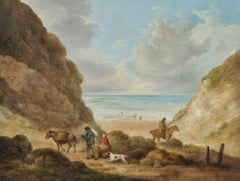
Heading home with the days catch

Heading home with the days catch

By George Morland

Located in Stoke, Hampshire

GEORGE MORLAND (BRITISH 1762/63-1804) Heading home with the days catch - Beach scene landscape Signed with initials lower right oil on canvas 28 x 36 in George Morland was the eldes...

Category

18th Century George Morland Art
Materials

Oil

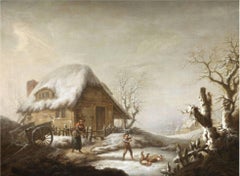
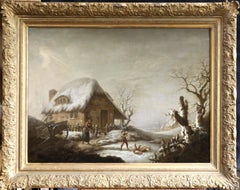
Winter Games - 18th Century Oil, Figures in Snow Landscape by George Morland

Winter Games - 18th Century Oil, Figures in Snow Landscape by George Morland

By George Morland

Located in Marlow, Buckinghamshire

A wonderfully painted oil on canvas by George Morland depicting children playing outside a cottage on a snowy winter's day. Signed lower right. George Morland was the son of the pastel portraitist, dealer and restorer Henry Robert Morland and the grandson of the genre painter George Henry Morland. He was taught by his father and first exhibited at the Royal Academy at the age of fifteen. Until the age of twenty-one, he devoted his entire existence to his work, his only friend being the painter and engraver Philip Dawe. In 1784, George Romney offered him a position as his assistant, but Morland refused, because he wanted to enjoy his freedom. In any case, the young artist had already produced works that had met with great success, such as The Angler's Repast, which had been painted when he was barely seventeen years old and was reproduced by William Ward. At first Morland painted portraits in Margate and at St-Omer in France. In 1876 he went back to London, where he married the sister of the engraver William Ward. Shortly afterwards, Ward married Morland's sister, and this double alliance cemented a collaboration which provided the English School with a considerable number of attractive and interesting prints. At the start of his career, Morland was mainly a painter of childhood. He depicted an English ideal of childhood in all its prettiness, with a pleasant, even witty touch. He had the gift of working with great ease and produced a large number of paintings in this genre. In the years 1788 and 1789 alone, no less than 59 engravings after Morland appeared. They were mezzotints of elegant scenes of childhood, executed by the finest artists. From 1790, Morland broadened his range, painting a greater variety of subjects. Though children still appeared in some of his pictures, they rarely played the principal part in the way they had previously done. On the other hand, horses, sheep, pigs and poultry feature in a large number of canvases. It was also around this time that he produced his series of recruits and deserters, and his gypsies, fishermen, and scenes of inns and public coaches. He was earning a lot of money, but he was spending even more, and he was obliged to retreat to a country dwelling in Leicestershire. This stay in the country had a considerable influence on his talent and sharpened his taste for landscape. When Morland returned to London in around 1792, he suffered the consequences of his past follies, as his creditors had obtained warrants for his arrest, and he lived in hiding for several years in order to avoid imprisonment. In the end he grew tired of this and in 1799 he took refuge in a cottage near Cowes on the Isle of Wight, which had been lent to him by a friend. He remained there for almost a year, living among the sailors and fishermen, where he found many typical faces he could use in his paintings. His return to London early in 1800 was swiftly followed by his imprisonment for debt. Briefly released in 1802, he was imprisoned again following an apoplectic fit, which left him unable to work. His wife survived him by only a few days. Morland is an interesting figure in the English School, an artist full of charm and verve. He left a considerable body of work. According to his family, during the last eight years of his life, he produced around eight hundred paintings and more than a thousand drawings. Museum and Gallery Holdings Bath (Holburne Mus. of Art): Horse and Dog in a Stable (1791, oil on canvas); The Deserter Pardoned (1792, oil on canvas) Birmingham (Mus. and AG): Pigs (oil on canvas); Shooting Sea Fowl (oil on canvas) Bristol: Interior with Sheep Bristol (City Mus. & AG): Quarry Scene (two); Gypsies in a Landscape (oil on canvas); Man Grooming Horse; Boy Seated on a Drinking Horse Budapest: Pigsty Dublin: Landscape with Figures and Cattle Edinburgh: study Glasgow: Smugglers on the Shore; Storm and Shipwreck; Seascape Leeds (City AG): Coast Scene (oil on canvas) Leicester: Calm Sea off the Isle of Wight London (National Portrait Gal.): George Morland (c. 1775-1780, oil on canvas); Henry Robert Morland (pencil, father of the artist); George Morland (c. 1795, chalk) London (Tate Collection): Inside of a Stable (exhibited in 1791, oil on canvas); Outside the Ale-House Door (1792, oil on canvas); Door of a Village Inn (oil on canvas); Rabbiting (1792, oil on canvas); The Fortune Teller (oil on canvas) London (Victoria and Albert Mus.): Farmer Paying his Bill to the Innkeeper; Horses in a Stable; Fishermen; Fishing Boats with Figures; Girl Stroking a Pigeon; Johanny Going to the Fair; Hunting Scene; Farmyard; Cottage, Farm Cart and Dog London (Wallace Collection): A Visit to the Boarding School (1789, oil on canvas) Manchester: watercolours Montreal (Learmont Collection): Village Brewery New York: Town-Country Nottingham (Castle Mus. & AG): The Wreckers; The Artist in his Studio; Sportsman Resting; Two Horses in the Snow...

Category

Late 18th Century Old Masters George Morland Art
Materials

Canvas, Oil

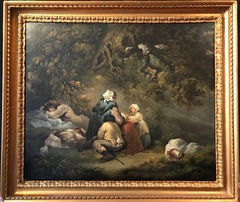
Travellers in Woodland Shelter Georgian Oil Painting

Travellers in Woodland Shelter Georgian Oil Painting

By George Morland

Located in Cirencester, Gloucestershire

Travellers Resting Attributed to George Morland (British 1763-1804) oil painting on canvas, framed canvas: 28 x 34 inches framed: 34.5 x 40 inches Very fine antique English oil painting on canvas depicting this group of travellers resting under the protection of the mighty oak tree in this wooded landscape. The painting is of exceptional quality and may be attributed to the British painter, George Morland (1763-1804). It dates to the circa 1790-1800 period. Painted on this grand, exhibition scale, the work beautifully captures this resting family, including the pet dog, taking shelter...

Category

Late 18th Century Victorian George Morland Art
Materials

Oil

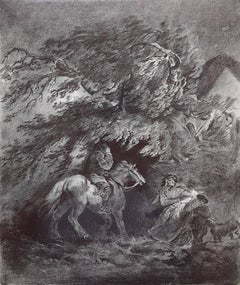
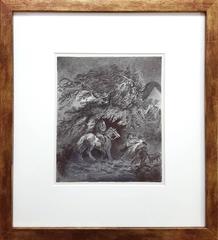
The Storm
The Storm

The Storm

By George Morland

Located in Saint Augustine, FL

An original lithograph after English artist George Morland (1763-1804) titled "The Storm", 1873. This lithograph was drawn on stone and made by English artist E. H. Mitchell in 1873....

Category

1870s Victorian George Morland Art
Materials

Lithograph

George Morland art for sale on 1stDibs.
Find a wide variety of authentic George Morland art available for sale on 1stDibs. You can also browse by medium to find art by George Morland in paint, oil paint, canvas and more. Much of the original work by this artist or collective was created during the 18th century and is mostly associated with the Old Masters style. Not every interior allows for large George Morland art, so small editions measuring 6 inches across are available. Customers who are interested in this artist might also find the work of George Wright , William Edward Frost, and Francis Plummer. George Morland art prices can differ depending upon medium, time period and other attributes. On 1stDibs, the price for these items starts at $750 and tops out at $25,355, while the average work can sell for $6,981.