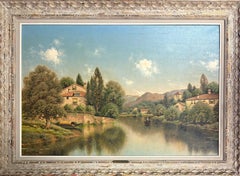
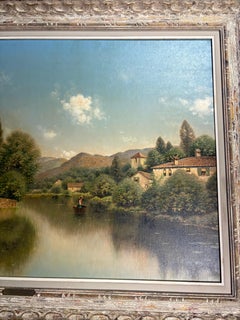
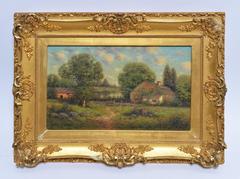
“Sunshine summer”
By George W. Drew
Located in Warren, NJ
George W. Drew Original Oil Painting On Canvas “summer Sunshine”. In good condition measures 43x31
Category
20th Century George W. Drew Art
Materials
Oil
George W. Drew was born on 21 December, 1875 in Massachusetts. He was a member of the Independent Artists Association. He exhibited at the National Academy of Design and they have him recorded as living at 745 Columbus Ave., New York in the year 1898. He also exhibited at the Allied Artists of America, which was established in 1914, Salons of America, N.Y. State Fair, Newark State Fair, Newark Museum and New York Museum of Science and Industry. Although there is little known about the personal life of George W. Drew, his paintings appear on the art market quite often. His work has always been well received because of the numerous exhibitions he has participated in. He is known for his rustic luminous depictions of the Nineteenth Century American Landscape. Like many of the Hudson River Painters, Drew captures the effects of light from within the canvas. He is a master of perspective, his landscapes are classically and harmoniously balanced, leaving the viewer to gently rest their eyes on the rustic countryside.
“Sunshine summer”
By George W. Drew
Located in Warren, NJ
George W. Drew Original Oil Painting On Canvas “summer Sunshine”. In good condition measures 43x31
Oil
$2,800
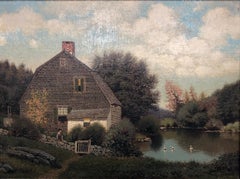
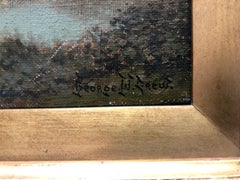
Farmhouse
By George W. Drew
Located in Greenville, DE
George W. Drew 1875-1968. Excellent example of his work, housed in a period Louie XIV style frame measuring 20.5 x 24.5in. Painted in early to mid 20th century.
Canvas, Oil
$480
H 15.75 in W 11.82 in
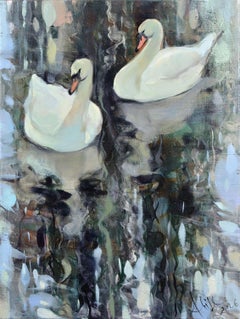
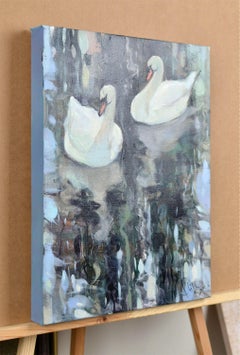
Swans and Reflections, by Alise Medina. Oil on canvas, 40x30 cm. Signed
Located in Riga, LV
Very often in my painting process I use photographs, sketches and I paint direct from the nature(in plein air). There are lot of excitement and impulses around; they can cover each o...
Canvas, Oil
$1,837
H 11.82 in W 11.82 in D 0.79 in
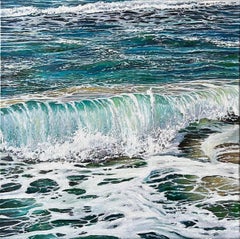
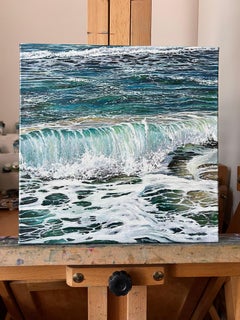
Fragility of Strength -Contemporary Seascape Oil Painting of Breaking Ocean Wave
By DARIA DUDOCHNYKOVA
Located in Zofingen, AG
The moment before everything changes, where strength teeters on the edge of fragility. DETAILS ● 100% original hand-painted ● The painting is textured ● The picture is painted with ...
Canvas, Oil

$12,000
H 31.5 in W 36.5 in
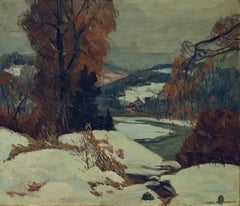
"Winter Landscape with Stream" Carl Rudolph Krafft, Early 20th Century Landscape
By Carl Rudolph Krafft
Located in New York, NY
Carl Rudolph Krafft Winter Landscape with Stream Signed lower right and with thumbprint Oil on canvas 25 x 30 inches Carl Rudolph Krafft was born in 1884 in Reading, Ohio, and his ...
Canvas, Oil
$22,000
H 16 in W 20 in D 3 in
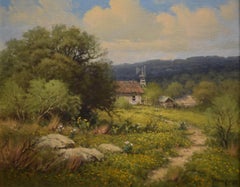
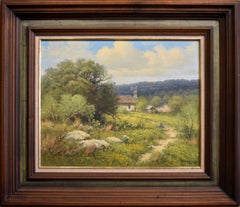
"COUNTRY PLACE" G. HARVEY (1933-2017) TEXAS HILL COUNTRY RANCH
By G. Harvey
Located in San Antonio, TX
G. Harvey (Gerald Harvey Jones) (1933-2017) San Antonio, Austin, and Fredericksburg Artist Image Size: 16 x 20 Frame Size: 25 x 29 Medium: Oil on Canvas Signed 1976 "Country Place" ...
Oil
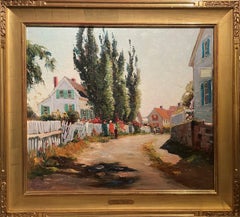
$45,000
H 40 in W 46 in
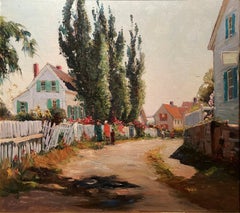
"Other Side of Town (Leading to Pigeon Cove)" Anthony Thieme, Rockport Cape Ann
By Anthony Thieme
Located in New York, NY
Anthony Thieme (1888 - 1954) Other Side of Town (Leading to Pigeon Cove) Oil on canvas 30 x 36 inches Signed lower left Provenance: David H. Hall Fine Art, Dover, Massachusetts Vose Galleries, Boston, Massachusetts Private Collection, New Jersey Anthony Thieme was born in the Dutch port city of Rotterdam in 1888. He studied at the Academy of Fine Arts in Rotterdam, at the Royal Academy at the Hague, as an apprentice to George Hoecker, a well known stage designer in Düsseldorf, Germany, and to Antonio Mancini, an Italian Impressionist. After completing his studies, Thieme journeyed throughout Europe and South America, working in stage design to support his travels. Thieme first came to the United States in 1917 and initially worked as a set designer and book illustrator first in New York and later in Boston. By the late 1920s, Thieme had married and moved from Boston to Cape Ann in Rockport, Massachusetts, an emerging art colony. Like the other Rockport artists...
Canvas, Oil
$10,000
H 22 in W 29 in
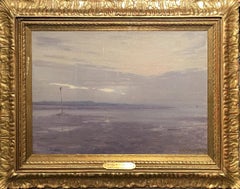
"La Marre de Soire, " George Leonard, American Impressionist, Beach Seascape
Located in New York, NY
George Henry Leonard, Jr. (1869 - 1928) La Marre de Soire Oil on canvas 15 x 21 3/4 inches Signed lower right A landscape painter--primarily using a late impressionist loose stroke as his main mode of expression--Leonard drew not only upon French influences, but also the American school of impressionism characterized by Frank Boggs...
Canvas, Oil
$6,500
H 18 in W 22 in
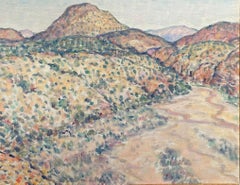
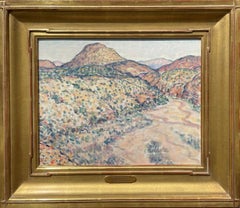
"View of Arizona Desert near Wickenberg" Will Foote, Impressionist Western Scene
Located in New York, NY
Will Foote View of Arizona Desert near Wickenberg, circa 1927 Signed lower center; titled and dated on the reverse Oil on artist's board 12 x 16 inches Foote was born on June 29, 1874 in Grand Rapids, Michigan, and died on January 27, 1965, in Sarasota, Florida. He was in Old Lyme, 1901-65; and in Cos Cob, 1903. Will Howe Foote was one of the earliest artists at Old Lyme and one who adopted the town as home. He first went there the summer of 1901 with his uncle, William H. Howe, a painter of cattle, who had been told about the beauties of the countryside by Henry Ward Ranger. Foote had himself heard of Old Lyme when he had met Clark Voorhees in France. He and his uncle were both from Grand Rapids, Michigan, where Foote's father was an executive in the furniture industry that made the city famous. Encouraged to be an artist by his father, he began his professional training at the Art Institute of Chicago in 1894. He became friends there with a fellow Michigan student, Frederick Frieseke, who would study with him again at the Art Students League in New York, where Foote worked in 1895-96 under H. Siddons Mowbray and Kenyon Cox. In 1897 he and Frieseke went to the Academic Julian in Paris, where Foote studied under Jean-Paul Laurens and Benjamin Constant. He was at Julian's until 1900, except for an Italian trip, summers at Laren, Holland, or Etaples, France, and a short period at Whistler's school in Paris. He exhibited twice at the Old Salon, and when he returned to the United States in 1900, he had a one-man exhibition in his hometown. Will Howe Foote's paintings were well received on his return from abroad. He exhibited frequently at the National Academy of Design and became an associate member in 1910. His awards included a bronze medal at the St. Louis Exposition in 1904 and a silver medal at the Panama-Pacific Exposition in San Francisco in 1915. Once he visited Old Lyme, Foote returned every summer. In 1902 he was hired as assistant to Frank DuMond at the Lyme Summer School of Art, which was sponsored by the Art Students League of New York. Sometime in 1903 he also taught a session in Cos Cob. After 1906, when the League moved its Lyme classes to Woodstock, New York, Foote continued in Old Lyme as a private instructor. In 1907 he was married to Helen Kirtland Freeman, whom he had met a year or two earlier when she had come to the Lyme art colony as a student of Henry Rankin Poore. Fellow artist William Chadwick was best man at the wedding. The Footes began building a house on Sill Lane in Old Lyme and upon its completion in 1909 spent every spring, summer and fall there, where Foote devoted full time to painting. The Gregory Smiths, old friends from Grand Rapids, arrived in Old Lyme in 1910 and became neighbors. Foote's early works in Connecticut, such as A Summer's Night reflect the artist's interest in soft, atmospheric scenes dominated by a single, overriding tone. The arrival of Childe Hassam and Walter Griffin...
Oil, Board
$6,000
H 25 in W 21 in
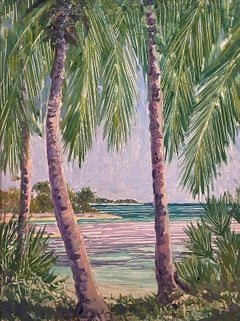
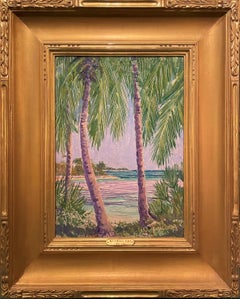
"Bermuda Landscape with Palm Trees, " Harry Hoffman, American Impressionism
By Harry L. Hoffman
Located in New York, NY
Harry Leslie Hoffman (1871 - 1964) Bermuda Oil on board 16 x 12 inches Signed lower right; estate stamped on the reverse A man with strong academic art training, Harry Hoffman was judged by his peers to have done best with his landscapes when he painted what he saw and set aside the theories. He studied in Paris, worked at Yale University with John Ferguson Weir, and was a student at the Art Students League with Frank DuMond. But Willard Metcalf had the strongest influence, encouraging Hoffman to paint in the style of impressionism. In 1902, Hoffman went to Old Lyme, Connecticut, and stayed at the Florence Griswold...
Oil, Board
$7,000
H 26 in W 30 in
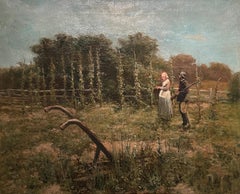
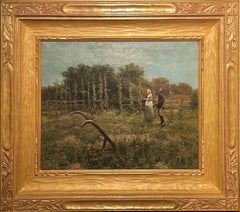
"Couple in the Field, " James Brade Sword, Hunter on Farm Landscape
By James Brade Sword
Located in New York, NY
James Brade Sword (1839 - 1915) Couple in the Field Oil on canvas 16 x 20 inches Signed lower left After a childhood in Macao, China, James Brade Sword started out in life, after hi...
Canvas, Oil
$8,000
H 36 in W 38 in
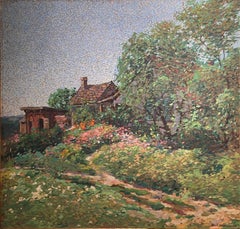
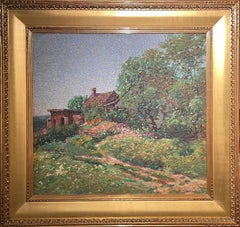
"Late Summer" Carl Wuermer, Pointilism, American Impressionism August Landscape
By Carl Wuermer
Located in New York, NY
Carl Wuermer (1900 - 1981) Late Summer, 1924 Oil on canvas 26 x 28 inches Signed and dated lower right Provenance: McColl Fine Art, North Carolina Known for serene, realistic lands...
Canvas, Oil
$9,500
H 17 in W 18.25 in
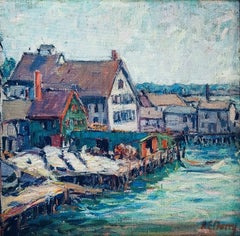
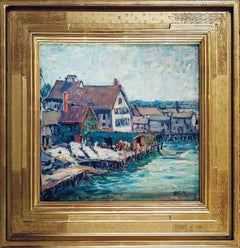
"Rockport Harbor" Kathryn E. Cherry, Female American Impressionist Landscape
Located in New York, NY
Kathryn E. Cherry Rockport Harbor Signed lower right Oil on canvas board 10 1/2 x 12 inches Kathryn Cherry was an influential St. Louis painter, ceramicist, designer, and art educa...
Oil, Illustration Board
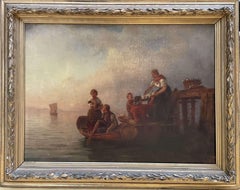
"European genre painting"
Located in Edinburgh, GB
No Signatured This evocative 19th-century oil painting presents a tranquil yet atmospheric riverside scene, capturing a group of figures engaged in daily life. The composition is mas...
Canvas, Oil
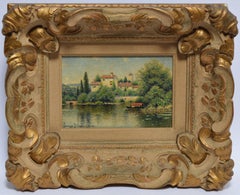
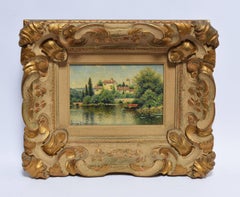
View of a Villa by George W. Drew
By George W. Drew
Located in Buffalo, NY
Impressionist view of a villa by George Drew (1875 - 1968). Oil on board, circa 1910. Signed lower left, "George W. Drew". Displayed in a period impressionist frame. Image size,...
Canvas, Oil
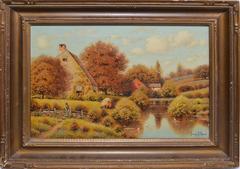
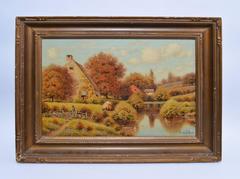
Lake Landscape with Ducks by George W. Drew
By George W. Drew
Located in Buffalo, NY
Impressionist lake landscape with ducks by George W. Drew (1875-1968). Oil on canvas, circa 1910. Signed lower right, "George W. Drew"...
Canvas, Oil
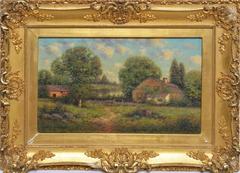
Lavender Landscape by Goerge W Drew
By George W. Drew
Located in Buffalo, NY
Impressionist lake landscape painting by George W. Drew (1875-1968). Oil on board, circa 1900. Signed lower right, "George W. Drew". Displayed in a giltwood frame. Image...
Canvas, Oil