By Georges Emile Henri Servant
Located in Peyraud, Auvergne-Rhône-Alpes
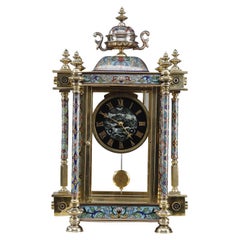
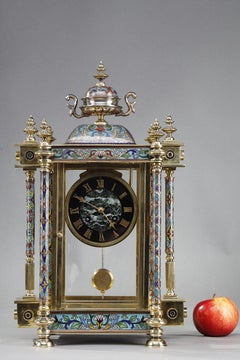
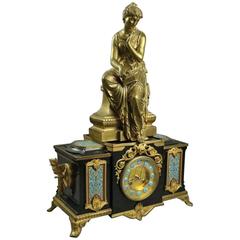
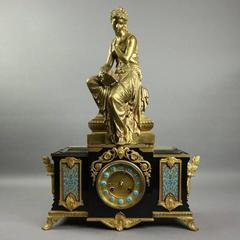
Cage clock of the Art Nouveau period in bronze and polychrome cloisonné enamels, of oriental style. The bronze structure is gilded, coppered, and decorated in places with acanthus leaves and flowers. The whole mechanism is surrounded by six columns with richly flowered motifs, four of which form feet. Each shaft ends in a button shape in a very oriental taste. The round dial has a green marble center and displays the hours in Roman numerals. It bears a signature on the front, "SERVANT FILS & J, Paris".
This 1900 clock testifies to the attraction for the Orient and the Orientalist aesthetic which experienced a considerable boom in Western countries throughout the 19th century.
Circa: 1900
Base dimensions: 27 cm x 19 cm (10.63 in x 7.48 in)
Overall dimensions: W: 27cm, D: 19cm, H: 44cm.
Overall dimensions: W: 10.6in, D: 7.5in, H: 17.3in.
The technique of cloisonne enamels
Cloisonné is a technique for making objects with enamel decoration surrounded by curved copper wires. This ancestral process originated in the Arabian Peninsula and was imported into China in the 13th century. Craftsmen quickly appropriated this technique and developed it to the point of making it a typically Chinese art which had its golden age during the Ming dynasty. The Chinese cloisonné is found on many objects such as vases, bowls or chests and fascinates by its impressive number of partitions that give it a rich and unique decoration. From the 14th century onwards, Peking enamels...
Category
Late 19th Century French Art Nouveau Antique Georges Emile Henri Servant Decorative Objects