By Georges Ricard-Cordingley
Located in Cotignac, FR
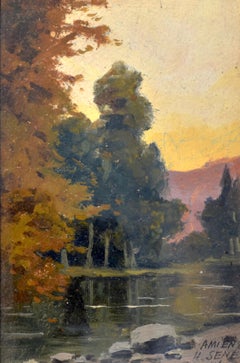
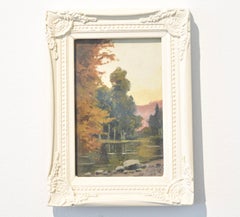
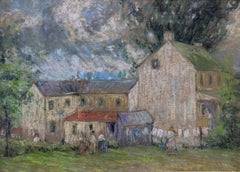
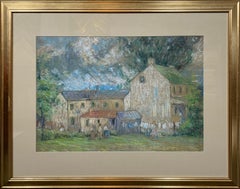
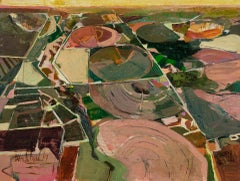
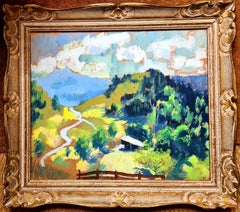
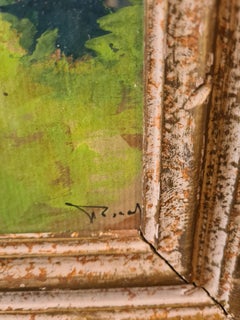
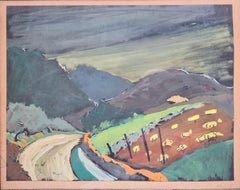
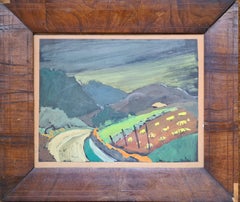
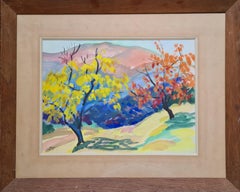
A French Fauvist gouache and watercolour landscape on paper by Georges Ricard-Cordingley. The painting carries the atelier stamp bottom right and is presented in a plain wood frame with a cut card mount.
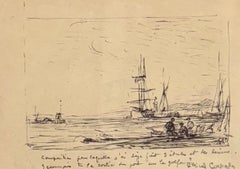
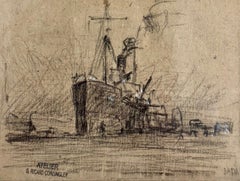
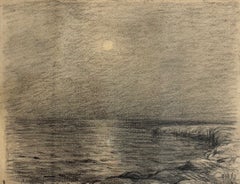
A very charming and colourful painting of trees in a mountain landscape. A rarer work for Cordingley as he loved capturing the sea and coastline, this work seems experimental for him, very much influenced by the work of the Fauves at the beginning of the 20th century. The medium of watercolour and colour palette has given him a freedom of composition.
Provenance: This drawing came from the estate of the artist's daughter who had acquired it directly from her father. It may date from his travels in Australia in the early 1900s.
Georges Ricard was born on January 30, 1873 in Lyon, son of Prosper Louis Ricard and Georgina Marie Cordingley. He spent part of his childhood in Lyon and Boulogne-sur-Mer. He displayed early gifts for drawing. He lost his father in 1885.
He began his training around 1887, becoming a pupil of Jean-Charles Cazin, a landscape painter from Pas-de-Calais and the Côte d'Opale. He then joined the School of Fine Arts in Lyon and remained there from 1888 to 1889. He moved to Paris in 1890, where he studied at the Académie Julian as a pupil of Benjamin Constant, Louis Martinet and Jules Lefebvre.
He lost his mother around 1892, went to England to his maternal family and added his mother's name to his name. He embarked for the North Sea with the Royal National Mission to Deep Sea Fishermen and carried out his first studies. In 1894, he met with great success at the court of Queen Victoria. He embarked a second time, in 1895, still for the North Sea and produced numerous studies of waves of clouds, of the port and of portraits of fishermen which he exhibited in Paris and London. He embarked a third time, around 1896, in the North Sea and the Atlantic Ocean with the Société des Travaux de Mer and was shipwrecked in Newfoundland.
In 1901, he set up his studio in Boulogne-sur-Mer. He divided his time between London, Paris and Boulogne-sur-Mer and painted portraits and seascapes. He realized the decoration of the casino of Wimereux.
He travelled to Australia, where he exhibited from 1909 to 1910.
In 1911, he married Suzanne Giraud-Teulon, the daughter of historian Alexis Giraud-Teulon, and had three children, Éliane, Louis and Gabrielle.
During the First World War, he was assigned to Lyon as a stretcher...
Category
Early 20th Century Fauvist Georges Ricard-Cordingley Paintings
MaterialsPaper, Watercolor, Gouache