Located in New Orleans, LA
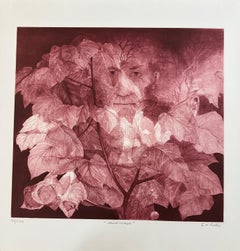
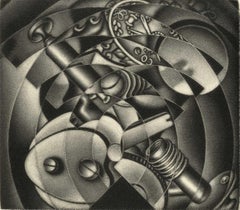
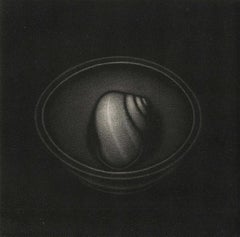
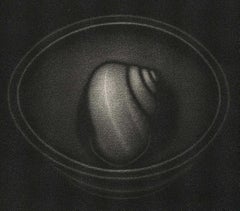
Leonard Merchant's mezzotint, "Snail in Cup" is inscribed for fellow artist, Fritz Eichenberg.
While a student at the Central School for Arts and Crafts in London, a young Leonard Marchant found an engraving rocker in a cupboard and proceeded to turn himself into a master of the painstaking art of mezzotinting.
Marchant, who has died in Shrewsbury aged 70, grew up in Simonstown, the Royal Navy's enclave in South Africa. Though his first job was as a parliamentary messenger, he taught himself to paint and, aged 19, was given a one-man show in Cape Town. Fired by this success, he left for England to study painting and, he claimed, to escape the stifling home atmosphere created by his Catholic mother and aunts. (His father was killed in the second world war.) Without contacts in London, he phoned Jacob Epstein, whose recommendation resulted in a grant to study briefly at the Central School. It was later, when studying full-time at the Central, that he saw the mezzotints of the Japanese master, Yozo Hamaguchi, in a London gallery. He was hooked.
Creating a mezzotint is tedious in the extreme. The copper plate must first be prepared with a "rocker" which roughens the surface. A plate may be "rocked" 30 or 40 times. The rough texture is then reduced with a burnisher and a scraper, allowing the print a range of tones from velvety black through the greys to white. Marchant's plates could be months in the making. But the technical demands were the least of his worries. In its 18th- and 19th-century heyday, mezzotint was solely a reproductive medium, for copying masters such as Reynolds and Turner. The development of photography rendered it unfashionable, and by the 1960s the technique, known as la manière anglaise, was a bygone medium.
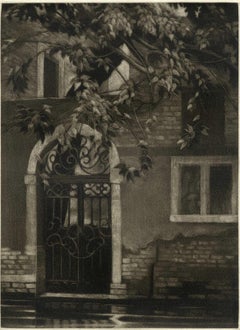
Marchant, by now a teacher in printmaking at the Central, began to create original mezzotints with a colleague, Radavan Kraguly. A perfectionist, he seemed to revel in the straitjacket procedure. Perhaps it was the metaphor of bringing darkness out of light that appealed to this straight-talking, sometimes sombre, man, who would suddenly relax and light up like a gleaming hue on one of his prints. His work was of squares and triangles with the occasional cat, black and ominous, and carefully arranged still lifes, featuring plants, a seed pod, a pot he might have bought at auction to celebrate the sale of a print.
There were one-man shows, notably at the Bankside Gallery. He sold well at the Royal Academy summer exhibition, was a Florence Biennale prizewinner, spent a fellowship year at the British School in Rome, and was elected a Fellow of the Royal Society of Painter-Printmakers.
But making mezzotints was not a paying job. Marchant and his South African wife...
Category
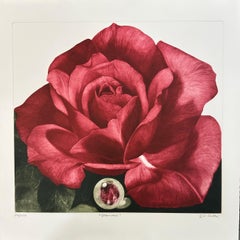
1980s Modern G.H. Rothe Art