Guenther Uecker Furniture

German, b. 1930
Uecker was born in Wendorf, Mecklenburg. Uecker began his artistic education in 1949 when he took up studies at Wismar. He then went to the art school in Berlin-Weißensee and in 1955 to Düsseldorf, where he studied under Otto Pankok at the Kunstakademie Düsseldorf. In 1956 he began using nails in his art. In addition to numerous Gruppo Zero exhibitions, Uecker has participated in many other exhibitions, including documenta 4, Kassel, Germany (1968), the Venice Biennale (1970), and numerous solos shows, including one at the Kunsthalle Düsseldorf (1983), a retrospective at the Kunsthalle der Hypo-Kulturstiftung, Munich (1990), and another solo show at the Ulmer Museum, Ulm, Germany (2010). He had his first solo exhibition in the United States at the Howard Wise Gallery on West 57th Street, showing important work such as the kinetic New York Dancer I (1966). He designed the scenery for Richard Wagner's Lohengrin at Bayreuth (1979–82). Uecker met the group ZERO with Heinz Mack and Otto Piene in 1960, artists who propagated a new beginning of art in opposition to the German Informel. He occupied himself with the medium of light, studied optical phenomena, series of structures and the realms of oscillation that actively integrate the viewer and enable him to influence the visual process by kinetic or manual interference. Uecker, Mack and Piene began working together in joint studios at the Stedelijk Museum in Amsterdam in 1962 and installed a 'Salon de Lumière' at the Palais des Beaux-Arts in Paris. Other 'light salons' followed in Krefeld and in Frankfurt. Since 1966, after the group ZERO dissolved and a last joint exhibition, Uecker increasingly used nails as an artistic means of expression—a material that, until today, stands in the centre of his oeuvre. At the beginning of the 1960s he began hammering nails into pieces of furniture, musical instruments and household objects, and then he began combining nails with the theme of light, creating his series of light nails and kinetic nails and other works. a-x Zero Garden from 1966, in the collection of the Honolulu Museum of Art, demonstrates his use of nails to create the illusion of movement. Light and electricity continued to be one of the main subjects and natural materials such as sand and water were included in his installations, resulting in an interaction of the different elements to create a sensation of light, space, movement and time. Uecker's work can be found in the collections of major institutions worldwide, among them: the ZERO foundation and Museum Kunst Palast, Düsseldorf; Calderara Foundation Collection, Milan; Courtauld Institute of Art, (London); Honolulu Museum of Art, Studio Esseci (Padua, Italy), Stedelijk Museum, Amsterdam, Van Abbemuseum (Eindhoven, Netherlands), Von der Heydt-Museum (Wuppertal, Germany); Museum of Modern Art, New York; Art Institute of Chicago, Chicago; Museum of Contemporary Art, Los Angeles; Centre Pompidou, Paris; Peggy Guggenheim Collection, Venice the Ulster Museum, Belfast; and the Walker Art Center, Minnesota.
to
2
1
2
2
1
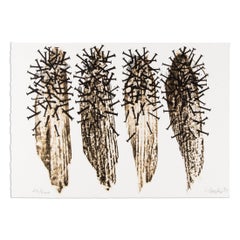
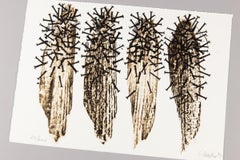
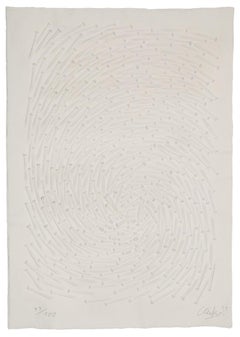
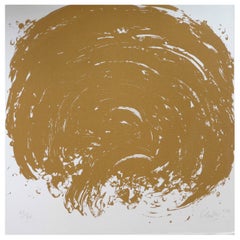
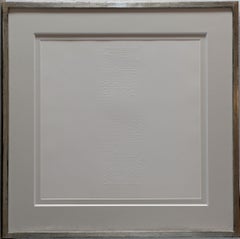
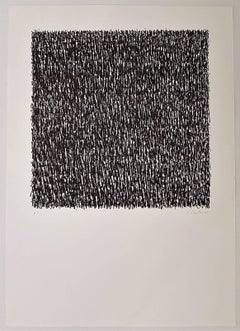
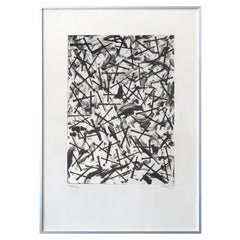
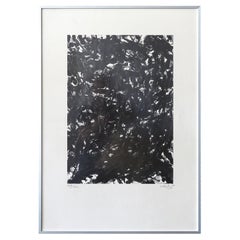
Günther Uecker ‘Nails and Finger Marks’, 2000

Günther Uecker ‘Nails and Finger Marks’, 2000

By Guenther Uecker

Located in Los Angeles, CA

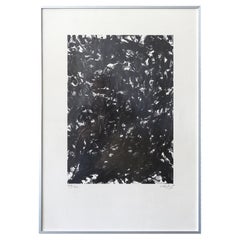
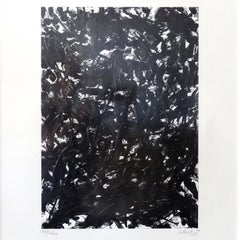
Wonderful limited edition, framed offset lithography on handmade paper by German sculptor, op artist and installation artist Günther Uecker (born 1930) called ‘Nails and Finger Marks...

Category

Early 2000s German Post-Modern Guenther Uecker Furniture

Materials

Paper

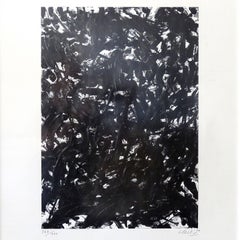
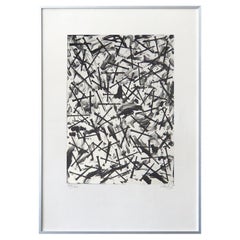
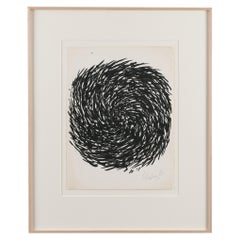
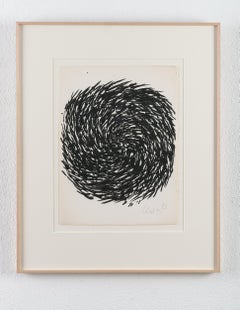
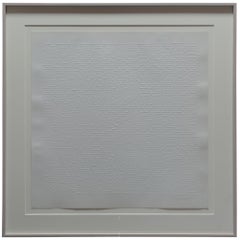
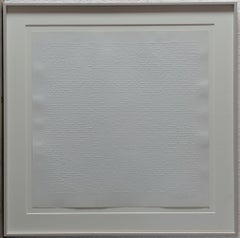
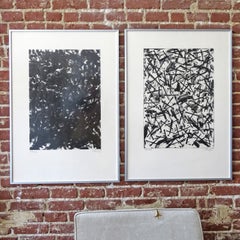
Günther Uecker "Verletzungen, Verbindungen, " 2000

Günther Uecker "Verletzungen, Verbindungen, " 2000

By Guenther Uecker

Located in Los Angeles, CA

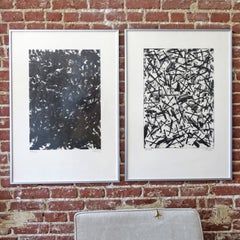
Wonderful part two of a set of original screen prints on hand-made Japanese paper by German sculptor, op artist and installation artist Günther Uecker (born 1930) called "Verletzunge...

Category

Early 2000s German Modern Guenther Uecker Furniture

Materials

Paper

Related Items
All Alone in the Museum of Modern Art Howard Hodgkin abstract black painting

All Alone in the Museum of Modern Art Howard Hodgkin abstract black painting

By Howard Hodgkin

Located in New York, NY

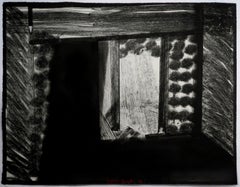
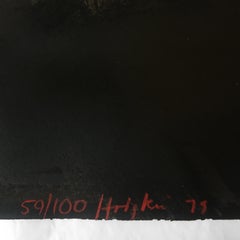
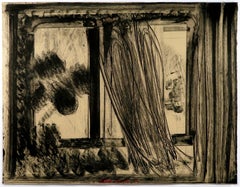
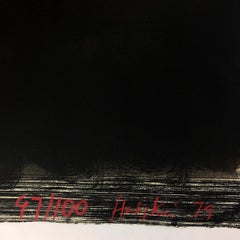
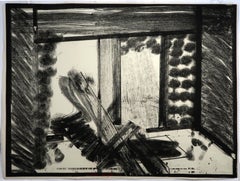
Large scale black and white abstract interior scene with dots, lines, brushstrokes, paint daubs, fingerprints, squares and rectangles, and hand painting in grey. Hang in contemporary, modern and minimalist spaces. While British pop artists such as David Hockney and Patrick Caulfield numbered amongst Howard Hodgkin's circle of friends, Hodgkin's work is painterly, emotional, expressionist, and abstract. Paper: 29.5 x 38.75 in. / 74.7 x 98.2 cm. Soft-ground etching with hand coloring in black gouache on grey BFK Rives mould made paper. Signed by the artist, dated 79, and numbered 59/100 lower center in red crayon. Printed from the same plate as 'Thinking Aloud in the Museum of Modern Art', this print was previously titled "Not Quite Alone in the Museum of Modern Art," suggesting an erotic dalliance in the museum. This print depicts an abstracted scene, perhaps a window and a door, in Hodgkin's signature painterly style. The expressive mark-making in this print is an example of the artist’s movement in the late 70s towards pronounced gestures. Beside bold black strokes, his fingerprints form areas of texture. Always seeking greater richness in his prints, Hodgkin layered ink and hand coloring in this print, rendering each print in the edition unique. Howard Hodgkin was introduced to the etching technique used in 'All Alone in the Museum of Modern Art' at Petersburg Press, where this print was produced and where he would become a long-time collaborator. This technique allowed him to work fluidly and spontaneously, creating the moody interior scenes that mark Hodgkin’s work from the late 70s and early 80s. Part of a series of four prints reflecting on a visit to the Museum...

Category

Late 20th Century Abstract Guenther Uecker Furniture

Materials

Etching

Howard Hodgkin Late Afternoon in the Museum of Modern Art abstract black white

Howard Hodgkin Late Afternoon in the Museum of Modern Art abstract black white

By Howard Hodgkin

Located in New York, NY

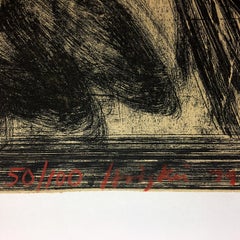
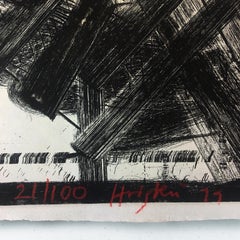
Abstract black, white and tan print of interior scene with dots, lines, shadow and painted brushstroke texture. Ideal for display in minimalist, modern and contemporary spaces. While British pop artists such as David Hockney and Patrick Caulfield numbered amongst Howard Hodgkin's circle of friends, Hodgkin's work is painterly, expressionist, and abstract. Late Afternoon in the Museum of Modern Art by Howard Hodgkin. Soft-ground etching on buff BFK Rives mould-made paper. Edition 100: this impression 36/100. Signed by the artist, numbered 36/100, and dated 79 lower center in red crayon. Printed from the same plate as Early Evening in the Museum of Modern Art. Published by Petersburg Press. This print depicts an abstracted scene, perhaps a sculpture in front of a window in the Museum of Modern Art, Oxford, in Hodgkin's signature painterly style. The expressive mark-making in this print is an example of the artist’s movement in the late 70s towards pronounced gestures. Hodgkin used his hand as a mark-making tool, combining these textures with loose and urgent brushwork. Howard Hodgkin was introduced to the etching technique used in Late Afternoon in the Museum of Modern Art at Petersburg Press, where this print was produced and where he would become a long-time collaborator. This technique allowed him to work fluidly and spontaneously, creating the moody interior scenes that mark Hodgkin’s work from the late 70s and early 80s. Part of a series of four prints reflecting on a visit to the Museum...

Category

Late 20th Century Abstract Guenther Uecker Furniture

Materials

Etching

Howard Hodgkin hand-colored Early Evening in the Museum of Modern Art

Howard Hodgkin hand-colored Early Evening in the Museum of Modern Art

By Howard Hodgkin

Located in New York, NY

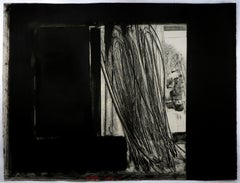
Large scale black and white abstract interior scene with dots, lines, brushstrokes, and hand painting in grey, to hang in contemporary, modern and minimalist spaces. While British pop artists such as David Hockney and Patrick Caulfield numbered amongst Howard Hodgkin's circle of friends, Hodgkin's work is painterly, emotional, expressionist, and abstract. Early Evening in the Museum of Modern Art, by Howard Hodgkin. Signed by the artist, numbered, and dated 79 lower center in red crayon. Soft-ground etching printed from the same plate as 'Late Afternoon in the Museum of Modern Art', with hand coloring in black gouache on Grey BFK Rives mould-made paper. This print depicts an abstracted scene, perhaps a sculpture in front of a window in the Museum of Modern Art, Oxford, in Hodgkin's signature painterly style. The expressive mark-making in this print is an example of the artist’s movement in the late 70s towards pronounced gestures. Wide areas of deep black pigment contrast urgent swipes of ink. Always seeking greater richness in his prints, Hodgkin layered ink and hand coloring in this print, rendering each impression in the edition unique. Part of a series of four prints reflecting on a visit to...

Category

Late 20th Century Abstract Guenther Uecker Furniture

Materials

Gouache, Etching

Artist and Model Howard Hodgkin - green and yellow etching watercolour gouache

Artist and Model Howard Hodgkin - green and yellow etching watercolour gouache

By Howard Hodgkin

Located in New York, NY

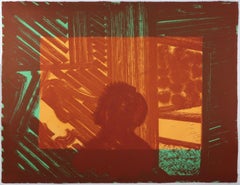
This vibrant abstract orange and green print is part of a group of soft-ground etchings (Artist and Model, Artist and Model (in green and yellow), These…Plants) by Howard Hodgkin. The two versions of Artist and Model are printed from the same plates, but in different colors. In this iteration, green watercolor contrasts beautifully with marigold orange, crimson, and terra cotta red. Seen in all three prints is a bust in silhouette before a window. Artist and Model is a surprising name, as Hodgkin never painted or drew from a model. Signed by the artist with initials, dated 1980, and numbered lower center in red crayon. Soft-ground etching with hand coloring in a yellow watercolor wash and green gouache on Stoneridge mould-made etching paper. Edition 100. Howard Hodgkin was introduced to the etching technique used in Artist and Model (in green and yellow) at Petersburg Press, where this print was produced and where he would become a long-time collaborator. This technique allowed him to work fluidly and spontaneously, creating the moody interior scenes that mark Hodgkin’s work from the late 70s and early 80s. Catalogue reference: Elizabeth Knowles...

Category

Late 20th Century Abstract Guenther Uecker Furniture

Materials

Watercolor, Gouache, Etching

Thinking Aloud in the Museum of Modern Art, Hodgkin, abstract black and white

Thinking Aloud in the Museum of Modern Art, Hodgkin, abstract black and white

By Howard Hodgkin

Located in New York, NY

Large scale black and white abstract interior scene with dots, lines, brushstrokes, paint daubs, fingerprints, squares and rectangles, and hand painting in grey. Hang in contemporary...

Category

Late 20th Century Abstract Guenther Uecker Furniture

Materials

Etching

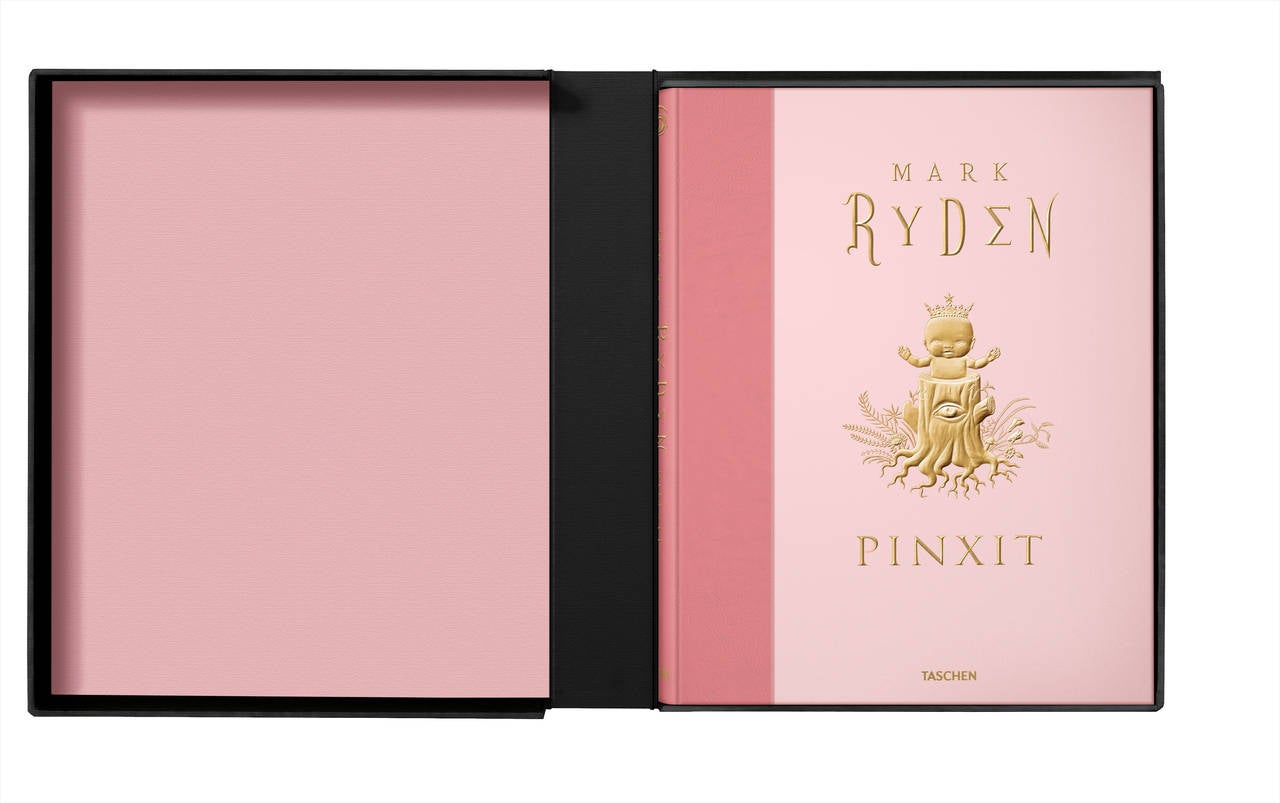
Mark Ryden Pinxit
Mark Ryden Pinxit

Mark Ryden Pinxit

$1,250 / item

H 19.7 in W 14.8 in D 3 in

Mark Ryden Pinxit

By Mark Ryden

Located in Los Angeles, CA

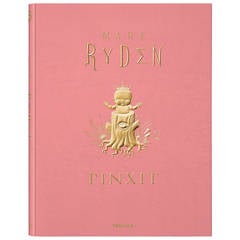
Fuzzy bunnies, big-eyed girls, meat, magic and mystery. Mark Ryden’s carnival of curiosities. Collector’s edition: No. 51–1,050. Limited to 1,000 individually numbered copies,...

Category

21st Century and Contemporary Italian Guenther Uecker Furniture

Souvenir, Howard Hodgkin: large scale black white gray abstract interior scene

Souvenir, Howard Hodgkin: large scale black white gray abstract interior scene

By Howard Hodgkin

Located in New York, NY

Very large scale black and white abstract interior scene with dots, lines, brushstrokes, paint daubs, fingerprints, squares and rectangles. Striking print to hang in contemporary, modern and minimalist spaces. While British pop artists such as David Hockney and Patrick Caulfield numbered amongst Howard Hodgkin's circle of friends, Hodgkin's work is more painterly, expressionist, and abstract. Paper 45 x 55 in. / 114.3 x 139.7 cm. Souvenir by Howard Hodgkin. Screenprint on Arches aquarelle mould-made paper. Signed by the artist with initials and dated 80 in pencil lower center, numbered in pencil lower left. This bold Howard Hodgkin print layers five shades of black, with a wide variety of marks including some from the artist’s fingerprints and hand. Scribbles and lines of grey loosely define what could be an interior space with furniture. As is typical of his prints, there is a sense of space, and of the passage of time, expressed through shapes that seem to recede through the picture, deep black shades and, unusually for Hodgkin’s work, the white of the paper showing through. The last photograph displays these rich surface textures on the sheet at an angle. Catalogue reference: Elizabeth Knowles...

Category

Late 20th Century Abstract Guenther Uecker Furniture

Materials

Screen

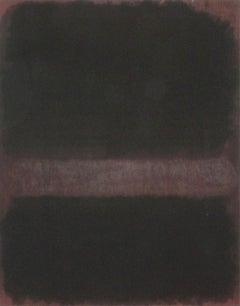
Mark Rothko Abstract Lithograph 35" x 28" Mid Century Modern Art

Mark Rothko Abstract Lithograph 35" x 28" Mid Century Modern Art

By (after) Mark Rothko

Located in Atlanta, GA

Large Abstract Color Lithograph, by Mark Rothko, American, circa 1970s. It has recently been professionally framed in a clean lined black lacquered wood gallery frame under UV resist...

Category

1970s American Mid-Century Modern Vintage Guenther Uecker Furniture

Materials

Plexiglass, Wood, Paper

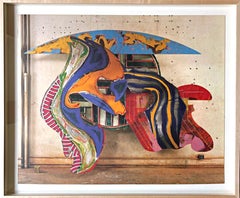
Print of Frank Stella Wall Relief Sculpture, Hand Signed, Dated by Artist Framed

Print of Frank Stella Wall Relief Sculpture, Hand Signed, Dated by Artist Framed

By Frank Stella

Located in New York, NY

Frank Stella (after) Untitled, for the Very Special Arts Gallery (Hand Signed by Frank Stella), 1992 Photo lithograph and offset litho on thin board (hand signed by Frank Stella) Fra...

Category

1990s Abstract Expressionist Guenther Uecker Furniture

Materials

Offset, Lithograph

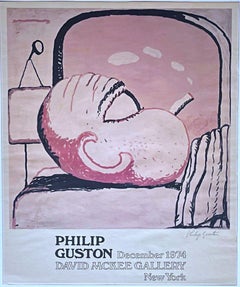
Rare 1970s offset lithograph exhibition poster (pencil signed by Philip Guston)

Rare 1970s offset lithograph exhibition poster (pencil signed by Philip Guston)

By Philip Guston

Located in New York, NY

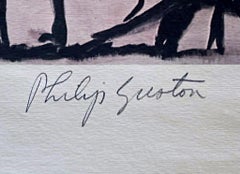
Philip Guston at David McKee Gallery (pencil signed by Philip Guston), 1974 Lithograph and offset lithograph poster Signed in graphite pencil under the image 24 1/2 × 20 inches Unframed, unnumbered Rare vintage lithographic poster of 1974 Guston exhibition at David McKee Gallery Signed under the image in graphite pencil by Philip Guston Another hand signed edition is in the permanent collection of Vassar College; otherwise we haven't seen another besides the present work; a true collectors item when hand signed by the artist. Philip Guston Biography Philip Guston (1913 – 1980) is one of the great luminaries of twentieth-century art. His commitment to producing work from genuine emotion and lived experience ensures its enduring impact. Guston’s legendary career spanned a half century, from 1930 to 1980. His paintings—particularly the liberated and instinctual forms of his late work—continue to exert a powerful influence on younger generations of contemporary painters. Born in Montreal, Canada, in 1913 to poor Russian Jewish émigrés, Guston moved with his family to California in 1919. Briefly attending the Otis Art Institute in Los Angeles in 1930, he was otherwise completely self-taught. Guston’s first precocious work, Mother and Child, was completed when he was only seventeen years of age. Influenced by the social and political landscape of the 1930s, his earliest works evoked the stylized forms of Giorgio de Chirico and Pablo Picasso, social realist motifs of the Mexican muralists, and classical properties of Italian Renaissance frescoes of Piero della Francesca and Masaccio that he had seen only in reproduction. Painted in Mexico with another young artist, the huge fresco The Struggle Against War and Fascism drew national attention in the US. Guston’s success continued in the WPA, a Depression-era government program that commissioned American artists to create murals in public buildings. While not widely known today, the young artist’s early experiences as a mural painter allowed a development of narrative and scale that he would draw upon in his late figurative work. In the early 1940s, as the WPA program was ending, Guston found work teaching at universities in the Midwestern United States. In his studio, he was working in oils on easel paintings that were more personal and smaller in scale, focusing on portraits and allegories, like Martial Memory and If This Be Not I. His first solo exhibition in Iowa was well received and, within a few years, he was offered his first solo show in New York City. Guston was awarded a Prix de Rome, allowing him to leave teaching and spend a year in Italy, studying firsthand the Italian masters he loved. By the time he had finished The Tormentors, Guston’s move to abstraction was all but complete. On his return from Italy, he continued dividing his time between the artists’ colony of Woodstock in Upstate New York and New York City, which was then emerging as the center of the postwar art world. He rented a studio on 10th Street, where abstract expressionists Jackson Pollock, Willem de Kooning and Mark Rothko also worked. For Guston, success was never what mattered most. He was already impatient with the language of pure abstraction and experimenting with larger forms, using a limited palette of grays, pinks and blacks. As his forms became still more reduced, he stopped painting altogether and embarked on a series of simplified abstract “pure drawings” in brush or charcoal. At this juncture, Guston removed himself from the art scene in New York, living and working in Woodstock for the remainder of his life. Guston’s move ­was hardly a withdrawal. Freed from the distractions and formal constraints of the art world and the opinions of critics, he was able to experiment with new forms and to engage more deeply with the issues that mattered to him. The 1960s was a period of great social upheaval in the United States, characterized by assassinations and violence, civil rights and anti-war protests. “When the 1960s came along I was feeling split, schizophrenic,” Guston later said. “The war, what was happening to America, the brutality of the world. What kind of man am I, sitting at home, reading magazines...

Category

1970s Abstract Expressionist Guenther Uecker Furniture

Materials

Lithograph, Offset

"Alice Tully Hall" by Guillermo Kuitca (Abstract, Red, Architecture, Design)

"Alice Tully Hall" by Guillermo Kuitca (Abstract, Red, Architecture, Design)

By Guillermo Kuitca

Located in New York, NY

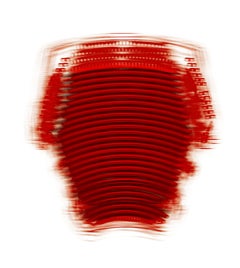
One screen print on wove paper titled, Alice Tully Hall by Guillermo Kuitca, 2009. It is hand signed in pencil, dated and numbered from the edition of 117 (total edition includes 18 artist's proofs) The sheet size is 22 1/4 by 20 inches, with the blindstamp of the printer, Brand X Editions, New York. Published by Lincoln Center for the Performing Arts, Inc., New York. This impression has a rich, bold red color on bright white paper. Guillermo Kuitca, whose paintings and prints are often inspired by seating arrangements in theater interiors, recreates the seating chart...

Category

Early 2000s Abstract Guenther Uecker Furniture

Materials

Screen

Asger Jorn 1978 Original Unused Vintage Exhibition Lithograph Poster Galerie

Asger Jorn 1978 Original Unused Vintage Exhibition Lithograph Poster Galerie

By Asger Jorn

Located in Miami, FL

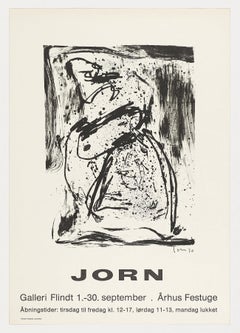
Asger Jorn (Denmark, 1914-1973) Jorn. Galleri Flindt, 1978 lithograph on paper 27.6 x 19.3 in. (70 x 49 cm.) Excellent condition, unframed Ref: JOR100-201 A humanist in the broadest...

Category

1970s Abstract Guenther Uecker Furniture

Materials

Lithograph

Previously Available Items
Spirale - Contemporary, Embossing, Nails, Light, Shadow

Spirale - Contemporary, Embossing, Nails, Light, Shadow

By Guenther Uecker

Located in Köln, DE

Günther Uecker has developed a unique and impressive artistic language with his embossed prints. These prints are characterised by a subtle interplay of light, shadow and structure, ...

Category

1990s Contemporary Guenther Uecker Furniture

Materials

Handmade Paper

Günther Uecker ‘Nails and Finger Marks’, 2000

Günther Uecker ‘Nails and Finger Marks’, 2000

By Guenther Uecker

Located in Los Angeles, CA

Wonderful limited edition, framed offset lithography on handmade paper by German sculptor, op artist and installation artist Günther Uecker (born 1930) called ‘Nails and Finger Marks...

Category

Early 2000s German Post-Modern Guenther Uecker Furniture

Materials

Paper

Günther Uecker "Verletzungen, Verbindungen, " 2000

Günther Uecker "Verletzungen, Verbindungen, " 2000

By Guenther Uecker

Located in Los Angeles, CA

Wonderful part two of a set of original screen prints on hand-made Japanese paper by German sculptor, op artist and installation artist Günther Uecker (born 1930) called "Verletzunge...

Category

Early 2000s German Modern Guenther Uecker Furniture

Materials

Paper

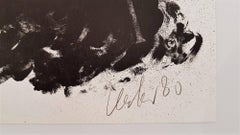
Bewegung III (Group ZERO, Piene, Mack)

Bewegung III (Group ZERO, Piene, Mack)

By Guenther Uecker

Located in Kansas City, MO

Bewegung III Year: 1980 Lithograph 19 1/10 × 26 1/10 in 48.5 × 66.3 cm Signed, dated and numbered by hand Edition: 180 Publisher: Erker Presse, St. Gallen, Switzerland Publisher's Bl...

Category

1980s Abstract Expressionist Guenther Uecker Furniture

Materials

Lithograph

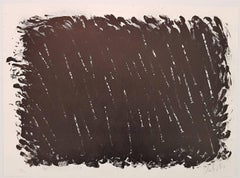
Bewegung II (Group ZERO, Piene, Mack)

Bewegung II (Group ZERO, Piene, Mack)

By Guenther Uecker

Located in Kansas City, MO

Bewegung II Year: 1980 Lithograph 19 1/10 × 26 1/10 in 48.5 × 66.3 cm Signed, dated and numbered by hand Edition: 180 Publisher: Erker Presse, St. Gallen, Switzerland Publisher's Bli...

Category

1980s Abstract Guenther Uecker Furniture

Materials

Lithograph

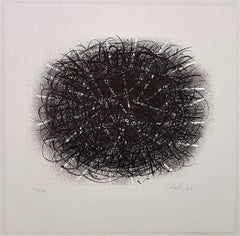
Untitled (Group ZERO, Piene, Mack)

Untitled (Group ZERO, Piene, Mack)

By Guenther Uecker

Located in Kansas City, MO

Untitled Lithograph Year: 1980 Signed, numbered and dated by hand Edition: 100 Size: 14.4 × 18.3 on 21.8 × 22.0 inches Publisher: Erker Presse, St. Gallen, Switzerland Publisher's Bl...

Category

1980s Abstract Expressionist Guenther Uecker Furniture

Materials

Lithograph

Ouroboros Series 2018 7 Large Terragraphs on Canvas

Ouroboros Series 2018 7 Large Terragraphs on Canvas

Sold

H 37.41 in W 37.41 in D 2.37 in

Ouroboros Series 2018 7 Large Terragraphs on Canvas

By Guenther Uecker

Located in Jesteburg, DE

Medium Print (Sand on Canvas) We have 7 of this series available. All Seven cost € 65.000,00 subject to availabiltiy, price for individual works is € 8.900,00 Signature Hand-...

Category

1960s German Minimalist Vintage Guenther Uecker Furniture

Materials

Paper

Günther Uecker Spiral, Original Lithograph, Signed and Numbered

Günther Uecker Spiral, Original Lithograph, Signed and Numbered

By Guenther Uecker

Located in Jesteburg, DE

Günther Uecker (1930) A beautiful original hand signed and dated lithograph on wove paper, 1965. Condition: Very good condition. Framed in extra thick matting and under gallery glass. The beautiful frame was hand silvered by an expert restorer. A note on this beautiful work: Günther Uecker was born in 1930 in Wendorf, Germany. He studied painting at the Kunsthochschule Berlin Weissensee from 1949 to 1953, and further pursued his artistic training in 1955 at the Kunstakademie Düsseldorf. Throughout the 1950s, Uecker cultivated a strong interest in repetitive practices and purification rituals, and became fascinated with the philosophies of Buddhism, Taoism, and Islam. He developed rituals of his own, including the lengthy, repetitive, meditative hammering of nails, and proceeded to translate this into his artistic practice. His nail-relief works exceed the limits of the two-dimensional plane and create a new realm for vision to explore the calculated patterns of light and shadow. Uecker examined this effect further in the 1960s by introducing Kinetic elements into his works through the use of engines, shifting his methodology from using precise, geometric patterns to more organic and irregular arrangements. In 1961, he joined the Zero Group founded by artists Heinz Mack and Otto Piene, who advocated for a new art form a degree zero to erase the destructive, violent forces by which human experience had come to be conditioned during the war, and which were expressed in the then-prevalent Art Informel style. The Zero Group made a large impact in the European postwar milieu, influencing a number of artists with similar ideas. Central to the movement were explorations of light, technology, and an Expansion beyond traditional two-dimensional confines of the canvas, all of which are implicated in Uecker’s work. The present work dates from this influential period. After the dissolution of the Zero Group, Uecker's work took a turn toward body, conceptual, and Land art, and in the 1970s he designed stage sets for several operas. He taught at the Kunstakademie Düsseldorf from 1974-1995, and was promoted to professor in 1976. Uecker has been the recipient of numerous prestigious awards, such as the Staatspreis des Landes Nordrhein-Westfalen in 2015. His work has been exhibited at museums around the world, including the Stedelijk Museum, Amsterdam; the Budapest Museum of Fine Art, Budapest; the Museum of Contemporary Art, Los Angeles; the Solomon R. Guggenheim Museum, New York; Ca’ Pesaro, International Gallery of Modern Art, Venice; and the Belvedere Museum, Vienna. He has also participated in documenta, Kassel in 1964, 1968, and 1977, and the Venice Biennale in 1970. The artist’s work is included in the collections of international institutions such as the Tate Modern, London; the Museum of Modern Art, New York; Los Angeles County Museum of Art, Los Angeles; the Solomon R. Guggenheim Museum, New York; Musée national d’art moderne, Centre Georges Pompidou, Paris; the Hamburger Bahnhof, Berlin; the Peggy Guggenheim collection, Venice; and the Museum Ludwig, Cologne. Recent exhibitions of Uecker’s work include a large-scale retrospective at K20 am Grabbeplatz, Kunstsammlung Nordrhein-Westfalen, Düsseldorf, in 2015; and a solo exhibition, Tribute to Hafez, at the Imam Ali...

Category

1960s German Minimalist Vintage Guenther Uecker Furniture
Materials

Paper

Günther Uecker "Serielle Reihung" Original Nail Embossing, 1965

Günther Uecker "Serielle Reihung" Original Nail Embossing, 1965

By Guenther Uecker

Located in Jesteburg, DE

Günther Uecker ( * 1930) "Serielle Reihung aus Abwicklung von Parallelstrukturen" A beautiful original Hand Signed and Dated Embossing on Wove Paper, 1965. This work is hand signed and dated by the artist "Uecker 65" at the lower right margin. It is also numbered 23/35 from the edition of only 35 at the lower left margin. Sheet 46,5 x 46,5 cm. Frame size 61 x 61 cm Condition: Very good condition. Framed in extra thick matting and under Gallery Glass. The beautiful frame was hand silvered by an expert restorer. A Note on This beautiful work: Günther Uecker was born in 1930 in Wendorf, Germany. He studied painting at the Kunsthochschule Berlin Weissensee from 1949 to 1953, and further pursued his artistic training in 1955 at the Kunstakademie Düsseldorf. Throughout the 1950s, Uecker cultivated a strong interest in repetitive practices and purification rituals, and became fascinated with the philosophies of Buddhism, Taoism, and Islam. He developed rituals of his own, including the lengthy, repetitive, meditative hammering of nails, and proceeded to translate this into his artistic practice. His nail-relief works exceed the limits of the two-dimensional plane and create a new realm for vision to explore the calculated patterns of light and shadow. Uecker examined this effect further in the 1960s by introducing kinetic elements into his works through the use of engines, shifting his methodology from using precise, geometric patterns to more organic and irregular arrangements. In 1961, he joined the Zero Group founded by artists Heinz Mack and Otto Piene, who advocated for a new art form—a degree zero—to erase the destructive, violent forces by which human experience had come to be conditioned during the war, and which were expressed in the then-prevalent Art Informel style. The Zero Group made a large impact in the European postwar milieu, influencing a number of artists with similar ideas. Central to the movement were explorations of light, technology, and an expansion beyond traditional two-dimensional confines of the canvas, all of which are implicated in Uecker’s work. The present work dates from this influential period. After the dissolution of the Zero Group, Uecker's work took a turn toward body, Conceptual, and Land art, and in the 1970s he designed stage sets for several operas. He taught at the Kunstakademie Düsseldorf from 1974 to 1995, and was promoted to professor in 1976. Uecker has been the recipient of numerous prestigious awards, such as the Staatspreis des Landes Nordrhein-Westfalen in 2015. His work has been exhibited at museums around the world, including the Stedelijk Museum, Amsterdam; the Budapest Museum of Fine Art, Budapest; the Museum of Contemporary Art, Los Angeles; the Solomon R. Guggenheim Museum, New York; Ca’ Pesaro, International Gallery of Modern Art, Venice; and the Belvedere Museum, Vienna. He has also participated in documenta, Kassel in 1964, 1968, and 1977, and the Venice Biennale in 1970. The artist’s work is included in the collections of international institutions such as the Tate Modern, London; the Museum of Modern Art, New York; Los Angeles County Museum of Art, Los Angeles; the Solomon R. Guggenheim Museum, New York; Musée national d’art moderne, Centre Georges Pompidou, Paris; the Hamburger Bahnhof, Berlin; the Peggy Guggenheim Collection, Venice; and the Museum Ludwig, Cologne. Recent exhibitions of Uecker’s work include a large-scale retrospective at K20 am Grabbeplatz, Kunstsammlung Nordrhein-Westfalen, Düsseldorf, in 2015; and a solo exhibition, Tribute to Hafez, at the Imam Ali...

Category

1960s German Minimalist Vintage Guenther Uecker Furniture
Materials

Paper

Günther Uecker "Serielle Reihung" Original Nail Embossing, 1965

Günther Uecker "Serielle Reihung" Original Nail Embossing, 1965

By Guenther Uecker

Located in Jesteburg, DE

Günther Uecker ( * 1930) "Serielle Reihung aus Abwicklung von Parallelstrukturen" A beautiful original Hand Signed and Dated Embossing on Wove Paper, 1965. This work is hand signed and dated by the artist "Uecker 65" at the lower right margin. It is also numbered 17/35 from the edition of only 35 at the lower left margin. Sheet 46,5 x 46,5 cm. Frame size 61 x 61 cm Condition: Very good condition. Framed in extra thick matting and under Gallery Glass. A Note on This beautiful work: Günther Uecker was born in 1930 in Wendorf, Germany. He studied painting at the Kunsthochschule Berlin Weissensee from 1949 to 1953, and further pursued his artistic training in 1955 at the Kunstakademie Düsseldorf. Throughout the 1950s, Uecker cultivated a strong interest in repetitive practices and purification rituals, and became fascinated with the philosophies of Buddhism, Taoism, and Islam. He developed rituals of his own, including the lengthy, repetitive, meditative hammering of nails, and proceeded to translate this into his artistic practice. His nail-relief works exceed the limits of the two-dimensional plane and create a new realm for vision to explore the calculated patterns of light and shadow. Uecker examined this effect further in the 1960s by introducing kinetic elements into his works through the use of engines, shifting his methodology from using precise, geometric patterns to more organic and irregular arrangements. In 1961, he joined the Zero Group founded by artists Heinz Mack and Otto Piene, who advocated for a new art form—a degree zero—to erase the destructive, violent forces by which human experience had come to be conditioned during the war, and which were expressed in the then-prevalent Art Informel style. The Zero Group made a large impact in the European postwar milieu, influencing a number of artists with similar ideas. Central to the movement were explorations of light, technology, and an expansion beyond traditional two-dimensional confines of the canvas, all of which are implicated in Uecker’s work. The present work dates from this influential period. After the dissolution of the Zero Group, Uecker's work took a turn toward body, Conceptual, and Land art, and in the 1970s he designed stage sets for several operas. He taught at the Kunstakademie Düsseldorf from 1974 to 1995, and was promoted to professor in 1976. Uecker has been the recipient of numerous prestigious awards, such as the Staatspreis des Landes Nordrhein-Westfalen in 2015. His work has been exhibited at museums around the world, including the Stedelijk Museum, Amsterdam; the Budapest Museum of Fine Art, Budapest; the Museum of Contemporary Art, Los Angeles; the Solomon R. Guggenheim Museum, New York; Ca’ Pesaro, International Gallery of Modern Art, Venice; and the Belvedere Museum, Vienna. He has also participated in documenta, Kassel in 1964, 1968, and 1977, and the Venice Biennale in 1970. The artist’s work is included in the collections of international institutions such as the Tate Modern, London; the Museum of Modern Art, New York; Los Angeles County Museum of Art, Los Angeles; the Solomon R. Guggenheim Museum, New York; Musée national d’art moderne, Centre Georges Pompidou, Paris; the Hamburger Bahnhof, Berlin; the Peggy Guggenheim Collection, Venice; and the Museum Ludwig, Cologne. Recent exhibitions of Uecker’s work include a large-scale retrospective at K20 am Grabbeplatz, Kunstsammlung Nordrhein-Westfalen, Düsseldorf, in 2015; and a solo exhibition, Tribute to Hafez, at the Imam Ali...

Category

1960s German Minimalist Vintage Guenther Uecker Furniture
Materials

Paper

Untitled [Ranking]  Ohne Titel [Reihung]

Untitled [Ranking] Ohne Titel [Reihung]

By Guenther Uecker

Located in London, GB

GÜNTHER UECKER b. 1930 Born in Wendorf 1930 (German) Title: Untitled [Ranking] Ohne Titel [Reihung], 1968 Technique: Original Hand Signed, Titled and Dated Embossing on Wove Paper...

Category

1960s Guenther Uecker Furniture
Materials

Mixed Media

Manuelle Strukturen VII

Manuelle Strukturen VII

By Guenther Uecker

Located in Kansas City, MO

“Manuelle Strukturen VII” Lithograph, Year: 1975 Signed by hand, dated and inscribed (H.C.) Size: 19.9 × 19.7 on 35.1 × 25.0 inches Guenther Uecker: German painter, sculptor and kinetic artist, most of whose works incorporate nails and are painted white. Worked first with regular mathematical sequences of nails, then from 1960 introduced organic structures, and made his first revolving disc-shaped structures and his first light boxes. Experimented with oscillation patterns, with nailed chairs...

Category

1970s Abstract Expressionist Guenther Uecker Furniture
Materials

Lithograph

Guenther Uecker furniture for sale on 1stDibs.
Guenther Uecker furniture are available for sale on 1stDibs. These distinctive items are frequently made of paper and are designed with extraordinary care. There are many options to choose from in our collection of Guenther Uecker furniture, although beige editions of this piece are particularly popular. Many of the original furniture by Guenther Uecker were created in the modern style in germany during the 21st century and contemporary. If you’re looking for additional options, many customers also consider furniture by Gerald Scarfe, Helmut Newton, and Wolfgang Volz. Prices for Guenther Uecker furniture can differ depending upon size, time period and other attributes — on 1stDibs, these items begin at $147 and can go as high as $2,800, while a piece like these, on average, fetch $2,800.
Creators Similar to Guenther Uecker