Guido Lopez Art

to
1
2
Overall Width
to
Overall Height
to
2
2
2
1
1
1
2
2
10,096
2,779
1,379
1,375
2
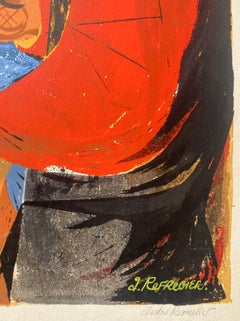
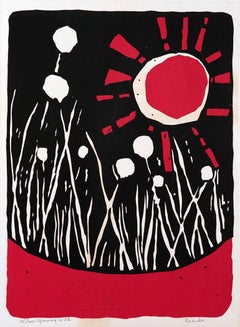
Artist: Guido Lopez
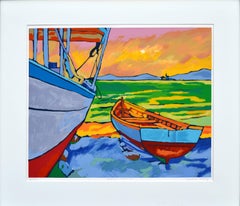
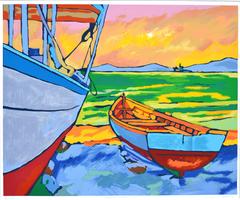
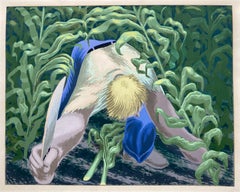
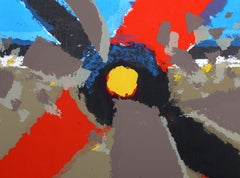
Poezia Marina, Spain - Abstract Landscape
By Guido Lopez
Located in Soquel, CA
Bright and bold screen print by Spanish artist Guido Lopez (Spain, 20th century). Titled "Poezia Marina", signed lower right "Guido Lopez', 12/150. Unframed. Image 22.5"H x 25"L, Mat...
Category

Early 2000s Modern Guido Lopez Art

Materials

Screen

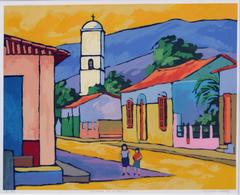
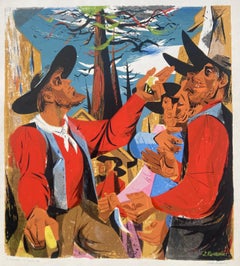
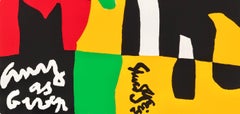
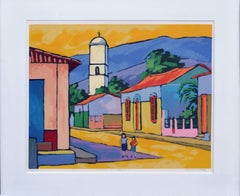
Calle De La Ermita, Valencia Spain
By Guido Lopez
Located in Soquel, CA
Bright and bold screen print by Spanish artist Guido Lopez (Spain, 20th century). Signed and titled, "Guido Lopez", 12/150. Unframed. Image 22.5"H x 25"L, Mat 31"H x 34.25"L.
Category

Early 2000s Modern Guido Lopez Art

Materials

Screen

Related Items
Thunder Bay
By Roy Ahlgren
Located in San Francisco, CA
This artwork titled "Thunder Bay" 1986 is a color serigraph on Wove paper by noted American artist Roy Ahlgren, 1927-2011 It is hand signed, titled, dated and numbered 14/95 in penci...
Category

Mid-20th Century Op Art Guido Lopez Art

Materials

Screen

Thunder Bay
Thunder Bay
$400
H 19 in W 15 in D 0.01 in
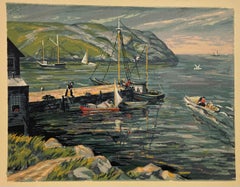
Harry Shokler, Island Harbor
By Harry Shokler
Located in New York, NY
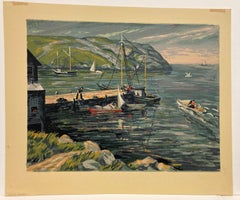
Harry Shokler used serigraphy to great advantage in this landscape. It's colorful and detailed. It is signed in the image at the lower left. When printmakers began making serigraphs...
Category

1940s American Modern Guido Lopez Art

Materials

Screen

Stuart Davis, Untitled, from Ten Works by Ten Painters, 1964
By Stuart Davis
Located in Southampton, NY
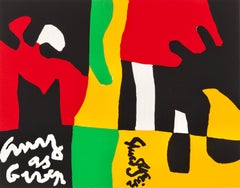
This exquisite silkscreen by Stuart Davis (1892–1964), titled Untitled, originates from the landmark 1964 folio X + X (Ten Works by Ten Painters). Published by the Wadsworth Atheneum...
Category

1960s American Modern Guido Lopez Art

Materials

Screen

Red Sky, Minimalist Abstract Screenprint by John Stritch
Located in Long Island City, NY
John Stritch was an American artist best known for his abstract and sculptural work. "Red Sky" features an abstracted and simplified red landscape. This screen...
Category

1980s Abstract Guido Lopez Art

Materials

Screen

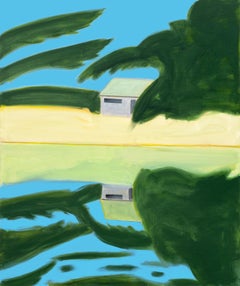
Alex Katz 'Reflection 2'
By Alex Katz
Located in New York, NY
Alex Katz (born 1927) Reflection 2 2021 Archival pigment ink on Innova Etching Cotton Rag 315 gsm fine art paper 47 x 39.5 inches (119 x 100.3 cm) Edition of 81/100 With flat plane...
Category

2010s Modern Guido Lopez Art

Materials

Screen

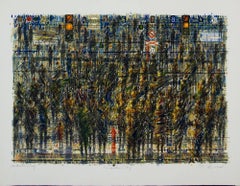
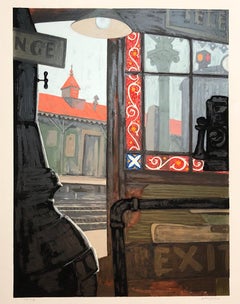
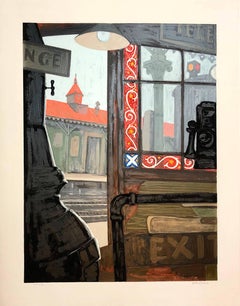
Modernist Silkscreen Screenprint 'El Station, Interior' NYC Subway, WPA Artist
By Anthony Velonis
Located in Surfside, FL
screenprint printed in color ink on wove paper. New York City subway station interior. Anthony Velonis (1911 – 1997) was an American painter and designer born in New York City who helped introduce the public to silkscreen printing in the early 20th century. While employed under the federal Works Progress Administration, WPA during the Great Depression, Velonis brought the use of silkscreen printing as a fine art form, referred to as the "serigraph," into the mainstream. By his own request, he was not publicly credited for coining the term. He experimented and mastered techniques to print on a wide variety of materials, such as glass, plastics, and metal, thereby expanding the field. In the mid to late 20th century, the silkscreen technique became popular among other artists such as Robert Rauschenberg and Andy Warhol. Velonis was born into a relatively poor background of a Greek immigrant family and grew up in the tenements of New York City. Early on, he took creative inspiration from figures in his life such as his grandfather, an immigrant from the mountains in Greece, who was "an ecclesiastical painter, on Byzantine style." Velonis attended James Monroe High School in The Bronx, where he took on minor artistic roles such as the illustration of his high school yearbook. He eventually received a scholarship to the NYU College of Fine Arts, into which he was both surprised and ecstatic to have been admitted. Around this time he took to painting, watercolor, and sculpture, as well as various other art forms, hoping to find a niche that fit. He attended NYU until 1929, when the Great Depression started in the United States after the stock market crash. Around the year 1932, Velonis became interested in silk screen, together with fellow artist Fritz Brosius, and decided to investigate the practice. Working in his brother's sign shop, Velonis was able to master the silkscreen process. He reminisced in an interview three decades later that doing so was "plenty of fun," and that a lot of technology can be discovered through hard work, more so if it is worked on "little by little." Velonis was hired by Mayor LaGuardia in 1934 to promote the work of New York's city government via posters publicizing city projects. One such project required him to go on a commercial fishing trip to locations including New Bedford and Nantucket for a fortnight, where he primarily took photographs and notes, and made sketches. Afterward, for a period of roughly six months, he was occupied with creating paintings from these records. During this trip, Velonis developed true respect and affinity for the fishermen with whom he traveled, "the relatively uneducated person," in his words. Following this, Velonis began work with the Public Works of Art Project (PWAP), an offshoot of the Civil Works Administration (CWA), where he was assigned to serve the different city departments of New York. After the formation of the federal Works Progress Administration, which hired artists and sponsored projects in the arts, he also worked in theater. Velonis began working for the federal WPA in 1935. He kept this position until 1936 or 1938, at which point he began working in the graphic art division of the Federal Art Project, which he ultimately led. Under various elements of the WPA program, many young artists, writers and actors gained employment that helped them survive during the Depression, as well as contributing works that created an artistic legacy for the country. When interviewed in December 1994 by the Library of Congress about his time in the WPA, Velonis reflected that he had greatly enjoyed that period, saying that he liked the "excitement" and "meeting all the other artists with different points of view." He also said in a later interview that "the contact and the dialogue with all those artists and the work that took place was just invaluable." Among the young artists he hired was Edmond Casarella, who later developed an innovative technique using layered cardboard for woodcuts. Velonis introduced silkscreen printing to the Poster Division of the WPA. As he recalled in a 1965 interview: "I suggested that the Poster division would be a lot more productive and useful if they had an auxiliary screen printing project that worked along with them. And apparently this was very favorably received..." As a member of the Federal Art Project, a subdivision of the WPA, Velonis later approached the Public Use of Arts Committee (PUAC) for help in "propagandizing for art in the parks, in the subways, et cetera." Since the Federal Art Project could not be "self-promoting," an outside organization was required to advertise their art more extensively. During his employment with the Federal Art Project, Velonis created nine silkscreen posters for the federal government. Around 1937-1939 Velonis wrote a pamphlet titled "Technical Problems of the Artist: Technique of the Silkscreen Process," which was distributed to art centers run by the WPA around the country. It was considered very influential in encouraging artists to try this relatively inexpensive technique and stimulated printmaking across the country. In 1939, Velonis founded the Creative Printmakers Group, along with three others, including Hyman Warsager. They printed both their own works and those of other artists in their facility. This was considered the most important silkscreen shop of the period. The next year, Velonis founded the National Serigraph Society. It started out with relatively small commercial projects, such as "rather fancy" Christmas cards that were sold to many of the upscale Fifth Avenue shops...
Category

1980s American Modern Guido Lopez Art
Materials

Screen

Stewart Wheeler, Atlantic City (New Jersey)
Located in New York, NY
The little that is know about the painter and printmaker Stewart Wheeler indicates that most of his career was spent in Philadelphia, Pennsylvania. And...
Category

Mid-20th Century American Modern Guido Lopez Art

Materials

Screen

Original "Wagon Lits" pop art style serigraph travel by train poster
By Valerio Adami
Located in Spokane, WA
Original “Wagon Lits” serigraph poster by the artist Valerio Adami. It was printed in France by GrafiCaza (Michel Caza), one of the finest serigraph companies on woven paper—in exce...
Category

1990s American Modern Guido Lopez Art
Materials

Screen

Pop Art Aspen Road Sign D'arcangelo Silkscreen Chiron Press Vintage Art Poster
Located in Surfside, FL
Allan D'Arcangelo (American/New York, 1930-1998), "Aspen Center of Contemporary Art", 1967 silkscreen, hand signed in pencil, dated, numbered "45/200" and blind stamped "Chiron Press, New York, NY" 32 in. x 24 in. Allan D'Arcangelo (1930-1998) was an American artist and printmaker, best known for his paintings of highways and road signs that border on pop art and minimalism, precisionism, Abstract illusionism and hard-edge painting, and also surrealism. His subject matter is distinctly American and evokes, at times, a cautious outlook on the future of this country. Allan D'Arcangelo was the son of Italian immigrants. He studied at the University of Buffalo from 1948–1953, where he got his bachelor's degree in history. After college, he moved to Manhattan and picked up his studies again at the New School of Social Research and the City University of New York, City College. At this time, he encountered Abstract Expressionist painters who were in vogue at the moment. After joining the army in the mid 1950s, he used the GI Bill to study painting at Mexico City College from 1957–59, driving there over 12 days in an old bakery truck retrofitted as a camper. However, he returned to New York in 1959, in search of the unique American experience. It was at this time that his painting took on a cool sensibility reminiscent of Roy Lichtenstein and Andy Warhol. His interests engaged with the environment, anti-Vietnam War protests, and the commodification and objectification of female sexuality. D'Arcangelo first achieved recognition in 1962, when he was invited to contribute an etching to The International Anthology of Contemporary Engraving: America Discovered; his first solo exhibition came the next year, at the Thiebaud Gallery in New York City. In 1965 he contributed three screenprints to Original Edition's 11 Pop Artists portfolio. By the 1970s, D'Arcangelo had received significant recognition in the art world. He was well known for his paintings of quintessentially American highways and infrastructure, and in 1971 was commissioned by the Department of the Interior to paint the Grand Coulee Dam in Washington state. However, his sense of morality always trumped his interest in art world fame. In 1975, he decided to quit the gallery that had been representing him for years, Marlborough Gallery, because of the way they handled Mark Rothko legacy. D'Arcangelo rejected Abstract Expressionism, though his early work has a painterly and somewhat expressive feel. He quickly turned to a style of art that seemed to border on Pop Art and Minimalism, Precisionism and Hard-Edge painting. Evidently, he didn't fit neatly in the category of Pop Art, though he shared subjects (women, signs, Superman) and techniques (stencil, assemblage) with these artists.He turned to expansive, if detached scenes of the American highway. These paintings are reminiscent of Giorgio de Chirico-though perhaps not as interested in isolation-and Salvador Dali-though there is a stronger interest in the present and disinterest in the past. These paintings also have a sharp quality that is reminiscent of the precisionist style, or more specifically, Charles Sheeler. 1950s, Before D'Arcangelo returned to New York, his style was roughly figurative and reminiscent of folk art. During the early 1960s, Allan D'Arcangelo was linked with Pop Art. "Marilyn" (1962) depicts an illustrative head and shoulders on which the facial features are marked by lettered slits to be "fitted" with the eyebrows, eyes, nose and mouth which appear off to the right in the composition. In "Madonna and Child," (1963) the featureless faces of Jackie Kennedy and Caroline are ringed with haloes, enough to make their status as contemporary icons perfectly clear. Select Exhibitions: Fischbach Gallery, New York, Ileana Sonnabend Gallery, Paris, Gallery Müller, Stuttgart, Germany Hans Neuendorf Gallery, Hamburg, Germany Dwan Gallery...
Category

1960s Pop Art Guido Lopez Art

Materials

Lithograph, Screen

Origiinal Piedmont "Take Off and Paint the Town" vintage airlines travel poster
Located in Spokane, WA
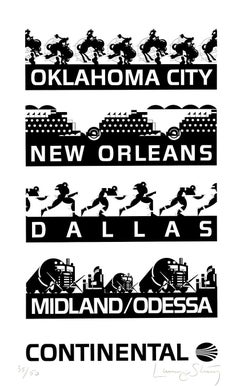
Original Piedmont, Take Off and Paint the Town vintage airlines travel poster. Archival linen backing in very good condition, ready to frame. This is a serigraph, so it features rich...
Category

1960s American Modern Guido Lopez Art
Materials

Screen

Girl at the Docks
By Nicola Simbari
Located in San Francisco, CA
This artwork titled "Girl at the Docks" c.1980, is an original colors serigraph by noted Italian artist Nicola Simbari, 1927-2012. It is hand signed and numbered 76/150 in pencil by ...
Category

Late 20th Century Modern Guido Lopez Art
Materials

Screen

Girl at the Docks
Girl at the Docks
$900
H 28.15 in W 35 in D 1 in
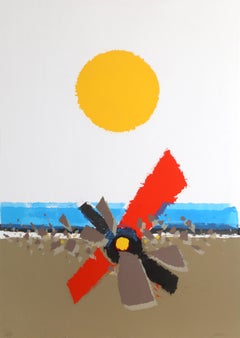
Windmill, Silkscreen with Collage by John Urbain
By John Urbain
Located in Long Island City, NY
Artist: John Urbain, Belgian/American (1920 - 2009) Title: Windmill Year: circa 1980 Medium: Silkscreen with Collage, signed and numbered in pencil Edition: AP Size: 36.5 x 26 in. (9...
Category

1970s Abstract Impressionist Guido Lopez Art
Materials

Screen

Guido Lopez art for sale on 1stDibs.

Find a wide variety of authentic Guido Lopez art available for sale on 1stDibs. You can also browse by medium to find art by Guido Lopez in screen print and more. Much of the original work by this artist or collective was created during the 21st century and contemporary and is mostly associated with the modern style. Not every interior allows for large Guido Lopez art, so small editions measuring 35 inches across are available. Customers who are interested in this artist might also find the work of Felix de Weldon , Eduardo Arroyo, and Virgilio Guidi. Guido Lopez art prices can differ depending upon medium, time period and other attributes. On 1stDibs, the price for these items starts at $860 and tops out at $955, while the average work can sell for $908.

Artists Similar to Guido Lopez

Still Thinking About These?

All Recently Viewed