Heinie Hartwig Art

to
1
Overall Width
to
Overall Height
to
1
1

Use search to find more

17
11,998
2,897
2,541
1,649

Use search to find more

Artist: Heinie Hartwig
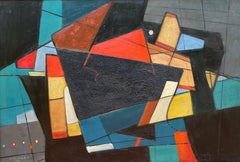
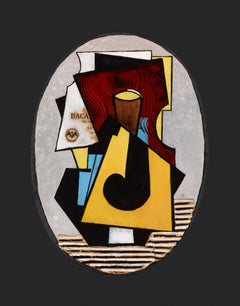
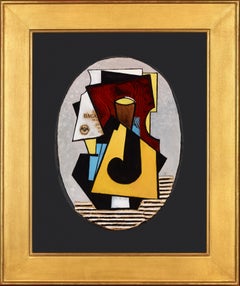
Explosive Abstract in Vibrant Blue, Red and Black

Explosive Abstract in Vibrant Blue, Red and Black

By Heinie Hartwig

Located in San Francisco, CA

Small but mighty. A moment caught, an explosion of energy, of color. And such a departure for California artist Heinie Hartwig (b. 1937), who is known primarily for his Western subje...

Category

Mid-20th Century Heinie Hartwig Art

Materials

Masonite, Oil

Related Items
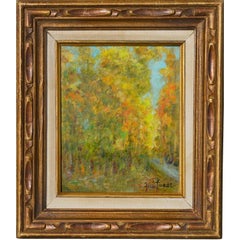
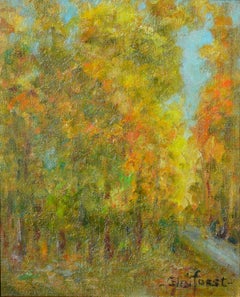
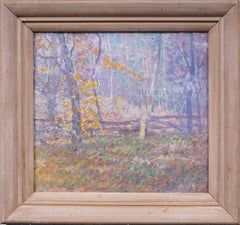
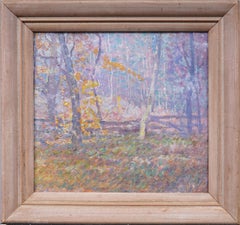
Autumn Trees - Mid Century Small-Scale Landscape, Signed Oil Painting

Autumn Trees - Mid Century Small-Scale Landscape, Signed Oil Painting

By Helen Enoch Gleiforst

Located in Soquel, CA

Autumn Trees - Mid Century Small-Scale Landscape, Signed Oil Painting Vivid mid century landscape of autumn trees blurring into colorful abstraction by Helen Gleiforst (American, 19...

Category

1950s American Impressionist Heinie Hartwig Art

Materials

Masonite, Oil

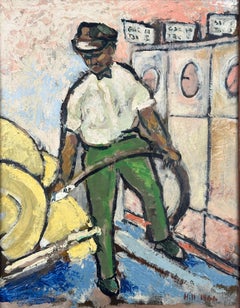
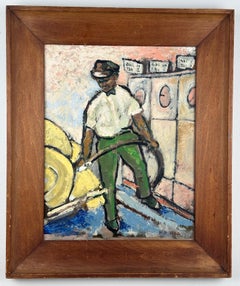
Gas Station Attendant (African American artist)

Gas Station Attendant (African American artist)

By Earl Hill

Located in Wilton Manors, FL

Earl Hill (1927-1985). Gas Station Attendant, 1966. Oil on masonite panel, 10.5 x 13.5 inches, 15 x 18 inches framed. Signed and dated lower right. Inscribed...

Category

Mid-20th Century Abstract Heinie Hartwig Art

Materials

Masonite, Oil

Untitled Abstraction

Untitled Abstraction

By E. Oscar Thalinger

Located in Los Angeles, CA

Untitled Abstraction, 1958, oil on board, signed and dated lower left, 24 x 35 inches, presented in a newer frame Oscar Edmund Thalinger was an American painter, draftsman, printmaker, and muralist best known for his evocative depictions of the American Midwest, his 1950s and 60s abstractions, and his contributions to Missouri art...

Category

Mid-20th Century American Modern Heinie Hartwig Art

Materials

Masonite, Oil

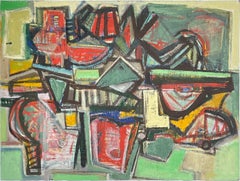
Abstract Mid-century Cubist Painting

Abstract Mid-century Cubist Painting

By Wesley Lea

Located in Wilton Manors, FL

Wesley Lea (1914-1981). Cubist Composition, ca. 1960. Oil on masonite panel, measuring 14.5 x 22 inches. Framed measurement: 19.5 x 27 inches. Signed lower left.

Category

Mid-20th Century Cubist Heinie Hartwig Art

Materials

Oil, Masonite

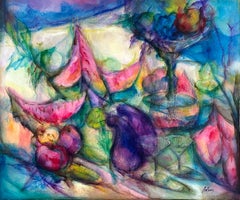
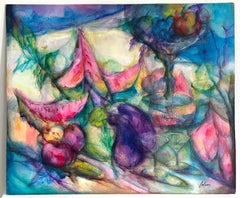
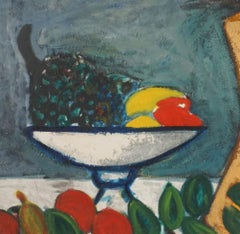
Cubist Still Life with Fruit and Compote

Cubist Still Life with Fruit and Compote

Located in Wilton Manors, FL

Beautiful cubist still life painted in jewel tones. ca. 1970. Oil on masonite panel measuring 20 x 24 inches. Unfrmaed. Signed "Galbrun" lower right.

Category

1970s Cubist Heinie Hartwig Art

Materials

Masonite, Oil

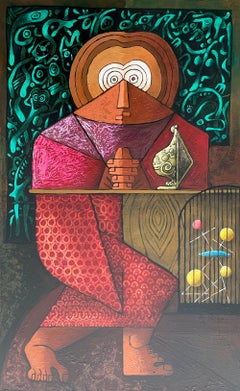
Untitled Surreal Landscape Painting, Mixed Media on Masonite, 1970

Untitled Surreal Landscape Painting, Mixed Media on Masonite, 1970

By Jacob El Hanani

Located in New York, NY

This early work by Jacob El Hanani was done in 1970. It is mixed media on masonite. It is hand signed in Hebrew and English in the bottom right. The piece comes framed in a black woo...

Category

1970s Contemporary Heinie Hartwig Art

Materials

Ink, Oil, Masonite

St. Atomic oil and tempera painting by Julio de Diego

St. Atomic oil and tempera painting by Julio de Diego

By Julio de Diego

Located in Hudson, NY

Julio De Diego’s Atomic Series paintings made an extraordinary statement regarding the shock and fear that accompanied the dawn of the nuclear age. In the artist’s own words, “Scientists were working secretly to develop formidable powers taken from the mysterious depths of the earth - with the power to make the earth useless! Then, the EXPLOSION! . . . we entered the Atomic Age, and from there the neo-Atomic war begins. Explosions fell everywhere and man kept on fighting, discovering he could fight without flesh.” To execute these works, De Diego developed a technique of using tempera underpainting before applying layer upon layer of pigmented oil glazes. The result is paintings with surfaces which were described as “bonelike” in quality. The forms seem to float freely, creating a three-dimensional visual effect. In the 1954 book The Modern Renaissance in American Art, author Ralph Pearson summarizes the series as “a fantastic interpretation of a weighty theme. Perhaps it is well to let fantasy and irony appear to lighten the devastating impact. By inverse action, they may in fact increase its weight.” Exhibited 1950 University of Illinois at Urbana "Contemporary American Painting" 1964 Marion Koogler McNay Art Institute, San Antonio, Texas This work retains its original frame which measures 54" x 36" x 2". About this artist: Julio De Diego crafted a formidable persona within the artistic developments and political struggles of his time. The artist characterized his own work as “lyrical,” explaining, “through the years, the surrealists, the social-conscious painters and the others tried to adopt me, but I went my own way, good, bad or indifferent.” [1] His independence manifested early in life when de Diego left his parent’s home in Madrid, Spain, in adolescence following his father’s attempts to curtail his artistic aspirations. At the age of fifteen he held his first exhibition, set up within a gambling casino. He managed to acquire an apprenticeship in a studio producing scenery for Madrid’s operas, but moved from behind the curtains to the stage, trying his hand at acting and performing as an extra in the Ballet Russes’ Petrouchka with Nijinsky. He spent several years in the Spanish army, including a six-month stretch in the Rif War of 1920 in Northern Africa. His artistic career pushed ahead as he set off for Paris and became familiar with modernism’s forays into abstraction, surrealism, and cubism. The artist arrived in the U.S. in 1924 and settled in Chicago two years later. He established himself with a commission for the decoration of two chapels in St. Gregory’s Church. He also worked in fashion illustration, designed magazine covers and developed a popular laundry bag for the Hotel Sherman. De Diego began exhibiting through the Art Institute of Chicago in 1929, and participated in the annual Chicago Artists Exhibitions, Annual American Exhibitions, and International Water Color Exhibitions. He held a solo exhibition at the Art Institute of Chicago in the summer of 1935. Though the artist’s career was advancing, his family life had deteriorated. In 1932 his first marriage dissolved, and the couple’s young daughter Kiriki was sent to live with friend Paul Hoffman. De Diego continued to develop his artistic vocabulary with a growing interest in Mexican art. He traveled throughout the country acquainting himself with the works of muralists such as Carlos Merida, and also began a collection of small native artifacts...

Category

1940s American Modern Heinie Hartwig Art

Materials

Masonite, Oil, Tempera

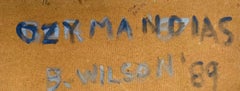
Ozymandias (unique, signed Abstract Expressionist painting by renowned painter)

Ozymandias (unique, signed Abstract Expressionist painting by renowned painter)

By Ben Wilson

Located in New York, NY

Ben Wilson Ozymandias, 1989 Oil on masonite board Boldly signed by Ben Wilson on the back 36 × 48 inches Unframed Provenance: acquired from the Estate of Ben Wilson This work is titled "Ozymandias" after the famous sonnet written by Percy Bysshe Shelley (1792-1822). Shelley's poem is one of the most poignant meditations on the fleeting nature of human power and the inevitability of decline. The poem serves as a reminder that time erodes even the most imposing empires and leaders and that the pursuit of lasting fame and control is ultimately futile. Depending on how one views Ben Wilson's Abstract Expressionist painting of "Ozymandias" -- some of the imagery might reveal the head of an angry king and a sickle. Shelley's poem Ozymandias reads: I met a traveler from an antique land...

Category

1980s Abstract Expressionist Heinie Hartwig Art

Materials

Masonite, Oil

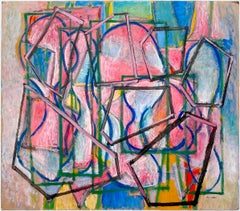
Concert  (unique, signed Abstract Expressionist painting by celebrated artist)

Concert (unique, signed Abstract Expressionist painting by celebrated artist)

By Ben Wilson

Located in New York, NY

Ben Wilson Concert, ca. 1989 Oil on masonite board (Hand Signed by the artist; also bears the Estate Stamp) Boldly signed front and back, titled and dated on the back by Ben Wilson and also stamped on the back by the estate of Ben Wilson 42 × 48 inches Unframed This stunning painting is done by the second generation Abstract Expressionist artist Ben Wilson - one of the youngest artists to be given a show at prestigious ACA Gallery in 1940. This work "Concert" - depicting instruments, in a light, lyrically abstract painting. Exquisite colors and subtle imagery. In 2017, he was the subject of a retrospective at the George Segal Gallery at Montclair State University from September 6 to November 4 and it was accompanied by a catalogue. About Ben Wilson: Ben Wilson was born in Philadelphia in 1913 to Jewish parents who had emigrated from Kiev and settled in New York City. He was educated in Manhattan public schools and graduated from City College in 1935. To gain exposure to a wider range of styles, he also studied at the National Academy of Design and at the Educational Alliance. Admired by critics throughout his long career, Wilson was singled out as a “discovery” by the New York Times art critic Edward Alden Jewel even before his first one-man show at the Galerie Neuf in 1946. His paintings of the ’30s and ’40s were expressionistically rendered, often Biblical parables, filled with what he called “the grief of the intolerable” and reflecting an acute awareness of the agony of the time, from the Holocaust to the Spanish Civil War. A WPA artist who identified strongly with the plight of the Jews in Europe, he relentlessly explored themes of war, torment, and futility in his early decades of painting. When times changed and social pressures subsided, Wilson’s mood lifted. He spent 1952-54 in Paris working at the Academie Julien. During the ’50s his involvement with specific imagery persisted but became more psychological and mythic in orientation. Influenced by Cubism, he created a vocabulary of interlocking shapes and bold, sweeping gestures that served as a transition between his early figurative expressionism and his later abstract constructivist concerns. Towards the end of the decade Wilson reached a crossroads, moving towards abstraction and searching for what he called “a scaffolding under the externals.” By 1960, influenced by the Russian Constructivists, Mondrian, and Abstract Expressionism, Wilson turned to abstraction. Reexamining the basic elements of painting, he evolved his own personal vocabulary and structure, fusing the cerebral and the emotive. He became increasingly experimental, using house paint, sand, and other unorthodox materials in paintings that he worked from all directions, dripping, spraying, stenciling, and collaging. He employed elements of disjunction, repetitions of geometric motifs, linear networks, and complex overlays to create the transparent, multi-layer development of space that characterizes his later paintings. A consummate draftsman, Wilson filled notebook after notebook with drawings that he amplified in his paintings. Eschewing popular movements, Wilson was always one to pursue a personal aesthetic. Despite more than 30 one-man shows and 50 years of teaching, he increasingly withdrew from the gallery scene but continued to paint daily until his death at age 88 in 2001 in Blairstown, New Jersey, where he and his sculptor wife Evelyn Wilson...

Category

1980s Abstract Expressionist Heinie Hartwig Art

Materials

Masonite, Oil

Composition, 1940–42

Composition, 1940–42

By Suzy Frelinghuysen

Located in Bryn Mawr, PA

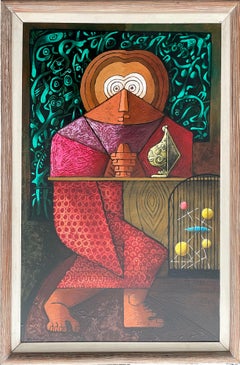
Composition, 1940–42 Oil on paper collage on masonite, 16 x 11 3/4 inches (40.6 x 29.8 cm) Framed dimensions: 26 x 21 3/4 inches Signed right center: SF Provenance Frelinghuysen Morris Foundation; Valerie Carberry Gallery, Chicago, Illinois Private collection until 2022 Suzy Frelinghuysen was born into a wealthy and prominent New Jersey family, and growing up, she was tutored in both art and music. While she showed an early talent for art, it was not her primary interest; as a child, she nurtured an nambition to become a professional singer. In 1935, she married George Morris, who came from an equally wealthy and distinguished New York family and had already established himself as an art collector, artist, and critic. Morris encouraged Frelinghuysen to paint and introduced her to a circle of affluent abstract artists, including the artist and collector Albert Gallatin. Gallatin owned a small but influential gallery, known as the Gallery of Living Art...

Category

Mid-20th Century Cubist Heinie Hartwig Art
Materials

Masonite, Paper, Oil

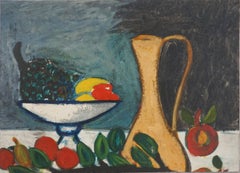
German Post War Modern Still Life of Fruit by Walter Junge Double-sided Painting

German Post War Modern Still Life of Fruit by Walter Junge Double-sided Painting

Located in Soquel, CA

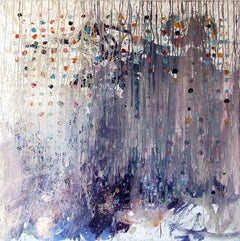
German Post War Modernist Still Life of Fruit and Pitcher by Walter Junge Double-sided Painting "An echo of the nature-oriented ideas from German Romanticism seems to continue to re...

Category

1960s Post-War Heinie Hartwig Art
Materials

Masonite, Oil

Untitled (Cubist Portrait)

Untitled (Cubist Portrait)

By Jerre H. Murry

Located in Los Angeles, CA

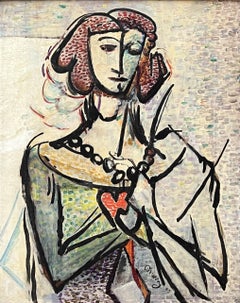
This work is part of our exhibition - America Coast to Coast: Artists of the 1940s Untitled (Cubist Portrait), 1945, oil on masonite, signed and dated lower middle, 20 x 16 inches, remnant of exhibition label verso, perhaps exhibited at Murry's solo exhibition at the Los Angeles's Screen Cartoonists' Gallery, July , 1945, presented in its original frame Jerre Murry was a California modernist painter. Born in Columbia, Missouri, Murry studied at the Detroit Academy of Art and worked as an artist for the Detroit News and Detroit Free Press. Murry traveled to the Bahamas, where he was inspired to paint modernist scenes of island life and people. By the early 1930s, Murry had relocated to Los Angeles, where he caught the attention of Synchromist painter Stanton Macdonald Wright, State Supervisor for the Federal Art Project (FAP) in Southern California. MacDonald Wright enrolled Murry into the FAP. Murry’s Gauguin-influenced painting Sun Image was exhibited together with other FAP artists at the Los Angeles County Museum of Art in 1936, and Murry was also included in the FAP exhibit at the Paris Exposition in 1937. Stendahl Galleries in Los Angeles, the Chamber of Commerce Gallery in Santa Barbara, and at the Los Angeles County Museum of Art also showed Murry’s work during the 1930s. Murry created a murals for Los Angeles Water & Power Company, the Boise, Idaho Post Office, and Glendale Junior College. In 1939, Murry's work was exhibited at the Golden Gate International Exposition and the New York World's Fair. He also was included in the All California Exhibition at the Los Angeles County Museum of art that same year. He went on to exhibit in Los Angeles at the Foundation of Western Art's Trends in Southern California Art shows in 1940 and 1941, at Raymond and Raymond Gallery in Hollywood and USC’s Elizabeth Holmes...

Category

1940s American Modern Heinie Hartwig Art
Materials

Masonite, Oil

Heinie Hartwig art for sale on 1stDibs.

Find a wide variety of authentic Heinie Hartwig available for sale on 1stDibs.