Henry Botkin Art

to
1
Overall Width
to
Overall Height
to
1
1
1
1
1
10,191
2,807
2,503
1,398
1
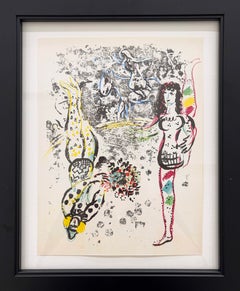
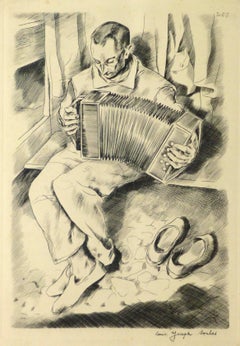
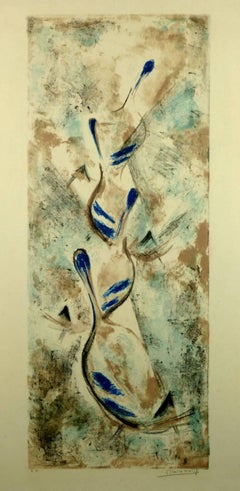
Artist: Henry Botkin
original lithograph

original lithograph

By Henry Botkin

Located in Henderson, NV

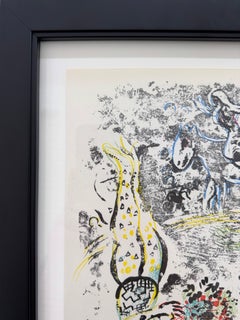
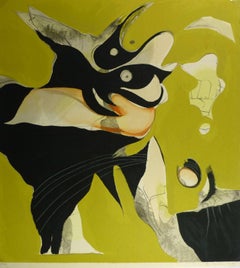
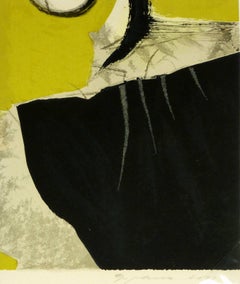
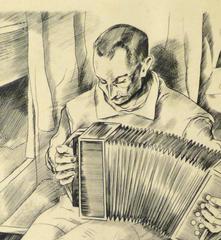
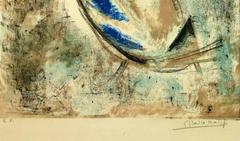
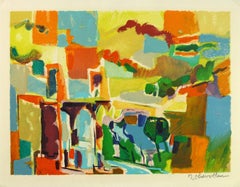
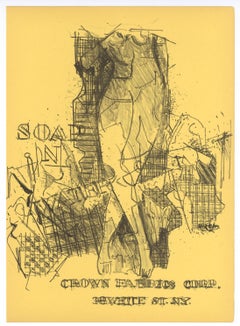
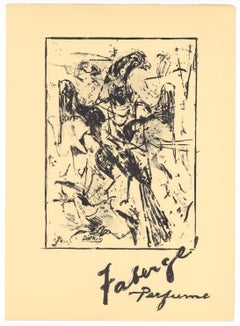
Medium: original lithograph. This lithograph is from the rare 1953 "Improvisations" portfolio, published by the Artists Equity Association of New York on...

Category

1950s Henry Botkin Art

Materials

Lithograph

Related Items
The Scribe, Rabbi Writing A Torah, Judaica Artists Proof

The Scribe, Rabbi Writing A Torah, Judaica Artists Proof

By Emanuel Schary

Located in Surfside, FL

EMANUEL SCHARY Israel, b. 1924, d. 1994 A lively affection for humanity characterizes the work of the Israeli-American artist Emanuel Schary (1924-1994). Working in a range of media,...

Category

20th Century Modern Henry Botkin Art

Materials

Lithograph

Landscape at Sunset - Lithograph by Ugo Attardi - 1970s

Landscape at Sunset - Lithograph by Ugo Attardi - 1970s

By Ugo Attardi

Located in Roma, IT

Lithograph on paper. Hand signed and numbered in pencil. Edition of 150. Very good condition. This evocative colour lithograph by Ugo Attardi presents a Mediterranean hill town...

Category

1970s Contemporary Henry Botkin Art

Materials

Lithograph

The Umbrellas, Japan - USA Offset lithograph poster (Hand Signed by Christo)

The Umbrellas, Japan - USA Offset lithograph poster (Hand Signed by Christo)

By Christo and Jeanne-Claude

Located in New York, NY

Christo and Jeanne-Claude The Umbrellas, Japan - USA (Hand Signed), 1991 Offset lithograph poster Boldly signed by Christo upper right 25 × 38 inches Unframed This rare vintage poster was published by Christo and Jeanne-Claude to promote and raise funds for Christo's famous Umbrellas Japan-USA project in the early 1990s. It is hand signed boldly in black marker "Christo" on the recto - upper right corner. This work was acquired from the Estate of Jacob and Aviva Baal-Teshuva, collectors, curators, authors, early supporters and good friends of Christo. Authenticity unconditionally guaranteed. ABOUT THE UMBRELLAS JAPAN-USA PROJECT: At sunrise, on October 9, 1991, Christo and Jeanne-Claude's 1,880 workers began to open the 3,100 umbrellas in Ibaraki and California, in the presence of the artists at both sites. This Japan-USA temporary work of art reflected the similarities and differences in the ways of life and the use of the land in two inland valleys, one 12 miles (19 kilometers) long in Japan, and the other 18 miles (29 kilometers) long in the USA. In Japan, the valley is located north of Hitachiota and south of Satomi, 75 miles (120 kilometers) north of Tokyo, around Route 349 and the Sato River, in the Prefecture of Ibaraki, on the properties of 459 private landowners and governmental agencies. In the USA, the valley is located 60 miles (96.5 kilometers) north of Los Angeles, along Interstate 5...

Category

1990s Pop Art Henry Botkin Art

Materials

Lithograph, Offset

From Celui Qui Dit Les Choses Sans Rien Dire (Cramer 99)

Marc ChagallFrom Celui Qui Dit Les Choses Sans Rien Dire (Cramer 99), 1975

$11,960Sale Price|20% Off

H 27 in W 22.75 in D 1 in

From Celui Qui Dit Les Choses Sans Rien Dire (Cramer 99)

By Marc Chagall

Located in Aventura, FL

Untitled from Celui qui dit les choses sans rien dire (One who says things without saying anything). Color etching and aquatint on Japon Imperial paper. Hand signed and numbered by M...

Category

1970s Surrealist Henry Botkin Art

Materials

Paper, Lithograph

Untitled - Lithograph by Alexander Calder - 1963

Untitled - Lithograph by Alexander Calder - 1963

By Alexander Calder

Located in Roma, IT

Untitled is an original Lithograph realized in 1963 by Alexander Calder from "Derrière Le Miroir" No signature. Very good condition including a white cardboard Passepartout. Alexa...

Category

1960s Contemporary Henry Botkin Art

Materials

Lithograph

"Cirdan, Tuolomne County 1934" - Figurative Lithograph

"Cirdan, Tuolomne County 1934" - Figurative Lithograph

Located in Soquel, CA

Bold lithograph of a vintage photo by an unknown artist (20th century). This piece is numbered "1/12" and titled "Cirdan, Tuolomne County 1934" on the bottom edge. Signed "M--- P----...

Category

Late 20th Century Contemporary Henry Botkin Art

Materials

Paper, Lithograph

Floating Cards (pencil signed Artist's Proof) 1960s lithograph on Arches Mourlot

Floating Cards (pencil signed Artist's Proof) 1960s lithograph on Arches Mourlot

By Joe Goode

Located in New York, NY

Joe Goode Floating Cards, 1969 Lithograph on Arches paper with two deckled edges. Hand Signed. Dated. Annotated Hand signed, dated and annotated Artists Proof on the lower front 22 1/4 × 29 4/5 inches Published by Mourlot, Paris Provenance: Reese-Palley Gallery, Atlantic City, New Jersey Unframed Part of Joe Goode's five part 1960s series "Floating Cards". Rarely to market. The provenance of this print is from the Reese-Palley Gallery. The famous dealer and adventurer Reese Palley of Atlantic City New Jersey - was the second gallerist in the 1960s - after Paula Cooper - to set up shop in SOHO. Hand signed, dated, and annotated Artist's Proof aside from the regular edition. Pop art pioneer Joe Goode (born 1937) was born in Oklahoma City, Oklahoma, in 1937. In 1959 he moved to Los Angeles, California, where he attended the Chouinard Art Institute until 1961. First recognized for his Pop Art milk bottle paintings and cloud imagery, Goode's work was included along with Roy Lichtenstein, Andy Warhol, Jim Dine, Phillip Hefferton, Robert Dowd, Edward Ruscha, and Wayne Thiebaud, in the 1962 ground-breaking exhibit New Painting of Common Objects, curated by Walter Hopps...

Category

1960s Abstract Henry Botkin Art

Materials

Pencil, Lithograph

Two Faces, Modern Self-Portrait Lithograph of the Artist Aging in Pink & Green

Two Faces, Modern Self-Portrait Lithograph of the Artist Aging in Pink & Green

By Dennis John Ashbaugh

Located in Soquel, CA

Limited edition hand signed lithograph featuring two consecutive modern portraits of faces with varying degrees of abstraction, in pink and green, by Dennis john Ashbaugh (American, b. 1946). Numbered "7/7" in the lower-left corner. Signed "Dennis John Ashbaugh" in the lower right corner. Presented in a new tan mat with foam core backing. Unframe. Image size: 4"H x 6.75"W. Some toning yellowing at mat opening. Dennis John Ashbaugh (American, b. 1946) was born in Red Oak, Iowa, and attended California State University at Fullerton, receiving his MA in 1969. Ashbaugh has spent most of his career in New York City. In 1992, he collaborated with William Gibson, a fiction writer, and with publisher Kevin Begos on a book, Agrippa, meaning 'book of the dead'. Exhibition venues include the Metropolitan Museum of Art in New York City, the P.S.1 Contemporary Art Center, the Seattle Art Museum, and the Whitney Museum of American ArtPublic collections holding his work include the Hirshhorn Museum, the Museum of Fine Arts, Houston, the Los Angeles County Museum of Art, and the New York Metropolitan. He received a Guggenheim Fellowship. Ashbaugh lives in a trim frame house in Flamingo Park...

Category

1970s Modern Henry Botkin Art

Materials

Paper, Ink, Lithograph

Woman Waving - 1991 Abstract Expressionist Lithograph on Paper

Woman Waving - 1991 Abstract Expressionist Lithograph on Paper

By Sidney Budnick

Located in Soquel, CA

Woman Waving - 1991 Abstract Expressionist Lithograph on Paper 1991 black and yellow abstract expressionist lithograph depicting a woman by Sidney Jonas Budnick (1921 - 1994). The w...

Category

1990s Post-War Henry Botkin Art

Materials

Acrylic, Laid Paper, Lithograph

Feminist Surrealist French Abstract Colorful Lithograph Print Myriam Bat Yosef

Feminist Surrealist French Abstract Colorful Lithograph Print Myriam Bat Yosef

Located in Surfside, FL

Myriam Bat-Yosef Surrealist abstract lithograph print in colorful abstract shapes and shades Hand signed and dated 1971. sheet measures 9.25 X 9.25 inches The envelope and the Peter Buch poster is just for provenance and is not included in this sale. Myriam Bat-Yosef, whose real name is Marion Hellerman, born on January 31, 1931 in Berlin, Germany to a Jewish family from Lithuania, she is an Israeli-Icelandic artist who paints on papers, paintings, fabrics, objects and human beings for performances. Myriam Bat-Yosef currently lives and works in Paris. In 1933, her family fleeing the Nazi Holocaust, Miriam Bat-Yosef emigrates to Palestine and settles in Jaffa. In 1936, she suffers a family tragedy, her father, militant Zionist, is called to fight, still recovering from an operation of appendicitis. The incision will become infected, antibiotics did not exist yet, and her father will die in the hospital after 9 months of suffering. Myriam and her mother leave Palestine to live in Paris for three years. French is Myriam's first school language. In 1939, still fleeing Nazism, she returned to Palestine, leaving France by the last boat from Marseille. She moved to Tel Aviv with her mother, aunt and maternal grandmother. In 1940, she began attending the Academy of Fine Arts in Tel Aviv and took her name as an artist, Bat-Yosef, which means Joseph's daughter in Hebrew, as a tribute to her father. In 1946, Myriam graduated as a kindergarten teacher but wanted to be an artist. Her mother enrolled her in an evening school to prepare a diploma of art teacher. At 19, she performs two years of military service in Israel. In 1952, with a pension of $50 a month that her mother allocated, she went to study at the Beaux-Arts in Paris. To survive, she has several activities while studying. In 1955, she had her first solo exhibition, at the Israeli Club on Wagram Avenue in Paris. Many artists, such as Yaacov Agam, Yehuda Neiman Avigdor Arikha, Raffi Kaiser, Dani Karavan and sculptors Achiam and Shlomo Selinger attended the opening . In 1956, she enrolled at the School of Fine Arts in Florence. This is where she meets the painter Errô. They share an icy studio in winter. Myriam moves to Milan with friends. She organizes a joint exhibition with Erro, one room each, at the Montenapoleone gallery. Her works are admired by the sculptor Marino Marini and the painters Renato Birolli and Enrico Prampolini. Myriam and Erro exhibit in Rome, Milan, Florence and meet many personalities: Alain Jouffroy and his wife, the painter Manina, Roberto Matta and his wife Malitte, textile artist who was one of the founders of the Pompidou Center. Back in Paris, Myriam and Erro get married, which allows Myriam to avoid being called into the Israeli army during the Suez Canal War. In 1957, Myriam and her husband went to Iceland. Myriam works in a chocolate factory. Having enough money, she starts producing art again. She exhibited in Reykjavik's first art gallery. She meets the artist Sigridur Bjornsdottir, married to the Swiss painter Dieter Roth . In 1958, Myriam and her husband leave for Israel. They exhibit in Germany, then in Israel. Back in Paris, the couple became friends with artists of the surrealist movement, such as Victor Brauner, Hans Bellmer, the sculptor Philippe Hiquily, Liliane Lijn, future wife of Takis and photographer Nathalie Waag. Erro and Myriam have a daughter on March 15, 1960, named Tura, after the painter Cosmè Tura, but also close to the Icelandic Thora or the Hebrew Torah. Bat-Yosef’s complex trajectory throughout the 20th century is linked as much to the transnational history of what was for a time called the School of Paris as it is to a certain legacy of Surrealism. Her work features the same idea of resolving antinomies that also defined the spirit of surrealism, and is enhanced with her readings of the Kabbalah and her spiritual grounding in Taoism. However, while there are reasons for her approach to be associated with the process of the ready-made, it is important to consider the immediate intrication of these works with her practice of performance, during which the body itself is also painted – a feminist response to Yves Klein’s Anthropometries (1960) and an echo of the happenings which Jean-Jacques Lebel organised at the time in Paris. In 1963, Erró told Myriam that if she wants to be a painter, she can not be his wife. Myriam chose to be a painter and the couple divorced in 1964. Since that time, Myriam Bat-Yosef has exhibited in many countries: Europe, United States, Japan, etc. Although long in the shadows, the work of Myriam Bat-Yosef has been greeted by many artists and personalities: Anaïs Nin, Nancy Huston, André Pieyre of Mandiargues, José Pierre, René de Solier , Jacques Lacarrière, Alain Bosquet, Pierre Restany, Sarane Alexandrian and Surrealist André Breton who, after a visit to her studio, confided to having been intrigued by its phantasmagorical dimension. She was included in the book Pop Art and Beyond: Gender, Race, and Class in the Global Sixties by Mona Hadler and Kalliopi Minioudaki. Extract "World Citizen, Artist of the Pop Era Sarah Wilson; Why do we know so little of Myriam Bat-Yosef, the most important female Israeli artist of the Pop era? Issues of identity and sexuality feature constantly in her work. She exhibited internationally from Reykjavik to Tokyo; she had two shows at Arturo Schwarz’s famous Dada/surrealist gallery in Milan; she participated in feminist art events in Los Angeles. Above all, in 1971, she conceived Total Art, a Pop Gesamtkunstwerk inside and outside the Israel Museum, Jerusalem. Painter, performer, and installation artist, she was also a lover, wife, and mother. Of Lithuanian-Jewish descent, she was close to the family of philosopher Emmanuel Levinas. An émigré in Paris she would repudiate a national passport, participating in Garry Davis’s short-lived “World Citizens” movement. She continues the lineage of women surrealist artists: Valentine Hugo, Leonor Fini, Dorothea Tanning, Leonora Carrington, Unica Zürn, Jane Graverol...

Category

1970s Surrealist Henry Botkin Art

Materials

Lithograph

Feminist Surrealist French Abstract Colorful Lithograph Print Myriam Bat Yosef

Feminist Surrealist French Abstract Colorful Lithograph Print Myriam Bat Yosef

Located in Surfside, FL

Myriam Bat-Yosef Surrealist abstract lithograph print in colorful abstract shapes and shades Hand signed and dated 1971. sheet measures 9.25 X 9.25 inches The envelope and the Peter Buch poster is just for provenance and is not included in this sale. Myriam Bat-Yosef, whose real name is Marion Hellerman, born on January 31, 1931 in Berlin, Germany to a Jewish family from Lithuania, she is an Israeli-Icelandic artist who paints on papers, paintings, fabrics, objects and human beings for performances. Myriam Bat-Yosef currently lives and works in Paris. In 1933, her family fleeing the Nazi Holocaust, Miriam Bat-Yosef emigrates to Palestine and settles in Jaffa. In 1936, she suffers a family tragedy, her father, militant Zionist, is called to fight, still recovering from an operation of appendicitis. The incision will become infected, antibiotics did not exist yet, and her father will die in the hospital after 9 months of suffering. Myriam and her mother leave Palestine to live in Paris for three years. French is Myriam's first school language. In 1939, still fleeing Nazism, she returned to Palestine, leaving France by the last boat from Marseille. She moved to Tel Aviv with her mother, aunt and maternal grandmother. In 1940, she began attending the Academy of Fine Arts in Tel Aviv and took her name as an artist, Bat-Yosef, which means Joseph's daughter in Hebrew, as a tribute to her father. In 1946, Myriam graduated as a kindergarten teacher but wanted to be an artist. Her mother enrolled her in an evening school to prepare a diploma of art teacher. At 19, she performs two years of military service in Israel. In 1952, with a pension of $50 a month that her mother allocated, she went to study at the Beaux-Arts in Paris. To survive, she has several activities while studying. In 1955, she had her first solo exhibition, at the Israeli Club on Wagram Avenue in Paris. Many artists, such as Yaacov Agam, Yehuda Neiman Avigdor Arikha, Raffi Kaiser, Dani Karavan and sculptors Achiam and Shlomo Selinger attended the opening . In 1956, she enrolled at the School of Fine Arts in Florence. This is where she meets the painter Errô. They share an icy studio in winter. Myriam moves to Milan with friends. She organizes a joint exhibition with Erro, one room each, at the Montenapoleone gallery. Her works are admired by the sculptor Marino Marini and the painters Renato Birolli and Enrico Prampolini. Myriam and Erro exhibit in Rome, Milan, Florence and meet many personalities: Alain Jouffroy and his wife, the painter Manina, Roberto Matta and his wife Malitte, textile artist who was one of the founders of the Pompidou Center. Back in Paris, Myriam and Erro get married, which allows Myriam to avoid being called into the Israeli army during the Suez Canal War. In 1957, Myriam and her husband went to Iceland. Myriam works in a chocolate factory. Having enough money, she starts producing art again. She exhibited in Reykjavik's first art gallery. She meets the artist Sigridur Bjornsdottir, married to the Swiss painter Dieter Roth . In 1958, Myriam and her husband leave for Israel. They exhibit in Germany, then in Israel. Back in Paris, the couple became friends with artists of the surrealist movement, such as Victor Brauner, Hans Bellmer, the sculptor Philippe Hiquily, Liliane Lijn, future wife of Takis and photographer Nathalie Waag. Erro and Myriam have a daughter on March 15, 1960, named Tura, after the painter Cosmè Tura, but also close to the Icelandic Thora or the Hebrew Torah. Bat-Yosef’s complex trajectory throughout the 20th century is linked as much to the transnational history of what was for a time called the School of Paris as it is to a certain legacy of Surrealism. Her work features the same idea of resolving antinomies that also defined the spirit of surrealism, and is enhanced with her readings of the Kabbalah and her spiritual grounding in Taoism. However, while there are reasons for her approach to be associated with the process of the ready-made, it is important to consider the immediate intrication of these works with her practice of performance, during which the body itself is also painted – a feminist response to Yves Klein’s Anthropometries (1960) and an echo of the happenings which Jean-Jacques Lebel organised at the time in Paris. In 1963, Erró told Myriam that if she wants to be a painter, she can not be his wife. Myriam chose to be a painter and the couple divorced in 1964. Since that time, Myriam Bat-Yosef has exhibited in many countries: Europe, United States, Japan, etc. Although long in the shadows, the work of Myriam Bat-Yosef has been greeted by many artists and personalities: Anaïs Nin, Nancy Huston, André Pieyre of Mandiargues, José Pierre, René de Solier , Jacques Lacarrière, Alain Bosquet, Pierre Restany, Sarane Alexandrian and Surrealist André Breton who, after a visit to her studio, confided to having been intrigued by its phantasmagorical dimension. She was included in the book Pop Art and Beyond: Gender, Race, and Class in the Global Sixties by Mona Hadler and Kalliopi Minioudaki. Extract "World Citizen, Artist of the Pop Era Sarah Wilson; Why do we know so little of Myriam Bat-Yosef, the most important female Israeli artist of the Pop era? Issues of identity and sexuality feature constantly in her work. She exhibited internationally from Reykjavik to Tokyo; she had two shows at Arturo Schwarz’s famous Dada/surrealist gallery in Milan; she participated in feminist art events in Los Angeles. Above all, in 1971, she conceived Total Art, a Pop Gesamtkunstwerk inside and outside the Israel Museum, Jerusalem. Painter, performer, and installation artist, she was also a lover, wife, and mother. Of Lithuanian-Jewish descent, she was close to the family of philosopher Emmanuel Levinas. An émigré in Paris she would repudiate a national passport, participating in Garry Davis’s short-lived “World Citizens” movement. She continues the lineage of women surrealist artists: Valentine Hugo, Leonor Fini, Dorothea Tanning, Leonora Carrington, Unica Zürn, Jane Graverol...

Category

1970s Surrealist Henry Botkin Art

Materials

Lithograph

Untitled - Lithograph by Alexander Calder - 1963

Untitled - Lithograph by Alexander Calder - 1963

By Alexander Calder

Located in Roma, IT

Untitled is an original Lithograph realized in 1963 by Alexander Calder from "Derrière Le Miroir" No signature. Very good condition including a white cardboard Passepartout. Alexa...

Category

1960s Abstract Henry Botkin Art

Materials

Lithograph

Previously Available Items
original lithograph

original lithograph

By Henry Botkin

Located in Henderson, NV

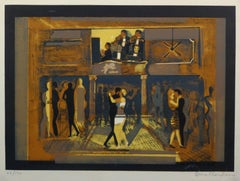
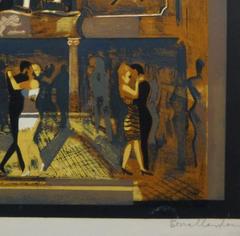
Medium: original lithograph. This lithograph is from the rare 1952 "Improvisations" portfolio, published by the Artists Equity Association of New York on the occasion of the 1952 Spr...

Category

1950s Henry Botkin Art

Materials

Lithograph

original lithograph

original lithograph

By Henry Botkin

Located in Henderson, NV

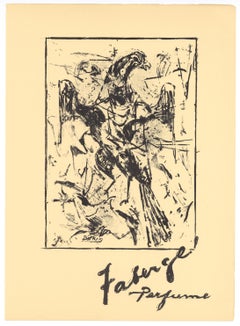
Medium: original lithograph. This lithograph is from the rare 1953 "Improvisations" portfolio, published by the Artists Equity Association of New York on the occasion of the 1953 Spr...

Category

1950s Henry Botkin Art

Materials

Lithograph

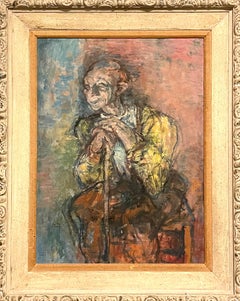
Henry Botkin Fauvist Expressionist Portrait Old Man Oil Painting WPA Artist

Henry Botkin Fauvist Expressionist Portrait Old Man Oil Painting WPA Artist

By Henry Botkin

Located in Surfside, FL

Henry Botkin (American 1896 - 1993) Abstract oil painting on canvas mounted to board Portrait of Old Man in Period Frame. Hand signed by the artist. Frame measure 31 inches x 24 inches, canvas measures 24 inches x 18 inches Mid century American Modernist Henry Botkin (1896-1983) born in Boston, Massachusetts, was an American abstract, modern and expressionist painter and illustrator; he was known for his Ashcan figure-views, still lifes, and non-objective paintings. He was active in artistic circles, served as president of four major art organizations (Artists Equity Association, American Abstract Artists, Group 256 Provincetown, and Federation of Modern Painters and Sculptors), and in 1955 organized the first exhibition of American abstract art at the Museum of Modern Art in Tokyo, Japan. He was an illustrator for The Saturday Evening Post, Harpers, and The Century Magazine. Botkin was a cousin and close friend to composers, George Gershwin and Ira Gershwin. His work had a school of Paris period, a cubist period and an Abstract Expressionism period. After training at the Massachusetts College of Art, Botkin moved to New York City. He took classes in drawing and illustration at the Art Students League of New York and worked as an illustrator for Harper’s, The Saturday Evening Post and Century magazines. In the late 1930s Botkin changed his approach to painting, moving from the School of Paris Modernism and cubism that he had adopted after he left Boston. Botkin was known for painting the theater, still lifes, landscapes, and low-country blacks in a romantic manner that some criticized for lacking social realism. By the late 1940s he had turned to abstraction in oils and collage. He grew an interest in collage in the early 1950s, which dominated his work until the 1960s. He also organized the sale of five hundred and forty paintings at the Whitney Museum of American Art in New York, 1959. Botkin spoke on the radio, “The Voice of America,” television, lead panel discussions throughout the country, and lectured and taught privately in New York, California, and Provincetown, Massachusetts. Botkin was a cousin, close friend, and painting teacher to Gershwin. Gershwin collected many of Botkin's paintings, which people said corresponded in mood to Gershwin's music. Martha Severens wrote in her book, The Charleston Renaissance, "The interaction between the two cousins was a dynamic one, and Botkin created paintings that reflect Gershwin's music. Correspondences are found in subject and in style. Both had a genuine interest in African-American culture that preceded their visit to Folly Beach...

Category

Mid-20th Century Expressionist Henry Botkin Art
Materials

Oil, Board

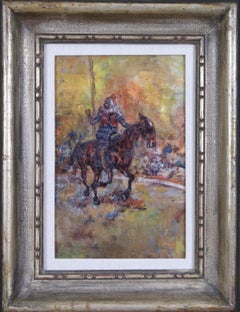
Clown with Orange Wig

Henry BotkinClown with Orange Wig

Sold

H 22.38 in W 17 in D 3.25 in

Clown with Orange Wig

By Henry Botkin

Located in Plano, TX

Oil on canvas laid on board measures 14 3/4 x 9 7/8; frame dimensions measure 22 3/8 x 17 x 3 1/4. Artist's signature, lower left. A fragment of a gallery brochure entitled, Peintures de Botkin is included with the painting. A partial title for the painting is listed under Number 3 in the exhibition. On the verso of the brochure is a label from Frank Rehn...

Category

Mid-20th Century Abstract Expressionist Henry Botkin Art
Materials

Oil

Henry Botkin art for sale on 1stDibs.

Find a wide variety of authentic Henry Botkin art available for sale on 1stDibs. You can also browse by medium to find art by Henry Botkin in oil paint, paint, board and more. Much of the original work by this artist or collective was created during the 20th century and is mostly associated with the abstract style. Not every interior allows for large Henry Botkin art, so small editions measuring 9 inches across are available. Customers who are interested in this artist might also find the work of Victor Thall, Harriet Holden Nash, and Ben Georgia. Henry Botkin art prices can differ depending upon medium, time period and other attributes. On 1stDibs, the price for these items starts at $75 and tops out at $16,000, while the average work can sell for $13,500.

Artists Similar to Henry Botkin