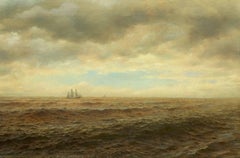
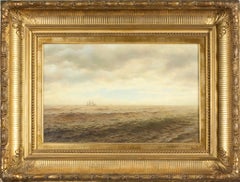
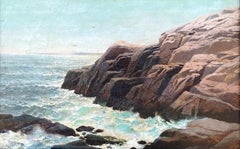
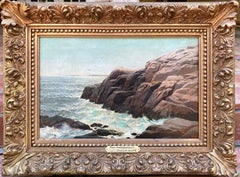
Sailing Ship on the Horizon
By Henry Pember Smith
Located in New York, NY
Signed and dated lower left: HENRY P. SMITH 1880
Category
19th Century Other Art Style Henry Pember Smith Landscape Paintings
Materials
Canvas, Oil
Henry Pember Smith was entirely self-taught as a painter. He traveled extensively and painted numerous landscapes of Normandy, England Brittany and particularly of Venice. Smith developed a reputation for his work as a landscape artist and became commercially successful in his lifetime. The body of his work focused on escapism, paintings that idealized tranquility and the essence of the quiet countryside, following in the trend of his contemporaries to present work that would appeal to an ever urbanizing audience. His work is noteworthy for its’ handling of light and watery reflections, these treated with intricate brushwork that just touched on impressionism, creating a dream-like effect that engendered nostalgia. Visions of homely cottages, farms by the water’s edge, Venetian buildings on canals and small village centers are all painted in his very distinct stylizing. Smith maintained studios in New York City and exhibited extensively at the Brooklyn Arts Association, the Art Institute of Chicago, the Pennsylvania Academy of Fine Arts and the National Academy of Design; he was also a member of the American Watercolor Society. His works are held in museums and institutions that include the Metropolitan Museum of Art, the Brooklyn Art Museum, Cincinnati Art Museum, the North Carolina Museum of Art and the Fine Arts Museums of San Francisco to list a few. Smith lived in the seaside town of Asbury Park, New Jersey until he died in 1907.
Sailing Ship on the Horizon
By Henry Pember Smith
Located in New York, NY
Signed and dated lower left: HENRY P. SMITH 1880
Canvas, Oil
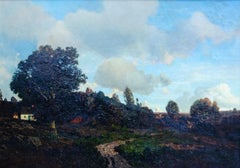
Countryside Landscape by Henry Pember Smith
By Henry Pember Smith
Located in New York, NY
Henry Pember Smith (American, 1854-1907) Landscape c. Late 19th/Early 20th Century Oil on board 20 1/8 x 28 in. Framed: 30 1/8 x 38 in. BIOGRAPHY Born in Waterford, Connecticut, He...
Oil, Board
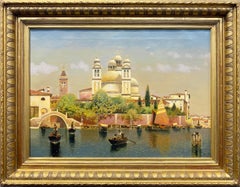
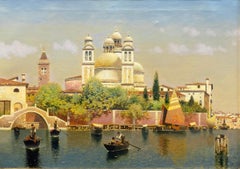
Venetian Scene
By Henry Pember Smith
Located in New York, NY
In the 1880’s Smith made a trip to Italy, which added a whole new dimension to his work. His tight style was highly suited to the depiction of the majestic architecture and complex c...
Oil, Canvas
$750Sale Price|50% Off
H 12.5 in W 14.5 in
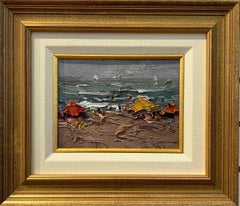
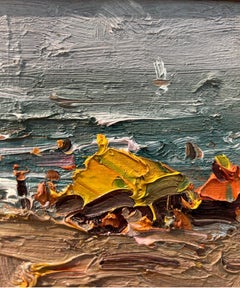
‘Yellow and Red Umbrellas’ Beach Seascape Impressionist Oil Painting
Located in Toronto, ON
Impasto style brushwork creates a vibrant beach day with colourful umbrellas. Strong impressionist influence can be seen through the gestural brushstrokes, with figures dotting the s...
Canvas, Oil
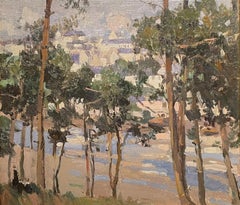
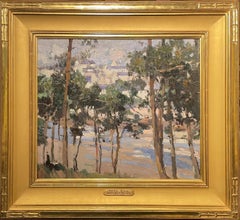
$15,000
H 27 in W 30 in
"Low Tide - Brittany, France, " Henriette Oberteuffer, Coastal Landscape
By Henriette Amiard Oberteuffer
Located in New York, NY
Henriette Amiard Oberteuffer (1878 - 1962) Low Tide - Brittany, France Oil on canvasboard 18 x 21 1/2 inches Signed lower right Painter, printmaker, and teacher Henriette Amiard Oberteuffer (1878-1962) was born in Le Havre, France and studied at the Academie Julian in Paris with Jean-Paul Laurens and Benjamin Constant. She moved with her husband and fellow artist George Oberteuffer...
Oil, Board
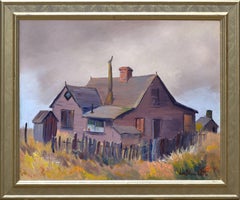
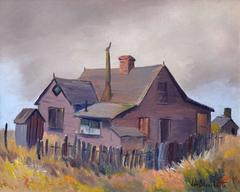
$1,675
H 20 in W 24 in D 1 in
Mendocino Homestead, Vintage 1970's Northern California Landscape
By Jon Blanchette
Located in Soquel, CA
Beautiful plein air landscape of an old Mendocino country house by listed artist Jon Blanchette (American, 1908-1987). Signed "Jon Blanchette" lower right. Presented in a giltwood ...
Oil, Canvas, Cardboard
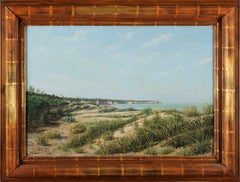
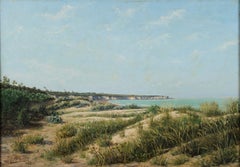
Beach landscape on Atlantic French coast
Located in BELEYMAS, FR
Jean-Georges PASQUET (Périgueux 1851 - 1936) Pointe de Suzac at Saint Georges de Didonne Oil on canvas H. 59 cm; W. 85 cm Signed and dated 1885 lower left Provenance: Private collec...
Oil, Canvas
$26,000
H 22 in W 28 in
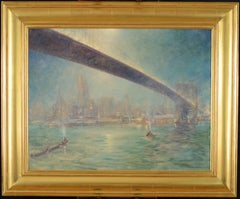
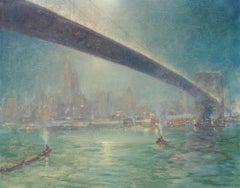
Bridge Nocturne oil painting by Johann Berthelsen
By Johann Berthelsen, 1883-1972
Located in Hudson, NY
One of Johann Berthelsen's iconic nocturne views of New York City across the Hudson River. Bridge Nocturne (c.1945) Oil on canvas, 22" x 28" 29 ½" x 36" x 2" framed Signed "Johann ...
Canvas, Oil
$12,000
H 30 in W 40 in
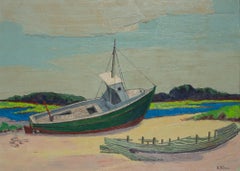
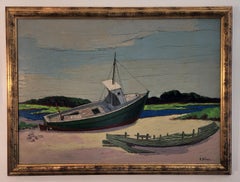
"Low Tide at Noon, Wellfleet, Massachusetts, " Ernest Fiene, WPA, Boat on Beach
By Ernest Fiene
Located in New York, NY
Ernest Fiene (1894 - 1965) Low Tide at Noon, Wellfleet, Massachusetts Oil on canvas 26 x 36 inches Signed lower right Ernest Fiene was born in Elberfeld, Germany in 1894. As a teenager, Fiene immigrated to the United States in 1912. He studied art at the National Academy of Design in New York City from 1914 to 1918, taking day classes with Thomas Maynard and evening classes with Leon Kroll. Fiene continued his studies at the Beaux-Arts Institute of Design in Paris from 1916 to 1918, adding classes in printmaking at the Art Students League in 1923. Fiene began his career as an artist in 1919 with his first exhibition of watercolors at the MacDowell Club arranged by his mentor Robert Henri. In 1923 the Whitney Studio Club mounted a large exhibition of his works. The following year he had an exhibition at the New Gallery in New York, which completely sold out all fifty-two works, including paintings, watercolors, drawings, and etchings. With the proceeds of sales from the New Gallery exhibition, Ernest Fiene and his younger brother Paul, a sculptor, built studios in Woodstock, New York in 1925. In the early Twenties Ernest Fiene painted mostly landscapes of Woodstock and both the Ramapo and Hudson River Valleys. He was the subject of the first monograph for the Younger Artists Series in 1922. Published in Woodstock, the series went on to include Alexander Brook, Peggy Bacon, and Yasuo Kuniyoshi. The book reproduced 1 illustration in color and another 27 reproductions in black and white. Around 1925 Fiene became fascinated with the intensity, excitement, and opportunities for color harmonies New York City offered as a subject. His paintings shifted to urban and industrial themes with architecture, industry, and transportation becoming his subjects. By 1926 Fiene had attracted the dealer Frank K.M. Rehn, who gave him a one-man exhibition that year, which travelled to the Boston Arts Club. C.W. Kraushaar Galleries gave Fiene a one-man exhibition of urban, landscape, portrait, and still life paintings in 1927. Julianna Force, the director of the Whitney Studio Club and first director of the Whitney Museum of American Art, included two of Fiene's paintings in a fall exhibition in 1928. The Whitney Studio Club showed Fiene's paintings in a two-man exhibition with Glenn O. Coleman that year and acquired three of Fiene's paintings. Also in 1928 Fiene became affiliated with Edith Halpert's Downtown Gallery where he had an exhibition of 20 lithographs in the spring. Fiene sold his house in Woodstock in 1928 to spend more of his time in New York City. With so many successful exhibitions, Fiene returned to Paris in 1928-29 where he rented Jules Pascin's studio and studied at the Académie de la Grande Chaumière. In France, Fiene painted both landscape and urban subjects developed from ideas influenced by Cubist geometry and the use of flat areas of broad color. Upon returning to New York in 1930, Fiene used this new approach to continue to paint New York skyscraper and waterfront subjects, as well as to begin a series of paintings on changing old New York based on the excavations for Radio City Music Hall and the construction of the Empire State Building. Frank K.M. Rehn Galleries exhibited this series, titled "Changing Old New York," in 1931. Fiene also has solo exhibitions at Rehn Galleries in 1930 and 1932. Fiene's oil paintings are exhibited at the Chicago Arts Club in 1930 as well. Fiene was included in the Museum of Modern Art's exhibition Painting and Sculpture by Living Americans in December of 1931. Visiting New York, Henri Matisse saw the exhibition and called Fiene's Razing Buildings, West 49th Street the finest painting he had seen in New York. Fiene had two mural studies from his Mechanical Progress series exhibited at the Museum of Modern Art's exhibition Murals by American Painters and Photographers in 1932. Fiene sent View from my Window which depicts Fiene working on a lithograph stone while looking out his window to the newly completed Empire State Building to the Carnegie International in 1931. In 1932 Fiene participated in the first Biennial of American Painting at the Whitney Museum and his prints were included in exhibitions at the Downtown Gallery and the Wehye Gallery. In the same year, Fiene was awarded a Guggenheim fellowship to further study mural painting in Florence, Italy. On his return from Italy in 1933 Fiene re-engaged himself in New York City life and won several public and private mural projects. Fiene resumed his active exhibition schedule, participating in two group exhibitions at the Whitney Museum and a one-man exhibition of recent paintings at the Downtown Gallery in January 1934. In 1933 he purchased a farm in Southbury, Connecticut, which added Connecticut scenes to his landscape subjects. This was also the year Fiene began to spend summers on Monhegan Island, Maine, where he painted seascapes, harbor scenes, and still lifes. Fiene's landscape paintings attracted numerous commissions as part of the American Scene movement. From 1935-36 Fiene took an extended sketching trip through the urban, industrial, and farming areas of Pennsylvania and West Virginia. Most of the twenty-four Pennsylvania urban and rural paintings from this trip were featured in an exhibition held at the First National Bank in Pittsburgh in October of 1937 by the Pittsburgh Commission for Industrial Expansion. Fiene said of these works that he formed rhythm, opportunity for space and color, and integrity in the Pennsylvania mill and furnace paintings. Fiene received the silver medal for one of the Pittsburgh paintings...
Canvas, Oil
$12,000
H 22 in W 28.5 in
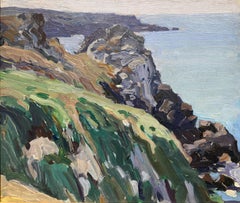
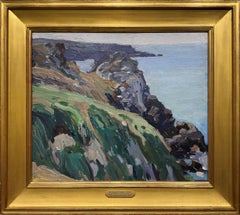
"Untitled (Coastal Cliffs, Brittany)" George Oberteuffer, Impressionist, Sea
Located in New York, NY
George Oberteuffer Untitled (Coastal Cliffs, Brittany), circa 1912 Oil on canvasboard 15 x 21 1/2 inches Born in Philadelphia, George Oberteuffer is best remembered for his Impress...
Canvas, Oil, Board
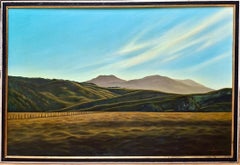
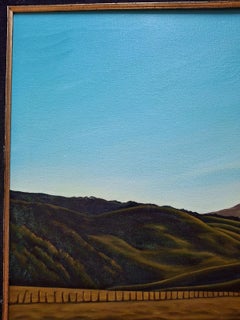
The Wide Open Spaces
Located in San Francisco, CA
If you’ve been dreaming of owning a piece of Wyoming or Montana, this wide-horizons painting deserves a spot over your stone fireplace. Photographic in its crisp detail, the artist c...
Canvas, Oil
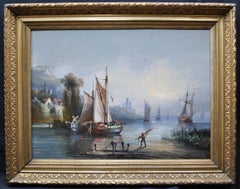
$839
H 25.2 in W 31.5 in D 2.76 in
Decorative river landscape in romantic style, oil on canvas
Located in DEVENTER, NL
Decorative river landscape in romantic style, Signed lower left 'I Roy', unknown artist, Oil on canvas Dimensions excl. frame: 49 x 65 Dimensions incl. frame: 64 x 80 x 7 cm. In go...
Canvas, Oil
$6,500
H 18 in W 22 in
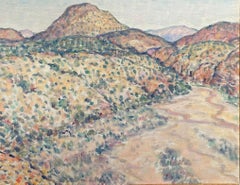
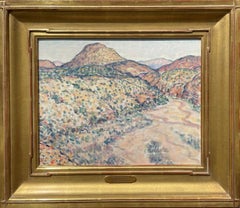
"View of Arizona Desert near Wickenberg" Will Foote, Impressionist Western Scene
Located in New York, NY
Will Foote View of Arizona Desert near Wickenberg, circa 1927 Signed lower center; titled and dated on the reverse Oil on artist's board 12 x 16 inches Foote was born on June 29, 1874 in Grand Rapids, Michigan, and died on January 27, 1965, in Sarasota, Florida. He was in Old Lyme, 1901-65; and in Cos Cob, 1903. Will Howe Foote was one of the earliest artists at Old Lyme and one who adopted the town as home. He first went there the summer of 1901 with his uncle, William H. Howe, a painter of cattle, who had been told about the beauties of the countryside by Henry Ward Ranger. Foote had himself heard of Old Lyme when he had met Clark Voorhees in France. He and his uncle were both from Grand Rapids, Michigan, where Foote's father was an executive in the furniture industry that made the city famous. Encouraged to be an artist by his father, he began his professional training at the Art Institute of Chicago in 1894. He became friends there with a fellow Michigan student, Frederick Frieseke, who would study with him again at the Art Students League in New York, where Foote worked in 1895-96 under H. Siddons Mowbray and Kenyon Cox. In 1897 he and Frieseke went to the Academic Julian in Paris, where Foote studied under Jean-Paul Laurens and Benjamin Constant. He was at Julian's until 1900, except for an Italian trip, summers at Laren, Holland, or Etaples, France, and a short period at Whistler's school in Paris. He exhibited twice at the Old Salon, and when he returned to the United States in 1900, he had a one-man exhibition in his hometown. Will Howe Foote's paintings were well received on his return from abroad. He exhibited frequently at the National Academy of Design and became an associate member in 1910. His awards included a bronze medal at the St. Louis Exposition in 1904 and a silver medal at the Panama-Pacific Exposition in San Francisco in 1915. Once he visited Old Lyme, Foote returned every summer. In 1902 he was hired as assistant to Frank DuMond at the Lyme Summer School of Art, which was sponsored by the Art Students League of New York. Sometime in 1903 he also taught a session in Cos Cob. After 1906, when the League moved its Lyme classes to Woodstock, New York, Foote continued in Old Lyme as a private instructor. In 1907 he was married to Helen Kirtland Freeman, whom he had met a year or two earlier when she had come to the Lyme art colony as a student of Henry Rankin Poore. Fellow artist William Chadwick was best man at the wedding. The Footes began building a house on Sill Lane in Old Lyme and upon its completion in 1909 spent every spring, summer and fall there, where Foote devoted full time to painting. The Gregory Smiths, old friends from Grand Rapids, arrived in Old Lyme in 1910 and became neighbors. Foote's early works in Connecticut, such as A Summer's Night reflect the artist's interest in soft, atmospheric scenes dominated by a single, overriding tone. The arrival of Childe Hassam and Walter Griffin...
Oil, Board
$975
H 11.25 in W 15.25 in
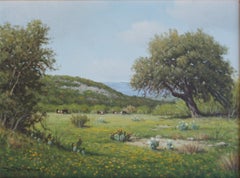
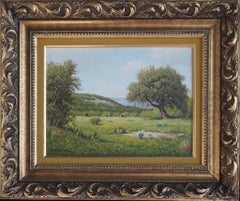
"Texas Hill Country Landscape With Cattle" oil painting of wildflowers, cactus
By Don Warren
Located in Austin, TX
Canvas Size: 12 x 16 in. Frame Size: 20.5 x 24.5 in. Signed, lower left: "Don Warren" A serene, classic, and cheerful scene in the Texas Hill Country by Don Warren. The foreground i...
Canvas, Oil
$2,750
H 26 in W 48 in D 1 in
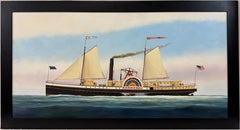
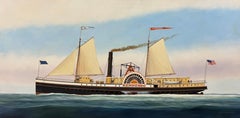
“Kennebec” Ship Portrait Sidewheeler Steamboat Paddle Steamer Oil on Canvas
Located in Yardley, PA
A striking and historically attentive portrait of the sidewheel steamer Kennebec, built in 1842. Rendered in crisp profile against a soft, painterly sky and calm Atlantic swells, Cameron’s portrait captures the stately elegance of early American steam navigation. The Kennebec, identified in bold red lettering on her paddle box, is shown under partial sail with twin smokestacks active - suggesting both the hybrid nature of early steam propulsion and the vessel’s readiness for sea. Flying period flags, including a U.S. ensign and company pennants, she presents as a proud representative of the Sanford Steamship Line, for whom she plied the route between Boston, Bangor, and the summer resorts of Maine. Her design, with a wood hull, 230-foot length, and distinctive “hogging truss,” speaks to mid-19th century innovation tailored to coastwise packets. Cameron’s style is reminiscent of 19th-century ship portraiture yet refined with contemporary technical precision. This is an excellent example of his work. This work is oil on canvas and is signed in the lower right. It is housed in its original black frame and retains the artist’s description of the ship on the reverse. Size: 22 inches tall by 44 inches wide (painting) 26 inches tall by 48 inches wide by 1 inch deep (frame) Provenance: Private collection; Acquired from the above About the artist: A Delaware artist, Scott Cameron paints the simple elegance of the America’s Cup races, serene coastal marsh scenes, timeless landscape vistas and historic steamboats in a style reminiscent of the era in which they reigned. An admirer of Andrew Wyeth and the Brandywine School of painters, Scott has combined the detail and quiet stillness of that School in his landscapes with the Luminist School’s sense of light glowing from within. A soft gentle atmosphere seems to fall over each scene adding to the peacefulness of the setting, and a sense of a time gone by. His America’s Cup scenes capture the action at a moment in time, allowing the beauty of the wind-filled sails to become the central design element of each painting. Scott Cameron has exhibited his oil paintings in numerous national and regional shows from the Mystic Seaport Museum to solo and group shows in some of the foremost galleries throughout the Northeast and Mid-Atlantic states. Favorite painting locations are the waterways and coastal inlets of Martha’s Vineyard and Maryland’s Eastern Shore and the gentle rolling landscapes of rural Pennsylvania, Delaware and Maryland. Meticulous research is behind every historic steamboat and America’s Cup painting...
Canvas, Oil
Sold
H 20 in W 30 in D 2 in
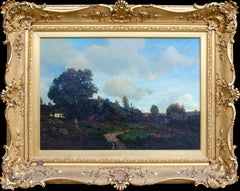
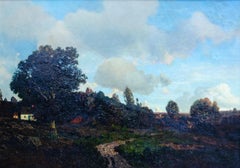
19th Century American Tonalist landscape by noted artist Henry Pember Smith
By Henry Pember Smith
Located in New York, NY
Henry Pember Smith (American, 1854-1907) Untitled, c. Late 1800s-Early 1900s Oil on canvas Framed: 20 x 30 x 2 in. Born in Waterford, Connecticut, Henry...
Canvas, Oil
“Near Kennebunkport”
By Henry Pember Smith
Located in Southampton, NY
Very original oil on canvas marine painting by the well known American artist, Henry Pember Smith. Signed lower right. Ke...
Canvas, Oil
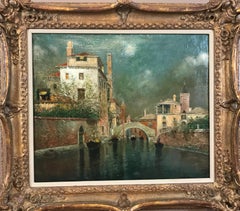

Venice
By Henry Pember Smith
Located in Plano, TX
A Venetian depiction of Italian architecture, gondolas, bridge and distant campanile, with an emphasis on light and water, Oil on canvas measures 15 3/8 x 18 3/8, housed in elegant f...
Oil