1901 Embossed Figural Litho Biscuit Book Tin by Huntley & Palmers Co. England
By Huntley & Palmers
Located in Morristown, NJ
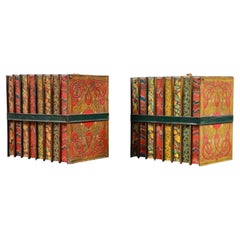
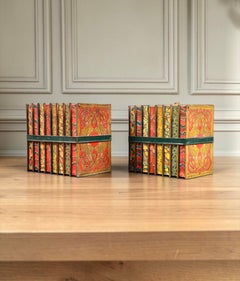
An antique tole, tin lithograph book box biscuit tin by Huntley and Palmers, 1901, Reading, England. The biscuit tin is offset litho printed and embossed with Art Nouveau style decoration, in the form of eight books with simulated tooled leather bindings and beautiful marbled end papers, bound by a strap. The tab on the top lifts up to pull up the lid with a hidden hinge at the back.
The books are: History of England, Pilgrims Progress by John Bunyan, Burns, Pickwick Papers by Dickens, Robinson Crusoe by Daniel Defoe, Gulliver's Travels by Jonathan Swift, Self Help, and Shakespeare.
Huntley & Palmers is a British company of biscuit makers originally based in Reading, Berkshire. Formed by Joseph Huntley in 1822, the company became one of the world's first global brands and ran what was once the world’s largest biscuit factory. The biscuits were sold in elaborately decorated biscuit tins.
An example of this tin can be seen at the Victoria and Albert Museum in London, England.
Dimensions:
6.25ʺw × 4.75ʺd × 6ʺh
Condition:
Good. This is a particularly nice example of a 123 year old tin item. The marbling effect remains beautifully intact and crisp. The embossed front and sides show only minor signs of paint loss and the metal is undamaged.
Historical Context:
The British biscuit tin came about when the Licensed Grocer's Act of 1861 allowed groceries to be individually packaged and sold. Coinciding with the removal of the duty on paper for printed labels. It was only a short step to the idea of printing directly on to tinplate. This development is first credited to Owen Jones who was a consultant designer to the stationary printers, Thomas de la Rue. He designed the first biscuit tin, transfer-printed and issued in 1868 for the firm of Huntley & Palmers. Other firms were quick to respond and a whole new industry was born. The new process of offset lithography, patented in 1877 allowed multicoloured designs to be printed on to exotically shaped tins.
The most exotic designs were produced in the early years of this century, just prior to the First World War. In the 1920s and 1930s, costs had risen substantially and the design of biscuit tins tended to be more conservative, with the exception of the tins targeted at the Christmas market and intended to appeal primarily to children. The designs, generally speaking are a barometer of popular interests.
The advent of the Second World War stopped all production of decorative tin ware...
Category
Early 1900s English Art Nouveau Antique Huntley & Palmers Boxes