Ian Hugo Art

to
3
3
3
3
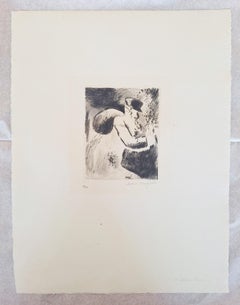
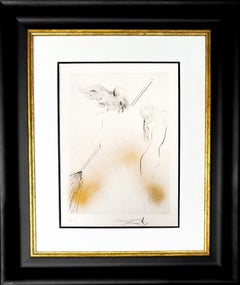
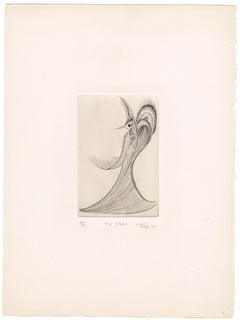
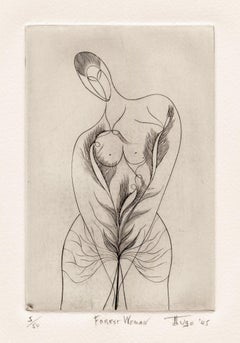
'Forest Woman' — Mid-Century Surrealism, Atelier 17

'Forest Woman' — Mid-Century Surrealism, Atelier 17

By Ian Hugo

Located in Myrtle Beach, SC

Ian Hugo, 'Forest Woman', engraving, 1945, edition 50. Signed, dated, titled, and numbered '5/50' in pencil. With the blind stamp 'madeleine-claude jobrack E...

Category

1940s Surrealist Ian Hugo Art

Materials

Engraving

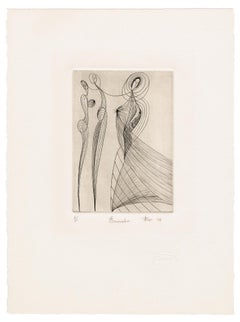
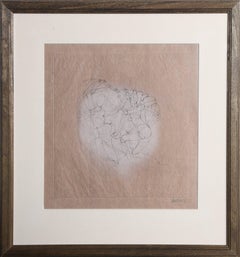
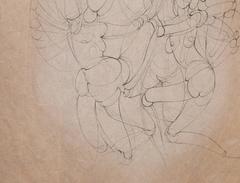
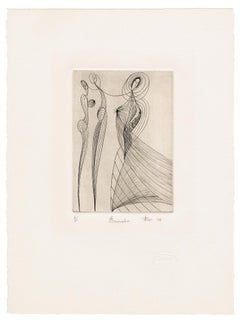
'Encircled' — Mid-Century Surrealism, Atelier 17

'Encircled' — Mid-Century Surrealism, Atelier 17

By Ian Hugo

Located in Myrtle Beach, SC

Ian Hugo, 'Encircled', engraving, 1946, edition 50. Signed, dated, titled, and numbered '5/50' in pencil. With the blind stamp 'madeleine-claude jobrack EDIT...

Category

1940s Surrealist Ian Hugo Art

Materials

Engraving

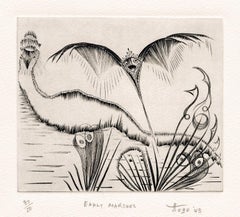
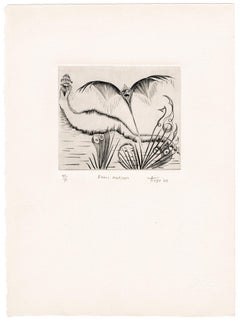
'Early Marshes' — Mid-Century Surrealism, Atelier 17

'Early Marshes' — Mid-Century Surrealism, Atelier 17

By Ian Hugo

Located in Myrtle Beach, SC

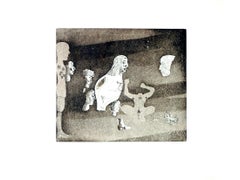
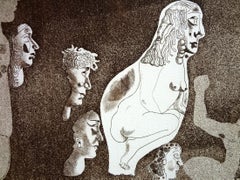
Ian Hugo, 'Early Marshes', from the portfolio 'Ten Engravings'. engraving, 1943, edition 50. Signed, dated, titled, and numbered '37/50' in pencil. A fine impression, with delicate overall plate tone, on cream wove paper, the full sheet with margins (2 5/8 to 7 inches), in excellent condition. With the blind stamp 'madeleine-claude jobrack EDITIONS', in the bottom right margin. Matted to museum standards, unframed. Image size 5 x 5 7/8 inches (127 x 149 mm); sheet size 15 x 11 inches (381 x 279 mm). Ian Hugo originally created "Ten Engravings" in 1945 and the portfolio included a foreword by his partner and collaborator, Anais Nin. In 1978, Hugo republished the portfolio with Madeleine-Claude Jobrack, an American master printmaker who studied under Stanley William Hayter at Atelier 17, Paris, and with Johnny Friedlaender. When Jobrack returned to the States she managed the Robert Blackburn Printmaking Studio in New York before opening her own printing studio, Madeleine-Claude Jobrak Editions. “The sign of the true artist is one who creates a complete universe, invents new plants, new animals, new figures to transfer to us a new vision of the universe in which dream and reality fuse. Ian Hugo's plants have eyes, the birds have the delicacy of dragonflies, their feathers have the shape of fans. Humor is apparent in every gesture. He uses a fine spider web to give a feeling of flight, speed, lightness. The body of a woman reveals the structure of a leaf, a plant. Wings are moving in a world unified by mythological themes. This is an animated world, humorous and levitating, elusive and decorative, which by its unique forms and shapes gives us the sensation of a rebirth, a liberation from the usual, the familiar, a visit to a new planet.” —Anais Nin, from the forward to the portfolio ‘Ten Engravings’ ABOUT THE ARTIST Ian Hugo was born Hugh Parker Guiler in Boston, Massachusetts, on February 15, 1898. His childhood was spent in Puerto Rico—a "tropical paradise," the memory of which stayed with him and surfaced in both his engravings and his films. He attended school in Scotland and graduated from Columbia University where he studied economics and literature. Hugo was working with the National City Bank when he met and married author Anais Nin in 1923. The couple moved to Paris the following year, where Nin's diary and Guiler's artistic aspirations flowered. Guiler feared his business associates would not understand his interests in art and music, let alone those of his wife, so he began a second, creative life as Ian Hugo. Ian and Anais moved to New York in 1939. The following year he took up engraving and etching, working at Stanley William Hayter’s experimental printmaking workshop Atelier 17, established at the New School for Social Research. Hugo began producing surreal images often used to illustrate Nin's books. For Nin, his unwavering love and financial support were indispensable—Hugo was the "fixed center, core... my home, my refuge" (Sept. 16, 1937, Nearer the Moon, The Unexpurgated Diary of Anais Nin, 1937-!939). Fictionalized portraits of Higo and Nin appear in Philip Kaufman's 1990 film drama of a literary love triangle, Henry & June. Inspired by comments that viewers saw motion in his engravings, Hugo took up filmmaking. He asked the avant-garde filmmaker Sasha Hammid for instruction but was told, "Use the camera yourself, make your own mistakes, make your own style." Hugo embarked on an exploration of the film medium as a vehicle to delve into his dreams, his unconscious, and his memories. Without a specific plan, He would collect resonant images, then reorder or superimpose them, seeking a sense of self-connection through the poetic juxtapositions he created. These intuitive explorations resembled the mystical evocations of his engravings, which he described in 1946 as "hieroglyphs of a language in which our unconscious is trying to convey important, urgent messages." In the underwater world of his film ‘Bells of Atlantis,’ the light originates from the world above the surface; it is otherworldly, out of place, yet essential. In ‘Jazz of Lights,’ the street lights of Times Square become in Nin's words, "an ephemeral flow of sensations." This flow that she also calls "phantasmagorical" had a crucial impact on Stan Brakhage, who said that without Jazz of Lights (1954), "there would have been no Anticipation of the Night" his autobiographical film which ushered in a new era of experimental modernist filmmaking. Hugo lived the last two decades of his life in a New York apartment high above street level. In the evenings, surrounded by an electrically illuminated man...

Category

1940s Surrealist Ian Hugo Art

Materials

Engraving

Related Items
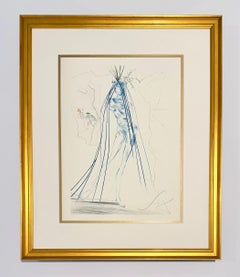
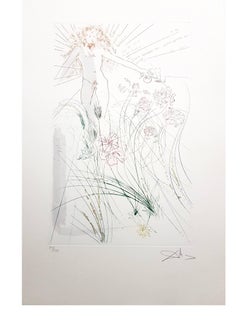
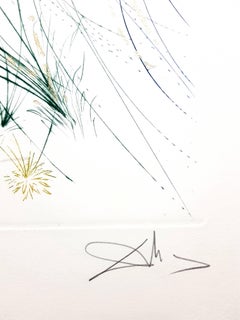
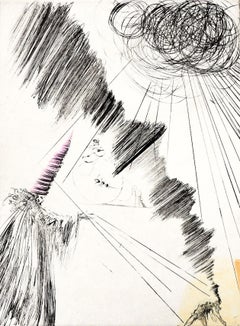
Le Viol d'Europe

Le Viol d'Europe

By Salvador Dalí­

Located in New York, NY

A very good impression of this color drypoint on Japon nacré. Artist's proof, aside from the edition of 270. Signed and inscribed "EA" in pencil. Published by Vision Nouvelle, Paris....

Category

1970s Surrealist Ian Hugo Art

Materials

Color, Drypoint

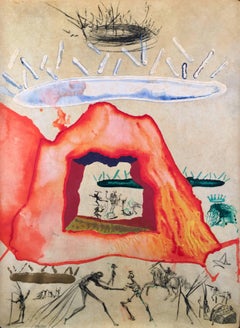
The Giant Beliagog - Drypoint attr.  to S. Dalì - 1969

The Giant Beliagog - Drypoint attr. to S. Dalì - 1969

By Salvador Dalí­

Located in Roma, IT

Hand signed. From the deluxe edition of 25 prints in Roman Numerals aside from the standard edition of 125. (There were 4 similarly-numbered editions in English, German, Italian, an...

Category

1960s Surrealist Ian Hugo Art

Materials

Drypoint

Salvador Dali Color Etching, Signed, 1973, The Twelve Tribes of Israel, Gad

Salvador Dali Color Etching, Signed, 1973, The Twelve Tribes of Israel, Gad

By Salvador Dalí­

Located in Washington, DC

Artist: Salvador Dali Title: Gad Portfolio: The Twelve Tribes of Israel Medium: Etching and pochoir on Arches paper Year: 1973 Edition: 130/195 Frame Size: 32 3/8" x 26 7/8" Sheet Si...

Category

1970s Surrealist Ian Hugo Art

Materials

Engraving

Pablo Picasso, L'Abreuvoir from La Suite Saltimbanques

Pablo Picasso, L'Abreuvoir from La Suite Saltimbanques

By Pablo Picasso

Located in Chatsworth, CA

This piece is an original drypoint created by Pablo Picasso in 1905 and printed by Ambroise Vollard after steel-facing in 1913. It is from a series entitled La Suite des Saltimbanque...

Category

1910s Surrealist Ian Hugo Art

Materials

Drypoint

Salvador Dali Color Engraving, Signed, 1970, Tristan's Testament

Salvador Dali Color Engraving, Signed, 1970, Tristan's Testament

By Salvador Dalí­

Located in Washington, DC

Artist: Salvador Dali Title: Tristan's Testament Portfolio: Tristan and Iseult Medium: Color engraving Year: 1970 Edition: XII/XXV Frame Size: 25 1/4" x 20 3/4" Sheet Size: 17 3/4" x...

Category

1970s Surrealist Ian Hugo Art

Materials

Engraving

Adam and Eve
Adam and Eve

Salvador Dalí­Adam and Eve, 1975

$4,000

H 25 in W 15.25 in

Adam and Eve

By Salvador Dalí­

Located in Toronto, Ontario

Salvador Dali (1904-1989) is Surrealism's most accomplished and iconic practitioner. His work is eccentric, elaborate, and mysterious, with an avant-garde style that explores the depths of consciousness and dream-like states. Prolific and endlessly inventive, Dali worked in almost every possible artistic medium; film, sculpture, photography, fashion and of course painting. Some of his earliest etchings date to the 1930's, as he worked in the graphic arts at the beginning of his career. "Adam & Eve" comes from a series called "Our Historical Heritage." The portfolio depicts eleven events and historical figures from the Hebrew scriptures (the Torah or Old Testament), including Noah's Ark, Joseph, Moses, and more. This portfolio emphasizes Dali's influence by religious themes, and is created with his signature mastery and style. This etching depicts the pivotal moment in the biblical story, when temptation strikes Adam and Eve, as they sit in the Garden of Eden and are lured to the lustrous forbidden fruit hanging from the tree of knowledge. Eve's hand wraps around the apple while Adam's reaches for it, as the serpent watches...

Category

1970s Surrealist Ian Hugo Art

Materials

Drypoint, Etching

Salvador Dali Color Etching, Signed, 1973, Symbols of Twelve Tribes of Israel

Salvador Dali Color Etching, Signed, 1973, Symbols of Twelve Tribes of Israel

By Salvador Dalí­

Located in Washington, DC

Artist: Salvador Dali Title: Symbols of the Twelve Tribes Portfolio: The Twelve Tribes of Israel Medium: Etching and pochoir on Arches paper Year: 1973 Edition: 130/195 Frame Size: 3...

Category

1970s Surrealist Ian Hugo Art

Materials

Engraving

Capricho de Goya n°63 - Héliogravure and Pochoir attr. to S. Dalì - 1977

Capricho de Goya n°63 - Héliogravure and Pochoir attr. to S. Dalì - 1977

By Salvador Dalí­

Located in Roma, IT

Capricho de Goya n°63 is an original héliogravure and pochoir, realized by Salvador Dalí in 1977, hand-signed and numbered n°125/200. Included a wooden frame. In very good condi...

Category

1970s Surrealist Ian Hugo Art

Materials

Engraving, Stencil

Salvador Dali Color Etching, Signed, 1973, The Twelve Tribes of Israel, Issacar

Salvador Dali Color Etching, Signed, 1973, The Twelve Tribes of Israel, Issacar

By Salvador Dalí­

Located in Washington, DC

Artist: Salvador Dali Title: Issacar Portfolio: The Twelve Tribes of Israel Medium: Etching and pochoir on Arches paper Year: 1973 Edition: 130/195 Frame Size: 32 3/8" x 26 7/8" Shee...

Category

1970s Surrealist Ian Hugo Art

Materials

Engraving

Previously Available Items
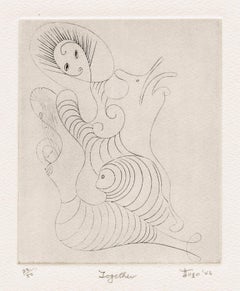
'Together' — Mid-Century Surrealism, Atelier 17

'Together' — Mid-Century Surrealism, Atelier 17

By Ian Hugo

Located in Myrtle Beach, SC

Ian Hugo, 'Together', from the portfolio 'Ten Engravings'. engraving, 1946, edition 50. Signed, dated, titled, and numbered '22/50' in pencil. A fine impression, with delicate overall plate tone, on cream wove paper, the full sheet with wide margins (2 7/8 to 5 1/2 inches), in excellent condition. With the blind stamp 'madeleine-claude jobrack EDITIONS', in the bottom right margin. Matted to museum standards, unframed. Image size 5 7/8 x 4 7/8 inches (149 x 124 mm); sheet size 15 x 11 1/8 inches (381 x 283 mm). Collection: Indianapolis Museum of Art. Ian Hugo originally created "Ten Engravings" in 1945 and the portfolio included a foreword by his partner and collaborator, Anais Nin. In 1978, Hugo republished the portfolio with Madeleine-Claude Jobrack, an American master printmaker who studied under Stanley William Hayter at Atelier 17, Paris, and with Johnny Friedlaender. When Jobrack returned to the States she managed the Robert Blackburn Printmaking Studio in New York before opening her own printing studio, Madeleine-Claude Jobrak Editions. “The sign of the true artist is one who creates a complete universe, invents new plants, new animals, new figures to transfer to us a new vision of the universe in which dream and reality fuse. Ian Hugo's plants have eyes, the birds have the delicacy of dragonflies, their feathers have the shape of fans. Humor is apparent in every gesture. He uses a fine spider web to give a feeling of flight, speed, lightness. The body of a woman reveals the structure of a leaf, a plant. Wings are moving in a world unified by mythological themes. This is an animated world, humorous and levitating, elusive and decorative, which by its unique forms and shapes gives us the sensation of a rebirth, a liberation from the usual, the familiar, a visit to a new planet.” —Anais Nin, from the forward to the portfolio ‘Ten Engravings’ ABOUT THE ARTIST Ian Hugo was born Hugh Parker Guiler in Boston, Massachusetts, on February 15, 1898. His childhood was spent in Puerto Rico—a "tropical paradise," the memory of which stayed with him and surfaced in both his engravings and his films. He attended school in Scotland and graduated from Columbia University where he studied economics and literature. Hugo was working with the National City Bank when he met and married author Anais Nin in 1923. The couple moved to Paris the following year, where Nin's diary and Guiler's artistic aspirations flowered. Guiler feared his business associates would not understand his interests in art and music, let alone those of his wife, so he began a second, creative life as Ian Hugo. Ian and Anais moved to New York in 1939. The following year he took up engraving and etching, working at Stanley William Hayter’s experimental printmaking workshop Atelier 17, established at the New School for Social Research. Hugo began producing surreal images often used to illustrate Nin's books. For Nin, his unwavering love and financial support were indispensable—Hugo was the "fixed center, core... my home, my refuge" (Sept. 16, 1937, Nearer the Moon, The Unexpurgated Diary of Anais Nin, 1937-!939). Fictionalized portraits of Higo and Nin appear in Philip Kaufman's 1990 film drama of a literary love triangle, Henry & June. Inspired by comments that viewers saw motion in his engravings, Hugo took up filmmaking. He asked the avant-garde filmmaker Sasha Hammid for instruction but was told, "Use the camera yourself, make your own mistakes, make your own style." Hugo embarked on an exploration of the film medium as a vehicle to delve into his dreams, his unconscious, and his memories. Without a specific plan, He would collect resonant images, then reorder or superimpose them, seeking a sense of self-connection through the poetic juxtapositions he created. These intuitive explorations resembled the mystical evocations of his engravings, which he described in 1946 as "hieroglyphs of a language in which our unconscious is trying to convey important, urgent messages." In the underwater world of his film ‘Bells of Atlantis,’ the light originates from the world above the surface; it is otherworldly, out of place, yet essential. In ‘Jazz of Lights,’ the street lights of Times Square become in Nin's words, "an ephemeral flow of sensations." This flow that she also calls "phantasmagorical" had a crucial impact on Stan Brakhage, who said that without Jazz of Lights (1954), "there would have been no Anticipation of the Night" his autobiographical film which ushered in a new era of experimental modernist filmmaking. Hugo lived the last two decades of his life in a New York apartment high above street level. In the evenings, surrounded by an electrically illuminated man...

Category

1940s Surrealist Ian Hugo Art
Materials

Engraving

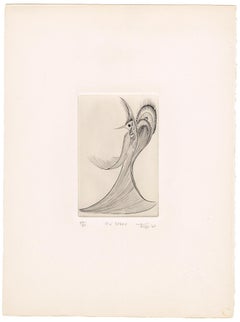
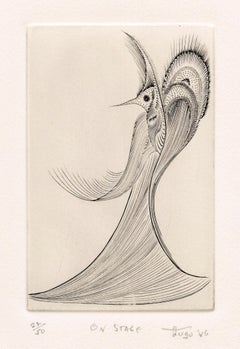
'On Stage' — Mid-Century Surrealism, Atelier 17

'On Stage' — Mid-Century Surrealism, Atelier 17

By Ian Hugo

Located in Myrtle Beach, SC

Ian Hugo, 'On Stage', from the portfolio 'Ten Engravings'. engraving, 1946, edition 50. Signed, dated, titled, and numbered '22/50' in pencil. A fine impression, with delicate overall plate tone, on cream wove paper, the full sheet with margins (3 5/8 to 4 7/8 inches), in excellent condition. With the blind stamp 'madeleine-claude jobrack EDITIONS', in the bottom right margin. Matted to museum standards, unframed. Image size 5 7/8 x 3 7/8 inches (149 x 98 mm); sheet size 15 1/8 x 11 1/8 inches (384 x 283 mm). Ian Hugo originally created "Ten Engravings" in 1945, and the portfolio included a foreword by his partner and collaborator, Anais Nin. In 1978, Hugo republished the portfolio with Madeleine-Claude Jobrack, an American master printmaker who studied under Stanley William Hayter at Atelier 17, Paris, and with Johnny Friedlaender. When Jobrack returned to the United States she managed the Robert Blackburn Printmaking Studio in New York before opening her own printing studio, Madeleine-Claude Jobrak Editions. “The sign of the true artist is one who creates a complete universe, invents new plants, new animals, new figures to transfer to us a new vision of the universe in which dream and reality fuse. Ian Hugo's plants have eyes, the birds have the delicacy of dragonflies, their feathers have the shape of fans. Humor is apparent in every gesture. He uses a fine spider web to give a feeling of flight, speed, lightness. The body of a woman reveals the structure of a leaf, a plant. Wings are moving in a world unified by mythological themes. This is an animated world, humorous and levitating, elusive and decorative, which by its unique forms and shapes gives us the sensation of a rebirth, a liberation from the usual, the familiar, a visit to a new planet.” —Anais Nin, from the forward to the portfolio ‘Ten Engravings’ ABOUT THE ARTIST Ian Hugo was born Hugh Parker Guiler in Boston, Massachusetts, on February 15, 1898. His childhood was spent in Puerto Rico—a "tropical paradise," the memory of which stayed with him and surfaced in both his engravings and his films. He attended school in Scotland and graduated from Columbia University where he studied economics and literature. Hugo was working with the National City Bank when he met and married author Anais Nin in 1923. The couple moved to Paris the following year, where Nin's diary and Guiler's artistic aspirations flowered. Guiler feared his business associates would not understand his interests in art and music, let alone those of his wife, so he began a second, creative life as Ian Hugo. Ian and Anais moved to New York in 1939. The following year he took up engraving and etching, working at Stanley William Hayter’s experimental printmaking workshop Atelier 17, established at the New School for Social Research. Hugo began producing surreal images often used to illustrate Nin's books. For Nin, his unwavering love and financial support were indispensable—Hugo was the "fixed center, core... my home, my refuge" (Sept. 16, 1937, Nearer the Moon, The Unexpurgated Diary of Anais Nin, 1937-!939). Fictionalized portraits of Higo and Nin appear in Philip Kaufman's 1990 film drama of a literary love triangle, Henry & June. Inspired by comments that viewers saw motion in his engravings, Hugo took up filmmaking. He asked the avant-garde filmmaker Sasha Hammid for instruction but was told, "Use the camera yourself, make your own mistakes, make your own style." Hugo embarked on an exploration of the film medium as a vehicle to delve into his dreams, his unconscious, and his memories. Without a specific plan, He would collect resonant images, then reorder or superimpose them, seeking a sense of self-connection through the poetic juxtapositions he created. These intuitive explorations resembled the mystical evocations of his engravings, which he described in 1946 as "hieroglyphs of a language in which our unconscious is trying to convey important, urgent messages." In the underwater world of his film ‘Bells of Atlantis,’ the light originates from the world above the surface; it is otherworldly, out of place, yet essential. In ‘Jazz of Lights,’ the street lights of Times Square become in Nin's words, "an ephemeral flow of sensations." This flow that she also calls "phantasmagorical" had a crucial impact on Stan Brakhage, who said that without Jazz of Lights (1954), "there would have been no Anticipation of the Night" his autobiographical film which ushered in a new era of experimental modernist filmmaking. Hugo lived the last two decades of his life in a New York apartment high above street level. In the evenings, surrounded by an electrically illuminated man...

Category

1940s Surrealist Ian Hugo Art
Materials

Engraving

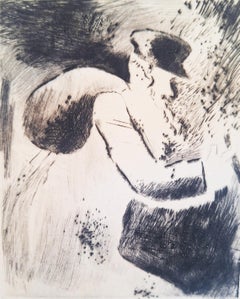
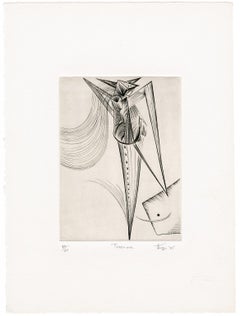
'Toreador' – Mid-Century Surrealism, Atelier 17

'Toreador' – Mid-Century Surrealism, Atelier 17

By Ian Hugo

Located in Myrtle Beach, SC

Ian Hugo, 'Toreador', engraving, 1945, edition 50. Signed, dated, titled, and numbered '22/50' in pencil. With the blind stamp 'madeleine-claude jobrack EDIT...

Category

1940s Surrealist Ian Hugo Art
Materials

Engraving

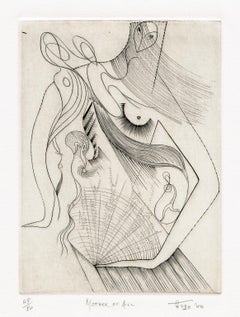
'Mother of All' – Mid-Century Surrealism, Atelier 17

'Mother of All' – Mid-Century Surrealism, Atelier 17

By Ian Hugo

Located in Myrtle Beach, SC

Ian Hugo, 'Mother of All', engraving, 1945, edition 50. Signed, dated, titled, and numbered '48/50' in pencil. With the blind stamp 'madeleine-claude jobrack...

Category

1940s Surrealist Ian Hugo Art
Materials

Engraving

Ian Hugo art for sale on 1stDibs.

Find a wide variety of authentic Ian Hugo art available for sale on 1stDibs. You can also browse by medium to find art by Ian Hugo in engraving and more. Much of the original work by this artist or collective was created during the 1940s and is mostly associated with the Surrealist style. Not every interior allows for large Ian Hugo art, so small editions measuring 4 inches across are available. Ian Hugo art prices can differ depending upon medium, time period and other attributes. On 1stDibs, the price for these items starts at $550 and tops out at $750, while the average work can sell for $700.