By Jaume Muxart Domenech
Located in Sitges, Barcelona
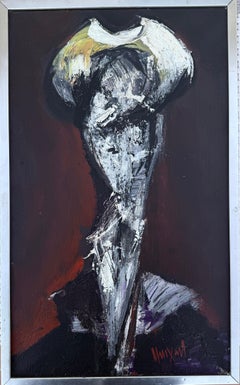
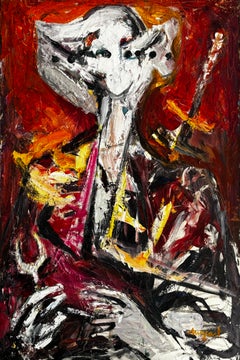
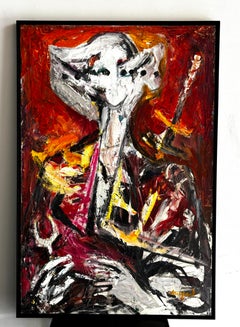
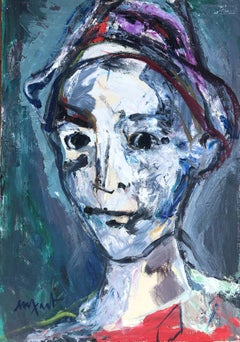
Mid Century Don Quixote Portrait Spanish Catalan Expressionist Oil
TECHNICAL SHEET
Oil on canvas
Mid-20th century
55 × 33 cm (21.7 × 13 in)
Frame: 58 × 36 cm (22.8 × 14.2 in)
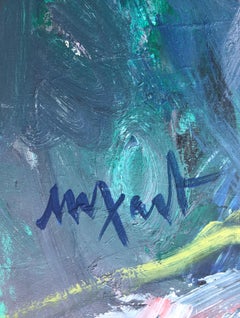
Signed lower right
Metal frame with matte finish
Very good overall condition
DESCRIPTION
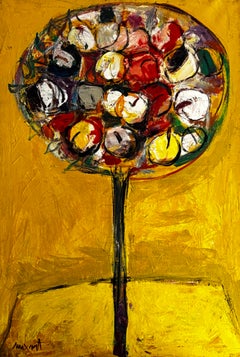
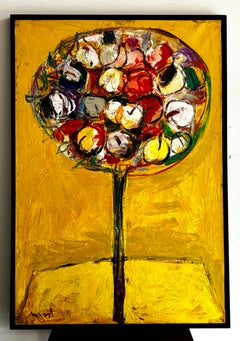
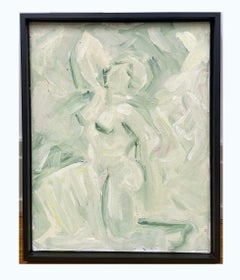
Striking Mid-Century modernist interpretation of Don Quixote by Jaume Muxart, executed in a strong Catalan Neo-Figurative Expressionist language characteristic of Spanish post-war painting.
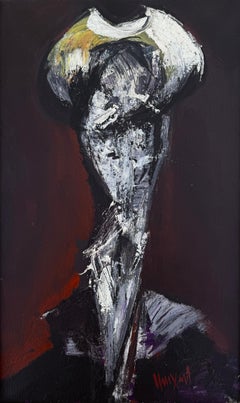
The elongated vertical figure is constructed through palette-knife structure and dense impasto, reducing Cervantes’ legendary knight to a symbolic psychological presence rather than a literal portrait. The helmet-like white head emerging from a deep burgundy background creates a dramatic apparition typical of Muxart’s mature figurative period.
The figure represents Don Quixote as an existential literary archetype frequently explored in Spanish modern painting and particularly within the renewal of Catalan modern art associated with artists connected to the Grupo Taüll, one of the key movements in the evolution of post-war avant-garde painting in Barcelona.
Compact in scale but visually intense, the painting combines strong decorative presence with the intellectual depth characteristic of Muxart’s Quixote interpretations.
ARTIST BIO
Jaume Muxart (1922–2019) was a major Catalan painter and founding member of the influential Grupo Taüll, alongside Antoni Tàpies, Modest Cuixart, Josep Guinovart and Joan-Josep Tharrats.
After early exhibitions in Barcelona in the late 1940s he travelled to Paris on scholarship, where he encountered the international avant-garde that shaped his expressive language. He later represented Spain at the São Paulo Biennial and exhibited widely across Europe and the Americas.
Muxart served as professor and later dean of the Faculty of Fine Arts at the University of Barcelona and became a member of the Royal Catalan Academy of Fine Arts of Sant Jordi. His work is held in numerous institutional and private collections.
ARTISTIC CONTEXT / INSPIRATION
This painting belongs to the expressive Neo-Figurative tradition developed in post-war Spain and Catalonia, where literary archetypes such as Don Quixote became vehicles for psychological and symbolic exploration.
Comparable resonances can be found in the structural figuration of Bernard Buffet, the expressive intensity of Antonio Saura, and the material experimentation associated with Antoni Tàpies, Modest Cuixart and Josep Guinovart within the post-war Catalan avant-garde.
don quixote painting...
Category
1960s Abstract Expressionist Jaume Muxart Domenech Art