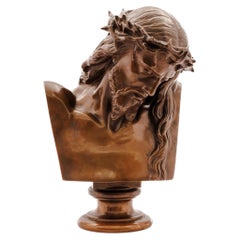
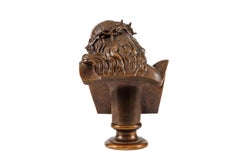
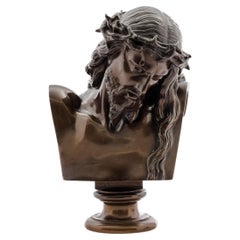
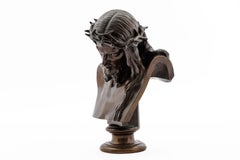
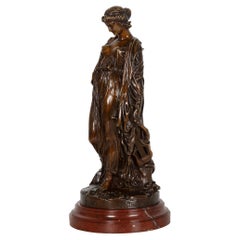
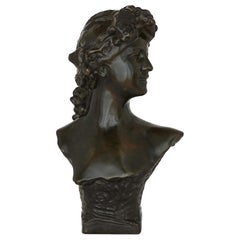
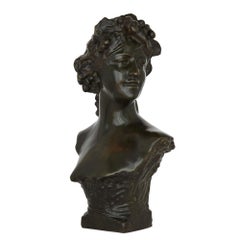
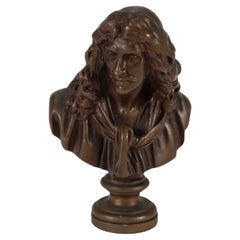
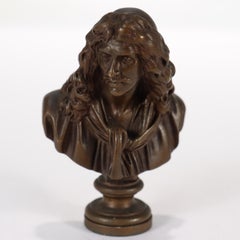
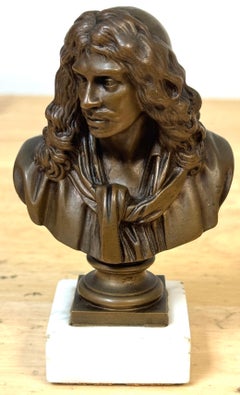
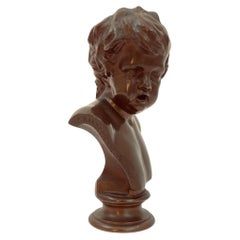
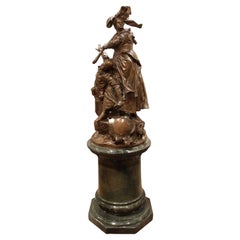
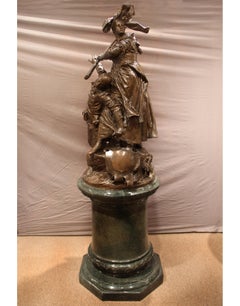
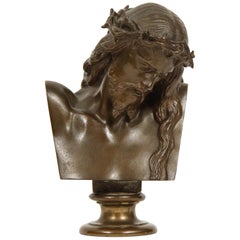
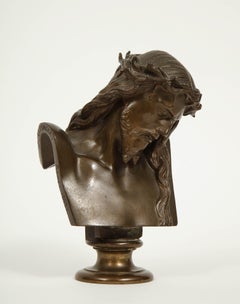
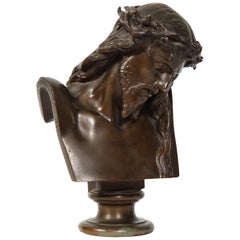
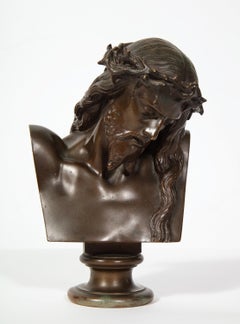
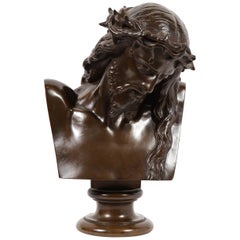
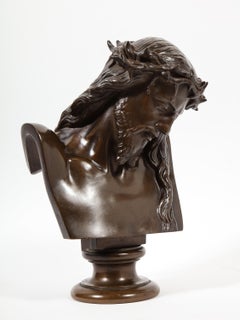
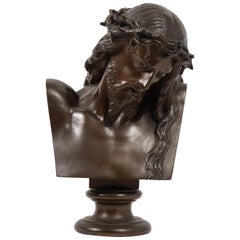
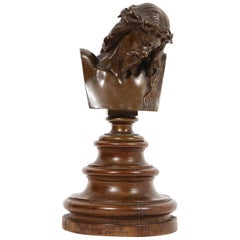
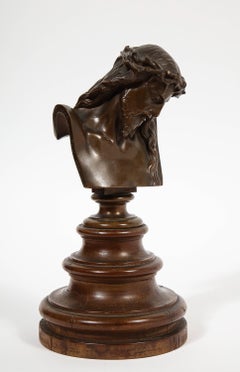
French Antique Bronze Bust after Jean-Baptiste Clésinger, F. Barbedienne
By Jean-Baptiste Auguste Clesinger, F. Barbedienne Foundry
Located in Shippensburg, PA
JEAN-BAPTISTE CLESINGER (FRENCH, 1814-1883) PATINATED ANTIQUE BRONZE SCULPTURE
Bust of Charlotte Corday c. 1880-90
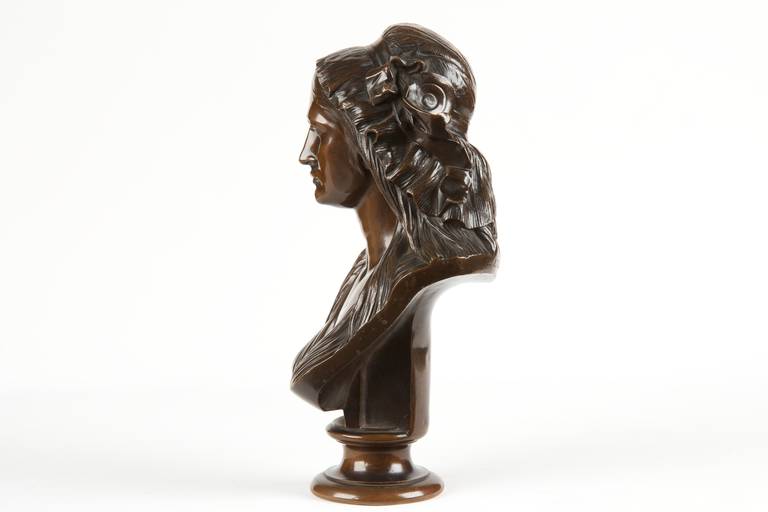
Originally executed in Rome in 1858 as a marble bust and exhibited at Salon in 1859 with two other busts, Jean-Baptiste Clésinger's moving sculpture of Charlotte Corday proceeded to be cast by the F. Barbedienne foundry in bronze. Listed in their 1886 catalogue (Catalogue des Bronzes D'Art, p. 60), the bust was offered in several editions including 68, 35, 29, 21 and 15 cm; the present 29 cm example was originally offered at 90 francs. Of exceptional clarity, the quality of the casting is above reproach - the surface is smooth and the patina deep, the wonderful details crisply chased and filed into the surface to result in a nearly photographic realism of the somber subject. Marie-Anne Charlotte de Corday d'Armont, or simply Charlotte Corday, was a Royalist sympathizer infamous for her assassination of Jean Paul Marat, a leader of the French Revolution. She was executed for her crime by guillotine at Place de la Révolution in 1773. Signed "J. Clesinger Rome 1858" along the back edge, the work is impressed "F. Barbedienne Fondeur" and bears the A. Collas Reduction Mechanique seal inside the verso. For serious collectors of French Romanticism, this is a very fine selection.
Born Jean-Baptiste, but later choosing to be known as Auguste, he was a student of his father, the academic sculptor George Philippe Clésinger. Later studying under sculptor Thorvaldsen, a Danish neoclassical artist whose influence is clear in Clésinger's subjects, he also studied under architect Salvi and briefly under David d'Angers. A somewhat distracted and highly ambitious spirit, Jean-Baptiste moved around from Switzerland to Florence and in 1845 settled in Paris. He was aggressive in making connections and arranging proper critical acclaim for his works, an effort that paid off in his 1847 debut of Woman Bitten by a Snake, a moving Romantic work that created a sensation among critics. He was awarded first-class medal at Salon in 1848 for his Reclining Bacchante and was awarded membership in the exclusive Legion of Honor in 1849 - later he was promoted to officier in 1864. While he also worked to market his own works, organizing public auctions and publishing a catalogue with Théophile Gautier in 1868-70, much of his work was cast by and promoted by the Ferdinand Barbedienne foundry. The firm's 1867 catalogue features Clésinger's work prominently and the majority of works executed during his lifetime bear the stamp of this founder.
Literature:
Romantic Bronzes of the Nineteenth Century: French, English and American Bronzes 1830-1915, Jeremy Cooper, p. 25
Catalogue Bronzes D'Art, F. Barbedienne, 1886, p. 60
The Romantics to Rodin: French Nineteenth Century Sculpture...
Category
19th Century French Romantic Antique Jean-Baptiste Auguste Clesinger Busts