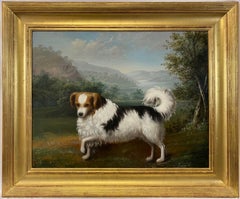
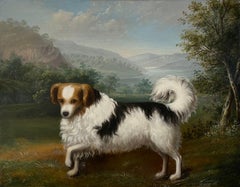
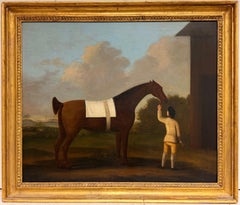
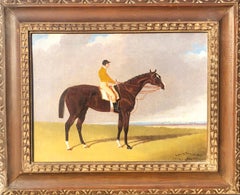
By John Frederick Herring Sr.
Located in London, GB
John Frederick HERRING, Sr. (1795-1865)
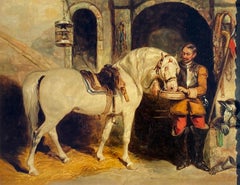
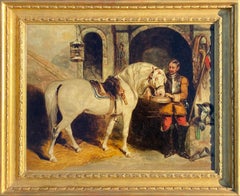
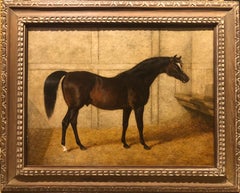
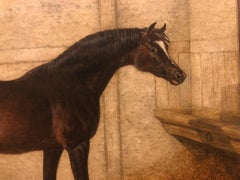
Touchstone, Saint Leger 1834
signed and dated (middle right)
oil on canvas
18 x 24 inches, unframed
24.5 x 30.5 inches, inc. frame
Touchstone
_________________________________________________________________________________
Touchstone was a British bred Thoroughbred racehorse and a Leading sire in Great Britain & Ireland on four occasions. He was owned and bred by Robert Grosvenor, 1st Marquess of Westminster who bought him for the cheap price, at the time, of only 600 guineas at the insistence of his chief stud groom Mr. Thomas Nutting.
Born: 1831, United Kingdom
Died: 29 January 1861
Owner: Robert Grosvenor, 1st Marquess of Westminster
Breed: Thoroughbred
Trainer: John Scott
Parents: Camel
Children: Newminster, Surplice, Orlando, Cotherstone
Herring
_________________________________________________________________________________
Herring, born in London in 1795, was the son of a London merchant of Dutch parentage, who had been born overseas in America. The first eighteen years of Herring's life were spent in London, where his greatest interests were drawing and horses. In the year 1814, at the age of 18, he moved to Doncaster in the north of England, arriving in time to witness the Duke of Hamilton's "William" win the St. Leger Stakes horse-race. By 1815, Herring had married Ann Harris; his sons John Frederick Herring Jr., Charles Herring, and Benjamin Herring were all to become artists, while his two daughters, Ann and Emma, both married painters. When she was barely of age in 1845 Ann married Harrison Weir.
In Doncaster, England, Herring was employed as a painter of inn signs and coach insignia on the sides of coaches, and his later contact with a firm owned by a Mr. Wood led to Herring's subsequent employment as a night coach driver. Herring spent his spare time painting portraits of horses for inn parlors, and he became known as the "artist coachman" (at the time). Herring's talent was recognized by wealthy customers, and he began painting hunters and racehorses for the gentry.
In 1830, John Frederick Herring, Senior left Doncaster for Newmarket, England, where he spent three years before moving to London, England. During this time, Herring might have received tuition from Abraham Cooper. In London, Herring experienced financial difficulties and was given financial assistance by W. T. Copeland, who commissioned many paintings, including some designs used for the Copeland Spode bone china...
Category
Early 19th Century John Frederick Herring Sr. Figurative Paintings