John Marin Art

American, 1872-1953
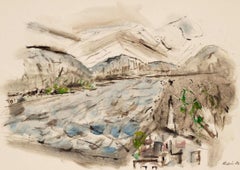
John Marin was born in Rutherford, New Jersey in 1870. His father was a public accountant; his mother died nine days after his birth. He was taken to his maternal grandparents with whom he lived in Weehawken, New Jersey. His grandparents, with their son and two daughters were the only parents Marin was to know; it has been suggested that his father seems to have ignored him. As a child of seven or eight Marin began to sketch and when he was a teenager he had completed his earliest watercolors. His education in the schools of New Jersey was interspersed with summers of hunting, fishing and sketching; he traveled in the Catskills, and as far away as Wisconsin and Minnesota. But formal training was almost incidental to his development as an artist. He is to America what Paul Cezanne was to France - an innovator who helped to oppose the influence of the narrative painters, the illustrators who were more interested in subject than form, in surface than substance. Marin brought to his work a combination of values which, at the turn of the century, was unique in this country: an aliveness of touch, colors that have both sparkle and solidity, and forms that are vibrant with an energy characteristic of our age. Marin established himself as a practicing architect. In the early 1890s, he worked for four architects and by 1893 had designed six houses in Union Hill, New Jersey. At the age of twenty-eight, he decided to become a professional artist and studied briefly at the Pennsylvania Academy of Fine Arts in Philadelphia and the Art Students League in New York City. As a watercolorist he had no equal. He used this fluid, spontaneous medium to abstract from objects - skyscrapers, boats, mountains and seas - a simplified anatomy of color and form and to define the pulsation of stresses and movements in the relationship of objects. It was a great disappointment, all his life, that his oil paintings did not achieve the popularity that his watercolors did. From 1905 to 1910 he worked in Europe, where he was influenced by Whistler's watercolors. It was Alfred Stieglitz, Marin's lifetime friend and dealer, whose firm faith in his genius made his position in the art world possible. He developed a distinctive style that he used most characteristically in powerful watercolors of the Maine coast. During the 1920s he provided the dominant force in the movement away from naturalistic representation towards an art of expressive semi-abstraction. He married Marie Jane Hughes after he returned to New York. They had one son, who grew up to run his father's considerable affairs. Marin continued to work at the same steady fast pace as long as he lived. Since 1908 he had produced 1700 paintings, an average of forty a year. He had made the frames for them as well. At the age of seventy-nine, he began to taper off from the days when he painted one hundred watercolors in a summer. He died in 1953.
to
1
15
2
17
14
4
4
2
2
1
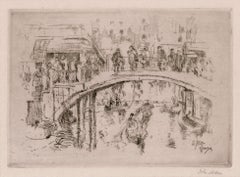
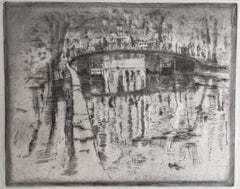
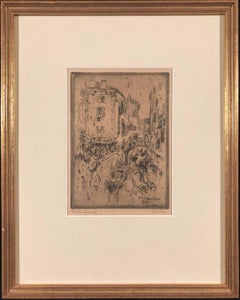
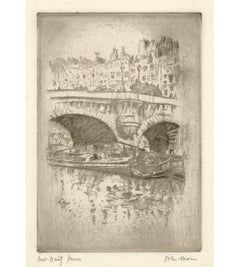
'Bridge, Venice' — Turn of the Century American Impressionism

'Bridge, Venice' — Turn of the Century American Impressionism

By John Marin

Located in Myrtle Beach, SC

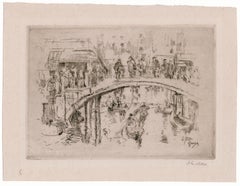
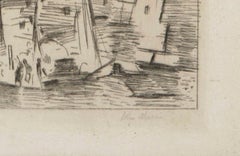
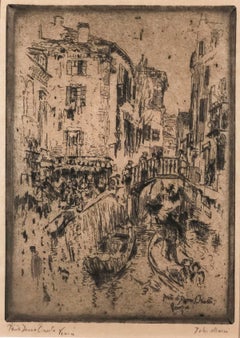
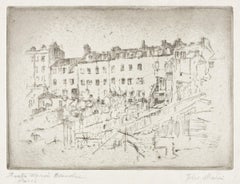
John Marin, 'Bridge, Venice', etching, 1907, Zigrosser 59. Signed in pencil. Signed and dated 'Marin 07' in the plate, lower center; titled 'Le Pont Venezia' in the plate lower right. A superb, delicately inked impression, on antique cream laid paper, the full sheet with margins (5/8 to 3/4 inches); slight lightening to the paper within the original mat opening, otherwise in excellent condition. Printed by George Haskell, New York. Matted to museum standards, unframed. Image size 5 x 7 1/16 inches; sheet size 6 5/8 x 8 11/16 inches. Literature: 'John Marin: Peintre Graveur', Charles Saunier, L' Art Décoratif, Paris, January, 1908 (illustrated). 'The Complete Etchings of John Marin', Carl Zigrosser, Philadelphia Museum of Art, 1969 (illustrated). Impressions of this work are in the following museum collections: Art Institute of Chicago (Stieglitz Collection), Cleveland Museum of Art, Fine Arts Museums of San Francisco, Metropolitan Museum of Art, and the Philadelphia Museum of Art. ABOUT THE ARTIST "How to paint the landscape: First, you make your bow to the landscape. Then you wait, and if the landscape bows to you, then, and only then, can you paint the landscape." —John Marin “I would say to a person who thinks he wants to paint, go and look at the way a bird flies, a man walks, the sea moves. There are certain laws, certain formulae. You have to know them. They are nature's laws and you have to follow them just as nature follows them... You don't create the formulae... You see them." —John Marin, conversation with Dorothy Norman...

Category

Early 1900s American Impressionist John Marin Art

Materials

Etching

Sunset
Sunset

Sunset

By John Marin

Located in London, GB

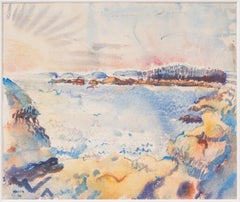
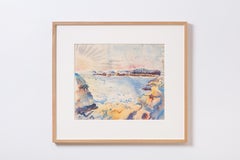
Maine became an important muse for Marin during his summer vacations, which is exampled in the present work ‘Sunset’. Marin first visited Maine in 1914, meaning ‘Sunset’ was one of h...

Category

Early 20th Century American Modern John Marin Art

Materials

Watercolor, Paper

Kufstein, Austrian Tyrol

Kufstein, Austrian Tyrol

By John Marin

Located in London, GB

In the summer of 1910, Marin spent a number of weeks in the Austrian Alps. The subject of his second solo exhibition at Alfred Stieglitz’s 291 Gallery located in NYC, in February 191...

Category

Early 20th Century American Modern John Marin Art

Materials

Paper, Watercolor

Weehawken Sequence

Weehawken Sequence

By John Marin

Located in Bryn Mawr, PA

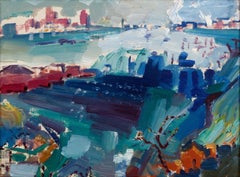
Weehawken Sequence, c. 1910-16 Oil on canvas board, 9 x 12 inches (22.9 x 30.5 cm) Framed dimensions: 13 3/8 x 16 1/4 inches John Marin’s long and prolific career is best marked by ...

Category

20th Century American Modern John Marin Art

Materials

Canvas, Oil, Board

Downtown, The El
Downtown, The El

Downtown, The El

By John Marin

Located in New York, NY

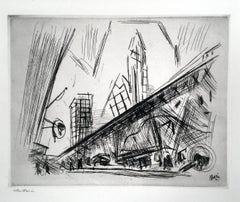
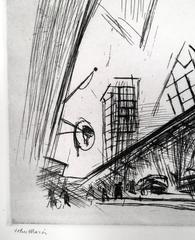
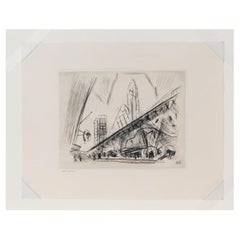
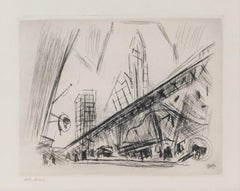
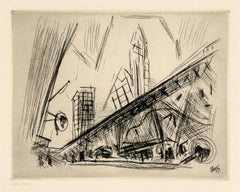
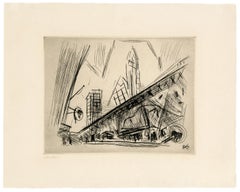
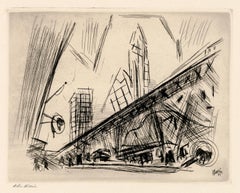
John Marin (1870-1953), Downtown, The El, etching, 1921, signed in pencil lower left (also signed and dated in the plate). Reference: Zigrosser 134, only state. Published initially by Alfred Stieglitz and then included as part of the Folio of American Etchings by the magazine The New Republic in 1924, in an edition of unknown size but probably above 500. In very good condition, the full sheet, on Van Gelder wove paper, 6 3/4 x 8 3/4, the sheet 11 x 13 3/4 inches. Provenance: Hirschl and Adler Galleries, Inc., New York, New York. A fine bright impression. Initially the New Republic Set, sometimes known as Six American Etchings, contained Marin’s Brooklyn Bridge No. 6 (Swaying) (Zigrosser 112). But after a small number of sets were completed, Downtown the El was substituted for Zigrosser 112 (and so the number of Downtown The Els in the set would have been a bit fewer than the others in the set). Zigrosser, who apparently had not seen a complete set at the time he created the catalogue raisonne, conjectured that the substitution might have been because the original plate was damaged. But since the printer, Peter Platt, was the most renowned artist’s printer of his time, and worked alone, it is unlikely that he would have damaged the plate; a more likely possibility is that he switched to a print that was more comparable in size to the others in the set (The Brooklyn Bridge print...

Category

1920s Futurist John Marin Art

Materials

Etching

John Marin Etching, 1921 - “Downtown, the El”

John Marin Etching, 1921 - “Downtown, the El”

By John Marin

Located in Phoenix, AZ

Beautiful etching by John Marin (1870-1953) created 1921. Title: Downtown, The El (From the New Republic Set) Medium: Etching Size: 6 7/8 x 8 5/8. Sheet: 10 3/4 x 14. Mat: 16 x 17 3...

Category

1920s John Marin Art

Materials

Paper

Meaux Cathedral II
Meaux Cathedral II

Meaux Cathedral II

By John Marin

Located in Middletown, NY

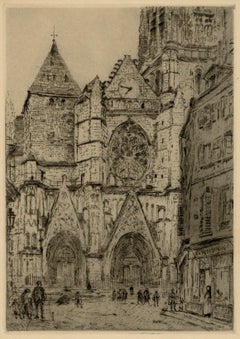
Paris: Gazette de Beaux Arts, 1907. Etching with aquatint on cream wove paper, 8 7/8 x 11 1/2 inches (225 x 292 mm), narrow lefthand margin, with a full margin with a deckle edge on ...

Category

Early 20th Century English School John Marin Art

Materials

Handmade Paper, Etching, Aquatint

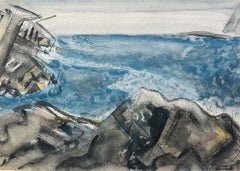
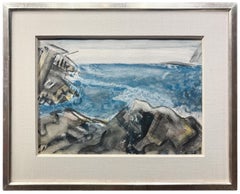
Sea Movement, Maine - Watercolor Waterscape Painting, Maine Coast, 1937

Sea Movement, Maine - Watercolor Waterscape Painting, Maine Coast, 1937

By John Marin

Located in Palm Desert, CA

John Marin's "Sea Movement, Maine" (1937) exemplifies his dynamic approach to watercolor, a medium he transformed into one of the most expressive vehicles of early American modernism...

Category

Mid-20th Century American Modern John Marin Art

Materials

Paper, Watercolor

CANAL BRIDGE AMSTERDAM

CANAL BRIDGE AMSTERDAM

By John Marin

Located in Santa Monica, CA

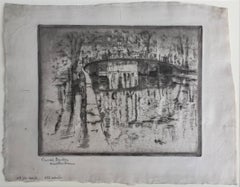
JOHN MARIN (1872 -1953) CANAL BRIDGE AMSTERDAM, 1906 (Zigrosser 13 i/ii) Etching, drypoint and plate tone. A PROOF IMPRESSION of the 1st state, Annotated...

Category

Early 1900s American Impressionist John Marin Art

Materials

Etching

Brooklyn Bridge NYC American Scene Ashcan 20th Century Social Realism Modern

Brooklyn Bridge NYC American Scene Ashcan 20th Century Social Realism Modern

By John Marin

Located in New York, NY

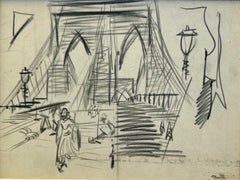
Brooklyn Bridge NYC American Scene Ashcan 20th Century Social Realism Modern John Marin (1870-1953) Brooklyn Bridge 7 1/2 x 9 7/8 inches Graphite on paper Signed lower right, c. 1...

Category

1920s American Modern John Marin Art

Materials

Paper, Graphite

John Marin "Clock Tower of Santa Maria Zobenigo, Venice, Italy" Etching c.1907

John Marin "Clock Tower of Santa Maria Zobenigo, Venice, Italy" Etching c.1907

By John Marin

Located in San Francisco, CA

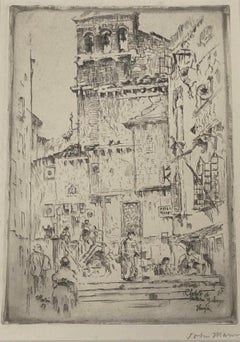
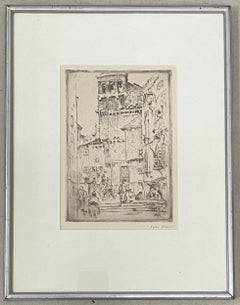
John Marin "Clock Tower of Santa Maria Zobenigo, Venice, Italy" Original Pencil Signed Etching c.1907 Rare pencil signed etching by listed American artist John Marin (1870-1953) Pl...

Category

Early 20th Century Impressionist John Marin Art

Materials

Etching

Study for Mid-Manhattan II

Study for Mid-Manhattan II

By John Marin

Located in Fairlawn, OH

Study for Mid-Manhattan II Oil and graphite on paper, mounted to board, 1932 Signed by the artist in pencil lower right Sight size: 8 1/2 x 7 inches One of a series of studies for th...

Category

1930s American Modern John Marin Art

Materials

Oil

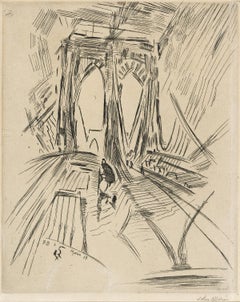
Brooklyn Bridge No. 6 (Swaying)

Brooklyn Bridge No. 6 (Swaying)

By John Marin

Located in New York, NY

John Marin (1870-1953), Brooklyn Bridge No. 6 (Swaying), 1913, Etching. Z112. Edition c. 12 (Steiglitz); 1924, unknown but small (New Republic). Signed in pencil. Signed and dated...

Category

1910s Cubist John Marin Art

Materials

Etching

St. Germain-Des-Pres, Paris

St. Germain-Des-Pres, Paris

By John Marin

Located in New York, NY

John Marin (1870-1953), St. Germain-Des-Pres, Paris, etching, 1906. Signed in pencil lower right and titled lower left [also signed and dated in the plate]. Zigrosser 47, only state,...

Category

Early 1900s American Impressionist John Marin Art

Materials

Etching

Woolworth Building, No. 2

Woolworth Building, No. 2

By John Marin

Located in New York, NY

A superb, richly-inked impression of this extremely scarce etching and drypoint. Second state (of 2). Edition of approximately only 10. Signed in pencil by Marin in lower right margi...

Category

1910s Modern John Marin Art

Materials

Drypoint, Etching

New York Street Movement and Figure - Architecture

New York Street Movement and Figure - Architecture

By John Marin

Located in Miami, FL

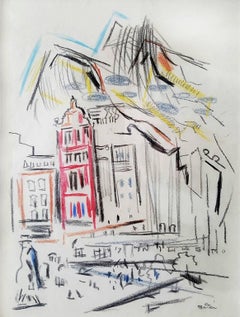
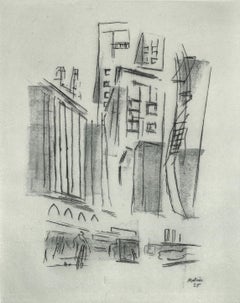
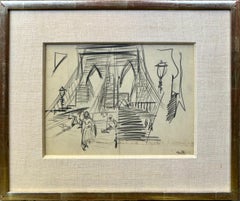
This work by John Marin depicts an image of lower Manhattan which was Marin's more iconic subject matter. The work has a stellar provenance as well. Provenance: Kennedy Galleries Richard York Gallery ACA Galleries...

Category

1920s American Modern John Marin Art

Materials

Crayon

Ponte di Donna Onesta, Venice

Ponte di Donna Onesta, Venice

By John Marin

Located in Missouri, MO

Very rare etching by John Marin. "Ponte di Donna Onesta, Venice" 1907 Original Etching Hand Signed Lower Right Titled Lower Left Edition: c. 30 Cat. Rais: ...

Category

Early 1900s Abstract John Marin Art

Materials

Etching

Related Items
lithograph

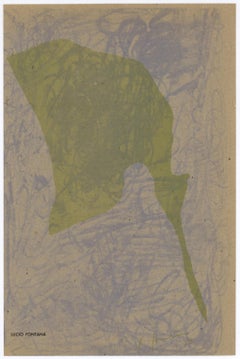
Lucio Fontanalithograph, 1958

$500

H 12.49 in W 8.19 in

lithograph

By Lucio Fontana

Located in Henderson, NV

Medium: original lithograph. Printed in 1958 and published in Milan by Groupe Espace for Documenti d'Arte d'Oggi. Sheet size: 12 1/2 x 8 1/4 inches (317 x 208 mm). There is printed t...

Category

1950s Futurist John Marin Art

Materials

Lithograph

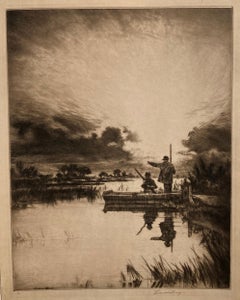
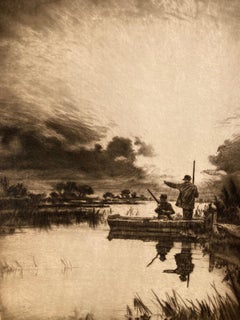
(HUNTERS WITH REFLECTIONS) -  RICH IMPRESSION

(HUNTERS WITH REFLECTIONS) - RICH IMPRESSION

By Levon West

Located in Santa Monica, CA

LEVON WEST (1900 - 1968) (Untitled) - HUNTERS with REFLECTIONS. ca 1925 Etching, signed and numbered 22, lower left. Plate, 13 1/2 x 10 1/2 inches. Sheet 15 3/4 x 11 3/4 inches. ...

Category

1920s American Impressionist John Marin Art

Materials

Etching

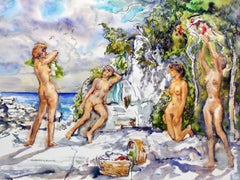
Nude Picnic Virgin Islands

Nude Picnic Virgin Islands

By Robert Noel Blair

Located in Buffalo, NY

Robert Noel Blair (American, 1912-2003) was an American artist, painter, sculptor, printmaker and teacher. He is best known for his rural life & desert landscapes and World War II sc...

Category

1960s American Modern John Marin Art

Materials

Archival Paper, Watercolor

Rainstorm Sunset

Rainstorm Sunset

By Robert Noel Blair

Located in Buffalo, NY

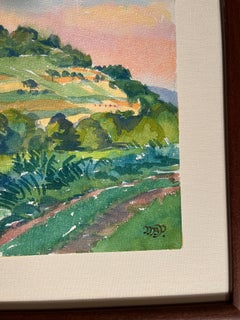
You are viewing a modernist American watercolor painting by Robert Noel Blair. Robert Noel Blair (American, 1912-2003) was an American artist, painter, sculptor, printmaker and te...

Category

American Modern John Marin Art

Materials

Paper, Watercolor

Glen Orchy.
Glen Orchy.

David Young CameronGlen Orchy., c. 1930

$1,250Sale Price|50% Off

H 28.63 in W 22 in D 1 in

Glen Orchy.

By David Young Cameron

Located in Plano, TX

Glen Orchy. c. 1925. Watercolor, pencil and conte crayon on paper. 9 1/4 x 13 (sheet 10 3/8 x 13 1/4). Ex-collection L.G. Duke,purchased at Sotheby's, London '10.12.70'. Mat line; ot...

Category

20th Century Modern John Marin Art

Materials

Watercolor, Pencil

North on West Street (West Side Highway NYC Cityscape)

North on West Street (West Side Highway NYC Cityscape)

By De Hirsch Margules

Located in Wilton Manors, FL

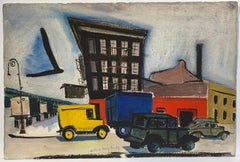
De Hirsh Margules (1899-1965). North on West Street , 1939. Watercolor on Arches wove paper. Signed and dated in pencil by artist lower margin. Sheet measures 15 x 22 inches. Framed measurement: 27 x 34 inched. Incredibly vibrant and saturated color with no fading or toning of sheet. Provenance: Babcock Galleries, NYC De Hirsh Margules (1899–1965) was a Romanian-American "abstract realist" painter who crossed paths with many major American artistic and intellectual figures of the first half of the 20th century. Elaine de Kooning said that he was "[w]idely recognized as one of the most gifted and erudite watercolorists in the country". The New York Times critic Howard Devree stated in 1938 that "Margules uses color in a breath-taking manner. A keen observer, he eliminates scrupulously without distortion of his material." Devree later called Margules "one of our most daring experimentalists in the medium" Margules was also a well-known participant in the bohemian culture of New York City's Greenwich Village, where he was widely known as the "Baron" of Greenwich Village.[1] The New York Times described him as "one of Greenwich Village's best-known personalities" and "one of the best known and most buoyant characters about Greenwich Village. Early Life De Hirsh Margules was born in 1899 in the Romanian city of Iași (also known as Iasse, Jassy, or Jasse). When Margules was 10 weeks old, his family immigrated to New York City. Both of his parents were active in the Yiddish theater, His father was Yekutiel "Edward" Margules, a "renowned Jewish actor-impresario and founder of the Yiddish stage." Margules' mother, Rosa, thirty-nine years younger than his father, was an actress in the Yiddish theater and later in vaudeville. Although Margules appeared as a child actor with the Adler Family[11] and Bertha Kalich, his sister, Annette Margules, somewhat dubiously continued in family theater and vaudeville tradition, creating the blackface role of the lightly-clad Tondelayo (a part later played on film Hedy Lamarr) in Earl Carroll's 1924 Broadway exoticist hit, White Cargo. Annette herself faced stereotyping as an exotic flower: writing about her publicist Charles Bouchert stated that "Romania produces a stormy, temperamental type of woman---a type admirably fitted to portray emotion." His brother Samuel became a noted magician who appeared under the name "Rami-Sami." Samuel later became a lawyer, representing magician Horace Goldin, among others. A family portrait including a young De Hirsh, a portrait of Rosa and Annette together, and individual photos of Rosa and Edward can be found on the Museum of the City of New York website. At around age 9 or 10, Margules took art classes with the Boys Club on East Tenth Street, and his first taste of exhibition was at a student art show presented by the club. By age 11, he had won a city-wide prize (a box camera) at a children's art show presented by the department store Wanamakers. As a young teenager, Margules was already displaying a characteristic kindness and loyalty. Upon hearing that two friends (one of them was author Alexander King), were in trouble for breaking a school microscope, the nearly broke Margules gave them five dollars to repair the microscope . Margules had to approach a wealthy man that Margules had once saved on the subway from a heart attack. Margules didn't reveal the source of the five dollars to King until twenty-five years later. In his late teens, Margules studied for a couple of months in Pittsburgh with Edwin Randby, a follower of Western painter Frederic Remington. Thereafter he pursued a two-year course of studies in architecture, design and decoration at the New York Evening School of Art and Design, while working as a clerk during the day at Stern's Department Store. He was encouraged in these artistic pursuits by his neighbor, the painter Benno Greenstein (who later went by the name of Benjamin Benno). Artistic career In 1922, Margules began work as a police reporter for the City News Association of New York .Margules then considered himself something of an expert on art, and the painter Myron Lechay is said to have responded to some unsolicited analysis of his work with the remark "Since you seem to know so much about it, why don't you paint yourself?" This led to study with Lechay and a flurry of painting. Margules' first show was in 1922 at Jane Heap's Little Review Gallery. Thereafter Margules began to participate in shows with a group including Stuart Davis, Jan Matulka, Buckminster Fuller (exhibiting depictions of his "Dymaxion house") in a gallery run by art-lover and restaurateur Romany Marie on the floor above her cafe. Jane Heap, left, with Mina Loy and Ezra Pound During the 1920s, Margules traveled outside of the country a number of times. In 1922, with the intent of reaching Bali, he took a job as a "'wiper on a tramp steamer where [he] played nursemaid to the engine." He reached Rotterdam before he turned back. He would return to Rotterdam shortly thereafter. In 1927, Margules took a lengthy leave of absence from his day job as a police reporter in order to travel to Paris, where he "set up a studio in Montmartre's Place du Tertre, on the top floor of an almost deserted hotel, a shabby establishment, lacking both heat and running water." He studied at the Louvre and traveled to paint landscapes in provincial France and North Africa. Margules also joined the "Noctambulist" movement and experimented with painting and showing his artwork in low light.Jonathan Cott wrote that: the painter De Hirsch Margulies sat on the quays of the Seine and painted pictures in the dark. In fact, the first exhibition of these paintings, which could be seen only in a darkened room, took place in [ Walter Lowenfels'] Paris apartment. Elaine de Kooning remarked that studying the works of the Noctambulists confirmed Margules' "direction toward the use of primary colors for perverse effects of heavy shadow." It was also in Paris that Margules initially conceived his idea of "Time Painting", where a painting is divided into sectors, each representing a different time of day, with color choices meant to evoke that time of day. In Paris, his social circle included Lowenfels, photographer Berenice Abbott, publisher Jane Heap, composer George Anthiel, sculptor Thelma Wood, painter André Favory, writer Norman Douglas, writer and editor George Davis, composer and writer Max Ewing, and writer Michael Fraenkel. Upon his return to New York in 1929, Margules attended an exhibition of John Marin's paintings. While at the exhibition, he "launched into an eloquent explanation of Marin to two nearby women", and was overheard by an impressed Alfred Stieglitz. The famous photographer and art promoter invited Margules to dine with his wife, the artist Georgia O'Keeffe, and his assistant, painter Emil Zoler. Stieglitz thereafter became a friend and mentor to Margules, becoming for him "what Socrates was to his friends." Alfred Stieglitz Stieglitz introduced Margules to John Marin, who quickly became the most important painterly influence upon Margules. Elaine de Kooning later noted that Margules was "indebted to Marin and through Marin to Cézanne for his initial conceptual approach - for his constructions of scenes with no negative elements, for skies that loom with the impact of mountains." Margules himself said that Marin was his "father and ... academy." The admiration was by no means unreciprocated: Marin said that Margules was "an art lover with abounding faith and sincerity, with much intelligence and quick seeing." Stieglitz also introduced Margules to many other artistic and intellectual figures in New York. With the encouragement of Alfred Stieglitz, Margules in 1936 opened a two-room gallery at 43 West 8th Street called "Another Place." Over the following two years there were fourteen solo exhibitions by Margules and others, and the gallery was well-respected by the press. It was in this gallery that the painter James Lechay, Myron's brother, exhibited his first painting. In 1936, Margules first saw recognition by major art museums when both the Museum of Modern Art and the Museum of Fine Arts, Boston purchased his works. In 1942, Margules gave up working as a police reporter, and apparently dedicated himself thereafter solely to an artistic vocation. "The Baron of Greenwich Village"[edit] Margules made his mark not only as an artist, but also as an outsized personality known throughout Greenwich Village and beyond. To local residents, Margules was known as the "Baron", after Baron Maurice de Hirsch, a prominent German Jewish philanthropist. Margules was easily recognizable by the beret he routinely wore over his long hair. Writer Charles Norman said that he "dressed with a flair for sloppiness." He was said to "know everybody" in Greenwich Village, to the extent that when the novelist and poet Maxwell Bodenheim was murdered, Margules was the first one the police sought to identify the body. Margules' letters show him interacting with art world figures such as Sacha Kolin, John Marin and Alfred Stieglitz, as well as with prominent figures outside the art world such as polymath Buckminster Fuller and writer Henry Miller. Most of his friends and acquaintances found Margules a generous and voluble man, given to broadly emotionally expressive gestures and acts of kindness and loyalty. In 1929, he exhibited an example of this loyalty and fellow-feeling when he appeared in court to fight what the wrongful commitment of his friend, writer and sculptor Alfred Dreyfuss, who appeared to have been a victim of an illicit attempt to block an inheritance. The Greenwich Village chronicler Charles Norman described the bone-crushing hugs that Margules would routinely bestow on his friends and acquaintances, and speaks of the "persuasive theatricality" that Margules seemed to have inherited from his actor parents. Norman also wrote about Margules' routine acts of kindness, taking in homeless artists, constantly feeding his friends and providing the salvatory loan where needed. Norman also notes that Margules was blessed with a loud and good voice, and was apt to sing an operatic air without provocation. The writer and television personality Alexander King said I think the outstanding characteristics of my friend's personality are affirmation, emphasis, and overemphasis. He chooses to express himself predominantly in superlatives and the gestures which accompany his utterances are sometimes dangerous to life and limb. Of the bystanders, I mean. King also spoke with affectionate amusement about Margules' pride in his cooking, speaking of how "if he should ever invite you to dinner, he may serve you a hamburger with onions, in his kitchen-living room, with such an air of gastronomic protocol, such mysterious hints and ogliing innuendoes, as if César Ritz and Brillat-Savarin had sneaked out, only a moment before, with his secret recipe in their pockets." Margules was such a memorable New York personality that comic book writer Alvin Schwartz imagined him at the Sixth Avenue Cafeteria in a risible yet poignant debate with Clark Kent about whether Superman had the ability to stop Hitler. Margules' entrenchment in the Greenwich Village milieu can be seen in a photograph from Fred McDarrah's "Beat Generation Album" of a January 13, 1961 writers' and poets' meeting to discuss "The Funeral of the Beat Generation", in Robert Cordier [fr]'s railroad flat at 85 Christopher Street. Among the people in the same photograph are Shel Silverstein...

Category

1930s American Modern John Marin Art

Materials

Watercolor, Rag Paper
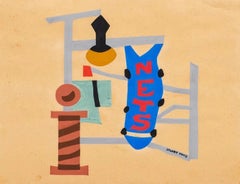
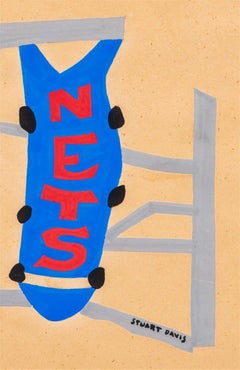
"NY Street Signs" Mid-20th Century WPA 1938 Modernist Abstract Realism Pop Art

"NY Street Signs" Mid-20th Century WPA 1938 Modernist Abstract Realism Pop Art

By Stuart Davis

Located in New York, NY

"NY Street Signs" Mid-20th Century WPA 1938 Modernist Abstract Realism Pop Art Stuart Davis (American, 1892-1964) "Street Signs" Modernist gouache and traces of pencil on paper in the proto-pop art style Davis is celebrated for, 1938, signed to lower right, framed. Image: 11 1/4 x 15 1/4 inches. Frame by Bark: 18 1/2 x 22 inches. LITERATURE: A, Boyajian, M. Rutkowski, Stuart Davis, A Catalogue Raisonne, Vol. 2, New Haven, Connecticut, 2007, vol. II, p. 632, no. 1232, illustrated. EXHIBITIONS: ACA Galleries, New York American Artists' Congress: Group Exhibition of Paintings and Sculpture, Dec. 3-16, 1939 (SDAB I, 12/3/39, p. 129). Outlines Gallery, Pittsburgh, Stuart Davis, Mar. 3-16, 1946. Coleman Art Gallery, Philadelphia, 5 Prodigal Sons: Former Philadelphia Artists: Ralston Crawford, Stuart Davis, Charles Demuth, Julian Levi, Charles Sheeler, Oct 4 - 30, 1947 (pamphlet), no. 12. PROVENANCE: The artist; Mr. and Mrs. Frank Bowles, New York, Apr. 3, 1956; thence by descent, Private Collection, New York. NOTES: According to the Catalogue Raissonne, "the title 'Street Signs' is recorded in the artist's account books...
Category

1930s American Modern John Marin Art

Materials

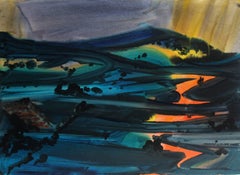
Paper, Gouache, Pencil

lithograph

Lucio Fontanalithograph, 1958

$500

H 12.49 in W 8.47 in

lithograph

By Lucio Fontana

Located in Henderson, NV

Medium: original lithograph. Printed in 1958 and published in Milan by Groupe Espace for Documenti d'Arte d'Oggi. Sheet size: 12 1/2 x 8 1/2 inches (317 x 215 mm). There is printed t...

Category

1950s Futurist John Marin Art

Materials

Lithograph

The Agam Passover Haggadah - Gold Edition

The Agam Passover Haggadah - Gold Edition

By Yaacov Agam

Located in Jerusalem, IL

A Passover Haggadah, made by the artist Yaacov Agam. 58 original serigraphs, pulled by hand on Rivs 270 Gr. (Arjomarie-Prioux) by Atelier Arcay in Paris, 1985. All color separations ...

Category

1980s Kinetic John Marin Art

Materials

Paper, Color

Palace of Fine Arts, Mid-Century San Francisco Landscape

Palace of Fine Arts, Mid-Century San Francisco Landscape

Located in Soquel, CA

Palace of Fine Arts, Mid-Century San Francisco Landscape Lively watercolor piece by Garrett Price (American, 1896-1979). A geometric, multi-colored background forms the foundation f...

Category

1950s American Modern John Marin Art

Materials

Paper, Watercolor

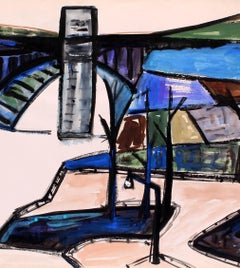
Watercolor Painting American Modern Painting Bridge Harbor Female Artist 1950

Watercolor Painting American Modern Painting Bridge Harbor Female Artist 1950

Located in Buffalo, NY

Dorothy Rivo Untitled (Bridge Tower), c. 1960s–70s Acrylic on paper, floated in a mat Framed dimensions: 30 in. H × 24 in. W Contemporary walnut or black wood frame with white archiv...

Category

1940s American Modern John Marin Art

Materials

Archival Ink, Watercolor, Archival Paper, Acrylic

Previously Available Items
Brooklyn Bridge, No. 6 (Swaying)

Brooklyn Bridge, No. 6 (Swaying)

By John Marin

Located in New York, NY

A dark, richly-inked impression of this extremely scarce etching. Edition of approximately only 12. Signed in pencil. Published by Alfred Stieglitz, 291 Fifth Avenue, New York. Cat...

Category

1910s American Modern John Marin Art

Materials

Etching

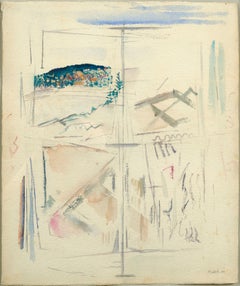
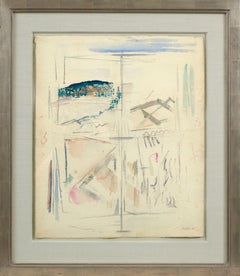
"Looking out the Window, West Point, Maine, " John Marin, Modernist Landscape

"Looking out the Window, West Point, Maine, " John Marin, Modernist Landscape

By John Marin

Located in New York, NY

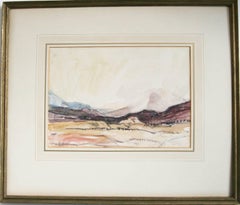
John Marin Looking out the Window, West Point, Maine, 1914 Signed and dated at lower right: Marin 14 // inscribed in Alfred Stieglitz's hand on an original label affixed to the reverse: Looking out the Window, Deer Isle— [sic] / Maine / by John Marin— / 1914 Watercolor and graphite on paper 19 1/2 x 15 3/4 inches Provenance: The artist An American Place, New York, circa 1935 Dorothy Norman...
Category

1910s Modern John Marin Art

Materials

Paper, Watercolor, Graphite

Quartier de la Maison Blanche
Quartier de la Maison Blanche
By John Marin

Located in New York, NY

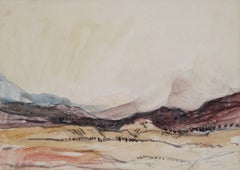
A superb, dark impression of this extremely scarce, early etching on Japan paper. Edition of approximately only 12. Signed and titled in pencil.

Category

Early 1900s American Modern John Marin Art

Materials

Etching

Downtown, the El — early 20th-century modernism

Downtown, the El — early 20th-century modernism

By John Marin

Located in Myrtle Beach, SC

John Marin, 'Downtown, the El', etching, 1921, Zigrosser 134. Signed in pencil. Signed and dated in the plate, lower right. A fine, richly-inked impression, with skillfully controlle...

Category

Early 1900s American Modern John Marin Art

Materials

Etching

"Delaware River Near Lambertville, New Jersey, " John Marin, American Modernism

"Delaware River Near Lambertville, New Jersey, " John Marin, American Modernism

By John Marin

Located in New York, NY

John Marin (1870 - 1953) Delaware River Near Lambertville, New Jersey, No. 3, 1950 Watercolor, ink and pencil on paper 9 3/4 x 14 inches Signed and dated lower right: Marin 50' Prov...

Category

1950s American Modern John Marin Art

Materials

Paper, Watercolor, Gouache, Pen, Pencil

Downtown, the El
Downtown, the El

John MarinDowntown, the El, 1921

Sold

H 6.88 in W 8.63 in

Downtown, the El

By John Marin

Located in Myrtle Beach, SC

John Marin, 'Downtown, the El', etching, 1921, Zigrosser 134. Signed in pencil. Signed and dated in the plate, lower right. A fine, richly-inked impression, with skillfully controlle...

Category

Early 1900s American Modern John Marin Art

Materials

Etching

THE LOBSTER FISHERMAN

THE LOBSTER FISHERMAN

By John Marin

Located in Portland, ME

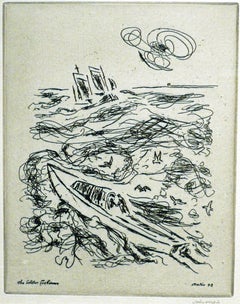
Marin, John. LOBSTER FISHERMAN. Z.172. Etching, 1948. Edition of 125 published by Twin Editions in 1950. Signed in pencil, and titled, signed and dat...

Category

1940s John Marin Art

Materials

Etching

"The Coast, Maine, " John Marin Early American Modernism New England Seascape

"The Coast, Maine, " John Marin Early American Modernism New England Seascape

By John Marin

Located in New York, NY

John Marin (1870 - 1953) The Coast, 1914 Watercolor and pencil on paper 15 1/2 x 18 1/2 inches Signed and dated lower right: Marin 14 Provenance: Ferdinand Howald, Columbus, Ohio C...

Category

1910s American Modern John Marin Art

Materials

Paper, Watercolor

"Delaware River Near Lambertville, New Jersey, " Mid-century Modern American

"Delaware River Near Lambertville, New Jersey, " Mid-century Modern American

By John Marin

Located in New York, NY

John Marin (1870 - 1953) Delaware River Near Lambertville, New Jersey, No. 3, 1950 Watercolor, ink and pencil on paper 9 3/4 x 14 inches Signed and dated lower right: Marin 50' Prov...

Category

1950s American Modern John Marin Art

Materials

Paper, Watercolor, Gouache, Pen, Pencil

Pont-Neuf, Paris
Pont-Neuf, Paris

John MarinPont-Neuf, Paris, 1905

Sold

H 7.88 in W 5.44 in

Pont-Neuf, Paris

By John Marin

Located in Myrtle Beach, SC

John Marin's atmospheric evocation of the historic Pont Neuf, the oldest standing bridge across the river Seine in Paris (the first stone was laid by Henry ...

Category

Early 1900s Post-Impressionist John Marin Art

Materials

Etching

DOWNTOWN SYNTHESIS
DOWNTOWN SYNTHESIS

John MarinDOWNTOWN SYNTHESIS, 1925

Sold

H 9.5 in W 7.625 in

DOWNTOWN SYNTHESIS

By John Marin

Located in Santa Monica, CA

JOHN MARIN DOWNTOWN SYNTHESIS (Zigrosser 140) Etching with tonal areas, 1925. Signed in pencil lower left, and titled lower right "Downtown N.Y." Edition c. 20. RARE. Only 2 have a...

Category

1920s American Modern John Marin Art

Materials

Etching

MOVEMENT DOWNTOWN (Unknown Unique Example)

MOVEMENT DOWNTOWN (Unknown Unique Example)

By John Marin

Located in Santa Monica, CA

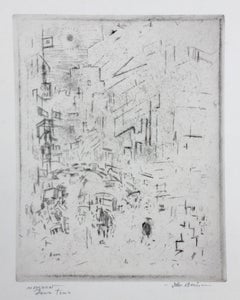
JOHN MARIN (1872 – 1953) MOVEMENT DOWNTOWN 1914, (Not in Zigrosser) Etching, signed and titled in pencil. Signed & dated in the plate lower left. 8 3/8 x 6 5/8”, sheet, 11 ¼” x 9...

Category

1910s American Modern John Marin Art

Materials

Etching

John Marin art for sale on 1stDibs.

Find a wide variety of authentic John Marin art available for sale on 1stDibs. You can also browse by medium to find art by John Marin in etching, aquatint, crayon and more. Much of the original work by this artist or collective was created during the 20th century and is mostly associated with the modern style. Not every interior allows for large John Marin art, so small editions measuring 7 inches across are available. Customers who are interested in this artist might also find the work of John French Sloan, Howard Norton Cook, and Kerr Eby. John Marin art prices can differ depending upon medium, time period and other attributes. On 1stDibs, the price for these items starts at $400 and tops out at $45,000, while the average work can sell for $7,750.

Artists Similar to John Marin