Harry Sternberg Art

American, 1904-2001

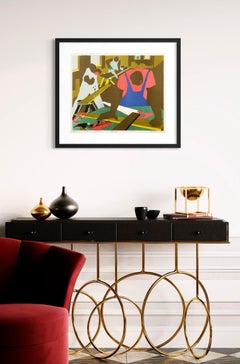
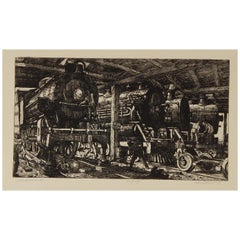
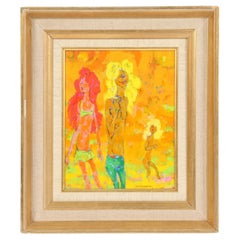
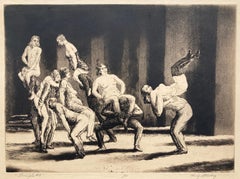
Harry Sternberg was an American painter, printmaker, muralist, lithographer and educator. He was born in New York City on July 19, 1904. He studied at the Art Students League of New York, graphics with Harry Wickey. During the Depression, he was a Works Progress Administration artist and his murals are in post offices in Chicago as well as Chester and Sellersville, Pennsylvania. In 1936, Sternberg was awarded a Guggenheim Fellowship for creating a series of drawings, prints and paintings showing the principal American Industrial and agricultural occupations. He confined his investigations to the coal and steel industries of eastern Pennsylvania, immersing himself for several months in the lives of the coal miners in Mahanoy City. When he returned to New York, he made a series of 11 prints that emphasized the bleak lives and dangerous work of the miners. Sternberg wished to point out the dangers of working in the mines, the diseases caused by the inhalation of coal dust, mine collapses and maiming dynamite accidents that would result in such mutilations. From 1934–68, he taught painting and graphics at the Art Students League of New York, from 1942–45, graphics at the New School for Social Research and 1959–69, he was the head of the Art Department in the Idyllwild School of Music and Art at the University of Southern California. He wrote several books on graphics including silk screening, etching and woodcutting. Sternberg died on November 27, 2001, in Escondido, California.

to
15
15
8
5
5
5
1
original lithograph

original lithograph

By Harry Sternberg

Located in Henderson, NV

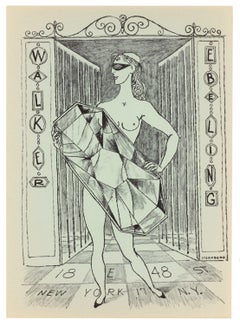
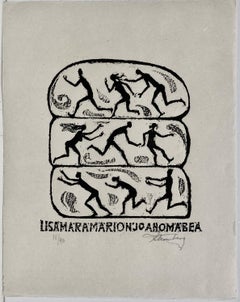
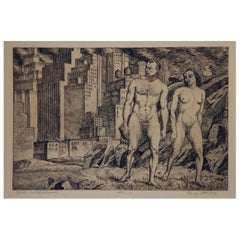
Medium: original lithograph. This lithograph was printed in 1957 for the "Improvisations" portfolio, published by the Artists Equity Association of New York on the occasion of the 19...

Category

1950s Harry Sternberg Art

Materials

Lithograph

original lithograph

original lithograph

By Harry Sternberg

Located in Henderson, NV

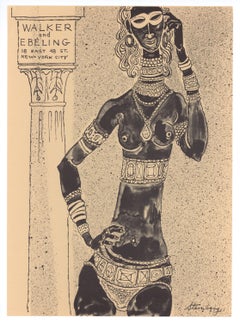
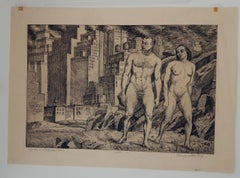
Medium: original lithograph. This lithograph was printed in 1956 for the "Improvisations" portfolio, published by the Artists Equity Association of New York on the occasion of the 19...

Category

1950s Harry Sternberg Art

Materials

Lithograph

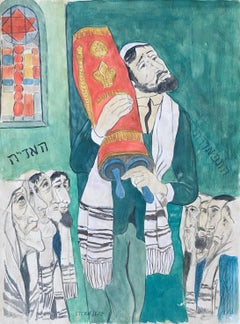
Modernist Rabbi In Synagogue Judaica Watercolor Harry Sternberg

Modernist Rabbi In Synagogue Judaica Watercolor Harry Sternberg

By Harry Sternberg

Located in Surfside, FL

Harry Sternberg, artist, teacher, and political activist was born in New York City's lower east side in 1904. He was the youngest of eight children born to his mother, a hungarian im...

Category

20th Century Modern Harry Sternberg Art

Materials

Ink, Watercolor

THOMAS HART BENTON
THOMAS HART BENTON

THOMAS HART BENTON

By Harry Sternberg

Located in Santa Monica, CA

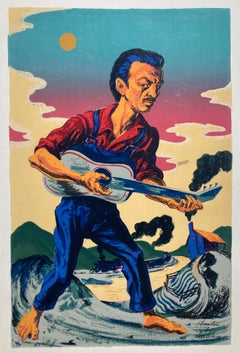
HARRY STERNBERG (American, 1904-2001) THOMAS BENTON, 1943. Color screenprint on gray card stock wove paper. Edition of 30. Signed "Benton by Sternberg" in ink, by hand by the artist...

Category

1940s American Modern Harry Sternberg Art

Materials

Screen

original lithograph

original lithograph

By Harry Sternberg

Located in Henderson, NV

Medium: original lithograph. This lithograph is from the rare 1951 "Improvisations" portfolio, published by the Artists Equity Association of New York on the occasion of the 1951 Spr...

Category

1950s Harry Sternberg Art

Materials

Lithograph

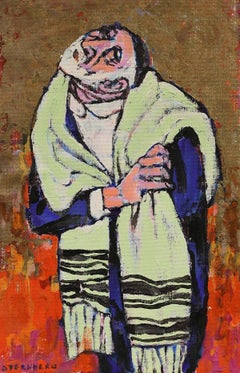
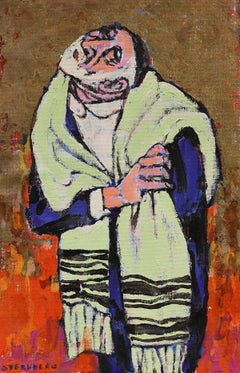
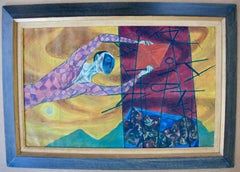
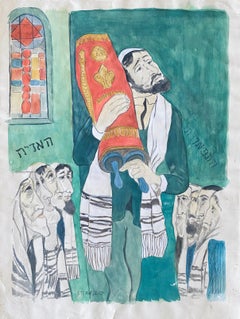
Modernist Rabbi Judaica Painting on Gold Background

Modernist Rabbi Judaica Painting on Gold Background

By Harry Sternberg

Located in Surfside, FL

A contorted Rabbi looking upward is depicted in a naive, and almost child-like manner. Vibrant colors, and gestural brushstrokes fill the composition, enhancing the flatness of the f...

Category

20th Century Modern Harry Sternberg Art

Materials

Acrylic, Illustration Board

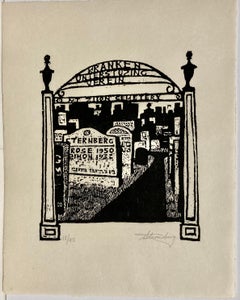
Harry Sternberg, Mount Zion Cemetery, from My Life in Woodcuts, 1991

Harry Sternberg, Mount Zion Cemetery, from My Life in Woodcuts, 1991

By Harry Sternberg

Located in New York, NY

In 1991 Harry Sternberg published a book with Brighton Press, San Diego. It was My Life in Woodcuts. At the time it was the only known woodcut autobiography. The deluxe editions of...

Category

1990s American Modern Harry Sternberg Art

Materials

Woodcut

original lithograph

original lithograph

By Harry Sternberg

Located in Henderson, NV

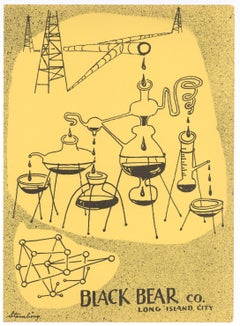
Medium: original lithograph. This lithograph was printed in 1957 for the "Improvisations" portfolio, published by the Artists Equity Association of New York on the occasion of the 19...

Category

1950s Harry Sternberg Art

Materials

Lithograph

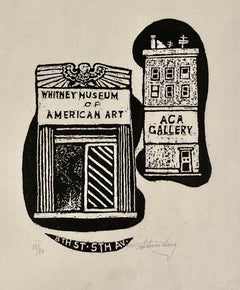
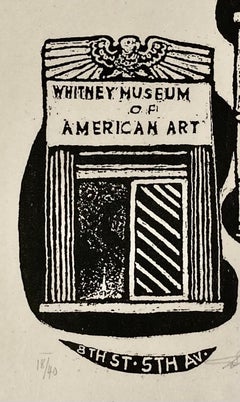
Harry Sternberg, Whitney and ACA, from My Life in Woodcuts, 1991

Harry Sternberg, Whitney and ACA, from My Life in Woodcuts, 1991

By Harry Sternberg

Located in New York, NY

In 1991 Harry Sternberg published a book with Brighton Press, San Diego. It was My Life in Woodcuts. At the time it was the only known woodcut autobiography. The deluxe editions of...

Category

1990s American Modern Harry Sternberg Art

Materials

Woodcut

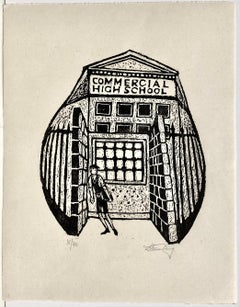
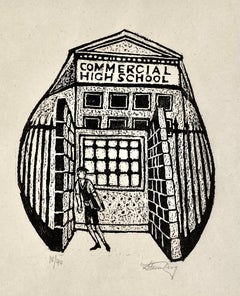
Harry Sternberg, Commercial High School from My Life in Woodcuts, 1991

Harry Sternberg, Commercial High School from My Life in Woodcuts, 1991

By Harry Sternberg

Located in New York, NY

In 1991 Harry Sternberg published a book with Brighton Press, San Diego. It was My Life in Woodcuts. At the time it was the only known woodcut autobiography. The deluxe editions of...

Category

1990s American Modern Harry Sternberg Art

Materials

Woodcut

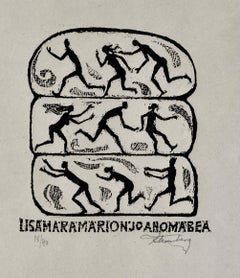
Harry Sternberg, Girlfriends, from My Life in Woodcuts, 1991

Harry Sternberg, Girlfriends, from My Life in Woodcuts, 1991

By Harry Sternberg

Located in New York, NY

In 1991 Harry Sternberg published a book with Brighton Press, San Diego. It was My Life in Woodcuts. At the time it was the only known woodcut autobiography. The deluxe editions of...

Category

1990s American Modern Harry Sternberg Art

Materials

Woodcut

Harry Sternberg,  (Chasing) Girlfriends, from My Life in Woodcuts, 1991

Harry Sternberg, (Chasing) Girlfriends, from My Life in Woodcuts, 1991

By Harry Sternberg

Located in New York, NY

In 1991 Harry Sternberg published a book with Brighton Press, San Diego. It was My Life in Woodcuts. At the time it was the only known woodcut autobiography. The deluxe editions of...

Category

1990s American Modern Harry Sternberg Art

Materials

Woodcut

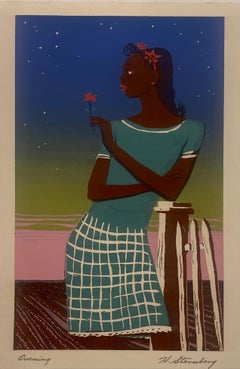
EVENING

EVENING

By Harry Sternberg

Located in Portland, ME

Sternberg, Harry (American, 1904-2001). EVENING. Screenprint in colors, 1941. Signed and titled in the screen. 8 3/4 x 5 7/8. In excellent condition.

Category

Mid-20th Century Harry Sternberg Art

Materials

Screen

original lithograph

original lithograph

By Harry Sternberg

Located in Henderson, NV

Medium: original lithograph. This lithograph is from the rare 1953 "Improvisations" portfolio, published by the Artists Equity Association of New York on the occasion of the 1953 Spr...

Category

1950s Harry Sternberg Art

Materials

Lithograph

Related Items
"Keith Richards Mugshot" Print 39 x 36 inch Edition of 75 by Gerard Marti

"Keith Richards Mugshot" Print 39 x 36 inch Edition of 75 by Gerard Marti

By Gerard Marti

Located in Culver City, CA

"Keith Richards Mugshot" Print 39 x 36 inch Edition of 75 by Gerard Marti Digital print on fine art paper. Ships rolled in a tube. Signed and numbered by the artist.

Category

21st Century and Contemporary Pop Art Harry Sternberg Art

Materials

Paper, Digital

Saturday Evening Post Illustration. “ The Devil’s Stronghold” Original Magazine

Saturday Evening Post Illustration. “ The Devil’s Stronghold” Original Magazine

By Edwin Georgi

Located in Miami, FL

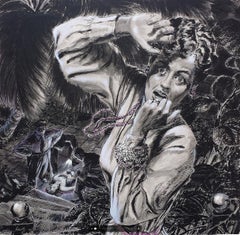
The work is mostly black and white to indicate that this is a night scene. On closer inspection, you will see areas of magenta and ivory throughout The publisher's label on verso ide...

Category

1960s American Modern Harry Sternberg Art

Materials

India Ink, Gouache, Pencil, Illustration Board

Splash Girl - Original painting, Signed

Splash Girl - Original painting, Signed

By Philippe Pasqua

Located in Paris, IDF

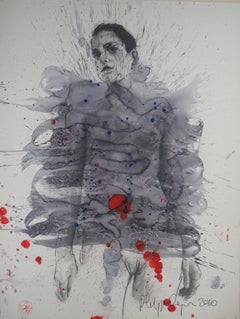
Philippe Pasqua (1965-) Splash Girl, 2010 Mixed medias : ink, watercolor and acrylic painting Signed bottom right Authenticated with the artist red stamp On...

Category

2010s Modern Harry Sternberg Art

Materials

Ink, Acrylic, Watercolor

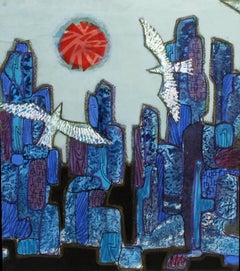
Birds in Flight

Birds in Flight, 1970s

$1,100Sale Price|38% Off

H 27 in W 23 in

Birds in Flight

Located in Buffalo, NY

A modern Chinese watercolor painting depicting birds soaring under a red sun.

Category

1970s Modern Harry Sternberg Art

Materials

Archival Ink, Archival Paper, Watercolor

Derriere Le Miroir-No. 190-Page 14-15

Derriere Le Miroir-No. 190-Page 14-15

By Alexander Calder

Located in Fairlawn, OH

Derriere Le Miroir-No. 190-Page 14-15 Color lithograph, 1971 Unsigned (as issued) From: Derriere Le Miroir, No. 190, 1971 Publisher: Aime Maeght, Paris Printer: L’Imprimerie Arts, Pa...

Category

1970s Abstract Harry Sternberg Art

Materials

Lithograph

Double Personage
Double Personage

Wifredo LamDouble Personage, 1979

$450

H 12.25 in W 9.25 in

Double Personage

By Wifredo Lam

Located in Fairlawn, OH

Double Personage Color lithograph, 1975 (?) Unsigned (as issued) Edition: Large Edition Limited, (estimated to be approximately 2000) Published in: XXe Siecle, No. 52, Juin 1979 Published: G. di San Lazzaro Printer: Mourlot Imprimeur, Paris, France Reference: Lam-Tonneau-Ryckelynck L7513 Condition: Excellent, fresh colors Traces of glue residue along margin edge where it was bound in the book Image/sheet size: 12 1/4 x 9 1/4 inches Wilfredo Lam (1902-1982) Biography Wifredo Lam was born in Sagua la Grande, Cuba, on December 8, 1902. He was the eighth child born to Lam-Yam―born in Canton around 1820, an immigrant to the Americas in 1860―and to Ana Serafina Catilla―born in 1862 in Cuba of mixed African and Spanish ancestry. The luxuriant nature of Sagua la Grande had a strong impact on Lam from early childhood. One night in 1907, he was startled by the strange shadows cast on the wall of his bedroom of a bat in flight. He often recounted the incident as his first magnificent awakening to another dimension to existence. In 1916, Lam and part of his family settled in Havana. He was enrolled in the Escuela Profesional de Pintura y Escultura, Academia de San Alejandro, where he remained a student until 1923. This period, with exhibitions at the Salón de Bellas artes, was determinant in his choice to become a painter. In 1923, the municipality of Sagua la Grande awarded him a grant to study in Europe and by the autumn of that year, at the age of twenty-one, he left the country for Spain. His time in Spain―initially intended as a short stay on his way to Paris―lasted 14 years. In Madrid, he was exposed to the ideas and movements of modern art. He spent long hours at the Archeological Museum and the Prado. He studied the great masters of Spanish painting, Velázquez and Goya, but felt particularly drawn to the works of Bosch and Bruegel the Elder. In 1931, his first wife, Eva (Sébastiana Piriz) and their son Wilfredo Victor died of tuberculosis. The terrible suffering he endured led to numerous paintings of mother and child. Lam found solace in the company of his Spanish friends and made contact with several political organizations. In 1936, with the help of his friend Faustino Cordón, he joined the Republican forces in their fight against Franco. He designed anti-Fascist posters and took part in the struggle by working in a munitions factory. The violence of the struggle inspired his painting La Guerra Civil. In 1938, Lam left Spain for Paris. Shortly before leaving, he met Helena Holzer, who would become his wife in 1944. His meeting Picasso in his studio on the Rue des Grands Augustins proved decisive. Picasso introduced his new “cousin” to his painter, poet and art critic friends, Braque, Matisse, Miró, Léger, Eluard, Leiris, Tzara, Kahnweiler, Zervos. Lam also met Pierre Loeb, the owner of the Galerie Pierre in Paris, which hosted Lam’s first solo exhibition in 1939. Shortly before the Germans arrived, Lam left Paris for Bordeaux and then Marseille, where many of his friends, for the most part surrealists, had gathered around André Breton in the Villa Air Bel: Pierre Mabille, René Char, Max Ernst, Victor Brauner, Oscar Domínguez, André Masson, Benjamin Péret. In the Villa Air Bel, a meeting place for creativity and experimentation, Lam worked and produced, most notably, a series of ink drawings that set the tone for what would become his signature style of hybrid figures, a vocabulary he would develop more fully during his years in Cuba from 1941 to 1947. In January and February 1941, Lam illustrated Breton’s poem Fata Morgana which was censored by the Vichy government. On March 25, Lam and Helena Holzer embarked on the “Capitaine Paul Lemerle” headed for Martinique, in the company of some 300 other artists and intellectuals―André Breton and Claude Lévi-Strauss among them. Upon arrival, the passengers were interred at Trois Îles. It was during this forced passage in Martinique and before leaving for Cuba that Lam and Aimé Césaire met for the first time to become life-long friends. Newly settled in his native land after almost twenty years, Lam delved deeper into his artistic investigations, finding nourishment for his ideas in the surroundings of his childhood and youth. His sister Eloisa, whom he was closest to, explained to him in much detail the workings of Afro-Cuban rituals and he began attending ritual ceremonies with some of his friends. This contact with Afro-Cuban culture brought new impetus to his art. He painted over one hundred canvases, most notably La Jungla, making the year 1942 his most productive of this period. Over the next few years, a number of exhibitions followed in the United States, at the Institute of Modern Art of Boston, at the MoMA of New York, at the Galerie Pierre Matisse, where La Jungla was presented and created a scandal. In 1946, Lam and Helena travel to Haiti and attend voodoo ceremonies in the company of Pierre Mabille and André Breton. Talking about his experience in Haiti, Lam said, “It is often assumed that my work took its final form in Haiti, but my stay there, like the trips I made to Venezuela, Colombia or to the Brazilian Mato Grosso only broadened its scope. I could have been a good painter from the School of Paris, but I felt like a snail out of its shell. What really broadened my painting is the presence of African poetry.” Picasso_Lam_Vallauris_1954_vignette Wifredo Lam et Pablo Picasso, Vallauris, 1954 Lam then went on to New York where he renewed contact with Marcel Duchamp and made new acquaintances: Jeanne Reynal, James Johnson Sweeney, Arshile Gorky, John Cage, Roger Wilcox, Mercedes Matter, Ian Hugo, Jesse Fernández, John Cage, Sonia Sekula and Yves Tanguy. By the end of the 1940s, Lam divided his time between Europe, Havana and New York, where they stayed with Pierre and Teeny Matisse...

Category

1970s Surrealist Harry Sternberg Art

Materials

Lithograph

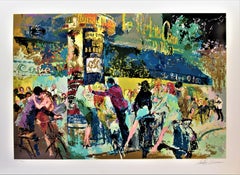
Left Bank Cafe, Paris

LeRoy NeimanLeft Bank Cafe, Paris, 1987

$5,780

H 32.25 in W 44 in D 0.01 in

Left Bank Cafe, Paris

By LeRoy Neiman

Located in San Francisco, CA

This artwork titled "Left Bank Cafe, Paris" 1987 is an original color serigraph by noted American artist LeRoy Neiman, 1921-2012. It is hand signed and numbered H.C 166/175 in pencil by the artist. The image size is 26 x 38 inches, sheet size is 32.25 x 44 inches. With the blind stamp of the printer Styria Studio at the lower left corner margin. It is in excellent condition, two small pieces of hanging tape remain on the back. About the artist: Mr. Neiman's kinetic, quickly executed paintings and drawings, many of them published in Playboy, offered his fans gaudily colored visual reports on heavyweight boxing matches, Super Bowl games and Olympic contests, as well as social panoramas like the horse races at Deauville, France, and the Cannes Film Festival. Quite consciously, he cast himself in the mold of French Impressionists like Toulouse-Lautrec, Renoir and Degas, chroniclers of public life who found rich social material at racetracks, dance halls and cafes. Mr. Neiman often painted or sketched on live television. With the camera recording his progress at the sketchpad or easel, he interpreted the drama of Olympic Games and Super Bowls for an audience of millions. When Bobby Fischer and Boris Spassky faced off in Reykjavik, Iceland, to decide the world chess championship, Mr. Neiman was there, sketching. He was on hand to capture Federico Fellini directing "8 ½" and the Kirov Ballet performing in the Soviet Union. In popularity, Mr. Neiman rivaled American favorites like Norman Rockwell, Grandma Moses and Andrew Wyeth. A prolific one-man industry, he generated hundreds of paintings, drawings, watercolors, limited-edition serigraph prints and coffee-table books yearly, earning gross annual revenue in the tens of millions of dollars. Although he exhibited constantly and his work was included in the collections of dozens of museums around the world, critical respect eluded him. Mainstream art critics either ignored him completely or, if forced to consider his work, dismissed it with contempt as garish and superficial — magazine illustration with pretensions. Mr. Neiman professed not to care. Maybe the critics are right," he told American Artist magazine in 1995. "But what am I supposed to do about it — stop painting, change my work completely? I go back into the studio, and there I am at the easel again. I enjoy what I'm doing and feel good working. Other thoughts are just crowded out." His image suggested an artist well beyond the reach of criticism. A dandy and bon vivant, he cut an arresting figure with his luxuriant ear-to-ear mustache, white suits, flashy hats and Cuban cigars. "He quite intentionally invented himself as a flamboyant artist not unlike Salvador Dalí, in much the same way that I became Mr. Playboy in the late '50s," Hugh Hefner told Cigar Aficionado magazine in 1995. LeRoy Runquist was born on June 8, 1921, in St. Paul. His father, a railroad worker, deserted the family when LeRoy was quite young, and the boy took the surname of his stepfather. He showed a flair for art at an early age. While attending a local Roman Catholic school, he impressed schoolmates by drawing ink tattoos on their arms during recess. As a teenager, he earned money doing illustrations for local grocery stores. "I'd sketch a turkey, a cow, a fish, with the prices," he told Cigar Aficionado. "And then I had the good sense to draw the guy who owned the store. This gave me tremendous power as a kid." After being drafted into the Army in 1942, he served as a cook in the European theater but in his spare time painted risqué murals on the walls of kitchens and mess halls. The Army's Special Services Division, recognizing his talent, put him to work painting stage sets for Red Cross shows when he was stationed in Germany after the war. On leaving the military, he studied briefly at the St. Paul School of Art (now the Minnesota Museum of American Art) before enrolling in the School of the Art Institute of Chicago, where, after four years of study, he taught figure drawing and fashion illustration throughout the 1950s. When the janitor of the apartment building next door to his threw out half-empty cans of enamel house paint, Mr. Neiman found his métier. Experimenting with the new medium, he embraced a rapid style of applying paint to canvas imposed by the free-flowing quality of the house paint. While doing freelance fashion illustration for the Carson Pirie Scott department store in Chicago in the early 1950s, he became friendly with Mr. Hefner, a copywriter there who was on the verge of publishing the first issue of a men's magazine. In 1954, after five issues of Playboy had appeared, Mr. Neiman ran into Mr. Hefner and invited him to his apartment to see his paintings of boxers, strip clubs and restaurants. Mr. Hefner, impressed, showed the work to Playboy's art director, Art Paul, who commissioned an illustration for "Black Country," a story by Charles Beaumont about a jazz musician. Thus began a relationship that endured for more than half a century and established Mr. Neiman's reputation. In 1955, when Mr. Hefner decided that the party-jokes page needed visual interest, Mr. Neiman came up with the Femlin, a curvaceous brunette who cavorted across the page in thigh-high stockings, high-heeled shoes, opera gloves and nothing else. She appeared in every issue of the magazine thereafter. Three years later, Mr. Neiman devised a running feature, "Man at His Leisure." For the next 15 years, he went on assignment to glamour spots around the world, sending back visual reports on subjects as varied as the races at Royal Ascot, the dining room of the Tour d'Argent in Paris, the nude beaches of the Dalmatian coast, the running of the bulls at Pamplona and Carnaby Street in swinging London. He later produced more than 100 paintings and 2 murals for 18 of the Playboy clubs that opened around the world. "Playboy made the good life a reality for me and made it the subject matter of my paintings — not affluence and luxury as such, but joie de vivre itself," Mr. Neiman told V.I.P. magazine in 1962. Working in the same copywriting department at Carson Pirie Scott as Mr. Hefner was Janet Byrne, a student at the Art Institute. She and Mr. Neiman married in 1957. She survives him. A prolific artist, he generated dozens of paintings each year that routinely commanded five-figure prices. When Christie's auctioned off the Playboy archives in 2003, his 1969 painting Man at His Leisure: Le Mans sold for $107,550. Sales of the signed, limited-edition print versions of his paintings, published in editions of 250 to 500, became a lucrative business in itself after Knoedler Publishing, a wholesale operation, was created in 1975 to publish and distribute his serigraphs, etchings, books and posters. Mr. Neiman's most famous images came from the world of sports. His long association with the Olympics began with the Winter Games in Squaw Valley in 1960, and he went on to cover the games, on live television, in Munich in 1972, Montreal in 1976, Lake Placid in 1980, and Sarajevo and Los Angeles in 1984, using watercolor, ink or felt-tip marker to produce images with the dispatch of a courtroom sketch artist. At the 1978 and 1979 Super Bowls, he used a computerized electronic pen to portray the action for CBS. Although he was best known for scenes filled with people and incident, he also painted many portraits. Athletes predominated, with Muhammad Ali and Joe Namath among his more famous subjects, but he also painted Leonard Bernstein, the ballet dancer Suzanne Farrell...

Category

21st Century and Contemporary American Modern Harry Sternberg Art
Materials

Screen

Baden Baden, Casino
Baden Baden, Casino

LeRoy NeimanBaden Baden, Casino, 1987

$4,000

H 42 in W 48 in D 0.01 in

Baden Baden, Casino

By LeRoy Neiman

Located in San Francisco, CA

This artwork titled "Baden Baden, Casino" 1988 is an original color serigraph by noted American artist LeRoy Neiman, 1921-2012. It is hand signed and numbered 261/375 in pencil by the artist. The image size is 36 x 42 inches, sheet size is 42 x 48 inches. With the blind stamp of the printer Styria Studio at the lower left corner margin. It is in excellent condition, three small pieces of hanging tape remain on the back. About the artist: Mr. Neiman's kinetic, quickly executed paintings and drawings, many of them published in Playboy, offered his fans gaudily colored visual reports on heavyweight boxing matches, Super Bowl games and Olympic contests, as well as social panoramas like the horse races at Deauville, France, and the Cannes Film Festival. Quite consciously, he cast himself in the mold of French Impressionists like Toulouse-Lautrec, Renoir and Degas, chroniclers of public life who found rich social material at racetracks, dance halls and cafes. Mr. Neiman often painted or sketched on live television. With the camera recording his progress at the sketchpad or easel, he interpreted the drama of Olympic Games and Super Bowls for an audience of millions. When Bobby Fischer and Boris Spassky faced off in Reykjavik, Iceland, to decide the world chess championship, Mr. Neiman was there, sketching. He was on hand to capture Federico Fellini directing "8 ½" and the Kirov Ballet performing in the Soviet Union. In popularity, Mr. Neiman rivaled American favorites like Norman Rockwell, Grandma Moses and Andrew Wyeth. A prolific one-man industry, he generated hundreds of paintings, drawings, watercolors, limited-edition serigraph prints and coffee-table books yearly, earning gross annual revenue in the tens of millions of dollars. Although he exhibited constantly and his work was included in the collections of dozens of museums around the world, critical respect eluded him. Mainstream art critics either ignored him completely or, if forced to consider his work, dismissed it with contempt as garish and superficial — magazine illustration with pretensions. Mr. Neiman professed not to care. Maybe the critics are right," he told American Artist magazine in 1995. "But what am I supposed to do about it — stop painting, change my work completely? I go back into the studio, and there I am at the easel again. I enjoy what I'm doing and feel good working. Other thoughts are just crowded out." His image suggested an artist well beyond the reach of criticism. A dandy and bon vivant, he cut an arresting figure with his luxuriant ear-to-ear mustache, white suits, flashy hats and Cuban cigars. "He quite intentionally invented himself as a flamboyant artist not unlike Salvador Dalí, in much the same way that I became Mr. Playboy in the late '50s," Hugh Hefner told Cigar Aficionado magazine in 1995. LeRoy Runquist was born on June 8, 1921, in St. Paul. His father, a railroad worker, deserted the family when LeRoy was quite young, and the boy took the surname of his stepfather. He showed a flair for art at an early age. While attending a local Roman Catholic school, he impressed schoolmates by drawing ink tattoos on their arms during recess. As a teenager, he earned money doing illustrations for local grocery stores. "I'd sketch a turkey, a cow, a fish, with the prices," he told Cigar Aficionado. "And then I had the good sense to draw the guy who owned the store. This gave me tremendous power as a kid." After being drafted into the Army in 1942, he served as a cook in the European theater but in his spare time painted risqué murals on the walls of kitchens and mess halls. The Army's Special Services Division, recognizing his talent, put him to work painting stage sets for Red Cross shows when he was stationed in Germany after the war. On leaving the military, he studied briefly at the St. Paul School of Art (now the Minnesota Museum of American Art) before enrolling in the School of the Art Institute of Chicago, where, after four years of study, he taught figure drawing and fashion illustration throughout the 1950s. When the janitor of the apartment building next door to his threw out half-empty cans of enamel house paint, Mr. Neiman found his métier. Experimenting with the new medium, he embraced a rapid style of applying paint to canvas imposed by the free-flowing quality of the house paint. While doing freelance fashion illustration for the Carson Pirie Scott department store in Chicago in the early 1950s, he became friendly with Mr. Hefner, a copywriter there who was on the verge of publishing the first issue of a men's magazine. In 1954, after five issues of Playboy had appeared, Mr. Neiman ran into Mr. Hefner and invited him to his apartment to see his paintings of boxers, strip clubs and restaurants. Mr. Hefner, impressed, showed the work to Playboy's art director, Art Paul, who commissioned an illustration for "Black Country," a story by Charles Beaumont about a jazz musician. Thus began a relationship that endured for more than half a century and established Mr. Neiman's reputation. In 1955, when Mr. Hefner decided that the party-jokes page needed visual interest, Mr. Neiman came up with the Femlin, a curvaceous brunette who cavorted across the page in thigh-high stockings, high-heeled shoes, opera gloves and nothing else. She appeared in every issue of the magazine thereafter. Three years later, Mr. Neiman devised a running feature, "Man at His Leisure." For the next 15 years, he went on assignment to glamour spots around the world, sending back visual reports on subjects as varied as the races at Royal Ascot, the dining room of the Tour d'Argent in Paris, the nude beaches of the Dalmatian coast, the running of the bulls at Pamplona and Carnaby Street in swinging London. He later produced more than 100 paintings and 2 murals for 18 of the Playboy clubs that opened around the world. "Playboy made the good life a reality for me and made it the subject matter of my paintings — not affluence and luxury as such, but joie de vivre itself," Mr. Neiman told V.I.P. magazine in 1962. Working in the same copywriting department at Carson Pirie Scott as Mr. Hefner was Janet Byrne, a student at the Art Institute. She and Mr. Neiman married in 1957. She survives him. A prolific artist, he generated dozens of paintings each year that routinely commanded five-figure prices. When Christie's auctioned off the Playboy archives in 2003, his 1969 painting Man at His Leisure: Le Mans sold for $107,550. Sales of the signed, limited-edition print versions of his paintings, published in editions of 250 to 500, became a lucrative business in itself after Knoedler Publishing, a wholesale operation, was created in 1975 to publish and distribute his serigraphs, etchings, books and posters. Mr. Neiman's most famous images came from the world of sports. His long association with the Olympics began with the Winter Games in Squaw Valley in 1960, and he went on to cover the games, on live television, in Munich in 1972, Montreal in 1976, Lake Placid in 1980, and Sarajevo and Los Angeles in 1984, using watercolor, ink or felt-tip marker to produce images with the dispatch of a courtroom sketch artist. At the 1978 and 1979 Super Bowls, he used a computerized electronic pen to portray the action for CBS. Although he was best known for scenes filled with people and incident, he also painted many portraits. Athletes predominated, with Muhammad Ali and Joe Namath among his more famous subjects, but he also painted Leonard Bernstein, the ballet dancer Suzanne Farrell...

Category

21st Century and Contemporary American Modern Harry Sternberg Art
Materials

Screen

Suzanna and the Elders

Ben ShahnSuzanna and the Elders, 1948

$40,000

H 22.5 in W 31.5 in

Suzanna and the Elders

By Ben Shahn

Located in Miami, FL

A modern interpretation of the biblical story Suzanna and the Elders. Signed lower right Ink and wash on paper The Downtown Gallery Felix Landau Gallery Ernest Brown & Phillips, Ltd...

Category

1940s American Modern Harry Sternberg Art
Materials

Ink, Watercolor, Gouache, Archival Paper

Duality of expression. Limited edition print, Surreal, Established Polish artist

Duality of expression. Limited edition print, Surreal, Established Polish artist

By Rafał Olbiński

Located in Warsaw, PL

Size of sheet is ca. 21 x 29 cm (A4) Contemporary figurative giclee print by Polish artist Rafal Olbinski. Print is signed, numbered and has a stamp of an artist's atelier. It comes...

Category

2010s Surrealist Harry Sternberg Art

Materials

Paper, Color

"Hatatatedai" Hiroshi Honda, Japanese Hawaiian, Monumental Fish Painting, Orange

"Hatatatedai" Hiroshi Honda, Japanese Hawaiian, Monumental Fish Painting, Orange

Located in New York, NY

Hiroshi Honda Hatatatedai Signed upper right Ink on paper laid on canvas 35 x 92 inches Hiroshi Honda was an American painter who was born in Hilo, Hawaii, to Japanese parents who ...

Category

1940s American Modern Harry Sternberg Art
Materials

Canvas, Paper, Ink, Watercolor

Derriere Le Miroir-Page 9

Derriere Le Miroir-Page 9

By Alexander Calder

Located in Fairlawn, OH

Derriere Le Miroir-Page 9 Color lithograph, 1973 From: Derriere Le Miroir, No. 201, January 1973 Unsigned (as issued) Publisher: Maeght Editeur, Paris Printer: L’Imprimerie Arte, Adr...

Category

1970s Abstract Harry Sternberg Art

Materials

Lithograph

Previously Available Items
Harry Sternberg Original Pencil Signed Etching, 1929, "Roundhouse #1"

Harry Sternberg Original Pencil Signed Etching, 1929, "Roundhouse #1"

By Harry Sternberg

Located in Phoenix, AZ

New York and California Artist, Harry Sternberg (1904-2001) Original Etching created 1929. Pencil Signed lower right, pencil titled lower left. Edition size is seen lower center: 40 ...

Category

Early 20th Century Harry Sternberg Art

Materials

Paper

Harry Sternberg Mid Century Modern Abstract Oil Painting Of A Beach Scene

Harry Sternberg Mid Century Modern Abstract Oil Painting Of A Beach Scene

By Harry Sternberg

Located in LOS ANGELES, CA

Harry Sternberg Mid Century Modern Abstract Oil Painting Of A Beach Scene. it is entitled “Like Father Like Son” and dates to the 1950’s.

Category

1950s Mid-Century Modern Vintage Harry Sternberg Art

Materials

Masonite

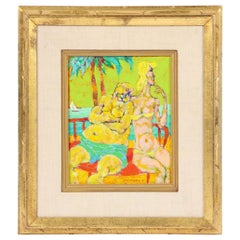
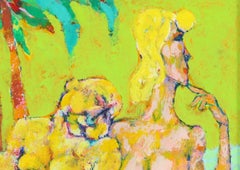
Harry Sternberg Abstract Semi-Nude Oil Painting Of Poolside Couple

Harry Sternberg Abstract Semi-Nude Oil Painting Of Poolside Couple

By Harry Sternberg

Located in LOS ANGELES, CA

Mid Century Modern Harry Sternberg Abstract Semi-Nude Oil Painting Of Poolside Couple. C.1956

Category

1950s American Mid-Century Modern Vintage Harry Sternberg Art

Materials

Masonite

Modernist Rabbi Judaica Painting on Gold Background

Modernist Rabbi Judaica Painting on Gold Background

By Harry Sternberg

Located in Surfside, FL

A contorted Rabbi looking upward is depicted in a naive, and almost child-like manner. Vibrant colors, and gestural brushstrokes fill the composition, enhancing the flatness of the figure. Harry Sternberg, artist, teacher, and political activist was born in New York City's lower east side in 1904. He was the youngest of eight children born to his mother, a hungarian immigrant, and his father, an immigrant from Russia, . His passion for art came early; by age 12 he had begun saturday art classes at the Brooklyn Museum of Art. Sternberg continued to advance his formal art education through 1922, studying at at New York's prestigious Arts Students League alongside Raphael Soyer, Yasuo Kuniyoshi and other notables of the day. His career as a professional artist began in 1928 when he consigned a group of his early prints with the dealer Frederick Keppel in New York. In 1933 he returned to the Art Students League of New York as an instructor, where he taught etching, lithography and composition, continuing to teach there for over 34 years. During the Great Depression he was a WPA artist, and his murals are in post offices in Chicago, Chester and Sellersville, Pennsylvania. Sternberg came to national prominence as a printmaker, painter, and muralist, in the Depression era and during World War II. Sternberg was an acclaimed member of a vital generation of American artists dedicated to exposing social injustices and offering support for an egalitarian society. His interest in the plight of American workers...

Category

20th Century Modern Harry Sternberg Art

Materials

Acrylic, Illustration Board

PRINCIPLE
PRINCIPLE

Harry SternbergPRINCIPLE, C. 1930

Sold

H 10.75 in W 14.75 in

PRINCIPLE

By Harry Sternberg

Located in Santa Monica, CA

HARRY STERNBERG (1904- 2001) PRINCIPLE #2 - Aquatint and etching, Signed, titled and numbered /40 in pencil. Image 10 3/4 x 13 3/4 inches.. Sheet 13 1/8 x 16 3/4 inches. In very go...

Category

1930s Realist Harry Sternberg Art

Materials

Etching, Aquatint

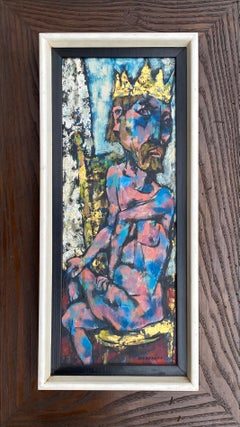
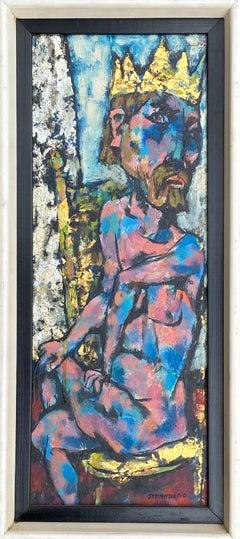
“The King”
“The King”

“The King”

By Harry Sternberg

Located in Southampton, NY

Original 1965 oil on masonite painting of a king on his throne with embellishments of gold and silver leaf by the well known American artist, Harry Sternberg. Signed lower right. Ci...

Category

1960s Post-Modern Harry Sternberg Art

Materials

Gold Leaf

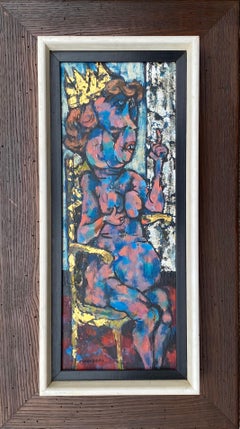
“The Queen”
“The Queen”

“The Queen”

By Harry Sternberg

Located in Southampton, NY

Original 1965 oil on masonite painting of a queen on her throne with embellishments of gold and silver leaf by the well known American artist, Harry Sternberg. Signed lower left. Ci...

Category

1960s Post-Modern Harry Sternberg Art

Materials

Gold Leaf

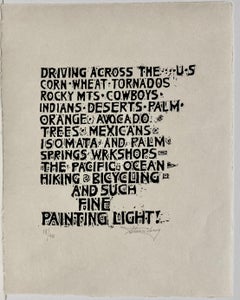
Driving Across the US, from My Life in Woodcuts, 1991

Driving Across the US, from My Life in Woodcuts, 1991

By Harry Sternberg

Located in New York, NY

In 1991 Harry Sternberg published a book with Brighton Press, San Diego. It was My Life in Woodcuts. At the time it was the only known woodcut autobiography. The deluxe editions of...

Category

1990s American Modern Harry Sternberg Art
Materials

Woodcut

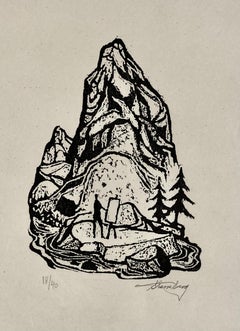
Painting the Mountains, from My Life in Woodcuts, 1991

Painting the Mountains, from My Life in Woodcuts, 1991

By Harry Sternberg

Located in New York, NY

In 1991 Harry Sternberg published a book with Brighton Press, San Diego. It was My Life in Woodcuts. At the time it was the only known woodcut autobiography. The deluxe editions of...

Category

1990s American Modern Harry Sternberg Art
Materials

Woodcut

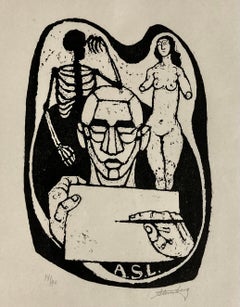
Harry Sternberg, A. S. L (Art Students League) from My Life in Woodcuts, 1991

Harry Sternberg, A. S. L (Art Students League) from My Life in Woodcuts, 1991

By Harry Sternberg

Located in New York, NY

In 1991 Harry Sternberg published a book with Brighton Press, San Diego. It was My Life in Woodcuts. At the time it was the only known woodcut autobiography. The deluxe editions of...

Category

1990s American Modern Harry Sternberg Art
Materials

Woodcut

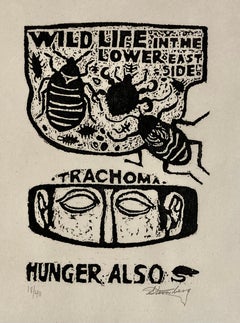
Harry Sternberg, Wildlife in the Lower East Side from My Life in Woodcuts, 1991

Harry Sternberg, Wildlife in the Lower East Side from My Life in Woodcuts, 1991

By Harry Sternberg

Located in New York, NY

In 1991 Harry Sternberg published a book with Brighton Press, San Diego. It was My Life in Woodcuts. At the time it was the only known woodcut autobiography. The deluxe editions of...

Category

1990s American Modern Harry Sternberg Art
Materials

Woodcut

Harry Sternberg art for sale on 1stDibs.
Find a wide variety of authentic Harry Sternberg art available for sale on 1stDibs. You can also browse by medium to find art by Harry Sternberg in lithograph, woodcut print, paint and more. Much of the original work by this artist or collective was created during the 20th century and is mostly associated with the modern style. Not every interior allows for large Harry Sternberg art, so small editions measuring 7 inches across are available. Customers who are interested in this artist might also find the work of Fritz Eichenberg., Lilya Vorobey, and Richard Florsheim. Harry Sternberg art prices can differ depending upon medium, time period and other attributes. On 1stDibs, the price for these items starts at $75 and tops out at $1,800, while the average work can sell for $400.
Artists Similar to Harry Sternberg

Charles Frederick William Mielatz
Donald Shaw MacLaughlan
Alfonso Avanessian
Benton Murdoch Spruance