John Pike Art

American, 1911-1979

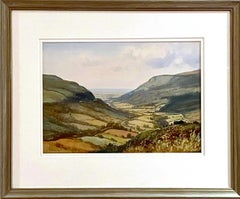
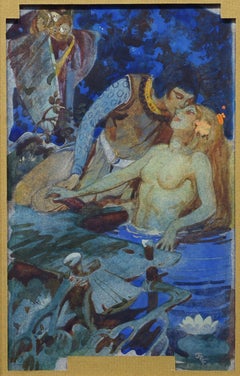
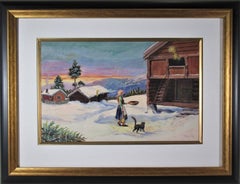
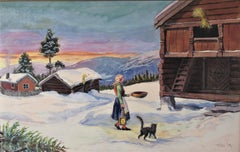
John Pike was born in the USA in 1911. Pike was a nationally-renowned illustrator, watercolor artist and leader in the art world for decades. In his early years, he created advertisements for a rum company in Jamaica, and later painted for the United States Air Force. Pike founded and ran the John Pike Watercolor School for many years, exhibited at the Metropolitan Museum of Art and won many prizes and recognitions for his watercolors.

to
1
Overall Width
to
Overall Height
to
1
1
1
1
1
1
1
1
1
10,159
2,807
2,503
1,398
1
Artist: John Pike
Related Items
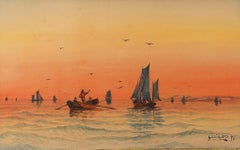
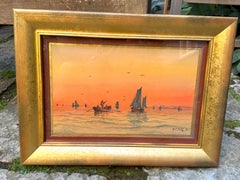
coastal landscape, bohuskusten, c. 1920s

coastal landscape, bohuskusten, c. 1920s

Located in Stockholm, SE

Watercolor on paper signed Axel Hilleström unframed 39.5 x 72 cm (15.6 x 28.3 in) framed 50 x 83 cm (19.7 x 32.7 in) This expansive watercolor depicts a sandy shoreline along the Sw...

Category

1920s Realist John Pike Art

Materials

Paper, Watercolor

"The Small Collar", Trees Inhabited by Human, Paper Drawing with Pigment Colors

"The Small Collar", Trees Inhabited by Human, Paper Drawing with Pigment Colors

By Frank Girard

Located in Clermont-Ferrand, Auvergne-Rhône-Alpes

This drawing by Frank Girard is created with ink and pigments Colors, on 300g/m2 neutral white paper. It is not framed. Through drawings, the masterful French artist Frank Girard is...

Category

2010s Realist John Pike Art

Materials

Paper, Ink, Watercolor, Pigment

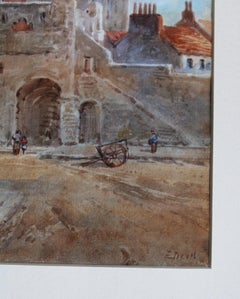
Notre-Dame de Paris. Paper, watercolor, 26.5x18 cm

Edward NevilNotre-Dame de Paris. Paper, watercolor, 26.5x18 cm, unknown

$615Sale Price|71% Off

H 10.44 in W 7.09 in D 0.4 in

Notre-Dame de Paris. Paper, watercolor, 26.5x18 cm

By Edward Nevil

Located in Riga, LV

Edward Nevil ( 1813 – 1901 ) Notre-Dame de Paris. Paper, watercolor, 26.5x18 cm

Category

Mid-19th Century Realist John Pike Art

Materials

Paper, Watercolor

"Great Pine", Tree Inhabited by Human in Nature, Drawing and Pigments on Paper

"Great Pine", Tree Inhabited by Human in Nature, Drawing and Pigments on Paper

By Frank Girard

Located in Clermont-Ferrand, Auvergne-Rhône-Alpes

This drawing by Frank Girard is created with pigments, Chinese ink, watercolors, acrylic, and colored pencils on 300g/m2 neutral white paper. It is not framed. Through drawings, the...

Category

2010s Realist John Pike Art

Materials

Paper, Ink, Acrylic, Watercolor, Color Pencil, Pigment

Red blooming war landscape with dead soldier - Bleeding flowers -

Red blooming war landscape with dead soldier - Bleeding flowers -

Located in Berlin, DE

Johannes Friedrich Heinrich Hänsch (1875-1945), Red blooming war landscape with dead soldier, 1918. Watercolor and gouache on paper, 15 x 24.5 cm (image), 27 x 37 cm (sheet size / frame), monogrammed and dated "19JH18" at lower left. - Paper slightly darkened About the artwork Despite the relatively small format, the watercolor with an internal frame depicts a panoramic view of a flat landscape stretching to the horizon. As far as the eye can see, the poppies bloom in flaming red. The flowers are not rendered individually, however, creating an almost cohesive red surface. The bright red is interspersed with vegetal green. A complementary contrast that creates an intense color effect. In this color contrast, a white area breaks through from the middle ground, widening towards the foreground and surrounding a brown hole. Next to it, in blue, is the actual protagonist of the painting, the first thing that catches the eye: a dead soldier. Next to him is his helmet, revealing the empty interior. The brown, hollow shape corresponds to the hole in the ground. A shell funnel is surrounded by bright ash, which, like the inverted helmet, becomes a sign of death. The soldier's arms point to the funnel, while the empty helmet paraphrases the calotte of the skull and, like the funnel, thematizes the empty darkness of death. The soldier's body, however, is intact and not - as in Otto Dix's triptych "The War" - a dismembered corpse. Instead, Johannes Hänsch activates the landscape, especially the color, to illustrate a blooming landscape of death that extends from the shell funnel in the foreground to the rising column of smoke on the horizon. If the soldier's body is intact, the tangle of barbed wire emblematically placed over the empty helmet also appears tattered. On the right side of the picture, the barbed wire even seems to stretch its arms to the sky in horror. Against the background of this allegory, the content of the bright red also becomes clear: the landscape is drenched in blood, literally a sea of blood, and the single unknown soldier stands pars pro toto for all those who died on the battlefield. Dying in war is not dying in community, but in solitude. In order to emphasize the isolation in death, Johannes Hänsch has set the blue of the soldier in the axis given by his body in the middle ground of the picture into the red sea. A master of landscape painting, Hänsch succeeds in creating a natural-looking landscape allegory that illustrates the horror and death of war, without depicting the brutality of war itself. This singular 'war memorial' of the unknown soldier is the opposite of heroization and yet the dignity of the deceased soldier is preserved through the integrity of his body. About the artist As the son of the sculptor Adolf Haensch, the young Johannes received his first artistic training in his father's Berlin studio. However, he eventually decided to become a painter, and in 1897 he entered the Berlin Academy of Arts. He initially studied under Paul Vorgang and Eugen Bracht, and was particularly influenced by Bracht's increasingly colourful landscape painting. In 1901 he moved to the class of Friedrich Kallmorgen, with whom he spent several weeks on excursions into nature. In 1905 he became a master pupil of Albert Hertel, who taught him watercolour painting. From 1903 to 1933 he exhibited annually at the Great Berlin Art Exhibition, the exhibitions of the Berlin Artists' Association and the Munich Glaspalast. In 1905 he was awarded the Carl Blechen...

Category

1910s Realist John Pike Art

Materials

Watercolor

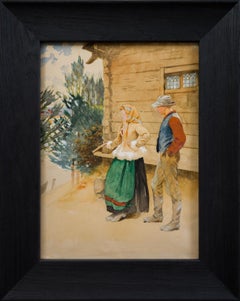
Quiet Contemplation: Rural Serenity in Hagborg's Watercolor

Quiet Contemplation: Rural Serenity in Hagborg's Watercolor

By August Hagborg

Located in Stockholm, SE

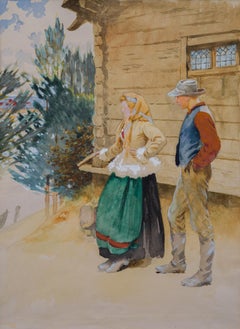
The artwork we present is a rare watercolor by the distinguished Swedish artist August Hagborg, painted in the later part of his career between 1910 and 1920. This watercolour is a departure from Hagborg's often-seen beach scenes with mussel pickers and instead offers a glimpse into a serene, pastoral moment. The scene is set against a timber house, with a man and a woman standing alongside, their gazes directed away from the viewer, which invites contemplation about the story behind their distant stares. Watercolors by Hagborg are rare, making this piece particularly special. Its fine details suggest a mastery of the medium, likely honed over the years of his extensive career. A written letter from Göteborgs Konstmuseum, dated to the 1940s, suggests a later date for this piece. August Hagborg, born on May 26, 1852, in Gothenburg and passed away on April 30, 1921, in Paris, was a renowned figure in the art world. His education at the Royal Swedish Academy of Arts in Stockholm from 1871 to 1874 placed him among peers who would rise to prominence, such as Carl Larsson and Anders Zorn. Moving to Paris in the fall of 1875, Hagborg initially painted within the costume genre before finding his niche in coastal landscapes that garnered him accolades and recognition. Hagborg's success was punctuated by his 1879 painting...

Category

1910s Realist John Pike Art
Materials

Watercolor

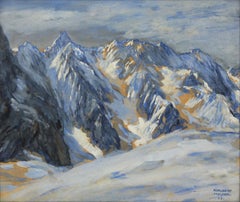
Wettersteinkamm - The blue of the mountains -

Wettersteinkamm - The blue of the mountains -

Located in Berlin, DE

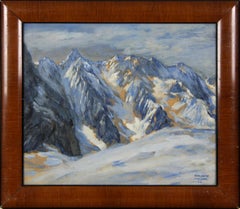
Adalbert Holzer (1881 Munich - 1966 Munich). Wettersteinkamm. Watercolour, 29 x 34.5 cm (visible size), 37.5 x 43 cm (frame), signed and dated at lower right 'ADALBERT HOLZER [19]23'. Framed behind glass. Frame shows signs of wear. - The blue of the mountains - About the artwork The Wetterstein ridge is revealed to the viewer from a gentle, snow-covered hill. In contrast to conventional depictions of mountains, the painting is composed entirely of shades of blue, which condense into the blue-grey of the rock or fade into the white of the snow. As a complementary colour to the blue, Holzer virtuously activates the ochre ground. The uniform yet exciting polarity of the colours emphasises the massive majesty of the mountains and at the same time underlines the special character of the Wetterstein ridge. Holzer transferred the translucency of glass painting, in which he was originally trained, to watercolour and developed a pictorial language related to the art of Ferdinand Hodler, which earned him the nickname 'Master of Blue' and led to the appreciation of his watercolours in particular. About the artist After an apprenticeship as a stained glass painter at the Kunstgewerbeschule, Adalbert Holzer studied at the Munich Art Academy under Carl von Marr...

Category

1920s Realist John Pike Art

Materials

Watercolor

"The Cold Wind in the Pine Trees",  Pigments Watercolor Acrylic Paper Drawing

"The Cold Wind in the Pine Trees", Pigments Watercolor Acrylic Paper Drawing

By Frank Girard

Located in Clermont-Ferrand, Auvergne-Rhône-Alpes

Titled "The cold wind in the pine trees", this artwork created by Frank Girard, utilizes pigments, Chinese ink, watercolors, acrylics, and colored pencils on 400g/m2 neutral white pa...

Category

2010s Realist John Pike Art
Materials

Paper, Ink, Acrylic, Watercolor, Color Pencil, Pigment

Previously Available Items
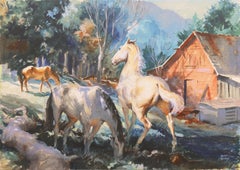
'Horses at Pasture', Salmagundi Club, Metropolitan Museum, AIC, PPFA, AWCS, NA

'Horses at Pasture', Salmagundi Club, Metropolitan Museum, AIC, PPFA, AWCS, NA

By John Pike

Located in Santa Cruz, CA

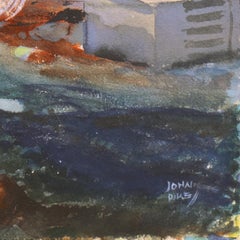
Signed lower right, 'John Pike' (American, 1911-1979) and painted circa 1955. A large and painterly study of three horses shown grazing and frolicking beside an old red barn with a ...

Category

1950s Impressionist John Pike Art
Materials

Watercolor, Gouache, Laid Paper

John Pike art for sale on 1stDibs.

Find a wide variety of authentic John Pike art available for sale on 1stDibs. You can also browse by medium to find art by John Pike in paint, watercolor and more. Not every interior allows for large John Pike art, so small editions measuring 28 inches across are available. Customers who are interested in this artist might also find the work of George Tzannes, Tom Perkinson, and Michael DeFrancesco. John Pike art prices can differ depending upon medium, time period and other attributes. On 1stDibs, the price for these items starts at $4,500 and tops out at $4,500, while the average work can sell for $4,500.

Artists Similar to John Pike