By John Rattenbury Skeaping
Located in Stoke, Hampshire
John Rattenbury Skeaping (1901-1980)
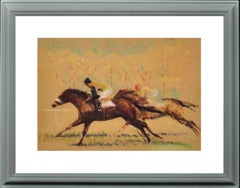
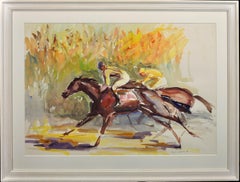
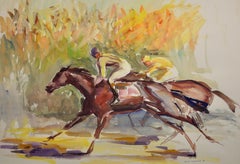
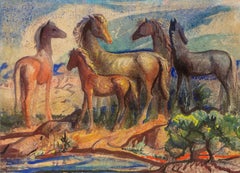
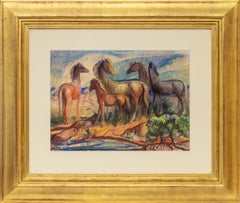
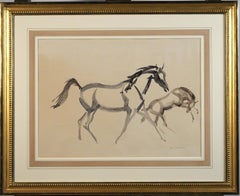
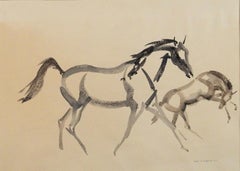
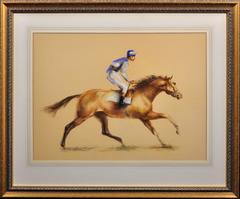
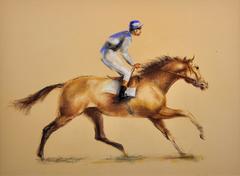
Mare and Foal
Singed and dated '62
watercolour and pencil
Drawing - 14 x 19 1/2 in
Framed size - 23 x 28 1/2 in
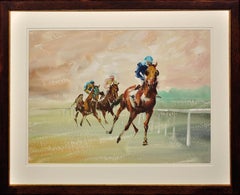
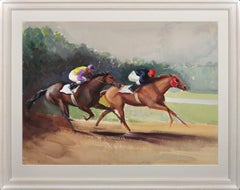
John Skeaping is regarded as the leading equine sculptor of the twentieth century. He also became a highly regarded racehorse painter in his middle age. He was born in South Woodford, Essex, England on 9 June 1901. His father was a portrait painter who shared a studio with Cézanne and his mother was a musician. Several other members of his family were also very artistic. He had an unconventional childhood as one of four children, none of whom were sent to school. His father believed in a basic training in the arts and they were therefore taken to exhibitions, concerts, theatre and ballet. For young John, the tandem themes of horses and art emerged and remained with him for the rest of his life. Aged 13 John Skeaping was already showing an early aptitude, and enrolled at Blackheath School of Art. Then aged 14 he went to Goldsmiths College in the Sculpture School. From there he went to the Central School of Arts & Crafts and then the Royal Academy Schools, where he won the Royal Academy Gold Medal and travelling scholarship. He then taught in Newcastle. In 1924 he won the Prix de Rome and went to Rome on a three year scholarship. Barbara Hepworth won the second prise and they met in Rome and married in Florence in 1925. They returned to London in 1926 and worked together for a while. Indeed, they put on a joint exhibition in Glasgow and London in 1928 that established them in the forefront of British Sculpture. However, the couple drifted apart artistically and personally and separated in 1931, divorcing two years later. Skeaping continued modelling and carving, and created several animal pieces for Wedgwood in 1928 of a Sea Lion, Kangaroo, Duiker, Polar Bear, Bison, Tiger, Deer and Antelope groups that are quite stylized and reflect the Art Deco influence of the era. He also did stone carvings of animals during this time. During the 1930s, Skeaping spent as much time as possible in the countryside with his second wife, whom he married in 1934. They were lent a cottage in Dartmoor, where they stayed for a summer and started to train and race greyhounds. At the beginning of the Second World War Skeaping served in the Royal Intelligence Corps as an official war artist in Europe before transferring to the SAS in North Africa. However, he began to suffer from nervous stomach trouble and was invalided out just before the end of the war. On his return to civilian life he became disillusioned with London, so went to Devon to live. After a short while though he returned to London and spent a period teaching at the Royal College of Art. He then went to Mexico for a year and a half, living amongst the Native Americans and learning how to make their traditional pottery. In 1950 he returned to England and became Professor of Sculpture at the Royal College of Art. He remained there until his retirement in 1959 when he moved to the Camargue in France, partly for health reasons. There he studied the wild horses of the Carmargue, and lived for twenty years with his third wife. Skeaping first exhibited at the Royal Academy in 1922; he was elected an Associate there in 1951 and Academician in 1959. During the late 1940s and into the 1950s, Skeaping was associated with the famous Ackermann firm who offered sporting and racing art. He produced many paintings and drawings of horses...
Category
20th Century Modern John Rattenbury Skeaping Art