By John Rogers Herbert
Located in London, GB
John Rogers Herbert TA, HRI (1810-1890)
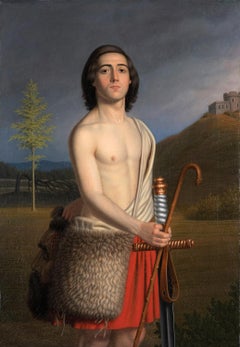
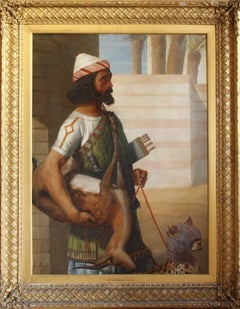
The Hunting Cheetah
Signed, inscribed and dated ‘J.R. Herbert R.A./Paris 1853’ (lower left)
Oil on canvas
37 ¼ x 28 inches, 47 1/4 x 38 inches inc. frame
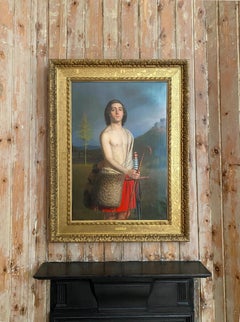
In the original frame
Provenance
Thomas Agndew & Sons
Sir Edward Bates, Gyrn Castle, North Wales
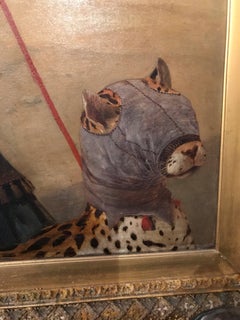
This striking portrait shows a Babylonian nobleman returning from a hunting expedition with his cheetah and its catch - a gazelle - which, from its distinctly curved horns and dark body stripe, can be identified as a Thomson’s Gazelle. The painting is important in a historical context as it dates from the time when archaeological findings, and their dissemination around the Western world, ensured that public fascination with Mesopotamia reached its height.
Herbert was a painter of portraits, historical genre and landscapes. His early work showed a preponderance of subjects derived from Italian history, following his visit to that country in
1836. These early compositions tend to be characterised by high drama and contraposto figurative groups, such as Pirates of Istria carrying off the Brides of Venice (1839). However during the 1830s he made contact with the Nazarenes, a German group of painters who cultivated a sharp-edged, flat style. Herbert’s aesthetic became more Nazarence in tendency (with its juxtaposition of decorative surfaces, The Hunting Cheetah, dated 1853, demonstrates the longevity of their influence). 1840 proved a seminal year for Herbert personally as he converted to Catholicism, much as a result of his friendship with the architect and man of letters Augustus Welby Pugin (1810-1852). It was Pugin who created the magnificent frame in which The Hunting Cheetah is presented. In the ensuring decades Herbert concentrated on religious subjects and submitted Pope Gregory Teaching the Boys to Sing (1846) as his Royal Academy diploma work. The same year he was one of the selection of artists chosen to decorate the interior of the New Palace of Westminster, and his contributions included nine Old Testament scenes...
Category
Mid-19th Century Old Masters John Rogers Herbert Art