By John Steven Dews
Located in New Orleans, LA
John Steven Dews
b.1949 British
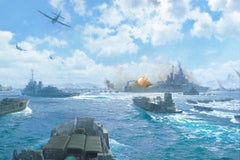
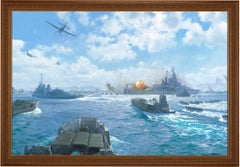
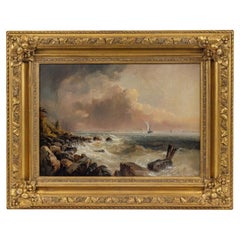
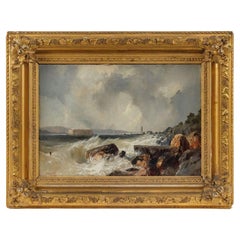
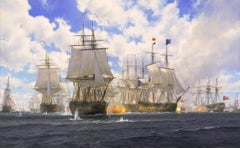
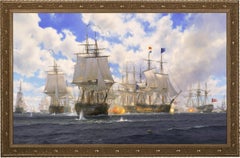
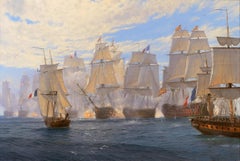
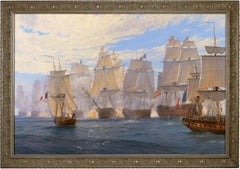
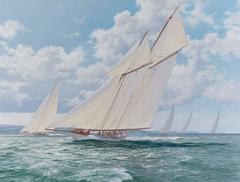
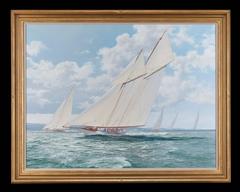
The Bombardment of Copenhagen
Signed "J Steven Dews" (lower left)
Oil on canvas
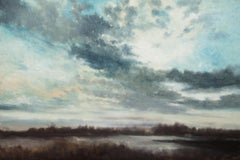
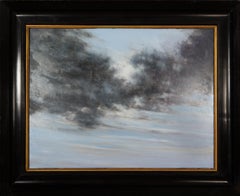
This masterpiece by John Dues, entitled The Bombardment of Copenhagen, stands as a testament to the artist's mastery of maritime art and immortalizes one of the most legendary naval battles in history. Dews' brushstrokes depict the famed British and Danish ships lined side by side and capture Lord Horatio Nelson's famous “leapfrog” strategy as his British ships successfully overpowered Copenhagen's powerful fortification. The artist’s virtuosic ability to capture wind, waves and the expansive sky creates an elevated depiction of this battle, unmatched by any previous renderings. It stands alone in works by this master and is considered perhaps the greatest painting of the famed sea battle.
During the late 18th and early 19th centuries, a period of intense geopolitical tension between France and Britain unfolded in Europe. The War of the Second Coalition (1798–1802) marked a struggle for supremacy between these two global powers. In response to Britain's blockade on France aimed at crippling its economy, Sweden, Prussia, Denmark and Russia formed the League of Armed Neutrality to ensure free trade with France. Unsurprisingly, this challenged Britain's interests. To disrupt the League, Britain dispatched a formidable fleet under Admiral Sir Hyde Parker and Vice-Admiral Horatio Nelson, and on March 30, 1801, the brilliant pair of admirals, along with 20 ships and their supports, arrived in Copenhagen.
Nelson, ever the tactician, suggested a southern approach to bypass the Middle Ground, a shoal east of the city too shallow for large ships. Admiral Parker agreed, and Nelson moved his ships southeast under the cover of darkness. Simultaneously, Parker's ships paraded in the north to distract the Danes. On the morning of April 2, Nelson initiated the attack. Despite early setbacks, including three ships running aground, the British fleet executed Nelson's "leapfrogging" strategy brilliantly. Admiral Parker, misjudging the situation due to obstructed visibility, signaled for a retreat. Nelson famously held his telescope to his blind eye, stating he could not see the signal, and continued until victory was achieved. The saying "Turning a blind eye” comes from this famed moment.
Eventually, the British gained the upper hand, capturing several Danish ships. Nelson then sent a message to the Danish Crown, threatening to burn the captured vessels unless a ceasefire was agreed upon. The Danes complied, and a peace treaty followed, effectively dissolving the League of Armed Neutrality. The Battle of Copenhagen...
Category
21st Century and Contemporary Academic John Steven Dews Art