John Trumbull Furniture
to
1
1
1
1
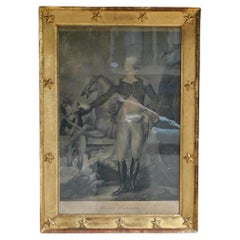
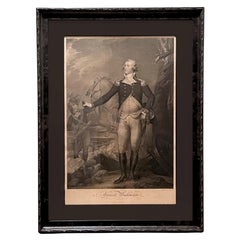
American Steel Engraving of George Washington in Orig. Gilt Starred Frame C 1800
By John Trumbull
Located in Charleston, SC
American Steel Engraving of General George Washington "Before the Battle of Trenton" By John Trumbull Under Original Wavy Glass and Thirteen Starred Gilt Frame, Early 19th Century. T...
Category
Early 1800s American American Colonial Antique John Trumbull Furniture
Materials
Steel
Related Items
French Engraving of Italian Landscape View, Gold Gilt Frame
Located in Barcelona, ES
Engraving printed in black on laid paper framed with a neoclassical style gold leaf frame. The engraving shows a beautiful view from the Aqueduct of Corigliano, Calabria.
Marks with ...
Category
19th Century French Neoclassical Antique John Trumbull Furniture
Materials
Gold Leaf


$847 Sale Price
20% Off
H 12.6 in W 15.75 in D 0.99 in
French Engraving, "Le Premier Pas a la Fortune" in Gilded Frame
Located in Pembroke, MA
French engraving in a 19th century entitled "Le Premier Pas A La Fortune" on hand-laid paper with a decorative giltwood frame. A charming double-entendre scene of seduction. Du Bois ...
Category
19th Century French Louis XV Antique John Trumbull Furniture
Materials
Giltwood, Paper

Male Portrait, Pastel In Its Frame, Circa 1800
Located in Honnelles, WHT
Male Portrait, Pastel In Its Frame, Around 1800
Category
Early 19th Century French Empire Antique John Trumbull Furniture
Materials
Canvas

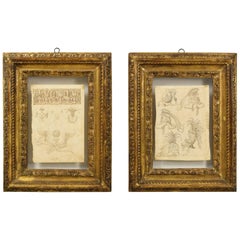
17th Century, Pair of Italian Ink Drawings on Paper with Studies for Grotesques
Located in IT
17th century, pair of ink drawings on paper with studies for grotesques, friezes and helmets.
Painter of central Italy of the 17th century, signed with monogram “A.M.”.
Measurements: cm L 45.5 x H 59.5 x 5.5; cm 22 x 33 / cm L 46.5 x H 59 x 5.5; cm 22.5 x 31.5
The pair of sheets, in good condition, is framed by antique frames in carved and gilded wood. They show some china studies with some studies for different subjects. Specifically, the first sheet represents the design of a frieze of Renaissance taste under which are some studies probably referring to a family coat of arms. Below the center is a monogram “A.M.”.
The sheet is also worked on the back in which are drawn some articulated elements of decoration in the style of the Renaissance grotesque...
Category
17th Century Italian Baroque Antique John Trumbull Furniture
Materials
Paper
$10,113
H 23.63 in W 18.51 in D 2.37 in
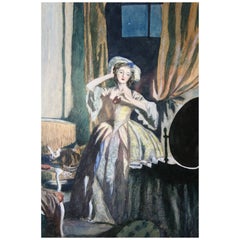
French painting « the Masquerade » , 19th Century - Louis XV style
Located in Beuzevillette, FR
Beautiful painting representing a woman of the XVIIIth century. The scene is set in a typical interior of the period, recognisable by the furniture, armchair and bench in the Louis X...
Category
19th Century French Antique John Trumbull Furniture
Materials
Paper
$171 Sale Price
20% Off
H 14.18 in W 11.82 in D 0.4 in
18th Century Framed Fashion Engraving
Located in Vista, CA
18th century framed fashion engraving of a woman with a plume feather hat with fan and a walking stick.
Category
18th Century French Antique John Trumbull Furniture
Materials
Glass, Paper, Wood

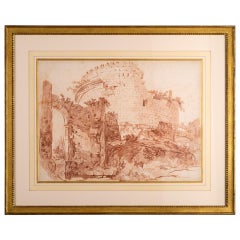
Large 18th Century Red Chalk Drawing of Ruins after Hubert Robert
By Hubert Robert
Located in Kittery Point, ME
The Tomb of Caecilia Metella, Rome.
Red chalk on paper.
Provenance: H. Shickman Gallery, New York (D1311). Label verso where given to Hubert Robert.
This sumptuous drawing is a ...
Category
1760s French Neoclassical Antique John Trumbull Furniture
Materials
Paper
Brown Pelican Lithograph, Signed
By Richard Sloan
Located in Dallas, TX
Richard Sloan "Brown Pelican" lithograph, hand-signed, copyright 1972 (American, 1935-2007)
Category
20th Century John Trumbull Furniture

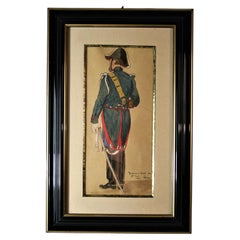
" Gendarme On Horseback " After Lalaisse Hand-Painted Watercolor 20th Century
Located in Beuzevillette, FR
Anonymous watercolor and drawing "Gendarme on horseback" after the work of the painter Lalaisse which is part of the collection of watercolor...
Category
Early 20th Century French John Trumbull Furniture
Materials
Paper
$171 Sale Price
20% Off
H 11.82 in W 5.52 in D 0.79 in
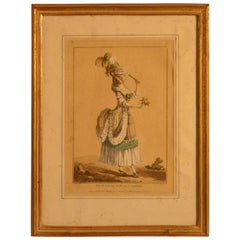
18th Century Framed Fashion Engraving
Located in Vista, CA
18th century framed fashion engraving of a woman dressed for entertaining or to be entertained, with a plume feather hat, a fancy bustle with gree...
Category
18th Century European Antique John Trumbull Furniture
Materials
Glass, Paper, Wood
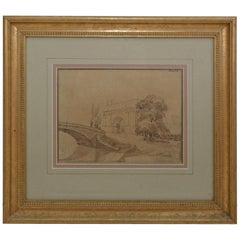
Antique Italian Landscape Drawing in Gilt Frame
Located in Sheffield, MA
The antique Italian drawing in pen-and-ink and wash pictures a landscape of a stone bridge, archway, trees and people in the Renaissance style. The drawing is set within a two-tone d...
Category
19th Century Italian Renaissance Antique John Trumbull Furniture
Materials
Wood, Paper
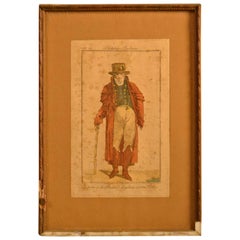
18th Century, Framed Fashion Engraving
Located in Vista, CA
18th Century framed fashion engraving. Gilding on frame is damaged (see picture).
Category
18th Century and Earlier French Antique John Trumbull Furniture
Materials
Giltwood, Glass
Previously Available Items
"General Washington" by Thomas Cheesman, after John Trumbull, 1796
By John Trumbull, Thomas Cheesman
Located in Colorado Springs, CO
Presented is a stipple engraving depicting General George Washington on the night of January 2nd, 1777, just after the Battle of the Assunpink Creek and before the decisive Battle of Princeton. The print was engraved by Thomas Cheesman, after the heroic 1792 painting by John Trumbull, "General Washington at Trenton." The engraving was published by Antonio Cesare Poggi in London, in 1796.
In the composition, Washington stands in front of the battlefield. In his left hand is his sword, and in his right hand is a spyglass. Just behind him, a soldier tends to his white horse Blueskin, while in the background soldiers wave a flag along the icy banks of New Jersey. Also depicted is the bridge over the Assunpink Creek and nearby mill, artillery, and campfires. This is a powerful lifetime portrait of our first President as the courageous and valiant Revolutionary War General.
In 1792, the city of Charleston...
Category
1790s English American Colonial Antique John Trumbull Furniture
Materials
Paper
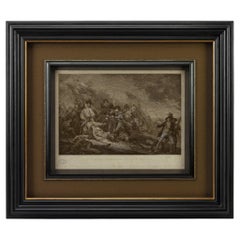
"The Battle of Bunker's Hill, Near Boston" Engraving by James Mitan, 1801
By John Trumbull
Located in Colorado Springs, CO
This dramatic Revolutionary War engraving of the Battle of Bunker Hill is after the famous 1785 oil-on-canvas by John Trumbull. Capturing the intensity of the battle, the engraving centers on Major John Small restraining a “lobster-back” from bayoneting Major General Joseph Warren. Warren lies mortally wounded in the midst of chaos around him. In the background, British forces are seen cresting the last defenses of the brave, yet green army of Colonial soldiers.
The Battle of Bunker Hill was fought on June 17, 1775, in the early stages of the American Revolutionary War. The battle is named after Bunker Hill in Charlestown, Massachusetts. Although it was the original objective of both the Colonial and British troops, the area was only peripherally involved in the battle. Rather, the majority of the combat took place on the adjacent Breed’s Hill. The battle pitted a more organized British force against a young and inexperienced American militia.
Although considered a tactical victory for the British, it came at the cost of considerable casualties, including a large number of officers. The battle demonstrated that the inexperienced American militia was able to stand up to the British army troops in battle. The battle results discouraged the British from any further frontal attacks against well-defended front lines. American casualties were comparatively fewer, although their losses included Gen. Joseph Warren.
During the battle, the patriot-turned-painter John Trumbull (1756-1843) was stationed in Roxbury on the far side of Boston, where he could hear the sounds of fighting. In late 1785, Trumbull decided to devote himself to the depiction of Revolutionary War scenes, a series of eight epic pictures. From the beginning, Trumbull intended for the paintings to be later engraved for sale. Trumbull began the oil-on-canvas of The Death of General Warren at the Battle of Bunker’s Hill and The Death of General Montgomery in the Attack of Quebec, in the studio of Benjamin West in London. Bunker’s Hill was completed in March 1786; Trumbull started Attack of Quebec in February 1785 and finished it before he brought it to Paris in 1786. He then started The Declaration of Independence at Thomas Jefferson's house in Paris.
As soon as Bunker’s Hill was completed, Trumbull searched for a suitable engraver in London. He was unsuccessful, as many British engravers were nervous about engraving an American battle...
Category
Early 1800s English Federal Antique John Trumbull Furniture
Materials
Paper
H 31.63 in W 36.25 in D 2.75 in
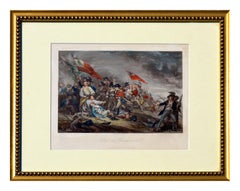
Battle at Bunker Hill - Hand Colored Engraving
By John Trumbull
Located in Soquel, CA
Hand-colored steel engraving of British and American soldiers in hand-to-hand combat during the Battle of Bunker Hill by John Trumbull (American, 1789-1843...
Category
1850s American Realist John Trumbull Furniture
Materials
Paper, Ink, Watercolor
John Trumbull furniture for sale on 1stDibs.
John Trumbull furniture are available for sale on 1stDibs. These distinctive items are frequently made of wood and are designed with extraordinary care. If you’re looking for additional options, many customers also consider furniture by John James Audubon, Wallace Nutting, and Dong Kingman. Prices for John Trumbull furniture can differ depending upon size, time period and other attributes — on 1stDibs, these items begin at $7,500 and can go as high as $45,000, while a piece like these, on average, fetch $26,250.