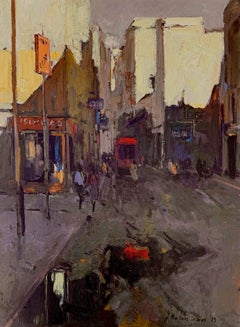
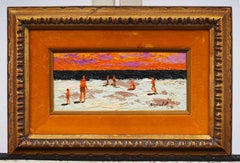
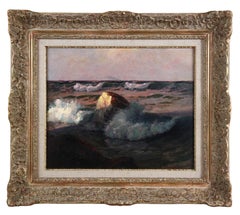
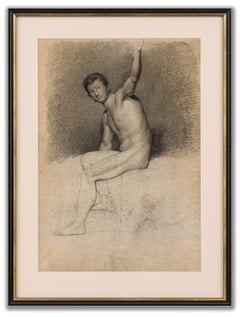
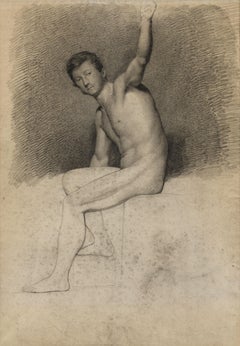
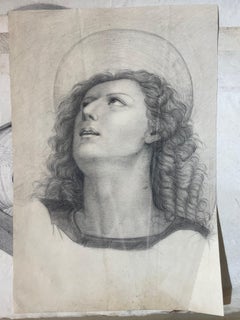
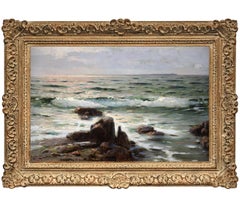
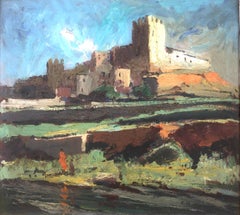
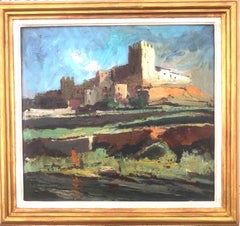
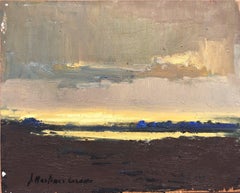
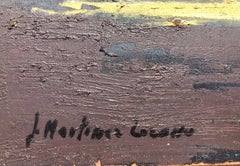
By Josep Martinez Lozano
Located in Sitges, Barcelona
Unframed
Josep Martínez Lozano was born in the Born district of Barcelona on March 29, 1923.
During his childhood he does not feel any kind of special inclination towards plastic arts or painting. It is not until his youth that he begins to paint and his vocation is forged definitively. Like so many artists of bohemian and random biography, he must fight with family opposition to his strong will to devote himself to body and soul painting. He tells it like this: "I said to my father: I want to be a painter. He replied: Well, get out of my house. And I did it." Since then, he will always place the painting above anything else in his life.
The first artistic studies are carried out at the Escola d'Arts i Oficis del Clot, in Barcelona (1937). There he receives the first and most basic notions of drawing by Sabadellense professor Doménech Soler. Later, he becomes a disciple of Ramón Sanvicens and Joaquim Terruella.
He is serving military service in Figueres shortly after the end of World War II, when the country is going through a difficult postwar period.
His first individual exhibition takes place in Figueres, in Can Fortunet, in 1946. Before the praise that his painting awakens, he acts prudently, knowing the dangers of being carried away by a fame that is new to him.
During his stay in Figueres, he gets in touch with different personalities of the cultural and artistic life of the Empordà capital, and it is at this moment that he begins his special relationship with Empordà and specifically with Llançà. Among his friends of that time are the watercolorist Ramon Reig, the journalist Manuel Brunet and Josep M. Fortunet.
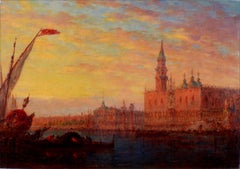
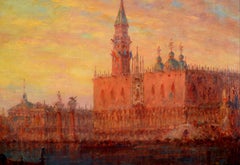
In 1951 he obtained a scholarship from the Diputación de Girona that took him to Venice. There he will make friends with the eight-center painter Giuseppe Quirubini, and the aesthetic emotions of the city and its canals will enrich his palette. The same year, he performed individually in Barcelona for the first time, in the Sala Gaspar, with a selection of his Venetian work. Also in 1951 he made the first exhibition in Madrid, and then established workshops in Montblanc, Tarragona and Llançà.
In Llançà he founded the Escola d'Arts i Oficis, as he had already done in Campo de Criptana in La Mancha. His relationship with Llançà is so intense since that time, that in 1988 he established there the foundation that bears his name and a museum of Watercolor, endowed with his works and other painters.
In 1963, Martínez Lozano participates in the Biennial of Painting, Premi Ciutat de Terrassa. He is still a stranger in the city, and his painting is relegated to a secondary room. The painting presented is a marina of bright and intense colors that does not get any awards. In spite of that, it does arouse the interest of collectors and painters from Tarragona.
His relationship with Terrassa begins that same year, precisely at the same time that the city begins its period of excessive growth and faces a great wave of immigration that will transform it decisively in a few years. Paradoxically, it is in this industrial city then surrounded by suburbs, where you will find an artistic atmosphere and sensitivity, as well as a nucleus of friends, who will seduce you. For all that, in 1965 he settled in Terrassa with his family permanently.
From that moment he alternated his residence in Terrassa and Llançà (he used to spend half a week indoors, and the other half by the sea), with his trips to France, Belgium, Romania, Portugal, Great Britain, Italy, Malaysia , Guatemala ... Martínez Lozano is an inveterately traveling painter.
His first study of Terrassa is in Sant Llorenç street, relatively close to the headquarters of the Amics de les Arts, an entity in which it will be integrated very early and that constitutes the nerve center of the Tarragona cultural life. Later, he moved to a larger studio, in the street that at that time bore the name of Martinez Anido. And finally, when he needs to turn the workshop into the family home, he finally settles in Teatre Street where, until recently, he still had the studio (where he used to work normally at night)
Since then, his relationship with the city has become increasingly closer. He makes an exhibition for the benefit of the Hospital de Sant Llàtzer, and shortly thereafter, together with Josep Boix, he publishes a book on the streets of Terrassa. The money obtained goes to the same hospital.
In May of 1969 he began his famous trip from La Mancha to Terrassa, with the donkey "Sandalio", which will become a small myth in the artistic life of Tarragona. In 1971 he was awarded the "Quixot" prize by the local press, which distinguishes his quixotic personal and artistic career. In 1972 he was awarded the "Terrassenc de l'any" award, in recognition of his civic career.
In 1975 he made a representative donation of his pictorial work to the city. Thus, the Martínez Lozano Room opens at the Alegre de Sagrera House-Museum. In 1989 he made a second donation of artistic work to the city of Terrassa.
The same year 1989 is created in Llançà, the Martínez Lozano Watercolor-Foundation Museum, which is initially nourished by a donation by the painter of more than 100 works from different European watercolorists. At that time, it becomes the only museum in Europe intended exclusively for watercolor. In 1991, Pepe decided to organize and found the National Watercolor Symposiums that have been held throughout the Spanish state (Córdoba, Montblanc, Bilbao, Jaca ...).
In 2001, he made a second donation of 36 works to the Watercolor Museum, on the occasion of his new location in the facilities of the House of Culture of Llançà.
In 2004, the Royal Academy of Fine Arts of Sant Jordi named him academic for Llançà. During these years, life continues to alternate between the populations of Llançà, Montblanc and Terrassa. It is in this last city where, in 2003, he must leave the study of Teatre street number...
Category
1970s Impressionist Josep Martinez Lozano Art