Located in Riva del Garda, IT
Carlo Ceresa (San Giovanni Bianco 1609 - Bergamo 1679) attributable
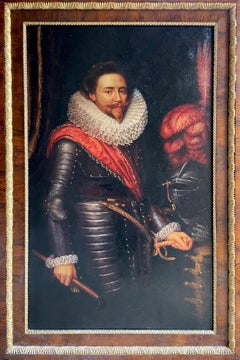
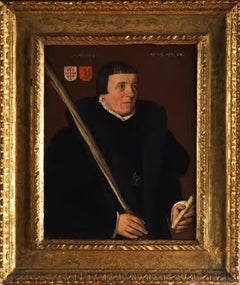
Full-length portrait of Giacomo Pesenti
Oil on canvas (206 x 121 cm - in frame 212 x 133 cm.)
This fascinating portrait, portraying a full-length gentleman and datable to the 17th century, illustrates the stylistic and compositional details typical of the pictorial production of the Lombardy area, Bergamo in particular. This reference is reflected in elements such as the natural light, the sober and austere setting and, above all, the subtle psychological characterisation of the face.
We are inclined to identify the hand of portrait painter Carlo Ceresa, one of the most illustrious Bergamasque figure painters of the 17th century, capable of developing a style of intense realism and acute psychological investigation. In his works, and our portrait perfectly reflects his canons, an extraordinary naturalistic imprint, great realism and remarkable essentiality are evident.
Those traits of severity, moral rigour and austerity typical of his portraiture find a perfect balance here: never courtly or rhetorical, his portraits are profoundly linked to the concept of counter-reform. Immortalising the main personalities of the time, he established himself as a point of reference for the Bergamasque aristocracy, from the Vertova to the Pesenti to the Secco Suardo.
The subject of the portrait is Giacomo Pesenti, here immortalised life-size in a rigorous black suit, his left hand resting on a table, on which is placed the necessities for writing and a manuscript, and his right hand, with a sealed ring on his little finger, abandoned along his side while he holds his gloves.
He wears a suit of incredible rigour, dressed as befits a man of his high social standing, while the sharp light focuses on his face, with an intensity that seems to be accentuated by the reflection of the white collar, with its sharp profile.
For Ceresa, it is not the richness of the garment that gives value to the person portrayed, it is the need to give feeling and bring out the character of the person, and this he succeeds in marvellously, aided by his ability to capture the essence of the person and return it to us in painting through the face and light used as a strong expressive element.
In fact, the image highlights that 'counter-reformed' composure typical of the portraiture of painters active in this area and era, adhering to a verism...
Category
17th Century Old Masters Joseph Highmore Art