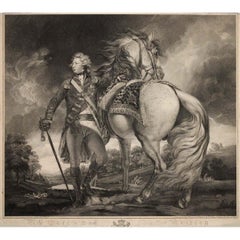
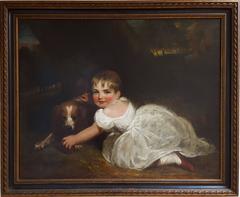
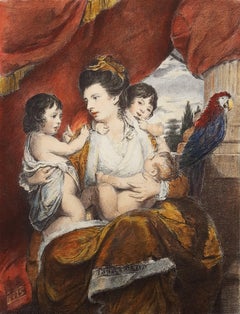
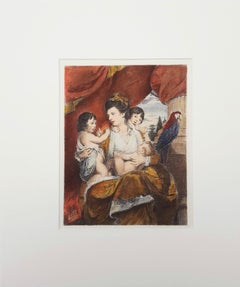
Miss Emma Lane, Attributed to J. Reynolds
By Joshua Reynolds
Located in Saint Augustine, FL
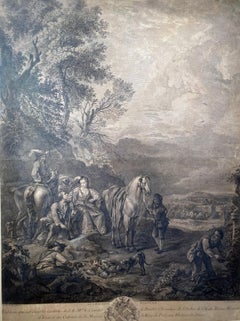
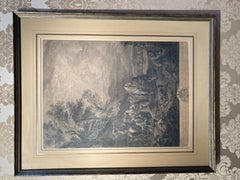
An original oil on canvas attributed to / studio of English artist Joshua Reynolds (1723-1792) titled "Miss Emma Lane", c. 1775. No signature found however label on verso reads "Miss Emma Lane - Portrait of Miss Emma Lane ... (illegible) ... by J. W. Reynolds". (See picture). Provenance: Lillian Goldsmith, River House Antiques, Pittsburgh, PA. Canvas has been relined, heavy in painting throughout, accretions and some craquelure. Minor scuffs and losses to antique frame. Framed size: 34.5" x 41.5". Canvas size: 29" x 36.5". In very good condition.
Joshua Reynolds was born on July 16, 1723, at Plympton, Devon, the third son and seventh child of the Reverend Samuel Reynolds, master of the Plympton Grammar School and sometime fellow of Balliol College, Oxford. Joshua was enabled by education, ability, and inclination to move all his adult life with ease and distinction in literary and learned circles. A vocation for art was confirmed by reading as a boy Jonathan Richardson's Essay on the Theory of Painting (1715), with its program for restoring portraiture to the dignity of high art, and at the age of 17 Joshua was apprenticed to Richardson's son-in-law, Thomas Hudson, in London.
Reynolds set up on his own in 1743 and practiced in Plympton and London. His work of this period shows the influence of Anthony Van Dyck and the innovations introduced by William Hogarth, then at the height of his powers.
In 1749 Reynolds sailed for Italy as the guest of Commodore Augustus Keppel. In Rome, Reynolds studied the Old Masters with a single-mindedness unmatched by any earlier English painter. His only diversion was a small number of caricature paintings in the manner of his fellow Devonian Thomas Patch. Raphael was Reynolds's hero, but on his way back to England he visited northern Italy and came under the spell of the Venetian painters and Correggio.
Reynolds settled in London in 1753 and established his reputation as the foremost portrait painter with Captain the Hon. Augustus Keppel (1753-1754), the first of a long series of portraits ennobled by a borrowed pose, here taken from the Apollo Belvedere. He used borrowed attitudes in two ways: as a mode of elevation and as a species of wit. As Horace Walpole noted, both usages are controlled by intellect and taste, manifested in the aptness of his application to the sitter's character, achievement, or role in society.
After his election as foundation president of the Royal Academy in 1768 until his death in London on Feb. 23, 1792, Reynolds's life was too closely intertwined with the artistic, literary, and social history of his time for a summary to be adequate. A small group of portraits of men of genius with whom he was intimate, headed by Dr. Johnson, is unique in European art in that each is accompanied by a written character sketch which is a masterpiece of psychological assessment.
Reynolds delivered 15 discourses to the members and students of the Royal Academy between 1769 and 1790. They upheld the ideal theory in art and constituted the classic formulation of academic doctrine after more than 2 centuries of debate.
Reynolds's main types of portraiture commemorate naval and military heroes, civil and ecclesiastical dignitaries, the English landowning oligarchy in both its public and private aspects, actors and actresses, and children in fanciful roles, related in their vein of sentiment to "fancy pictures" like the Age of Innocence (1788). His most ambitious translation of a subject picture into a portrait is the group of the daughters of Sir William Montgomery, the Graces Adorning a Term of Hymen (1774), a Miltonian bridal masque in which the rite of worship to the God of Wedlock is performed by three famous beauties, one recently married, another preparing for marriage, and the third still to be betrothed. Among the finest of his heroicized military portraits in a battle setting are Colonel Banastre Tarleton (1782) and George Augustus Eliott, Lord Heathfield (1788).
A visit to Flanders and Holland in 1781 renewed Reynolds's enthusiasm for Peter Paul Rubens and was followed by a decade of prodigious creative energy. To this final phase belong most of Reynolds's history paintings, including those commissioned for John Boydell's Shakespeare Gallery and the Infant Hercules...
Category
1770s Rococo Joshua Reynolds Art