Joy Carrington Art
to
1
Overall Width
to
Overall Height
to
1
1
1
1
1
1
1
1
1
1
1
10,164
2,784
1,380
1,375
1
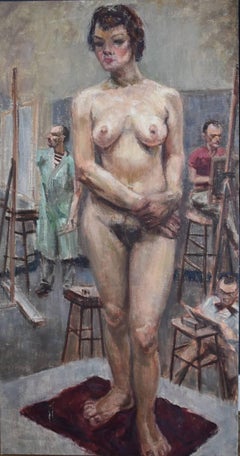
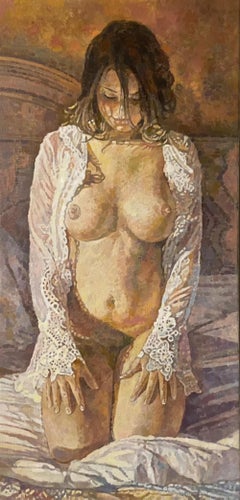
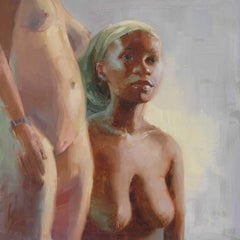
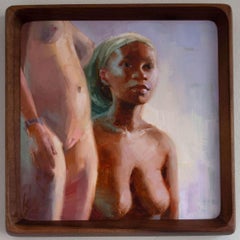
Artist: Joy Carrington
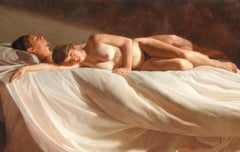
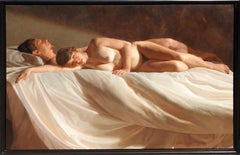
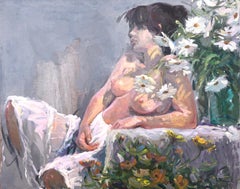
"Nude with Art Students" Classroom Nude
By Joy Carrington
Located in San Antonio, TX
Joy Carrington Nude Model with Art Students
(1907 - 1999)
San Antonio Artist
Image Size: 35 x 18.5
Frame Size: Unframed
Medium: Oil on Canvas
Sign...
Category
1930s Impressionist Joy Carrington Art
Materials
Oil
Related Items
Nude woman oil on canvas painting portrait
By Joan Palet
Located in Sitges, Barcelona
Joan Palet (1911 - 1996) - Nude - Oil on canvas
Oil measures 65x81 cm.
Frameless.
Joan Palet was born in Barcelona on March 28, 1911 in a family of sculptors and wood carvers.
He b...
Category
1970s Impressionist Joy Carrington Art
Materials
Canvas, Oil
$713 Sale Price
40% Off
H 25.6 in W 31.89 in
Female Bather (Nude Women)
Located in Wilton Manors, FL
Ann Brockman (1895–1943) was an American artist who achieved success as a figurative painter following a successful career as an illustrator. Born in California, she spent her childhood in the American Far West and, upon marrying the artist William C. McNulty, relocated to Manhattan at the age of 18 in 1914. She took classes at the Art Students League where her teachers included two realist artists of the Ashcan School, George Luks and John Sloan. Her career as an illustrator began in 1919 with cover art for four issues of a fiction monthly called Live Stories. She continued providing cover art and illustrations for popular magazines and books until 1930 when she transitioned from illustrator to professional artist. From that year until her death in 1943, she took part regularly in group and solo exhibitions, receiving a growing amount of critical recognition and praise. In 1939 she told an interviewer that making money as an illustrator was so easy that it "almost spoiled [her] chances of ever being an artist."[1] In reviewing a solo exhibition of her work in 1939, the artist and critic A.Z Kruse wrote: "She paints and composes with a thorough understanding of form and without the slightest hesitancy about anatomical structure. Add to this a magnificent sense of proportion, and impeccable feeling for color and an unmistakable knowledge of what it takes to balance the elements of good pictorial composition and you have a typical Ann Brockman canvas."[2]
Early life and training
Brockman was born in Northern California in 1895 and spent much of her youth in nearby Oregon, Washington, and Utah.[1][3] She met the artist William C. McNulty in Seattle where he was employed as an editorial cartoonist. They married in March 1914 and promptly moved to Manhattan where he worked as a freelance illustrator.[4][5] At the time of their marriage, Brockman was 18 years old.[6] Over the next few years, her career generally followed that path that her husband had previously taken. His art training had been at the Art Students League beginning in 1908; she began her training there after moving to New York in 1914.[1] After an early career as an editorial cartoonist, he freelanced as a magazine and book illustrator beginning in 1914; she began her career as a magazine and book illustrator in 1919.[7] He embarked on a teaching career in the early 1930s and not long after, she began giving art instruction.[8][9] While they both adhered to the realist tradition in art, their usual subjects were different. His prominently depicted urban cityscapes in the social realist whereas hers generally focused on rural landscapes. He was best known for his etchings and she for her oils and watercolors.[8][10]
Brockman returned to the Art Students League in 1926 to take individual instruction for a month at a time from George Luks and John Sloan.[1] Despite their help, one critic said McNulty's "sympathetic encouragement and guidance" was more important to her development as a professional artist.[11]
Career in art
In the course of her career as illustrator, Brockman would sometimes paint portraits of celebrities before drawing them, as for example in 1923 when she painted the French actress Andrée Lafayette who had traveled to New York to play title role in a film called Trilby.[12] She would also sometimes accept commissions to make portrait paintings and in 1929 painted two Scottish terriers on one such commission.[13] During this time, she also produced landscapes. In 1924 she displayed a New England village street scene painting in the Second Annual Exhibition of Paintings, Watercolors, and Drawings in the J. Wanamaker Gallery of Modern Decorative Art.[14] Available sources show no further exhibitions until in 1930 a critic for the Boston Globe described one of her portraits as "well done" in a review of a Rockport Art Association exhibition held that summer.[15]
Between 1931 and her death in 1943, Brockman participated in over thirty group exhibitions and five solos.[note 1] Her paintings appeared in shows of the artists' associations to which she belonged, including the Rockport Art Association, Salons of America, Society of Independent Artists, and National Association of Women Painters and Sculptors.[17][19]Between 1932 and 1935, her paintings appeared frequently in New York's Macbeth Gallery.[20][23][25][27] She won an award for a painting she showed at the Art Institute of Chicago in 1940.[41] In 1942, the Whitney Museum bought one of the paintings she showed in its Biennial of that year.[10] Critical praise for her work steadily increased during the decade that ended with her untimely death in 1943. In 1932, her painting called "The Camera Man" was called "a clever piece of illustration."[21] Three years later, a painting called "Small Town" gave a critic "the impression of freshness, honesty, and skill".[29] In 1938, a critic described her "Folly Cove" as "masterful" and said "Pigeon Hill Picnic" was "sustained by excellence of execution".[48] At that time, Howard Devree of the New York Times saw "evidence of gathering powers" in her work and wrote "she imparts a dramatic feeling to landscape. She even manages this time to do trees touched by Autumn tints without calendar effect, which is no small praise."[51] Three years later, a Times critic reported Brockman had "set herself a new high" in the watercolors she presented,[52] and another critic said the gallery where she was showing had not "for some time" shown "so outstanding a solo exhibitor as Ann Brockman."[2] Shortly before her death, a critic for Art News maintained that she was "one of America's most talented women painters".[46]
After she had died, a critic said Brockman's paintings "displayed real power", adding that she was "highly rated among the nation's professional artists" and was known to give "aid and encouragement, always with a smile," both artists and to her students.[10] in reviewing the memorial exhibition at the Kraushaar Galleries held in 1945, reviewers wrote about the strength and vibrancy of her personality, the quality of her painting ("every bit as good, possibly better than people had thought"),[53] called her "one of the best of our twentieth century women painters", and credited "her sense of the vividness of life" as a contributor to "the unusual breadth that is so characteristic of her work.[11] One noted that her work was "widely recognized throughout the country" and could be found in the collections of prominent museums, including the Metropolitan Museum of Art, the Whitney Museum of American Art, and the Art Institute of Chicago.[54] Writing in the Times, Devree wrote, "even those who had followed the steady growth of this artist for more than a decade, each successive show being at once an evidence of new achievement and an augury of still better work to come, may well be surprised at the combined impact of the selected paintings in the present showing,"[55] and writing in the Brooklyn Daily Eagle, A.Z Kruse said she had made "extraorginary accomplishments", painted with "inordinate distinction" showing a "lyrical majesty," and possessed "a keen esthetic sense which did not deviate from truth."[54]
Artistic style
(1) Ann Brockman, undated drawing, black chalk on paper, 18 x 22 inches
(2) Ann Brockman, High School Picnic, about 1935, oil on canvas, 34 1/4 x 44 1/4 inches
(3) Ann Brockman, untitled landscape, about 1943, watercolor and pencil on paper, 15 1/4 x 22 1/2 inches
(4) Ann Brockman, North Coast, undated watercolor, 21 1/2 x 30 inches
(5) Ann Brockman, On the Beach, 1942, watercolor on paper, 16 1/2 x 20 inches
(6) Ann Brockman, Lot's Wife, 1942, oil on canvas, 46 x 35 inches
(7) Ann Brockman, New York Harbor, 1934, watercolor on paper, 13 1/2 x 19 1/4 inches
(8) Ann Brockman, Youth, 1942, oil on board, 13 1/2 x 11 1/2 inches
Brockman was a figurative painter whose main subjects were rural landscapes and small-town and coastal scenes. She worked in oils and watercolors, becoming better known for the latter late in her career. Most of her paintings were relatively small. Although she made figure pieces infrequently, the nudes and circus and Biblical scenes she painted were seen to be among her best works. In 1938, Howard Devree wrote: "Her gray-day marines and coast scenes are familiar to gallery goers and are favorites with her fellow artists. Her figure pieces have attained a sculptural quality without losing warmth or taking on stiffness. One spirited circus incident of equestriennes about to enter the big tent compares not unfavorably with many of the similar pictures by a long line of painters who have been fascinated by the theme. She imparts a dramatic feeling to landscape. She even manages this time to do trees touched by Autumn tints without calendar effect, which is no small praise."[51] Similarly, a critic for Art Digest wrote that year: "Fluently and virilely painted, [her] canvases suggest a close affinity between nature and humans. The artist takes her subjects out in the open where they may picnic or bathe with space and air about them. A fast tempo is felt in the compositions of restless horses and nimble entertainers busily alert for the coming performance. Miss Brockman is also interested in portraying frightened groups of people, hurrying to safety or standing half-clad in the lowering storm light."[56]
Her palette ranged from vivid colors in bright sunlight to somber ones in the overcast skies of stormy weather. Of the former, one critic spoke of the rich colors and "sun-drenched rocks" of her coastal scenes and another of her "summery landscapes of coves and picnics."[11][50] Of the latter, Howard Devree said she "painted so many moody Maine coast vignettes of lowering skies and uneasy seas that artists have been heard to refer to an effect as 'an Ann Brockman day'".[57]
Brockman's handling of Biblical subjects can be seen in the oil called "Lot's Wife", shown above, Image No. 6. Her watercolor called "On the Beach" and her oil portrait called "Youth" may both indicate the "sculptural quality" that Devree said was typical of her figure pieces (Image No. 8, above).
An example of Brockman's bright palette in a typical summer theme is the oil painting called "High School Picnic" shown above, Image No. 2. Next to it is a painting, an untitled landscape of about 1943 whose medium, watercolor on paper, shows off the sunny palette she often used (Image No. 3).
Among the darkest of her works was an untitled 1942 drawing she made in black chalk (shown above, Image No. 1). In a book called Drawings by American Artists (1947), the artist and art editor Norman Kent noted that this study influenced her painting through its use of "forms" that were "elastic" and suggested "color". He said its "massing of dark and light" created "a definite mood" that was "impressionistic" and had "the strength of a man's work".[58] Brockman's undated watercolor called "North Coast" (shown above, Image No. 4) is an example of the paintings to which Kent referred.
Illustrator
(9) Ann Brockman, cover, March 12, 1917, Every Week magazine
(10) Illustration of an article, "The Taking of a Salient" by Henry Russell...
Category
1930s American Impressionist Joy Carrington Art
Materials
Oil
$1,200 Sale Price
20% Off
H 13.5 in W 9 in D 0.75 in
Reverie - Neo-Impressionist Nude Figurative Oil Painting by Georges Lemmen
By Georges Lemmen
Located in Marlow, Buckinghamshire
Signed and titled oil on board nude circa 1905 by Belgian neo-impressionist painter Georges Lemmen. The work titled 'Reverie' depicts a red-haired lady who is kneeling down and resting her head on her arm.
Signature:
Signed lower right and titled on original artist's label verso
Dimensions:
Framed: 16"x19"
Unframed: 10"x13"
Provenance:
Original artists label verso for Georges Lemmen at 96 Avenue Coghen , Brussels
Private collection - Brussels
Georges Lemmen was the son of an architect and studied under Amédée Bourson at the academy in St Joost-ten-Node. He was invited in 1889 to join the Group of Twenty ( Cercle des XX) which had been launched in 1884 by Oscar Maus and had in the interim emerged as an influential force in Belgian artistic circles, not least by bringing to public and critical attention the work of such artists as Georges Seurat and Paul Signac. The Cercle des XX would be reborn in 1894 as La Libre Esthétique.
In the early days of the Cercle des XX, Lemmen espoused a pointilliste technique. His earlier painting was clearly influenced by the Neo-Impressionists; over time, however, his style became more subtle and nuanced - recalling, perhaps, that of his compatriot Van Rysselberghe, another Cercle des XX member. With the group's rebirth as the Libre Esthétique, Lemmen's work became more intimiste in character, most notably in his portraits, nudes and still-lifes, where the influence of Bonnard and Vuillard is unmistakable, as is that of Renoir, particularly after Lemmen's travels in the Midi in 1911. From this point onwards, he would go on to make a major contribution to the renewal of the graphic and decorative arts in terms of his input to the new 'free' aesthetic and to Art Nouveau. Although his draughtsmanship retained its essential purity and elegance of line, his painting became more fleshy, imprecise and sensual, his compositions governed less by technical considerations than by the urgent need to express his emotions.
Between 1889 and 1893, Lemmen exhibited at the Salon des Indépendants in Paris, aligning himself with the Neo-Impressionists. In 1893, Henry van de Velde invited him to participate in the Pour l'Art association that had been created in Antwerp. He travelled to the south of France in 1911. By this juncture, he had already exhibited solo on two occasions (in 1906 and 1908) at the Galerie Druet in Paris. A further solo exhibition in 1913, his first in Brussels, cemented Lemmen's reputation.
Museum and Gallery Holdings:
Bremen (Kunsthalle): Standing Nude Combing her Hair
Brussels (Mus. royaux des Beaux-Arts de Belgique): Children's Room (watercolour); Reading; Couture; Young Girl by the Sea...
Category
Early 1900s Impressionist Joy Carrington Art
Materials
Oil, Board
Mid Century Portrait of an African American Man
By Genevieve Rogers
Located in Soquel, CA
Mid-century figure study of an African American man by American Impressionist artist Genevieve Rogers. Unsigned, but acquired with a collection of her...
Category
Mid-20th Century American Impressionist Joy Carrington Art
Materials
Oil, Laid Paper
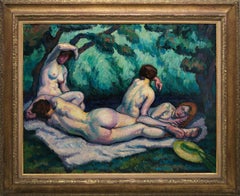
Bathing in the Forest
By Victor Gabriel Gilbert
Located in St. Albans, GB
Victor Gilbert
1847 - 1933, French
Oil on Panel
A magnificent work by Victor Gilbert and one for all collectors.
This is a rare and important example on a grand scale that is scarcely seen. Artist's very rarely painted on beautiful mahogany panels as large as this as they were too expensive and very hard to buy. The fact that Gilbert did this highlights the significance of this work.
Panel Size: 45 x 26" (114 x 66cm)
Outside Frame Size: 52 x 33" (132 x 84cm)
Free Shipping
Victor Gilbert’s natural ability as an artist was recognized early, but his family lacked the financial resources to send the young man to the École des Beaux-Arts. Rather than enrolling in the École, Gilbert was apprenticed to Eugene Adam as an artisan painter and decorator. His only formal education was evening classes with Pierre Levasseur at the École de la Ville de Paris.
Perhaps it was his early immersion into la vie quotidienne that formed the basis for his later choices of subject matter for his art, that of the markets and streets of Paris.
Despite his lack of formal training, Gilbert’s admissions to the Paris Salons of 1873 and 1874 were very well received by audiences and critics alike; at this time he was supported by the dealer Paul Martin, who was an important proponent of the Impressionist movement.
Gilbert emerged in the early 1880s as the primary Realist painter to record the French marketplace...
Category
Early 20th Century Impressionist Joy Carrington Art
Materials
Oil
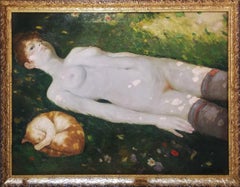
French Reclining Nude in Dreamlike Light Radiant Serenity Framed Oil Painting
Located in Cirencester, Gloucestershire
Nude in Dreamlike Light
French School, second half 20th century
signed oil on canvas, framed
Framed: 20.5 x 27 inches
Canvas: 15 x 22 inches
Provenance: private collection, France
Co...
Category
Mid-20th Century Impressionist Joy Carrington Art
Materials
Oil
$1,163
H 20.5 in W 27 in D 1 in
Impressionist Reclining Nude laying on a bed
By Albert de Belleroche
Located in Woodbury, CT
Count Albert de BELLEROCHE 1864–1944
Painter of portraits and genre, and lithographer; influenced by Impressionism. Born 22 October 1864 in Swansea, of Huguenot descent. Brought up b...
Category
1920s Impressionist Joy Carrington Art
Materials
Oil
$1,837 Sale Price
25% Off
H 18 in W 21.5 in D 53 in
Nude Woman Along Stream
By Allen Dean Cochran
Located in Fredericksburg, VA
Allen Dean Cochran’s Nude Woman Sitting by Stream is a captivating exploration of serenity and nature, rendered in vibrant hues of green and blue. The painting features a nude woman ...
Category
Early 20th Century Impressionist Joy Carrington Art
Materials
Oil, Board
Nude Study Oil painting
Located in New York, NY
This stunning and beautifully executed nude model in the studio was done perhaps while Friis was studying at the Académie Julian in Paris. It is framed in a French Louis style frame ...
Category
20th Century American Impressionist Joy Carrington Art
Materials
Canvas, Oil
$4,640 Sale Price
20% Off
H 31.25 in W 24.25 in
The Bather
By Roland Wheelwright
Located in St. Albans, GB
ROWLAND WHEELWRIGHT
A beautiful painting by Roland Wheelwright in keeping with his traditional subject matter. This piece is a large and important example of his work and is not oft...
Category
1920s Impressionist Joy Carrington Art
Materials
Oil
"Serenity in the Left Hand" by Ale Casanova, Original Painting, Nude Portrait
Located in Denver, CO
Ale Casanova's "Serenity in the Left Hand" is an original, handmade oil painting that depicts a nude female model holding a mouse.
Alejandro Casanova was born in Valencia, Spain, i...
Category
2010s Impressionist Joy Carrington Art
Materials
Linen, Oil
$840
H 11.82 in W 15.75 in
'The Red Hand-Towel' Munich School, Impressionist, Dortmund Kunstakademie, Paris
By Carl Otto Müller
Located in Santa Cruz, CA
After the Bath, Bathing Nude, Woman Drying
'The Red Hand-Towel' by Carl Otto Müller, 1969.
Munich School, Impressionist, Dortmund Kunstakademie, Paris
-----
Initialed lower left 'C....
Category
1960s Impressionist Joy Carrington Art
Materials
Oil, Board
Joy Carrington art for sale on 1stDibs.
Find a wide variety of authentic Joy Carrington art available for sale on 1stDibs. You can also browse by medium to find art by Joy Carrington in oil paint, paint and more. Much of the original work by this artist or collective was created during the 1930s and is mostly associated with the Impressionist style. Not every interior allows for large Joy Carrington art, so small editions measuring 19 inches across are available. Customers who are interested in this artist might also find the work of Robert Hallowell, Stanley Sobossek, and Caroline Hutchinson. Joy Carrington art prices can differ depending upon medium, time period and other attributes. On 1stDibs, the price for these items starts at $3,999 and tops out at $3,999, while the average work can sell for $3,999.