Kerr Eby, N.A. Prints and Multiples

American, 1890-1946
Kerr Eby was born in 1890 in Tokyo, Japan, the son of Methodist missionaries from Canada. Returning to that country when he was three, Eby grew up studying art, which his parents encouraged, as his mother came from a family of prominent artists. Harold Kerr Eby was born to Canadian Methodist missionaries in Tokyo, Japan, on October 19, 1889. At the age of three his family moved to Vancouver, B.C. and by the time he was twelve, he had lived in Vancouver, Kingston, Toronto and Bracebridge. He worked as a 'printer's devil' on the Bracebridge paper, and at fifteen he took his savings and moved to New York with the dream of becoming an artist After graduating from high school in 1907, Eby moved to New York City to study art, first at the Pratt Institute, and later at the Art Students League.. He enrolled in art classes at Pratt Institute while working for a lithographic firm earning $4.00 a week. His pay barely covered his room and drawing supplies. Within a year, life became desperate for the young artist. Starving and feeling defeated, he left in the spring for home in Canada and was employed by a surveying party in Northern Ontario. While in this northern wilderness, Eby regained his dream of becoming an artist, and in his spare time he started to draw his surroundings. By fall he had saved enough money to return to New York. He attended night classes at the Art Students League while working for another lithographic firm. He spent several more summers surveying in Northern Ontario before he was able to make a living as an illustrator. During this period he formed a number of influential friendships with major artists such as John Henry Twachtman and Childe Hassam and joined a summer artists' colony founded by them at Cos Cob, Connecticut. He supported himself by working as a magazine illustrator and at the American Lithographic Company. Through study and practice, Eby refined both his drawing and printing techniques. Eby was an Associate of the National Academy NA (1930); National Academy of Design (1934); Society of American Etchers; Chicago Society of Etchers; Philadelphia Society of Etchers; National Institute of Arts and Letters. Kerr Eby's work can be found in these collections of the Library of Congress, The Fine Arts Museums of San Francisco, Harvard Art Museums, New York Public Library, Navy Art Collection.
to
4
3
2
1
Overall Width
to
Overall Height
to
4
1
6
1,249
945
927
852
6
3
5
1
3
2
1
1
1
1
1
1
1
1
1
6
1
1
1
1
2
6
Artist: Kerr Eby
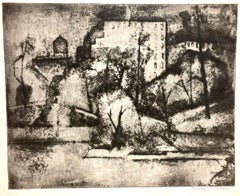
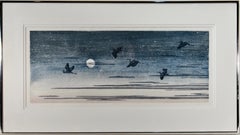
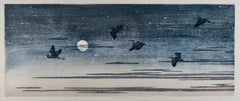
The Whale's Back [Connecticut]

The Whale's Back [Connecticut]

By Kerr Eby

Located in Plano, TX

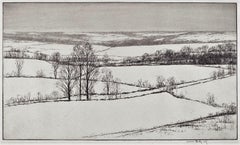
The Whales Back. 1925. Etching. Giardina catalog 95 stateiii. Image: 6 1/2 x 12 (sheet 10 x 16). Trial proof, prior to the edition of 90. Illustrated in Fine Prints of the Year, 1927. A rich impression with plate tone printed on cream laid paper. Signed and annotated 'imp' (imprimit) in pencil, indicating a proof printed Eby. The scene is probably Westport or Cos Cob, Connecticut. The scene is probably Westport or Cos Cob, Connecticut. Kerr Eby...
Category

Early 20th Century American Modern Kerr Eby, N.A. Prints and Multiples

Materials

Etching

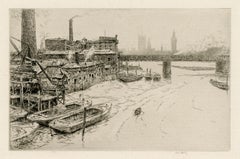
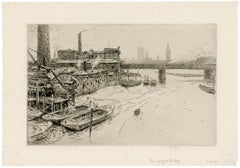
Hungerford Bridge, London

Hungerford Bridge, London

By Kerr Eby

Located in Myrtle Beach, SC

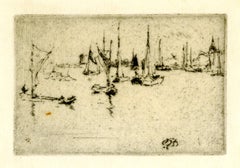
Kerr Eby 'Hungerford Bridge, London', etching and sandpaper ground, 1929, edition 90, Giardina 144. Signed, titled, and annotated 'Ed 90' in pencil. Signed again in the bottom right sheet corner. A fine, atmospheric impression, with delicate plate tone, on cream wove paper; the full sheet with margins (1 1/2 to 1 5/8 inches), in excellent condition. Matted to museum standards, unframed. Hungerford Foot Bridge spans the River Thames in London, between Westminster Bridge and Waterloo Bridge. Eby visited Great Britain and France during 1924 and 1925. Impressions of this work are in the permanent collection of the following institutions: American Academy and Institute of Arts and Letters, Arizona State University, Boston Public Library, Davison Art Center (Wesleyan University), Herbert F, Johnson Museum of Art, Huntington Museum of Art, Hood Museum of Art (Dartmouth College), Metropolitan Museum of Art, Montgomery Museum of Fine Arts, National Museum of American Art, New York Public Library, Smithsonian Museum of American Art. ABOUT THE ARTIST Kerr Eby was born in 1890 in Tokyo, Japan, the son of Methodist missionaries from Canada. The family returned to Vancouver when Eby was only three, and he grew up studying art encouraged by his parents as his mother was from a family of prominent artists. By age twelve, he had lived in Vancouver, Kingston, Toronto and Bracebridge where he found work as a ‘printer’s devil’ on the local Bracebridge newspaper. After graduating from high school in 1907, Eby moved to New York City to study art, first at the Pratt Institute, and later at the Art Students League. He enrolled in art classes at Pratt Institute while working for a lithographic firm earning $4.00 a week. His pay barely covered his room and drawing supplies. Within a year, starving and feeling defeated, he returned to Canada and was employed by a surveying party in Northern Ontario. Eby gradually regained his dream of becoming an artist, and in his spare time, he began to draw the surrounding wilderness landscapes. By fall he had returned to New York to attend night classes at the Art Students League while working for another lithographic firm. He spent several more summers surveying in Northern Ontario before he was able to make a living as an illustrator. During this period he formed several friendships with influential artists including John Henry Twachtman and Childe Hassam and joined a summer artists' colony founded by them at Cos Cob, Connecticut. He supported himself by working as a magazine illustrator and at the American Lithographic Company. Through diligent study and practice, Eby refined both his drawing and printmaking techniques. In 1917, when the United States entered World War I, Eby joined the U.S. Army. Failing to obtain a commission as an artist, he was assigned first to ambulance duty and later as a sergeant in the 40th Engineers in France. He spent most of WWI on the front line as a camouflager of the field artillery ‘big guns”. On his time off duty, he would sketch everything he witnessed, from the explosive big guns and men in action to the dead soldiers in the field. He sent the drawings home each week, and upon his return from the war, they became the basis for his first successful group of etchings. He continued creating his war-related prints throughout the 1920s and '30s as his work became widely exhibited Frederick Keppel, the renowned print dealer and a relative of Eby, became the exclusive agent for many of his print editions. With another global conflict beginning in the mid-1930s, Eby wanted to show the world the true face of war...

Category

1920s Impressionist Kerr Eby, N.A. Prints and Multiples

Materials

Etching

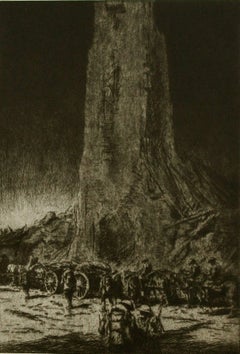
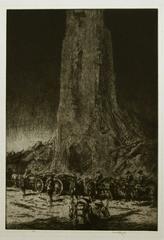
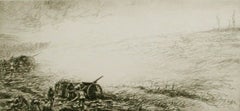
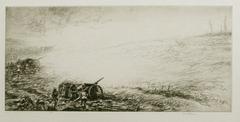
September 13, 1918. St. Mihiel [The Great Black Cloud].

September 13, 1918. St. Mihiel [The Great Black Cloud].

By Kerr Eby

Located in Plano, TX

September 13, 1918. St. Mihiel [The Great Black Cloud]. 1934. Etching, aquatint and sandpaper ground. Giardina catalog 182 state iv. 10 3/8 x 16 (sheet 13 1/8 x 18 1/4). Edition 100. Illustrated: Prints vol. VI, no. 2, 1935, page 85; Print Collector's Quarterly 26 (1939): 82; Fine Prints of the Year, 1935; Eby. War. Provenance: Frederick Keppel & Co. A rich, beautifully wiped impression on cream-colored wove paper. Signed and annotated 'imp' and 'Edition 100' in pencil, indicating a proof printed by the artist. This is Eby's most famous etching...

Category

Early 20th Century American Modern Kerr Eby, N.A. Prints and Multiples

Materials

Mixed Media, Etching, Aquatint

Open Action.
Open Action.

Kerr EbyOpen Action., 1926/1928

$1,200Sale Price|31% Off

Open Action.

By Kerr Eby

Located in Plano, TX

Published edition, not trial proof Open Action. 1926/1928. Etching. Giardina 124. 7 x 15 1/8 (sheet 12 3/4 x 15 1/4). Trial proof, prior to the edition of 90. A rich, tonal impressi...

Category

1920s American Modern Kerr Eby, N.A. Prints and Multiples

Materials

Etching

"The Caissons Go Rolling Along".

"The Caissons Go Rolling Along".

By Kerr Eby

Located in Plano, TX

"The Caissons Go Rolling Along". 1929. Etching and sandpaper ground. Giardina 145. 17 3/8 x 9 1/2 (sheet 18 3/4 x 11 1/2). Edition 90. Slight mat line, otherwise find condition. A ri...

Category

1920s American Modern Kerr Eby, N.A. Prints and Multiples

Materials

Drypoint, Etching

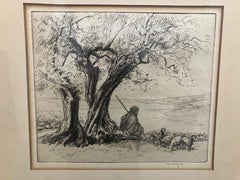
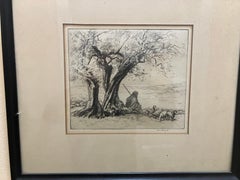
Kerr Eby Shepherd and His Flock

Kerr Eby Shepherd and His Flock

By Kerr Eby

Located in San Francisco, CA

Kerr Eby: 1889-1946. Very well listed Canadian American artist. He is best known as a printmaker for his fabulous etchings. He has auction results over $6300 for a single print. This...

Category

Early 20th Century Realist Kerr Eby, N.A. Prints and Multiples

Materials

Etching

Related Items
No Thru Traffic, by Art Werger

No Thru Traffic, by Art Werger

By Art Werger

Located in Palm Springs, CA

In No Thru Traffic, master printmaker Art Werger offers a striking aerial view of an archetypal suburban neighborhood, rendered with his characteristic precision and subtle wit. Curv...

Category

1990s Contemporary Kerr Eby, N.A. Prints and Multiples

Materials

Etching, Aquatint

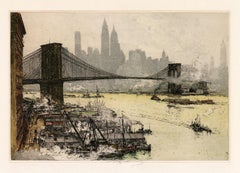
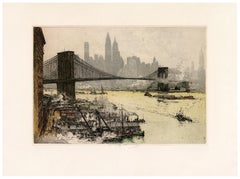
'Brooklyn Bridge' — Iconic New York City Landmark

'Brooklyn Bridge' — Iconic New York City Landmark

By Luigi Kasimir

Located in Myrtle Beach, SC

Luigi Kasimir, 'Brooklyn Bridge', color etching with aquatint, 1927, edition 100. Signed in pencil. A superb impression, with fresh colors, on heavy, cream wove paper; with margins...

Category

1920s American Modern Kerr Eby, N.A. Prints and Multiples

Materials

Etching, Aquatint

The Grand Canal, Venice

The Grand Canal, Venice

By Elias S. Mandel Grossman

Located in Middletown, NY

1926. Etching in sepia ink on Japon paper, 9 5/8 x 11 1/2 inches (245 x 292 mm), full margins with the lower margin slightly notched. Signed, titled and dated in pencil in the lower ...

Category

Early 20th Century American Modern Kerr Eby, N.A. Prints and Multiples

Materials

Handmade Paper, Etching

Low Country (South Carolina)

Low Country (South Carolina)

By Elizabeth Verner

Located in Middletown, NY

An enchanting Southern landscape by the mother of the Charleston Renaissance. A native of Charleston, South Carolina, and educated under the tutelage of Thomas Anshutz at The Pennsylvania Academy of Fine Arts, O'Neill Verner was a teacher, a mother, an artist, an ardent preservationist, and a skilled autodidact. Having previously focused on painting, in the early 1920s she found herself deeply moved by printmaking as a media, and especially so by the simple, peaceful themes and tableaus she discovered in Japanese art. She embarked on a effort to teach herself Japanese printmaking techniques, and in the process, produced the charming images of every day life in Charleston and its environs that earned her recognition as a cultural icon in her day, and in more modern times, as the mother of the Charleston Renaissance, which flourished well into the 1930s. In 1923 she opened a studio in Charleston where she focused on documenting the local color and the architecture and landscape that distinguishes Charleston as one of the South's most beautiful cities, all the while applying the gentle and poetic thematic sensibilities of Japanese printmaking. O'Neill Verner soon found herself in high demand when municipalities and institutions throughout the country sought commissions from her to document the beauty of their grounds and historic buildings. She worked as far north as the campuses of Harvard and Princeton, and extensively across the South, including in Savannah, Georgia, where through sweeping commissions she was able to marry her love of southern preservation and art. O'Neill Verner was a lifelong learner, and continued a path of edification that led her to study etching at the Central School of Art in London, to travel extensively through Europe, and to visit Japan in 1937, where she studied sumi (brush and ink) painting. She was a founding member of the Charleston Etchers Club, and the Southern States Art League. Her works are represented in the permanent collections of leading museums across the American south, and in major national institutions including the Metropolitan Museum of Art, Boston's Museum of Fine Art, and the Smithsonian American Art Museum. O'Neil Verner...

Category

Early 20th Century American Modern Kerr Eby, N.A. Prints and Multiples

Materials

Archival Paper, Drypoint, Etching

The Gate, Chelsea

The Gate, Chelsea

By Theodore Casimir Roussel

Located in New York, NY

Theodore Roussel (1847-1926), The Gate, Chelsea; etching and drypoint, 1889-1890, signed on the tab and inscribed imp [also signed in the plate lowere right]. Reference: Hausberg 33, fourth state (of 4), from the total printing of about 43 impressions. In excellent condition, trimmed by the artist all around on the plate mark except for the tab, 8 1/8 x 6 1/2 inches. A fine impression, printed on a light cream wove paper with plate tone (wiped to brighten the gate and doorway area) and substantial burr in the drypoint work. According to Hausberg, “The gate and house behind it still stand today at No. 4 Cheyne Walk...

Category

1880s Impressionist Kerr Eby, N.A. Prints and Multiples

Materials

Drypoint, Etching

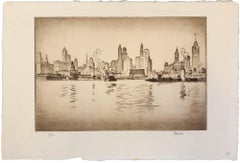
Chicago Skyline
Chicago Skyline

Paul SchumannChicago Skyline, 1900

$800

H 7.17 in W 10.83 in

Chicago Skyline

By Paul Schumann

Located in Middletown, NY

A beautiful turn-of-the-century lake view of Chicago by an American artist known for his Texas landscapes. Etching with drypoint on watermarked Umbria laid paper with deckle edges, 7 1/4 x 10 7/8 inches (182 x 275 mm), full margins. Signed and numbered 4/25 in pencil, lower margin. In good condition with adhesive residue at the sheet edges on the verso, does not show through to the recto. A lovely Lake Michigan landscape...

Category

Early 20th Century American Modern Kerr Eby, N.A. Prints and Multiples

Materials

Handmade Paper, Etching, Drypoint

Tugs on the Hudson
Tugs on the Hudson

Tugs on the Hudson

By Charles Frederick William Mielatz

Located in Middletown, NY

Drypoint etching with engraving printed in black ink on Japanese mulberry paper, 4 1/2 x 3 3/8 inches (113 x 84 mm), full margins. In superb condition. A beautiful New York City river...

Category

Early 20th Century American Modern Kerr Eby, N.A. Prints and Multiples

Materials

Handmade Paper, Drypoint, Etching

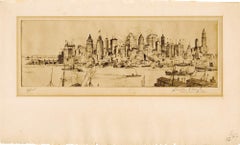
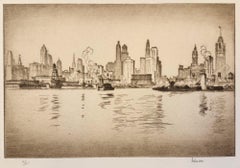
New York Skyline
New York Skyline

Louis H. RuylNew York Skyline, 1920

$450

H 9.18 in W 12.72 in

New York Skyline

By Louis H. Ruyl

Located in Middletown, NY

Etching with drypoint on cream wove paper with deckle edges, 4 3/8 x 12 3/4 inches (233 x 323 mm); sheet 9 1/2 x 15 3/4 inches (240 x 338 mm), full margins. Signed and numbered 4/75 ...

Category

Early 20th Century American Modern Kerr Eby, N.A. Prints and Multiples

Materials

Handmade Paper, Etching, Drypoint

Vachère au Bord de l'Eau

Camille PissarroVachère au Bord de l'Eau, 1890

$1,463Sale Price|24% Off

H 7.75 in W 5.25 in

Vachère au Bord de l'Eau

By Camille Pissarro

Located in Santa Monica, CA

CAMILLE PISSARRO (French 1830-1903) VACHERE au BORD de l’EAU 1890 (Delteil 93 viii/viii) Etching, unsigned as published in “Gazette des Beaux Arts”, Paris, 1890. On laid paper Very...

Category

1890s Impressionist Kerr Eby, N.A. Prints and Multiples

Materials

Drypoint, Etching

Steps to the Grand Canal, St. Mark's in the distance, Venice.

Steps to the Grand Canal, St. Mark's in the distance, Venice.

By Donald Shaw MacLaughlan

Located in Middletown, NY

A lovely view of Venice from the water. Etching with drypoint on antique cream laid paper with a large figural watermark, signed in pencil, lower right. 14 1/4 x 11 inches (362 x 280...

Category

Early 20th Century American Modern Kerr Eby, N.A. Prints and Multiples

Materials

Laid Paper, Drypoint, Etching

“Longs Peak & Mount Meeker” Color Aquatint Etching by George Elbert Burr

“Longs Peak & Mount Meeker” Color Aquatint Etching by George Elbert Burr

By George Elbert Burr

Located in Denver, CO

This original early 20th-century color aquatint etching by celebrated American printmaker George Elbert Burr (1859–1939) captures the majestic beauty of Longs Peak and Mount Meeker a...

Category

1920s American Impressionist Kerr Eby, N.A. Prints and Multiples

Materials

Aquatint

'Foul Rope (Left)' — Early American Southwest Rodeo

'Foul Rope (Left)' — Early American Southwest Rodeo

By William Robinson Leigh

Located in Myrtle Beach, SC

William Robinson Leigh, 'Foul Rope (Left)', etching, c. 1920, edition unknown but small. Signed in pencil and signed in the plate, lower left. A superb, richly-inked impression, in dark brown ink, on buff wove Umbria paper, the full sheet with margins (1 1/2 to 2 3/4 inches); slight toning at the sheet edges, otherwise in excellent condition. Very scarce. Archivally matted to museum standards, unframed. Image size 14 7/8 x 11 15/16 inches (378 x 303 mm); sheet size 20 3/8 x 15 3/8 inches (518 x 391 mm). ABOUT THE ARTIST Born near Falling Waters, West Virginia, on a plantation a year after the Civil War and raised in Baltimore, William Robinson Leigh (1866 - 1955) became one of the foremost painters of the American West. His career spanning some seventy-five years, Leigh created some of the most iconic depictions of the Western landscape, with admirers referring to him as ‘The Sagebrush Rembrandt.’ The son of impoverished Southern aristocrats, Leigh received his first art training at age 14 from Hugh Newell at the Maryland Institute, where he was regarded as the best student in his class. From 1883 to 1895, he studied in Europe, mainly at the Royal Academy in Munich with Ludwig Loefftz. From 1891 to 1896, he painted six cycloramas or murals in the round, a giant German panorama. In 1896, Leigh began working as a magazine illustrator for Scribner's and Collier's Weekly Magazine in New York City. He also painted portraits, landscapes, and genre scenes. Leigh's trips to the Southwest began in 1906 when he agreed to paint the Grand Canyon with William Simpson, Santa Fe Railway advertising manager, in exchange for free transportation West. In 1907, he completed his Grand Canyon painting, which led to more commissions and an extensive painting trip through Arizona and New Mexico. These travels inspired him to paint western subjects for the next 50 years, and his primary interests were the Hopi and Navajo Indians. In 1910, he traveled to Wyoming, where he painted in Yellowstone Park and created sketches, many of which he later converted into large canvases such as ‘Lower Falls of the Yellowstone’ (1915) and ‘Grand Canyon of the Yellowstone’ (1911). In 1926, he traveled to Africa at the invitation of Carl Akeley for the American Museum of Natural History, and from this experience, wrote and illustrated 'Frontiers of Enchantment: An Artist's Adventures in Africa'. In 1933, he wrote and illustrated 'The Western Pony'. His adventures were chronicled in several popular magazines, including Life, the Saturday Evening Post, and Colliers. For many years, Grand Central Art Galleries at the Biltmore Hotel handled his work exclusively in New York. In 1953, Leigh was elected an associate member of the National Academy of Design and became a full Academician in 1955. In March 1999, the Historical Center of Cody, Wyoming, held an exhibition of his field sketches and finished works depicting his experiences near Cody early in the century. Between 1910 and 1921, when he often painted in the Carter Mountain vicinity, these years were considered pivotal to his artistic development and devotion to the Western landscape. Leigh's work is held in many museum collections of American Western art...

Category

1920s Realist Kerr Eby, N.A. Prints and Multiples

Materials

Etching

Previously Available Items
Snow on the Aspetuck.

Kerr EbySnow on the Aspetuck., 1927

Sold

H 6.07 in W 10.88 in D 0.5 in

Snow on the Aspetuck.

By Kerr Eby

Located in Plano, TX

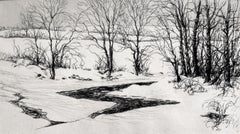
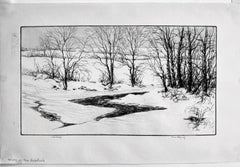
Snow on the Aspetuck. 1927. Etching. Giardina catalog 109 state iii. Image: 6 1/16 x 10 7/8 (sheet 9 x 13 3/4). Trial proof, apart from the edition of 90. A rich impression with plate tone printed on cream-laid paper. Signed and annotated 'trial proof' and 'imp' (imprimit) in pencil, indicating a proof printed Eby Kerr Eby is one of the great 20th-century printmakers, heralded for his use of negative space and plate tone. His plates usually held a combination of drypoint and etched lines, resulting in an interplay of strong lines and delicate details. His landscapes are just as telling of his talents and skilled hand. They speak to his ability to edit, as he would enlist only one or two lines to do the work of many- letting the almost unmarked plate...

Category

Early 20th Century American Modern Kerr Eby, N.A. Prints and Multiples

Materials

Etching

Snow Fields
Snow Fields

Kerr EbySnow Fields, 1927

Sold

H 7.2 in W 12.75 in D 0.5 in

Snow Fields

By Kerr Eby

Located in Plano, TX

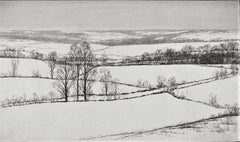
Snow Fields. 1924. Etching. Giardina 92. 7 1/2 x 12 3/4 (sheet 9 3/4 x 14 7/8). Edition 90-100. A rich impression with plate tone printed on cream-laid paper. Illustrated: Flint, Contemporary American Prints, 1931; Signed and annotated 'imp' (imprimit) in pencil, indicating a proof printed Eby. The scene is probably Westport or Cos Cob, Connecticut. Kerr Eby is one of the great 20th-century printmakers, heralded for his use of negative space and plate tone. His plates usually held a combination of drypoint and etched lines, resulting in an interplay of strong lines and delicate details. His landscapes are just as telling of his talents and skilled hand. They speak to his ability to edit, as he would enlist only one or two lines to do the work of many- letting the almost unmarked plate...

Category

Early 20th Century American Modern Kerr Eby, N.A. Prints and Multiples

Materials

Etching

The Cow Shed
The Cow Shed

Kerr EbyThe Cow Shed, 1946

Sold

H 9.63 in W 15.13 in D 0.5 in

The Cow Shed

By Kerr Eby

Located in Plano, TX

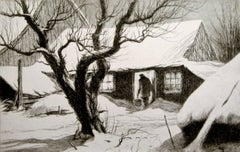
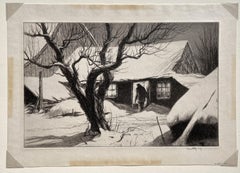
The Cow Shed. 1946. Etching, aquatint, and sandpaper ground. Giardina 211. 9 5/8 x 15 1/8. Edition 100. Tape marks at the margin edges, well away from the image. A rich impression printed on cream wove paper with full margins. Signed and annotated 'imp' (imprimit) in pencil, indicating a proof printed Eby. Housed in an 18 3/4 x 24-inch archival mat, suitable for framing. Eby is known for his stark and lovely landscapes of Connecticut in the winter. He first got to know Connecticut when he spent several summers at the artist’s colony at Cos Cob immediately before the First World War. There he became friends with the American Impressionist artist Childe Hassam, who was almost thirty years older than Eby. Eby and Hassam had a close working relationship, with the younger artist providing the older artist with technical advice on etching and the use of his etching press. Following the War, Eby married Frances Sheldon, whom he had met in Cos Cob, and the couple eventually settled in a pre-Revolutionary War saltbox...

Category

Mid-20th Century American Modern Kerr Eby, N.A. Prints and Multiples

Materials

Etching

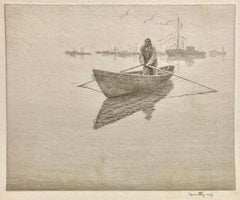
Kerr Eby, Lobster Fleet

Kerr Eby, Lobster Fleet

By Kerr Eby

Located in New York, NY

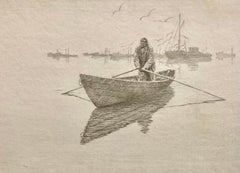
Although the title 'Lobster Fleet' calls to mind numerous vessels at sea in a single spot (and there's a group in the distance), in fact the print features a lone fisherman in a smal...

Category

1930s Ashcan School Kerr Eby, N.A. Prints and Multiples

Materials

Etching

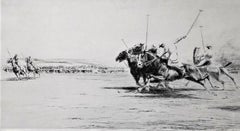
Polo, Plate B.
Polo, Plate B.

Kerr EbyPolo, Plate B., 1941

Sold

H 8.63 in W 15.57 in D 0.5 in

Polo, Plate B.

By Kerr Eby

Located in Plano, TX

Polo Plate B. 1927. Aquatint. Giardina 113. 8 5/8 in. x 15 9/16 (sheet 12 3/4 x 19 1/8) . Edition of 90. Published state. A barely-noticeable 1/8-inch abr...

Category

Early 20th Century American Modern Kerr Eby, N.A. Prints and Multiples

Materials

Etching

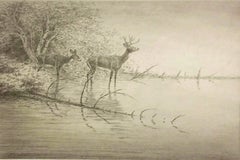
White Tails in the Morning

Kerr EbyWhite Tails in the Morning, 1941

Sold

H 16 in W 20 in D 0.5 in

White Tails in the Morning

By Kerr Eby

Located in Plano, TX

White Tails in the Morning. 1935. Etching. Giardina catalog 183. state i. 8 1/4 x 12 1/2 (sheet 10 5/8 x 14 7/8). Edition approximately 100. Mat line; otherwise in good condition. A fine impression with subtle plate tone, printed by the artist on cream wove paper. Signed and annotated 'imp' in pencil. where the artist lived. Housed in a 16 x 20-inch archival mat. The scene is probably near the artist's farmhouse in Westport, Connecticut. Kerr Eby...

Category

Early 20th Century American Modern Kerr Eby, N.A. Prints and Multiples

Materials

Etching

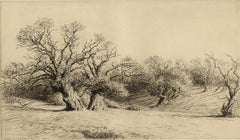
Oaks in Windsor Park

Kerr EbyOaks in Windsor Park, 1927

Sold

H 7.88 in W 13.63 in

Oaks in Windsor Park

By Kerr Eby

Located in New Orleans, LA

Kerr Eby's "Oaks in Windsor Park" is a 1927 etching on laid paper, with margins. It is signed in pencil. Kerr Eby was born in 1890 in Tokyo, Japan, the son of Methodist missionaries from Canada. He grew up studying art, which his parents encouraged, as his mother came from a family of prominent artists. As a boy he worked as a printer’s apprentice in a newspaper office which may have encouraged his interest in printing as an artistic medium. After graduating from high school in 1907, Eby moved to New York City to study art, first at the Pratt Institute, and later at the Art Students League. During this period he formed a number of influential friendships with major artists such as John Henry Twachtman and Childe Hassam and joined a summer artists’ colony founded by them at Cos Cob, Connecticut When the U.S. entered World War I in 1917, Eby, too, became involved. After unsuccessful efforts to obtain a commission as an artist, he enlisted and ultimately was assigned to the 40th Engineers, Artillery Brigade, Camouflage Division, which was sent to the war front where the Division helped to protect the troops. Eby saw much battle action, especially in northeastern France, including at Belleau Wood and Meuse-Argonne, and in 1918, he participated in the battles of Château-Thierry and Saint-Mihiel, which were instrumental in preventing the Germans from advancing on Paris. In addition to his work as a camoufleur, he also made drawings of the images he witnessed on the battlefield. In 1936, concerned about the unstable world situation that would soon lead to World War II, Eby published his book "War" (Yale University Press, New Haven) which illustrated 28 prints and drawings he had made during his experience in World War I and which included an essay outlining his abhorrence of war and his opinion of its futility and barbarity. Although he was himself too old to serve during the Second World War, he served as a correspondent in the Pacific in the combat artist program developed by Abbott Laboratories (which was instrumental in the development of plasma and hired artists to depict its use in the war). Eby again drew images of soldiers, and in November 1943, he went ashore with the U.S. invading force in Tarawa, one of the most brutal battles in the history of the Marines. He again witnessed much death and, again, recorded his experience in numerous prints and drawings. His friend John Taylor Arms, in a moving tribute to Eby written shortly after his death in 1946, felt that Eby, like the soldiers whose deaths he recorded, had also given his life for the cause, because Eby had contracted a tropical disease while living with the troops for three weeks in a foxhole in the jungles of Bougainville, a condition from which he never recovered and which contributed to his early death. In creating anti-war works, Eby joined a long line of artists stretching back into antiquity. Of these, Goya’s etchings...

Category

1920s American Modern Kerr Eby, N.A. Prints and Multiples

Materials

Etching

Shipping
Shipping

Kerr EbyShipping, 1932

Sold

H 8.38 in W 17.25 in

Shipping

By Kerr Eby

Located in Myrtle Beach, SC

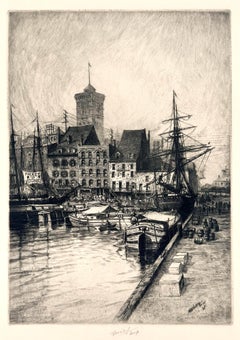
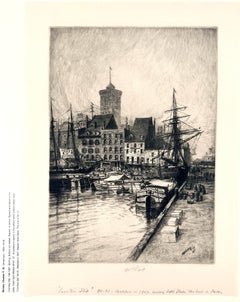
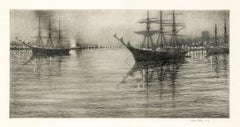
Kerr Eby 'Shipping' also 'Shipping, Connecticut', etching and sandpaper ground, 1932, edition 100, Giardina 171. Signed in pencil and titled 'Shipping' in the bottom left sheet edge. A superb, atmospheric impression, with skillfully controlled plate tone, on heavy, cream wove paper; the full sheet with wide margins (2 to 2 3/4 inches), in excellent condition. Matted to museum standards, unframed. Image size 8 3/8 x 17 1/4 inches (316 x 176 mm); sheet size 13 7/16 x 8 3/8 inches (341 x 213 mm). The scene depicted was on the Connecticut coast...

Category

1940s American Impressionist Kerr Eby, N.A. Prints and Multiples

Materials

Etching

Two Bridges
Two Bridges

Kerr EbyTwo Bridges, 1930

Sold

H 7.94 in W 14.94 in

Two Bridges

By Kerr Eby

Located in Myrtle Beach, SC

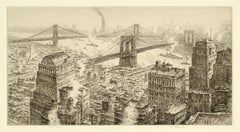
Kerr Eby 'Two Bridges', etching, 1930, edition 90, Giardina 149. Signed and annotated 'Trial No. 4' in pencil. A fine, atmospheric impression, with selective plate tone, on cream laid paper; the full sheet with margins (1 1/2 to 1 5/8 inches), in excellent condition. A fifth state (final) trial proof, printed by the artist. The scene depicted is of the east side of Manhattan in the foreground looking across the East River with the Brooklyn Bridge in the middle ground and the Manhattan Bridge in the distance. Impressions of this work are in the permanent collection of the following institutions: American Academy and Institute of Arts and Letters, Boston Public Library, Herbert F, Johnson Museum of Art, Hood Museum of Art (Dartmouth College), Metropolitan Museum of Art, National Museum of American Art, New York Historical Society, New York Public Library, Palmer Museum of Art (Pennsylvania State University), Smithsonian Museum of American Art, Yale University Art Gallery. ABOUT THE ARTIST Kerr Eby was born in 1890 in Tokyo, Japan, the son of Methodist missionaries from Canada. The family returned to Vancouver when Eby was only three, and he grew up studying art encouraged by his parents as his mother was from a family of prominent artists. By age twelve, he had lived in Vancouver, Kingston, Toronto and Bracebridge where he found work as a ‘printer’s devil’ on the local Bracebridge newspaper. After graduating from high school in 1907, Eby moved to New York City to study art, first at the Pratt Institute, and later at the Art Students League. He enrolled in art classes at Pratt Institute while working for a lithographic firm earning $4.00 a week. His pay barely covered his room and drawing supplies. Within a year, starving and feeling defeated, he returned to Canada and was employed by a surveying party in Northern Ontario. Eby gradually regained his dream of becoming an artist, and in his spare time, he began to draw the surrounding wilderness landscapes. By fall he had returned to New York to attend night classes at the Art Students League while working for another lithographic firm. He spent several more summers surveying in Northern Ontario before he was able to make a living as an illustrator. During this period he formed several friendships with influential artists including John Henry Twachtman and Childe Hassam and joined a summer artists' colony founded by them at Cos Cob, Connecticut. He supported himself by working as a magazine illustrator and at the American Lithographic Company. Through diligent study and practice, Eby refined both his drawing and printmaking techniques. In 1917, when the United States entered World War I, Eby joined the U.S. Army. Failing to obtain a commission as an artist, he was assigned first to ambulance duty and later as a sergeant in the 40th Engineers in France. He spent most of WWI on the front line as a camouflager of the field artillery ‘big guns”. On his time off duty, he would sketch everything he witnessed, from the explosive big guns and men in action to the dead soldiers in the field. He sent the drawings home each week, and upon his return from the war, they became the basis for his first successful group of etchings. He continued creating his war-related prints throughout the 1920s and '30s as his work became widely exhibited Frederick Keppel, the renowned print dealer and a relative of Eby, became the exclusive agent for many of his print editions. With another global conflict beginning in the mid-1930s, Eby wanted to show the world the true face of war...

Category

1930s American Impressionist Kerr Eby, N.A. Prints and Multiples

Materials

Etching

Th Last Supper (Macabre World War I image /dead soldiers in a bombed out house)

Th Last Supper (Macabre World War I image /dead soldiers in a bombed out house)

By Kerr Eby

Located in New Orleans, LA

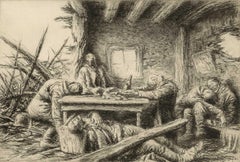
Kerr Eby captures an interior room of a ruined house with a table surrounded by six dead soldiers in sitting and prone positions. They died where they sat in a log shelter pierced by cannon fire. One holds a bottle. This image is in the permanent collection of The Metropolitan Museum, the Smithsonian Museum of American Art and the Cleveland Museum of Art. Eby was born in 1890 in Tokyo, Japan, the son of Methodist missionaries from Canada. He grew up studying art, which his parents encouraged, as his mother came from a family of prominent artists. As a boy he worked as a printer’s apprentice in a newspaper office which may have encouraged his interest in printing as an artistic medium. After graduating from high school in 1907, Eby moved to New York City to study art, first at the Pratt Institute, and later at the Art Students League. During this period he formed a number of influential friendships with major artists such as John Henry Twachtman and Childe Hassam and joined a summer artists’ colony founded by them at Cos Cob, Connecticut When the U.S. entered World War I in 1917, Eby, too, became involved. After unsuccessful efforts to obtain a commission as an artist, he enlisted and ultimately was assigned to the 40th Engineers, Artillery Brigade, Camouflage Division, which was sent to the war front where the Division helped to protect the troops. Eby saw much battle action, especially in northeastern France, including at Belleau Wood and Meuse-Argonne, and in 1918, he participated in the battles of Château-Thierry and Saint-Mihiel, which were instrumental in preventing the Germans from advancing on Paris. In addition to his work as a camoufleur, he also made drawings of the images he witnessed on the battlefield. In 1936, concerned about the unstable world situation that would soon lead to World War II, Eby published his book "War" (Yale University Press, New Haven) which illustrated 28 prints and drawings he had made during his experience in World War I and which included an essay outlining his abhorrence of war and his opinion of its futility and barbarity. Although he was himself too old to serve during the Second World War, he served as a correspondent in the Pacific in the combat artist program developed by Abbott Laboratories (which was instrumental in the development of plasma and hired artists to depict its use in the war). Eby again drew images of soldiers, and in November 1943, he went ashore with the U.S. invading force in Tarawa, one of the most brutal battles in the history of the Marines. He again witnessed much death and, again, recorded his experience in numerous prints and drawings. His friend John Taylor Arms, in a moving tribute to Eby written shortly after his death in 1946, felt that Eby, like the soldiers whose deaths he recorded, had also given his life for the cause, because Eby had contracted a tropical disease while living with the troops for three weeks in a foxhole in the jungles of Bougainville, a condition from which he never recovered and which contributed to his early death. In creating anti-war works, Eby joined a long line of artists stretching back into antiquity. Of these, Goya’s etchings...

Category

1930s American Modern Kerr Eby, N.A. Prints and Multiples

Materials

Etching

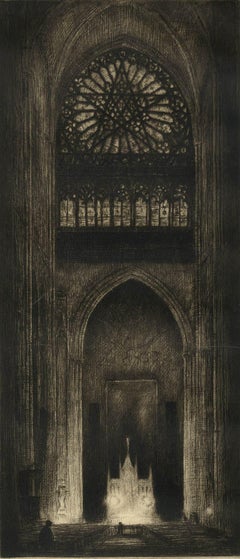
St. Ouen, Rouen
St. Ouen, Rouen

Kerr EbySt. Ouen, Rouen, 1928

Sold

H 8 in W 13.75 in

St. Ouen, Rouen

By Kerr Eby

Located in New Orleans, LA

Rouen is a city in France, northwest of Paris. This interior scene of its famous cathedral depicts the view down the main aisle. It is #130 in the Giardina catalogue raisonne and is in the collection of the Smithsonian American Art Museum and the Fine Arts Museum of San Francisco. It is referenced in "Kerr Eby, The Complete Prints" by Bernadette Passi, published by M Hausberg, New York 1997. Kerr Eby was born in 1890 in Tokyo, Japan, the son of Methodist missionaries from Canada. He grew up studying art, which his parents encouraged, as his mother came from a family of prominent artists. As a boy he worked as a printer’s apprentice in a newspaper office which may have encouraged his interest in printing as an artistic medium. After graduating from high school in 1907, Eby moved to New York City to study art, first at the Pratt Institute, and later at the Art Students League. During this period he formed a number of influential friendships with major artists such as John Henry Twachtman and Childe Hassam and joined a summer artists’ colony founded by them at Cos Cob, Connecticut When the U.S. entered World War I in 1917, Eby, too, became involved. After unsuccessful efforts to obtain a commission as an artist, he enlisted and ultimately was assigned to the 40th Engineers, Artillery Brigade, Camouflage Division, which was sent to the war front where the Division helped to protect the troops. Eby saw much battle action, especially in northeastern France, including at Belleau Wood and Meuse-Argonne, and in 1918, he participated in the battles of Château-Thierry and Saint-Mihiel, which were instrumental in preventing the Germans from advancing on Paris. In addition to his work as a camoufleur, he also made drawings of the images he witnessed on the battlefield. In 1936, concerned about the unstable world situation that would soon lead to World War II, Eby published his book "War" (Yale University Press, New Haven) which illustrated 28 prints and drawings he had made during his experience in World War I and which included an essay outlining his abhorrence of war and his opinion of its futility and barbarity. Although he was himself too old to serve during the Second World War, he served as a correspondent in the Pacific in the combat artist program developed by Abbott Laboratories (which was instrumental in the development of plasma and hired artists to depict its use in the war). Eby again drew images of soldiers, and in November 1943, he went ashore with the U.S. invading force in Tarawa, one of the most brutal battles in the history of the Marines. He again witnessed much death and, again, recorded his experience in numerous prints and drawings. His friend John Taylor Arms, in a moving tribute to Eby written shortly after his death in 1946, felt that Eby, like the soldiers whose deaths he recorded, had also given his life for the cause, because Eby had contracted a tropical disease while living with the troops for three weeks in a foxhole in the jungles of Bougainville, a condition from which he never recovered and which contributed to his early death. In creating anti-war works, Eby joined a long line of artists stretching back into antiquity. Of these, Goya’s etchings...

Category

1920s American Modern Kerr Eby, N.A. Prints and Multiples

Materials

Etching

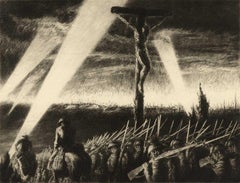
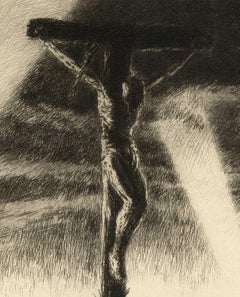
Barrage (Eby parallels WWI soldiers sacrifice with sacrifice of Christ on cross)

Barrage (Eby parallels WWI soldiers sacrifice with sacrifice of Christ on cross)

By Kerr Eby

Located in New Orleans, LA

Kerr Eby portrays the sacrifice of brave WWI soldiers in France with the sacrifice of Christ on the Cross. This image is a trial proof of the edition and was signed and printed by the artist. Born to Canadian missionary parents stationed in Japan, Harold Kerr...

Category

1920s American Realist Kerr Eby, N.A. Prints and Multiples

Materials

Drypoint, Etching

Kerr Eby prints and multiples for sale on 1stDibs.

Find a wide variety of authentic Kerr Eby prints and multiples available for sale on 1stDibs. You can also browse by medium to find art by Kerr Eby in etching, drypoint, engraving and more. Much of the original work by this artist or collective was created during the 20th century and is mostly associated with the modern style. Not every interior allows for large Kerr Eby prints and multiples, so small editions measuring 11 inches across are available. Customers who are interested in this artist might also find the work of Isabel Bishop, Louis Conrad Rosenberg, and Sylvia Spicuzza. Kerr Eby prints and multiples prices can differ depending upon medium, time period and other attributes. On 1stDibs, the price for these items starts at $400 and tops out at $12,000, while the average work can sell for $938.