By Lee Friedlander
Located in Surfside, FL
Lee Friedlander (American, b. 1934)
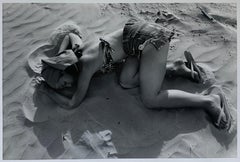
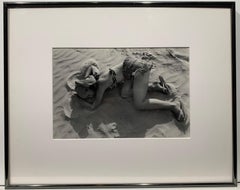
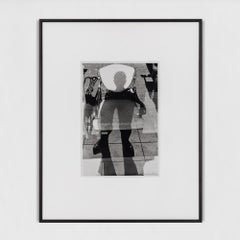
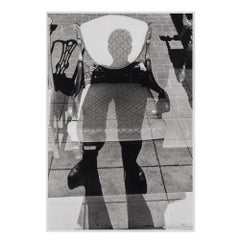
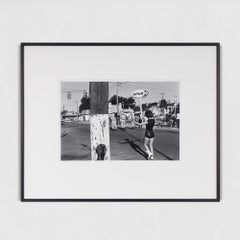
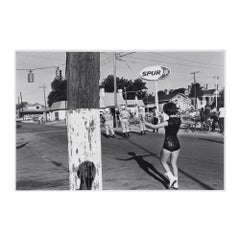
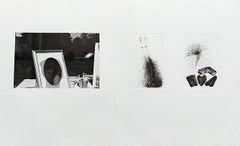
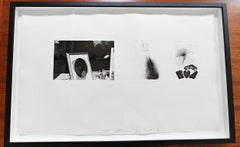
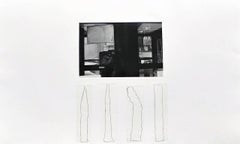
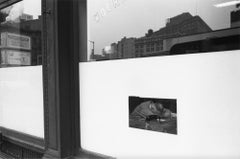
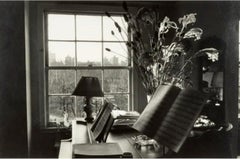
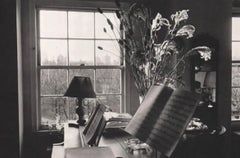
"New York City, 1974"
Silver Gelatin print. LF 7770 - C.
Sight 7 3/8 X 11 in. Framed 14 x 17 1/2 in.
It has not been examined out of frame.
Provenance: Zabriskie Gallery, New York.
The Members' Gallery, Albright-Knox Art Gallery, Buffalo, NY.
The collection of Mr. & Mrs. Roy W. Doolittle, Jr., Buffalo, NY.
This depicts a Manhattan interior with a piano and music notes overlooking a view of Central Park.
Lee Friedlander (American, 1934-) is an American photographer and artist. In the 1960s and 1970s, Friedlander evolved an influential and often imitated visual language of urban "social landscape," with many of his photographs including fragments of store-front reflections, structures framed by fences, posters and street signs.
Friedlander was born in Aberdeen, Washington on July 14, 1934 to Kaari Nurmi (Finnish descent) and Fritz (Fred) Friedlander (a German-Jewish émigré). His mother Kaari died of cancer when he was seven years old. Already earning pocket-money as a photographer since he was 14, he went on at the age of 18, to study photography at the Art Center College of Design in Pasadena, California. In 1956, he moved to New York City, where he photographed jazz musicians for record covers, over 100 record albums are graced by a Friedlander portrait, including the likes of Etta James, John Coltrane, Miles Davis and others. His early work was influenced by Eugene Atget, Robert Frank, and Walker Evans. In 1960, Friedlander was awarded a Guggenheim Fellowship to focus on his art, and was awarded subsequent grants in 1962 and 1977. Some of his most famous photographs appeared in the September 1985 Playboy, black and white nude photographs of Madonna from the late 1970s. A student at the time, she was paid $25 for her 1979 set. In 2009, one of the images fetched $37,500 at a Christie's Art House auction. Working primarily with hand-held Leica 35 mm cameras and black-and-white film, Friedlander's style focused on the "social landscape". His vintage photographs used detached images of urban life, storefront reflections, structures framed by fences, and posters and signs all combining to capture the look of modern life. In 1963, Nathan Lyons, Assistant Director and Curator of Photography at the International Museum of Photography at George Eastman House mounted Friedlander's first solo exhibition. Friedlander was then a key figure in curator John Szarkowski's 1967 "New Documents" exhibition, at the Museum of Modern Art in New York along with Garry Winogrand and Diane Arbus. In 1973, his work was honored at the Rencontres d'Arles festival in France with the screening "Soirée américaine : Judy Dater, Jack Welpott, Jerry Uelsmann, Lee Friedlander" presented by Jean-Claude Lemagny. In 1990, the MacArthur Foundation awarded Friedlander a MacArthur Fellowship. In 2005, the Museum of Modern Art presented a major retrospective of Friedlander's career, including nearly 400 vintage photographs from the 1950s to the present; it was presented again in 2008 at the San Francisco Museum of Modern Art. His later images are similar to those of Josef Sudek who also photographed the confines of his home and studio. Friedlander began photographing parks designed by Frederick Law Olmsted for a six-year commission from the Canadian Centre for Architecture in Montreal beginning in 1988. After completing the commission he continued to photograph Olmsted parks, for twenty years in total. His series includes New York City's Central Park; Brooklyn's Prospect Park; Manhattan's Morningside Park...
Category
1970s American Modern Lee Friedlander Art