By Leon Kelly
Located in New York, NY
Leon Kelly (American, 1901 - 1982)
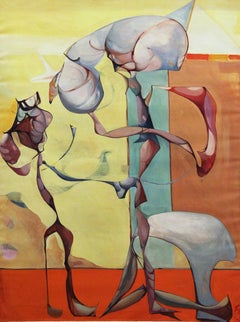
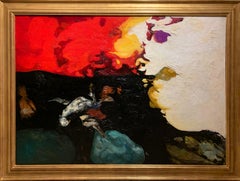
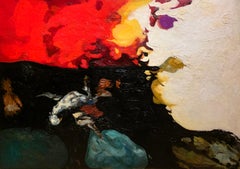
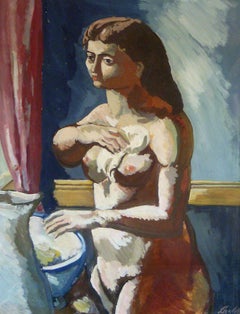
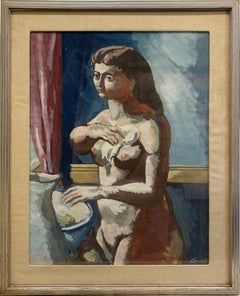
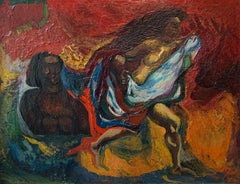
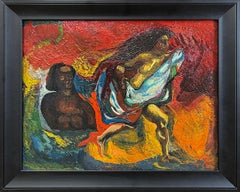
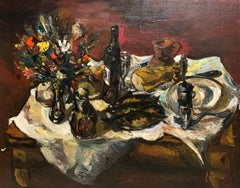
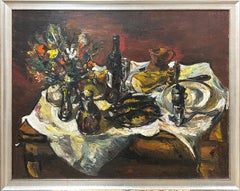
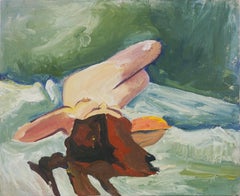
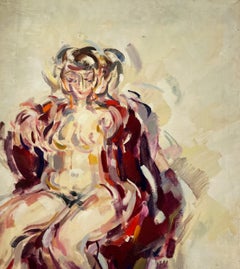
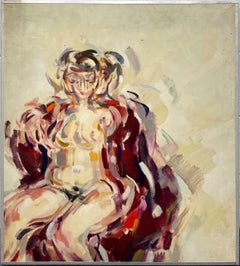
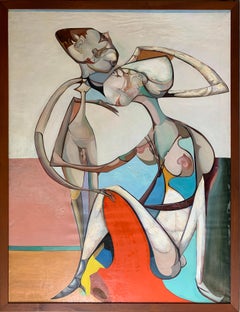
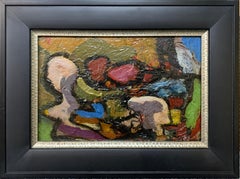
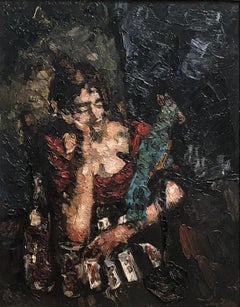
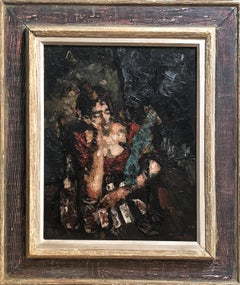
The Fortune Teller (Woman with Playing Cards, a Bottle of Wine, and a Parrot), circa 1926
Oil on canvasboard
20 x 16 inches
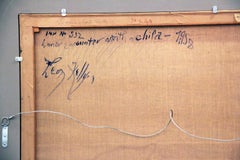
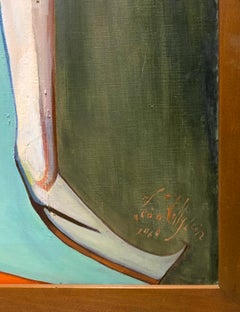
Signed lower right
Housed in a distressed wooden frame
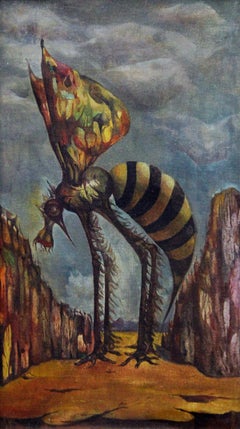
Leon Kelly is admired as one of America’s most talented surrealist painters. He exhibited alongside Salvador Dali, Yves Tanguy, Max Ernst, Marcel Duchamp, Arshile Gorky, Roberto Matta, and Eugene Berman at the premier gallery for Surrealism in America, the Julien Levy Gallery. However, it is widely acknowledged that along the path to a deep understanding of Surrealism, Kelly mastered many artistic styles. He skillfully moved from a modernist approach to Impressionism, through Pointillism, Purism, Fauvism, Geometric Abstraction, Analytical Cubism, and in the 1960’s, a bold, more robust Baroque style of painting and drawing.
Kelly’s talent was clear from childhood, particularly his ability to draw. At 13, he took private painting lessons from Albert Jean Adolphe at the School of Industrial Art, now the University of the Arts, in Philadelphia. He enhanced his artistic education by copying Old Master paintings and drawing animals at the Philadelphia Zoo. Several years later, Kelly briefly studied sculpture with Alexander Portnoff before joining the Quartermaster Corp at the Army Depot at the outbreak of World War II.
Kelly’s family’s financial situation changed in 1920 when his father’s tailoring business failed and his parents divorced. The young Kelly was now forced to support his mother and grandmother and over the next four years, he worked evenings at a bakery. With his days free, Kelly studied anatomy at the Philadelphia School of Osteopathy and mastered an understanding of the human body by dissecting a cadaver. Around this time, he met the artist Earl Horter with whom he studied etching. Horter had an important collection of European modern art which exposed Kelly to artists such as Brancusi, Matisse, Picasso and Braque, among others, and opened his mind to the new artistic movements in Paris. Kelly enrolled at the Pennsylvania Academy of the Fine Arts in 1922 where he flourished under the guidance of Arthur B. Carles. Kelly’s artistic talents were apparent and according to the artist’s family, Carles declared him to be his best student.
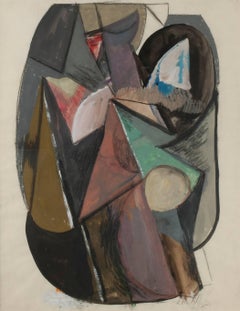
In 1925, Kelly traveled in Europe for four months on a Cresson Fellowship. After his return to Philadelphia, he enrolled again at the Academy. Soon thereafter, Kelly moved to Paris where he lived for the next six years. While living in his apartment at 19 rue Daguerre he painted The Musician, a work that reflects Kelly’s engagement with Analytic Cubism as practiced by Pablo Picasso, Georges Braque and Juan Gris.
Although his finances during this period were bleak, Kelly’s intellectual and cultural life were rich. He met Henry Miller, James Joyce and the well-known anarchist and art critic Felix Feneon. At this time, museums and important collectors began purchasing his works and he received the patronage of Albert Barnes. While exploring the current modern styles, Kelly continued his practice of copying old master paintings at the Louvre.
During this period, Kelly’s paintings were included in numerous exhibitions, both group and solo, primarily to favorable reviews. In October 1934, several of his works were among those included in the Second Regional Exhibition of Painting and Prints by Philadelphia Artists at the Whitney Museum in New York. At this time, Kelly created studies for a mural, now lost, in the School Administration Building under the Philadelphia Public Works of Art Project.
In 1940, Julien Levy recognized Kelly’s talent immediately and included Kelly’s work in his gallery located on 57th St. in New York. The first exhibition in 1941 was held at the Art Alliance in Philadelphia and was followed the next year with a solo show in New York. Kelly’s second solo exhibition at Julien Levy Gallery was held in 1944. In a letter to Kelly, Tanguy reported that when Alfred Barr, the first director of the Museum of Modern Art, saw the exhibition, Barr declared that Kelly was one of the best American draftsmen.
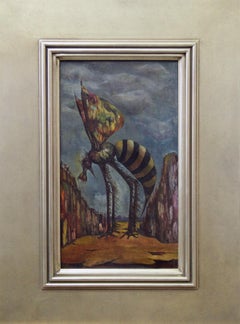
Surrealism, a movement which sought to release the creative potential of the unconscious mind, was now fully occupying Kelly’s canvases...
Category
1920s American Modern Leon Kelly Paintings