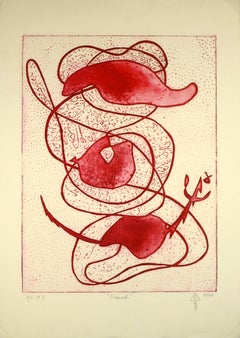
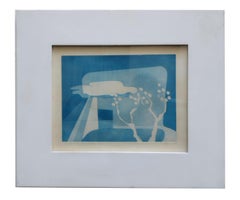
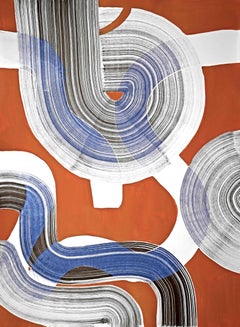
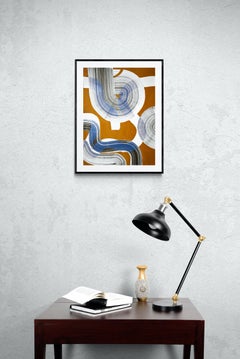
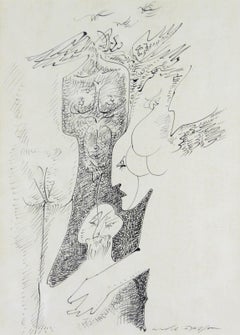
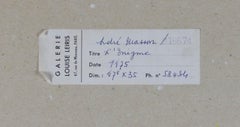
By Paul Jenkins
Located in New York, NY
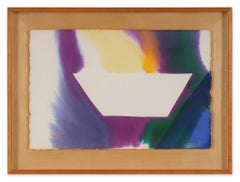
As a teen, Paul Jenkins worked with ceramicist James Weldon which led to a fascination with glazes; Jenkins cultivated and eventually achieved a similar effect in his paintings by mixing oil and enamel on canvas in the 50s. In 1937, Jenkins attended classes at the Kansas City Art Institute where he painted his first series of watercolors he called interior landscapes inspired by caves in the Ozarks. After serving in the US Naval Air Corps for 2 years, Jenkins moved to New York to study with Yasuo Kuniyoshi and Morris Kantor at the Art Students League from 1948 to 1952. During those years, Jenkins met Mark Rothko, Jackson Pollock and Barnett Newman.
In 1953 left for Paris where he discovered and was struck by the color density and luminosity in abstract oil works termed ébauches by Gustave Moreau and pastels by Odilon Redon. He began to experiment with poured paints in various thicknesses on canvas and paper and found this technique achieved luminosity of color which in its own way was comparable to that of Moreau and Redon. The next year, Jenkins added Winsor Newton pigments and chrysochrome, a viscous enamel paint, into his poured paintings, further enriching their color density and incandescence. The next major development in technique came in 1959 when he began using an ivory knife to guide the flow of paint. That same year, he also began to title his paintings Phenomena followed by a key word or phrase. A film on Jenkins' technique titled The Ivory Knife: Paul Jenkins at Work was shown at the Museum of Modern Art and received the Golden Eagle Award at the Venice Film Festival in 1966.
In 1954 Jenkins had his first solo exhibition in Paris where he met Martha Jackson, whose New York gallery included Jenkins in a group show the following year. In 1956, Martha Jackson Gallery held a solo exhibition of Jenkins’ work at which Divining Rod...
Category
1980s Abstract Expressionist Lilly McElroy Art
MaterialsWatercolor, Paper