By Jean Lurçat
Located in Southampton, NY
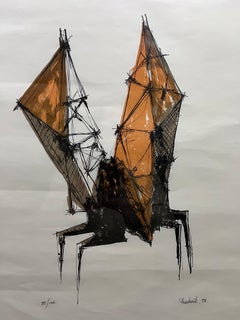
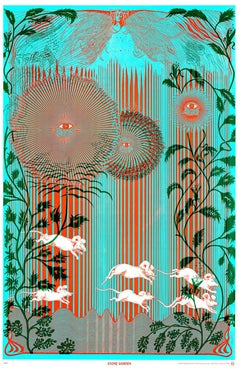
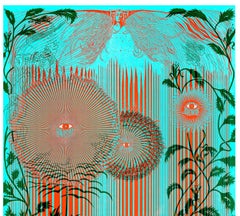
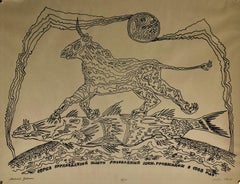
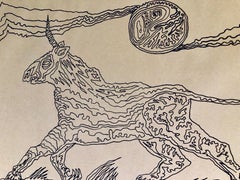
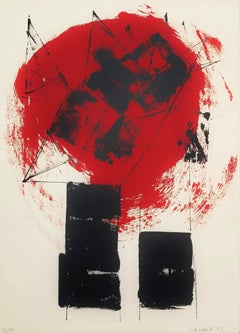
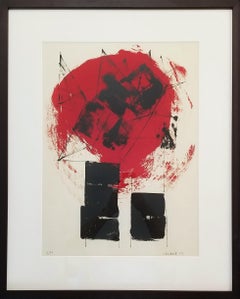
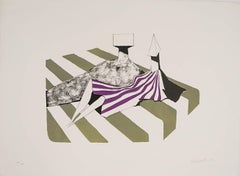
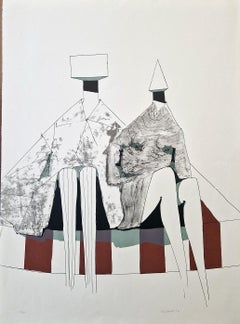
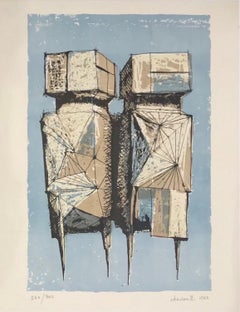
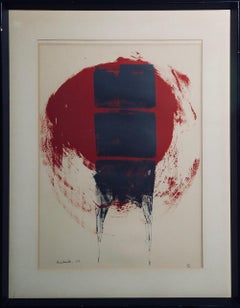
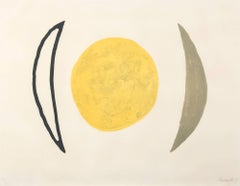
This exquisite lithograph after Jean Lurcat (1892–1966), titled Carpe de Lune (Carp of the Moon), from Geographie animale (Animal Geography), originates from the January 22, 1975 issue published by Production Edito-Service S.A., Geneve in collaboration with Andre Gonin, Lausanne, and M. Jean Graven, Paris, and printed by Edito-Service S.A., Italy, 1975. This visionary composition reflects Lurcats mastery of the lithographic medium, embodying his poetic imagination through fluid line, expressive form, and a luminous sense of movement. The work conveys the artists unique ability to merge symbolism, nature, and emotion into a cohesive visual language, transforming even the simplest subject into a deeply evocative and dreamlike image. Infused with lyricism and spiritual resonance, the composition exemplifies Lurcats enduring exploration of mythology, cosmic order, and the transcendent power of art. The piece forms part of Geographie animale (Animal Geography), a landmark publication that documents and celebrates one of the most significant aspects of his graphic oeuvre.
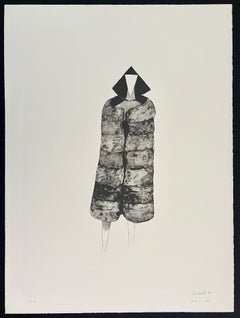
Executed as a lithograph on bouffant des Papeteries de Hauteville paper, this work measures 12.4 x 9.37 inches (31.5 x 23.8 cm). Unsigned and unnumbered as issued. The edition exemplifies the superb craftsmanship of the Edito-Service atelier, renowned for its refined European printing collaborations.
Artwork Details:
Artist: After Jean Lurcat (1892–1966)
Title: Carpe de Lune (Carp of the Moon), from Geographie animale (Animal Geography), January 22, 1975
Medium: Lithograph on bouffant des Papeteries de Hauteville paper
Dimensions: 12.4 x 9.37 inches (31.5 x 23.8 cm)
Inscription: Unsigned and unnumbered as issued
Date: 1975
Publisher: Production Edito-Service S.A., Geneve in collaboration with Andre Gonin, Lausanne, and M. Jean Graven, Paris
Printer: Edito-Service S.A., Italy
Condition: Well preserved, consistent with age and medium
Provenance: From Geographie animale (Animal Geography), published by Production Edito-Service S.A., Geneve, 1975
Notes:
Excerpted from the folio (translated from French), This edition of the Animal Geography by Jean Lurcat was established by publisher Andre Gonin in Lausanne, with the collaboration of Mr. Jean Graven. The lithographs were taken in the workshops of the Graphic Arts J.- E. Wolfensberger in Zurich, under the personal direction of the artist. The stones were sanded after the draw. The text, in Caslon character, body twenty, was composed and printed in Geneva, on velin pur fil a la forme des papeteries du Marais, by the master printer Andre Kundig with the help of Marc Barraud and Auguste Griess. The final to shot was given the iron June 1948. This second edition, 23.8 x 31.5 cm, was drawn with the authorization of Andre Gonin on Velin bouffant des Papeteries de Hauteville.
About the Publication:
Geographie animale (Animal Geography) stands as one of the most imaginative printed projects associated with Jean Lurcat, uniting visual invention, literary wit, and refined European craftsmanship in a richly conceived publication devoted to the symbolic world of animals. Originally conceived under the guidance of publisher Andre Gonin and later issued in this authorized 1975 edition by Production Edito-Service S.A. of Geneve in collaboration with partners in Lausanne and Paris, the publication reflects the enduring appeal of Lurcats bestiary imagery and philosophical approach to nature. The lithographs were prepared in the workshops of J.- E. Wolfensberger in Zurich under the artists personal supervision, demonstrating the close relationship between artist and printer that characterized the finest twentieth century illustrated editions. More than a portfolio of images, Geographie animale (Animal Geography) is a meditation on the animal kingdom as metaphor, presenting creatures as emblems of instinct, wisdom, humor, vigilance, and cosmic order. Through its union of image, typography, and material elegance, the publication remains an important testament to the vitality of postwar European graphic art and to Lurcats singular ability to merge intellect, decoration, and poetic symbolism.
About the Artist:
Jean Lurcat (1892–1966) was a pioneering French painter, ceramicist, and tapestry master who transformed the ancient art of tapestry into a modern, intellectual, and spiritual medium, establishing himself as one of the most original and influential artists of the 20th century. Born in Bruyeres, France, Lurcat studied in Nancy and Paris, where he became part of the avant-garde circle that included Pablo Picasso, Alexander Calder, Alberto Giacometti, Salvador Dali, Joan Miro, Wassily Kandinsky, Marcel Duchamp, and Man Ray. His early paintings reflected the influence of Post-Impressionism, Cubism, and Symbolism, but his true innovation came when he reimagined tapestry as a form of monumental art rather than decorative craft. Profoundly inspired by the medieval Apocalypse of Angers tapestry, he sought to revive the grandeur of weaving by fusing ancient techniques with modernist abstraction and symbolism. In the 1930s, working with the Aubusson and Gobelins workshops, Lurcat revolutionized the process of tapestry-making by introducing a precise color notation system and standardizing thread palettes, allowing artists to maintain creative control from conception to completion. His bold compositions radiant with color, geometric rhythm, and allegorical imagery embodied a philosophy of cosmic balance and human resilience. After World War II, Lurcats work deepened in moral and spiritual scope, culminating in his monumental cycle Le Chant du Monde (The Song of the World, 1957–1965), a humanist response to the destruction of war and one of the greatest artistic achievements of the postwar era. His art, characterized by suns, moons, mythic creatures, and symbolic geometry, reflected his belief that art should harmonize intellect, craft, and emotion while reconnecting humanity to the natural and divine order. A contemporary and peer of Pablo Picasso, Alexander Calder, Alberto Giacometti, Salvador Dali, Joan Miro, Wassily Kandinsky, Marcel Duchamp, and Man Ray, Lurcat shared their passion for abstraction and innovation while extending it into the tactile, enduring world of textile art. His influence resonated with later artists and designers such as Fernand Leger, Sonia Delaunay, Le Corbusier, and Victor Vasarely, whose integration of color and geometry echoed his ideas. His work is preserved in major collections including the Musee Jean Lurcat et de la Tapisserie Contemporaine in Angers, the Musee d’Art Moderne de Paris, and the Centre Pompidou. The highest auction record for Jean Lurcat was achieved by Apocalypse Tapestry, which sold for $290,500 USD at Sotheby’s, Paris, on May 29, 2014, underscoring his enduring legacy as the visionary who redefined tapestry as a cornerstone of modern art.
Jean Lurcat Carpe de Lune, Lurcat Geographie animale, Jean Lurcat lithograph...
Category
1970s Modern Lynn Chadwick Art