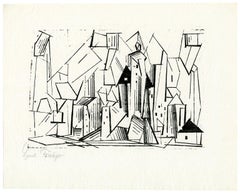
Lyonel Feininger Art
American, 1871-1956
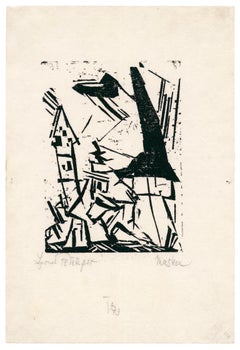
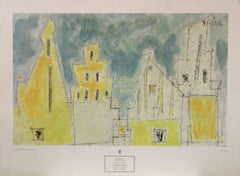
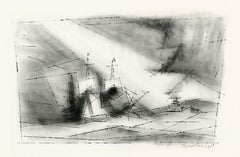
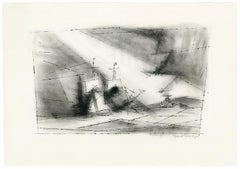
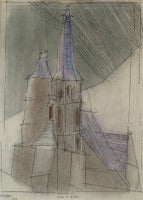
Lionel Feininger (1871–1956), a German-American painter, graphic artist, and caricaturist, developed a distinctive style influenced by Cubism and Expressionism. Born in New York City but raised in Germany, Feininger honed his skills at the Hamburg School of Arts and Crafts before studying under renowned artists in Berlin. Initially associated with the avant-garde group "Die Brücke" (The Bridge), Feininger's style evolved over time, gravitating towards Cubism after being inspired by artists like Picasso and Braque. His participation in the "Der Blaue Reiter" (The Blue Rider) exhibition in 1911 further solidified his reputation as an essential figure in the Expressionist movement. Returning to the United States during World War I, Feininger became associated with the American avant-garde, though the Nazis later targeted his works in the "Degenerate Art" exhibition. Feininger experimented with various mediums throughout his career, producing bold and vibrant works depicting urban landscapes and architectural motifs. His legacy as a pioneer of modern art continues to resonate, with his contributions to Cubism, Expressionism, and abstract art celebrated worldwide. Feininger passed away in 1956, leaving behind a rich and influential body of work.to
1
12
1
1
3
Overall Width
to
Overall Height
to
18
2
4
5
2
3
1
1
4
2
1
12
4
1
7
6
4
3
3
2
2
2
1
1
1
1
1
10
6
6
3
3
18
10,138
2,778
1,376
1,375
1
14
4
Artist: Lyonel Feininger
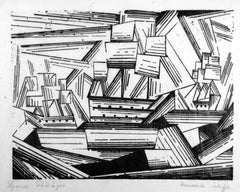
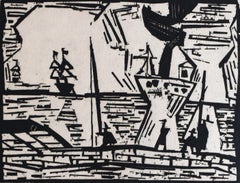
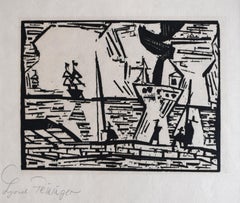
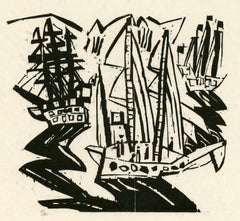
Kreuzende Segelschiffe 2 (Cruising Sailing Ships 2)
By Lyonel Feininger
Located in New York, NY
Lyonel Feininger, “Kreuzende Segelschiffe 2 (Cruising Sailing Ships 2)”
1919, Woodcut.
Prasse W175. Edition 275 unsigned for portfolio Die tunlte Jahresgabe des Kreises graphischer ...
Category
1910s Bauhaus Lyonel Feininger Art
Materials
Woodcut
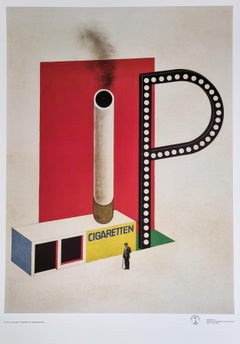
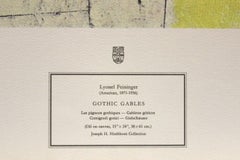
"Gothic Gables" New York Graphic Society 1966, Printed in Switzerland
By Lyonel Feininger
Located in Chesterfield, MI
"Gothic Gables" Poster/Print by LYONEL FEININGER (American-German, 1871-1956). The print measures approximately 20 x 27 inches and is unframed. Published by New York Graphic Society 1966. Printed in Switzerland...
Category
1960s Lyonel Feininger Art
Materials
Lithograph
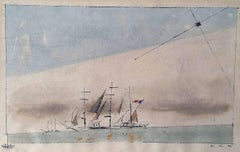
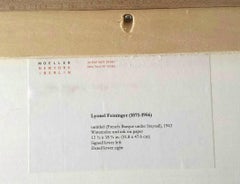
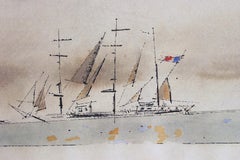
Bauhaus . Untitled (French Barque under Staysail)
By Lyonel Feininger
Located in Miami, FL
Bauhaus Iconic work by the master or Cubism and Expressionism
Dalzell Hatfield Gallery, Los Angeles
Bonhams,
Exhibited: Moller Fine Art, "Precision ...
Category
1940s Expressionist Lyonel Feininger Art
Materials
Watercolor, Pencil
Connecticut Hills
By Lyonel Feininger
Located in Miami, FL
This later work by Lyonel Feininger approaches almost full abstraction. It was executed in 1950 at a crucial moment in American art history. Abstract Expressionism and non-representational art were in full gear and taking the world by storm. Yet Feininger who was associated with the German expressionist groups: Die Brücke...
Category
1990s Abstract Expressionist Lyonel Feininger Art
Materials
India Ink, Watercolor
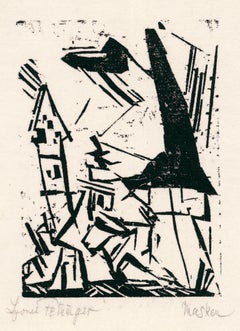
'Masken (Masks)' — German Expressionism, Bauhaus
By Lyonel Feininger
Located in Myrtle Beach, SC
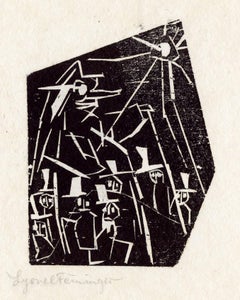
Lyonel Feininger, 'Masken (Masks)' also 'Carnival Masks', woodcut, 1920, proofs only. Prasse W193. Signed and titled in pencil. Annotated '1973', the artist’s inventory number. A fin...
Category
1920s Bauhaus Lyonel Feininger Art
Materials
Woodcut
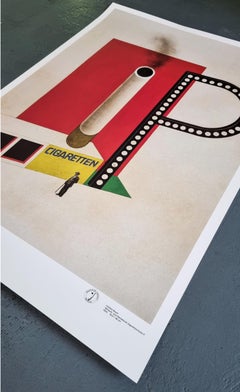
Bauhaus . Untitled (French Barque under Staysail)
By Lyonel Feininger
Located in Miami, FL
Bauhaus Iconic work by the master or Cubism and Expressionism
Dalzell Hatfield Gallery, Los Angeles
Bonhams,
Exhibited: Moller Fine Art, "Precision ...
Category
1940s Expressionist Lyonel Feininger Art
Materials
Watercolor, Pencil
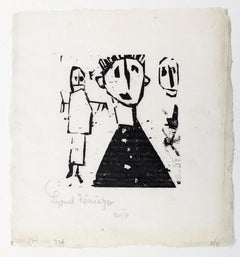
Stehkragen (rare hand signed woodcut)
By Lyonel Feininger
Located in Aventura, FL
Woodcut print on paper. Hand signed and dated by Lyonel Feininger. Unknow edition. Image size approx 3.9 x 3.9 inches. Sheet size 7 x 6.5 inches.
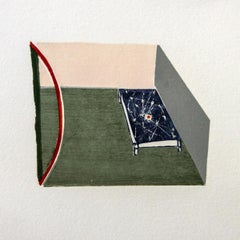
Artwork is in excellent conditio...
Category
1920s Contemporary Lyonel Feininger Art
Materials
Silk, Screen
$6,750 Sale Price
25% Off
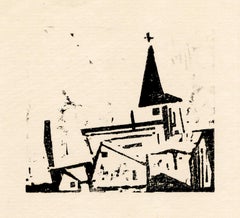
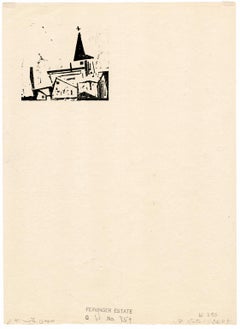
'Church with Star' – Artist's Personal Letterhead, Bauhaus Modernism
By Lyonel Feininger
Located in Myrtle Beach, SC
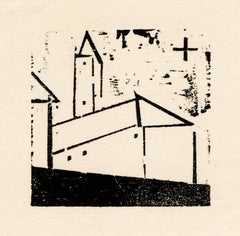
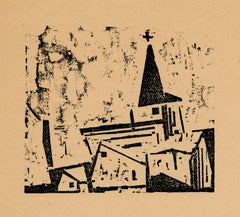
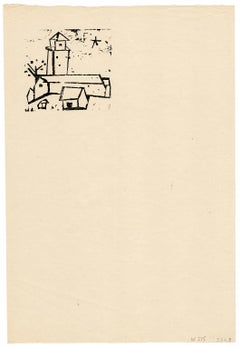
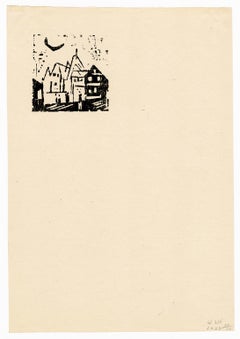
Lyonel Feininger, 'Church with Star (Kirche mit Stern)', woodcut, 1936, one of a small but unknown number of letterhead proofs; Prasse W265. Annotated 'W 265' (Feininger catalogue number) and inventory no. '2808' in pencil, in the bottom right sheet corner. A fine impression, on cream, laid letterhead stock; hinge remains on the left and right top sheet edges, verso, in excellent condition. Very scarce.
Image size 2 3/8 x 2 3/8 inches; sheet size 10 1/16 x 7 1/16 inches. Archivally sleeved, unmatted.
ABOUT THE ARTIST
Lyonel Feininger (1871-1956) was born in New York City into a musical family—his father was a violinist and composer, his mother was a singer and pianist. He studied violin with his father, and by the age of 12, he was performing in public, but he also drew incessantly, most notably the steamboats and sailing ships on the Hudson and East Rivers, and the landscape around Sharon, Conn., where he spent time on a farm owned by a family friend. At the age of 16 he left New York to study music and art in Germany, from where his parents emigrated. Drawn more to the visual arts, he attended schools in Hamburg, Berlin, and Paris from 1887 to 1892.
After completing his studies, Feininger began his artistic career as a cartoonist and illustrator, his originality leading him to great success. In 1906, after working for a dozen years in Germany, he was offered a job as a cartoonist at the Chicago Tribune, the largest circulation newspaper in the Midwest. He worked there for a year, inventing what became the standard design for the comic strip: in the words of John Carlin, “an overall pattern. . . that allowed the page to be read both as a series of elements one after the other, like language and as a group of juxtaposed images, like visual art.” His originality did not end there: he went on to become one of the great abstract painters. Like Kandinsky, music was his model, but Kandinsky only knew music from the outside—as a listener (inspired initially by Wagner, then by Schoenberg)—while Feininger knew it from the inside. He lived in Paris from 1906 to 1908, during which time he met and was influenced by the work of progressive painters Robert Delaunay and Jules Pascin, as well as that of Paul Cezanne and Vincent van Gogh. He began painting full-time, developing his distinctive Iyrical style based on Cubist and Expressionist idioms and a concern for the emotive qualities of light and color. He exhibited with the Der Blaue Reiter group in 1913, and in 1917, he had his first solo exhibition at Galerie Der Sturm in Berlin.
One year after his solo exhibition, in 1918, Feininger began making woodcuts. He became enamored with the medium, producing an impressive 117 in his first year of exploring the printmaking medium. In 1919 at the invitation of the architect Walter Gropius, he was appointed the first master at the newly formed Staatliches Bauhaus in Weimar. His woodcut of a cathedral crowned...
Category
1930s Bauhaus Lyonel Feininger Art
Materials
Woodcut
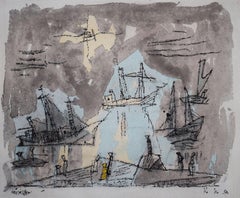
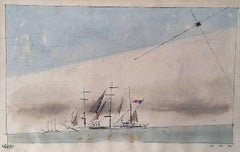
Sailing Ships, Boats, and Figures on the Shore - Sailing Ships Coastline
By Lyonel Feininger
Located in London, GB
This work is hand signed in ink by the artist “Feininger” in the lower left margin.
It is also dated in black ink "ii . ix . 50" [2nd September 1950] at the lower right corner.
Pro...
Category
1950s Lyonel Feininger Art
Materials
Paper, Ink, Watercolor, Pen
'Da - Da I' — German Expressionism, Rare
By Lyonel Feininger
Located in Myrtle Beach, SC
Lyonel Feininger, 'Da-Da I' also titled by the artist 'Der Abgott' (The Idol), woodcut, 1918, a proof impression. Prasse W91. Signed in pencil and annotated '1876', the artist’s inv...
Category
1920s Bauhaus Lyonel Feininger Art
Materials
Woodcut
Three Figures with Umbrellas - Watercolor German American Bauhaus
By Lyonel Feininger
Located in London, GB
This work is hand signed in ink by the artist "Feininger" at the upper right corner.
Provenance:
The Collection of Peter Kamnitzer.
Peter Kamnitzer (1922-2016) was a renowned and r...
Category
1950s Bauhaus Lyonel Feininger Art
Materials
Paper, Ink, Watercolor, Pen
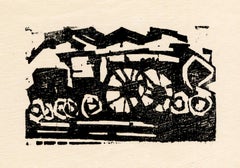
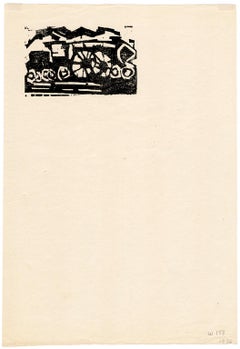
'Little Locomotive' – Artist's Personal Letterhead, Bauhaus Modernism
By Lyonel Feininger
Located in Myrtle Beach, SC
Lyonel Feininger, 'Little Locomotive (Kleine Lokomotive)', woodcut, 1936, one of a small but unknown number of letterhead proofs; Prasse W158. Annotated 'W 158' (Feininger catalogue number) and '1936' in pencil, in the bottom right sheet corner.
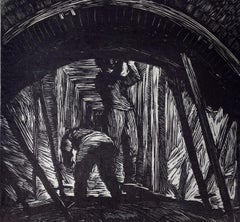
A fine impression, on cream, laid letterhead stock; hinge remains on the left and right top sheet edges, verso, in excellent condition. Very scarce.
Image size 2 1/4 x 3 5/16 inches; sheet size 10 x 7 inches. Archivally sleeved, unmatted.
Exhibited: 'Lyonel Feininer, Woodcuts Used As Letterheads'; Associated American Artists; Feb 4 - March 2, 1974; New York, NY.
Collections: Cleveland Museum of Art, Museum of Modern Art, Staatliche Museen zu Berlin (East Berlin KK).
ABOUT THE ARTIST
Lyonel Feininger (1871-1956) was born in New York City into a musical family—his father was a violinist and composer, his mother was a singer and pianist. He studied violin with his father, and by the age of 12, he was performing in public, but he also drew incessantly, most notably the steamboats and sailing ships on the Hudson and East Rivers, and the landscape around Sharon, Conn., where he spent time on a farm owned by a family friend. At the age of 16 he left New York to study music and art in Germany, from where his parents emigrated. Drawn more to the visual arts, he attended schools in Hamburg, Berlin, and Paris from 1887 to 1892.
After completing his studies, Feininger began his artistic career as a cartoonist and illustrator, his originality leading him to great success. In 1906, after working for a dozen years in Germany, he was offered a job as a cartoonist at the Chicago Tribune, the largest circulation newspaper in the Midwest. He worked there for a year, inventing what became the standard design for the comic strip: in the words of John Carlin, “an overall pattern. . . that allowed the page to be read both as a series of elements one after the other, like language and as a group of juxtaposed images, like visual art.” His originality did not end there: he went on to become one of the great abstract painters. Like Kandinsky, music was his model, but Kandinsky only knew music from the outside—as a listener (inspired initially by Wagner, then by Schoenberg)—while Feininger knew it from the inside. He lived in Paris from 1906 to 1908, during which time he met and was influenced by the work of progressive painters Robert Delaunay and Jules Pascin, as well as that of Paul Cezanne and Vincent van Gogh. He began painting full-time, developing his distinctive Iyrical style based on Cubist and Expressionist idioms and a concern for the emotive qualities of light and color. He exhibited with the Der Blaue Reiter group in 1913, and in 1917, he had his first solo exhibition at Galerie Der Sturm in Berlin.
One year after his solo exhibition, in 1918, Feininger began making woodcuts. He became enamored with the medium, producing an impressive 117 in his first year of exploring the printmaking medium. In 1919 at the invitation of the architect Walter Gropius, he was appointed the first master at the newly formed Staatliches Bauhaus in Weimar. His woodcut of a cathedral crowned...
Category
1930s Bauhaus Lyonel Feininger Art
Materials
Woodcut
'Three Masted Ship, 2' – Artist's Personal Letterhead, Bauhaus Modernism
By Lyonel Feininger
Located in Myrtle Beach, SC
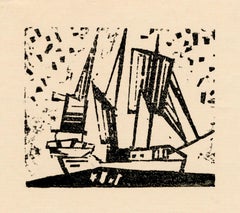
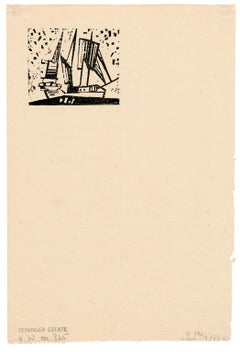
Lyonel Feininger, 'Three Masted Ship, 2 (Dreimastiges Schiff, 2)', woodcut, 1937, one of a small but unknown number of letterhead proofs; Prasse W296. Feininger estate stamp and inventory no. 'W 865' in pencil, bottom left sheet corner. Annotated 'W 296' and 'on block : 3702a' in pencil, bottom right sheet corner.
A fine impression, on cream, laid, letterhead stock; hinge remains on the left and right top sheet edges, verso, in excellent condition. Very scarce.
Image size 2 1/4 x 2 11/16 inches; sheet size 10 x 6 3/4 inches. Archivally sleeved, unmatted.
Exhibited: 'Lyonel Feininer, Woodcuts Used As Letterheads'; Associated American Artists; Feb 4 - March 2, 1974; New York, NY.
ABOUT THE ARTIST
Lyonel Feininger (1871-1956) was born in New York City into a musical family—his father was a violinist and composer, his mother was a singer and pianist. He studied violin with his father, and by the age of 12, he was performing in public, but he also drew incessantly, most notably the steamboats and sailing ships on the Hudson and East Rivers, and the landscape around Sharon, Conn., where he spent time on a farm owned by a family friend. At the age of 16 he left New York to study music and art in Germany, from where his parents emigrated. Drawn more to the visual arts, he attended schools in Hamburg, Berlin, and Paris from 1887 to 1892.
After completing his studies, Feininger began his artistic career as a cartoonist and illustrator, his originality leading him to great success. In 1906, after working for a dozen years in Germany, he was offered a job as a cartoonist at the Chicago Tribune, the largest circulation newspaper in the Midwest. He worked there for a year, inventing what became the standard design for the comic strip: in the words of John Carlin, “an overall pattern. . . that allowed the page to be read both as a series of elements one after the other, like language and as a group of juxtaposed images, like visual art.” His originality did not end there: he went on to become one of the great abstract painters. Like Kandinsky, music was his model, but Kandinsky only knew music from the outside—as a listener (inspired initially by Wagner, then by Schoenberg)—while Feininger knew it from the inside. He lived in Paris from 1906 to 1908, during which time he met and was influenced by the work of progressive painters Robert Delaunay and Jules Pascin, as well as that of Paul Cezanne and Vincent van Gogh. He began painting full-time, developing his distinctive Iyrical style based on Cubist and Expressionist idioms and a concern for the emotive qualities of light and color. He exhibited with the Der Blaue Reiter group in 1913, and in 1917, he had his first solo exhibition at Galerie Der Sturm in Berlin.
One year after his solo exhibition, in 1918, Feininger began making woodcuts. He became enamored with the medium, producing an impressive 117 in his first year of exploring the printmaking medium. In 1919 at the invitation of the architect Walter Gropius, he was appointed the first master at the newly formed Staatliches Bauhaus in Weimar. His woodcut of a cathedral crowned...
Category
1930s Bauhaus Lyonel Feininger Art
Materials
Woodcut
'Church with House and Tree' – Artist's Personal Letterhead, Bauhaus Modernism
By Lyonel Feininger
Located in Myrtle Beach, SC
Lyonel Feininger, 'Church with House and Tree (Kirche mit Haus und Baum)', woodcut, 1936, one of a small but unknown number of letterhead proofs; Prasse W290 V. Inscribed 'J. F. note paper', in pencil, in the artist’s hand; with the Feininger estate stamp and catalog no. 'W 859' in pencil. Annotated 'W.290 V state 3609' in pencil, in the bottom right sheet corner.
A fine impression, on cream, laid letterhead stock; hinge remains on the left and right top sheet edges, verso, in excellent condition. Very scarce.
Image size 2 3/8 x 2 3/4 inches; sheet size 10 x 7 5/16 inches. Archivally sleeved, unmatted.
Exhibited: 'Lyonel Feininer, Woodcuts Used As Letterheads'; Associated American Artists; Feb 4 - March 2, 1974; NY, NY.
ABOUT THE ARTIST
Lyonel Feininger (1871-1956) was born in New York City into a musical family—his father was a violinist and composer, his mother was a singer and pianist. He studied violin with his father, and by the age of 12, he was performing in public. Still, he also drew incessantly, most notably the steamboats and sailing ships on the Hudson and East Rivers, and the landscape around Sharon, Conn., where he spent time on a farm owned by a family friend. At the age of 16 he left New York to study music and art in Germany, from where his parents emigrated. Drawn more to the visual arts, he attended schools in Hamburg, Berlin, and Paris from 1887 to 1892.
After completing his studies, Feininger began his artistic career as a cartoonist and illustrator, his originality leading him to great success. In 1906, after working for a dozen years in Germany, he was offered a job as a cartoonist at the Chicago Tribune, the largest circulation newspaper in the Midwest. He worked there for a year, inventing what became the standard design for the comic strip: in the words of John Carlin, “an overall pattern. . . that allowed the page to be read both as a series of elements one after the other, like language and as a group of juxtaposed images, like visual art.” His originality did not end there: he went on to become one of the great abstract painters. Like Kandinsky, music was his model, but Kandinsky only knew music from the outside—as a listener (inspired initially by Wagner, then by Schoenberg)—while Feininger knew it from the inside. He lived in Paris from 1906 to 1908, during which time he met and was influenced by the work of progressive painters Robert Delaunay and Jules Pascin, as well as that of Paul Cezanne and Vincent van Gogh. He began painting full-time, developing his distinctive Iyrical style based on Cubist and Expressionist idioms and a concern for the emotive qualities of light and color. He exhibited with the Der Blaue Reiter group in 1913, and in 1917, he had his first solo exhibition at Galerie Der Sturm in Berlin.
One year after his solo exhibition, in 1918, Feininger began making woodcuts. He became enamored with the medium, producing an impressive 117 in his first year of exploring the printmaking medium. In 1919 at the invitation of the architect Walter Gropius, he was appointed the first master at the newly formed Staatliches Bauhaus in Weimar. His woodcut of a cathedral crowned...
Category
1930s Bauhaus Lyonel Feininger Art
Materials
Woodcut
'Church with House and Tree' – Artist's Personal Letterhead, 1940s Modernism
By Lyonel Feininger
Located in Myrtle Beach, SC
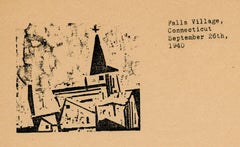
Lyonel Feininger, 'Church with House and Tree (Kirche mit Haus und Baum)', woodcut, 1936, one of a small but unknown number of letterhead proofs; Prasse W290 IV. Annotated 'PW 290 state IV / IV 3669', in pencil, in the bottom right sheet corner. With the artist's typed address and date adjacent to the letterhead image: 'Falls Village, Connecticut September 26th, 1940'.
A fine impression, on buff, wove letterhead stock; several small losses, and tears, in the sheet edges (not affecting the image area); a crease in the bottom right sheet edge, otherwise in good condition. Very scarce.
Image size: 2 3/8 x 2 3/4 inches; sheet size 11 x 8 5/8 inches. Archivally sleeved, unmatted.
Feininger moved from Germany to New York City in 1938 and began spending his summers in Falls Village in 1940.
Exhibited: 'Lyonel Feininer, Woodcuts Used As Letterheads'; Associated American Artists; Feb 4 - March 2, 1974; New York, NY.
ABOUT THE ARTIST
Lyonel Feininger (1871-1956) was born in New York City into a musical family—his father was a violinist and composer, his mother was a singer and pianist. He studied violin with his father, and by the age of 12, he was performing in public, but he also drew incessantly, most notably the steamboats and sailing ships on the Hudson and East Rivers, and the landscape around Sharon, Conn., where he spent time on a farm owned by a family friend. At the age of 16 he left New York to study music and art in Germany, from where his parents emigrated. Drawn more to the visual arts, he attended schools in Hamburg, Berlin, and Paris from 1887 to 1892.
After completing his studies, Feininger began his artistic career as a cartoonist and illustrator, his originality leading him to great success. In 1906, after working for a dozen years in Germany, he was offered a job as a cartoonist at the Chicago Tribune, the largest circulation newspaper in the Midwest. He worked there for a year, inventing what became the standard design for the comic strip: in the words of John Carlin, “an overall pattern. . . that allowed the page to be read both as a series of elements one after the other, like language and as a group of juxtaposed images, like visual art.” His originality did not end there: he went on to become one of the great abstract painters. Like Kandinsky, music was his model, but Kandinsky only knew music from the outside—as a listener (inspired initially by Wagner, then by Schoenberg)—while Feininger knew it from the inside. He lived in Paris from 1906 to 1908, during which time he met and was influenced by the work of progressive painters Robert Delaunay and Jules Pascin, as well as that of Paul Cezanne and Vincent van Gogh. He began painting full-time, developing his distinctive Iyrical style based on Cubist and Expressionist idioms and a concern for the emotive qualities of light and color. He exhibited with the Der Blaue Reiter group in 1913, and in 1917, he had his first solo exhibition at Galerie Der Sturm in Berlin.
One year after his solo exhibition, in 1918, Feininger began making woodcuts. He became enamored with the medium, producing an impressive 117 in his first year of exploring the printmaking medium. In 1919 at the invitation of the architect Walter Gropius, he was appointed the first master at the newly formed Staatliches Bauhaus in Weimar. His woodcut of a cathedral crowned...
Category
1930s Bauhaus Lyonel Feininger Art
Materials
Woodcut
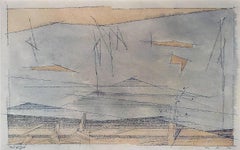
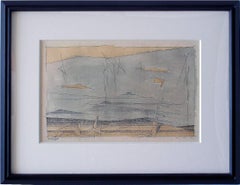
Connecticut Hills
By Lyonel Feininger
Located in Miami, FL
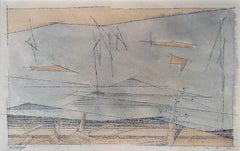
Executed in 1950 during the heyday of Abstract Expressionism and non-representational art, Feininger reduces a landscape to the bare minimums of lines and wash.
Moeller Fine Art
Category
1950s Abstract Geometric Lyonel Feininger Art
Materials
Watercolor, Pencil
Steamboat Odin Dampfer Odin - German Woodcut
By Lyonel Feininger
Located in London, GB
This original woodcut is hand signed in pencil "Lyonel Feininger" at the lower left margin.
It is also inscribed with the work number by the artist “1815” in the lower centre of the...
Category
1910s Expressionist Lyonel Feininger Art
Materials
Woodcut
On the Quay Wall Auf der Quaimauer, 1921
By Lyonel Feininger
Located in London, GB
LYONEL FEININGER 1871-1956
1871 - New York - 1956 (American/German)
Title: On the Quay Wall Auf der Quaimauer, 1921
Technique: Original Hand Signed Woodcut on Wove Paper
Paper...
Category
1920s Expressionist Lyonel Feininger Art
Materials
Woodcut
Related Items
Animals - Original Lithograph By Jean Lurçat - Mid-20th Century
By Jean Lurçat
Located in Roma, IT
Animals is an original artwork realized by Jean Lurçat (1892 Bruyeres - 1966 St.-Paul-de-Vence) .
Lithograph print, mid-20th Century.
Perfect conditions.
Jean Lurçat (1892-1966) ...
Category
1940s Modern Lyonel Feininger Art
Materials
Lithograph
$357
H 12.21 in W 9.26 in D 0.08 in
"Farewell, " Sunset Landscape Woodcut by Carol Summers
By Carol Summers
Located in Milwaukee, WI
"Farewell" is an original color woodcut by Carol Summers. The artist signed the piece. This woodcut depicts a river flowing through green hills beneath a blood-red sky. The edition number is 20/50.
24 1/4" x 37" art
32" x 45" frame
Carol Summers has worked as an artist throughout the second half of the 20th century and into the first years of the next, outliving most of his mid-century modernist peers. Initially trained as a painter, Summers was drawn to color woodcuts around 1950 and it became his specialty thereafter.
Over the years he has developed a process and style that is both innovative and readily recognizable. His art is known for it’s large scale, saturated fields of bold color, semi-abstract treatment of landscapes from around the world and a luminescent quality achieved through a printmaking process he invented.
In a career that has extended over half a century, Summers has hand-pulled approximately 245 woodcuts in editions that have typically run from 25 to 100 in number. His talent was both inherited and learned.
Born in 1925 in Kingston, a small town in upstate New York, Summers was raised in nearby Woodstock with his older sister, Mary. His parents were both artists who had met in art school in St. Louis. During the Great Depression, when Carol was growing up, his father supported the family as a medical illustrator until he could return to painting. His mother was a watercolorist and also quite knowledgeable about the different kinds of papers used for various kinds of painting. Many years later, Summers would paint or print on thinly textured paper originally collected by his mother.
From 1948 to 1951, Carol Summers trained in the classical fine and studio arts at Bard College and at the Art Students League of New York. He studied painting with Steven Hirsh and printmaking with Louis Schanker. He admired the shapes and colors favored by early modernists Paul Klee (Sw: 1879-1940) and Matt Phillips (Am: b.1927- ). After graduating, Summers quit working as a part-time carpenter and cabinetmaker (which had supported his schooling and living expenses) to focus fulltime on art. That same year, an early abstract, Bridge No. 1 was selected for a Purchase Prize in a competition sponsored by the Brooklyn Museum. In 1952, his work (Cathedral, Construction and Icarus) was shown the first time at the Museum of Modern Art in New York City in an exhibition of American woodcuts.
In 1954, Summers received a grant from the Italian government to study for a year in Italy. Woodcuts completed soon after his arrival there were almost all editions of only 8 to 25 prints, small in size, architectural in content and black and white in color. The most well-known are Siennese Landscape and Little Landscape, which depicted the area near where he resided. Summers extended this trip three more years, a decision which would have significant impact on choices of subject matter and color in the coming decade. After returning from Europe, Summers’ images continued to feature historical landmarks and events from Italy as well as from France, Spain and Greece. However, as evidenced in Aetna’s Dream, Worldwind and Arch of...
Category
1990s Lyonel Feininger Art
Materials
Woodcut
$7,900 / item
H 32 in W 45 in
Glen Orchy.
By David Young Cameron
Located in Plano, TX
Glen Orchy. c. 1925. Watercolor, pencil and conte crayon on paper. 9 1/4 x 13 (sheet 10 3/8 x 13 1/4). Ex-collection L.G. Duke,purchased at Sotheby's, London '10.12.70'. Mat line; ot...
Category
20th Century Modern Lyonel Feininger Art
Materials
Watercolor, Pencil
Joost Schmidt-Bauhaus Exhibition-1995- Vintage
Located in Brooklyn, NY
Schmidt's 1923 poster for the Bauhaus Exhibition is celebrated for its innovative use of geometric forms and typographic elements, reflecting the school's avant-garde approach to des...
Category
Mid-20th Century Bauhaus Lyonel Feininger Art
Materials
Offset
Original drawing-Golden Summer- British Awarded Artist, custom frame included.
Located in London, GB
Shizico spent three days painting this plein air in her sunlit garden. She applied 550 Ture Gold paint and Van Gogh Yellow creating a stunning backdrop which served as the canvas for...
Category
2010s Abstract Expressionist Lyonel Feininger Art
Materials
Gold
$617
H 16.54 in W 11.82 in D 0.04 in
FARMHOUSE WITH YELLOW FIELDS
By Junichiro Sekino
Located in Portland, ME
Sekino, Junchiro (Jaoanese, 1914-1988), FARMHOUSE WITH YELLOW FIELDS. Color Woodblock, not dated. Signed, Lower right. 13 3/8 x 19 inches, framed to 20 x 25 inches. In excellent cond...
Category
Mid-20th Century Lyonel Feininger Art
Materials
Woodcut
19th century color lithograph figures cemetery willow tree memorial headstone
By Nathaniel Currier
Located in Milwaukee, WI
The present hand-colored lithograph was produced as part of the funeral and mourning culture in the United States during the 19th century. Images like this were popular as ways of remembering loved ones, an alternative to portraiture of the deceased. This lithograph shows a man, woman and child in morning clothes next to an urn-topped stone monument. Behind are additional putto-topped headstones beneath weeping willows, with a steepled church beyond. The monument contains a space where a family could inscribe the name and death dates of a deceased loved one. In this case, it has been inscribed to a young Civil War soldier:
William W. Peabody
Died at Fairfax Seminary, VA
December 18th, 1864
Aged 18 years
The young Mr. Peabody probably died in service for the Union during the American Civil War. Farifax Seminary was a Union hospital and military headquarters in Alexandria, Virginia. The hospital served nearly two thousand soldiers during the war time. Five hundred were also buried on the Seminary's grounds.
13.75 x 9.5 inches, artwork
23 x 19 inches, frame
Published before 1864
Inscribed bottom center "Lith. & Pub. by N. Currier. 2 Spruce St. N.Y."
Framed to conservation standards using 100 percent rag matting and TruVue Conservation Clear glass, housed in a gold gilded moulding.
Nathaniel Currier was a tall introspective man with a melancholy nature. He could captivate people with his piercing stare or charm them with his sparkling blue eyes. Nathaniel was born in Roxbury, Massachusetts on March 27th, 1813, the second of four children. His parents, Nathaniel and Hannah Currier, were distant cousins who lived a humble yet spartan life. When Nathaniel was eight years old, tragedy struck. Nathaniel’s father unexpectedly passed away leaving Nathaniel and his eleven-year-old brother Lorenzo to provide for the family. In addition to their mother, Nathaniel and Lorenzo had to care for six-year-old sister Elizabeth and two-year-old brother Charles. Nathaniel worked a series of odd jobs to support the family, and at fifteen, he started what would become a life-long career when he apprenticed in the Boston lithography shop of William and John Pendleton.
A Bavarian gentleman named Alois Senefelder invented lithography just 30 years prior to young Nat Currier’s apprenticeship. While under the employ of the brothers Pendleton, Nat was taught the art of lithography by the firm’s chief printer, a French national named Dubois, who brought the lithography trade to America.
Lithography involves grinding a piece of limestone flat and smooth then drawing in mirror image on the stone with a special grease pencil. After the image is completed, the stone is etched with a solution of aqua fortis leaving the greased areas in slight relief. Water is then used to wet the stone and greased-ink is rolled onto the raised areas. Since grease and water do not mix, the greased-ink is repelled by the moisture on the stone and clings to the original grease pencil lines. The stone is then placed in a press and used as a printing block to impart black on white images to paper.
In 1833, now twenty-years old and an accomplished lithographer, Nat Currier left Boston and moved to Philadelphia to do contract work for M.E.D. Brown, a noted engraver and printer. With the promise of good money, Currier hired on to help Brown prepare lithographic stones of scientific images for the American Journal of Sciences and Arts. When Nat completed the contract work in 1834, he traveled to New York City to work once again for his mentor John Pendleton, who was now operating his own shop located at 137 Broadway. Soon after the reunion, Pendleton expressed an interest in returning to Boston and offered to sell his print shop to Currier. Young Nat did not have the financial resources to buy the shop, but being the resourceful type he found another local printer by the name of Stodart. Together they bought Pendleton’s business.
The firm ‘Currier & Stodart’ specialized in "job" printing. They produced many different types of printed items, most notably music manuscripts for local publishers. By 1835, Stodart was frustrated that the business was not making enough money and he ended the partnership, taking his investment with him. With little more than some lithographic stones, and a talent for his trade, twenty-two year old Nat Currier set up shop in a temporary office at 1 Wall Street in New York City. He named his new enterprise ‘N. Currier, Lithographer’
Nathaniel continued as a job printer and duplicated everything from music sheets to architectural plans. He experimented with portraits, disaster scenes and memorial prints, and any thing that he could sell to the public from tables in front of his shop. During 1835 he produced a disaster print Ruins of the Planter's Hotel, New Orleans, which fell at two O’clock on the Morning of the 15th of May 1835, burying 50 persons, 40 of whom Escaped with their Lives. The public had a thirst for newsworthy events, and newspapers of the day did not include pictures. By producing this print, Nat gave the public a new way to “see” the news. The print sold reasonably well, an important fact that was not lost on Currier.
Nat met and married Eliza Farnsworth in 1840. He also produced a print that same year titled Awful Conflagration of the Steamboat Lexington in Long Island Sound on Monday Evening, January 18, 1840, by which melancholy occurrence over One Hundred Persons Perished. This print sold out very quickly, and Currier was approached by an enterprising publication who contracted him to print a single sheet addition of their paper, the New York Sun. This single page paper is presumed to be the first illustrated newspaper ever published.
The success of the Lexington print launched his career nationally and put him in a position to finally lift his family up. In 1841, Nat and Eliza had their first child, a son they named Edward West Currier. That same year Nat hired his twenty-one year old brother Charles and taught him the lithography trade, he also hired his artistically inclined brother Lorenzo to travel out west and make sketches of the new frontier as material for future prints. Charles worked for the firm on and off over the years, and invented a new type of lithographic crayon which he patented and named the Crayola. Lorenzo continued selling sketches to Nat for the next few years.
In 1843, Nat and Eliza had a daughter, Eliza West Currier, but tragedy struck in early 1847 when their young daughter died from a prolonged illness. Nat and Eliza were grief stricken, and Eliza, driven by despair, gave up on life and passed away just four months after her daughter’s death.
The subject of Nat Currier’s artwork changed following the death of his wife and daughter, and he produced many memorial prints and sentimental prints during the late 1840s. The memorial prints generally depicted grief stricken families posed by gravestones (the stones were left blank so the purchasers could fill in the names of the dearly departed). The sentimental prints usually depicted idealized portraits of women and children, titled with popular Christian names of the day.
Late in 1847, Nat Currier married Lura Ormsbee, a friend of the family. Lura was a self-sufficient woman, and she immediately set out to help Nat raise six-year-old Edward and get their house in order. In 1849, Lura delivered a son, Walter Black Currier, but fate dealt them a blow when young Walter died one year later. While Nat and Lura were grieving the loss of their new son, word came from San Francisco that Nat’s brother Lorenzo had also passed away from a brief illness. Nat sank deeper into his natural quiet melancholy. Friends stopped by to console the couple, and Lura began to set an extra place at their table for these unexpected guests. She continued this tradition throughout their lives.
In 1852, Charles introduced a friend, James Merritt Ives, to Nat and suggested he hire him as a bookkeeper. Jim Ives was a native New Yorker born in 1824 and raised on the grounds of Bellevue Hospital where his father was employed as superintendent. Jim was a self-trained artist and professional bookkeeper. He was also a plump and jovial man, presenting the exact opposite image of his new boss.
Jim Ives met Charles Currier through Caroline Clark, the object of Jim’s affection. Caroline’s sister Elizabeth was married to Charles, and Caroline was a close friend of the Currier family. Jim eventually proposed marriage to Caroline and solicited an introduction to Nat Currier, through Charles, in hopes of securing a more stable income to support his future wife.
Ives quickly set out to improve and modernize his new employer’s bookkeeping methods. He reorganized the firm’s sizable inventory, and used his artistic skills to streamline the firm’s production methods. By 1857, Nathaniel had become so dependent on Jims’ skills and initiative that he offered him a full partnership in the firm and appointed him general manager. The two men chose the name ‘Currier & Ives’ for the new partnership, and became close friends.
Currier & Ives produced their prints in a building at 33 Spruce Street where they occupied the third, fourth and fifth floors. The third floor was devoted to the hand operated printing presses that were built by Nat's cousin, Cyrus Currier, at his shop Cyrus Currier & Sons in Newark, NJ. The fourth floor found the artists, lithographers and the stone grinders at work. The fifth floor housed the coloring department, and was one of the earliest production lines in the country. The colorists were generally immigrant girls, mostly German, who came to America with some formal artistic training. Each colorist was responsible for adding a single color to a print. As a colorist finished applying their color, the print was passed down the line to the next colorist to add their color. The colorists worked from a master print displayed above their table, which showed where the proper colors were to be placed. At the end of the table was a touch up artist who checked the prints for quality, touching-in areas that may have been missed as it passed down the line. During the Civil War, demand for prints became so great that coloring stencils were developed to speed up production.
Although most Currier & Ives prints were colored in house, some were sent out to contract artists. The rate Currier & Ives paid these artists for coloring work was one dollar per one hundred small folios (a penny a print) and one dollar per one dozen large folios. Currier & Ives also offered uncolored prints to dealers, with instructions (included on the price list) on how to 'prepare the prints for coloring.' In addition, schools could order uncolored prints from the firm’s catalogue to use in their painting classes.
Nathaniel Currier and James Merritt Ives attracted a wide circle of friends during their years in business. Some of their more famous acquaintances included Horace Greeley, Phineas T. Barnum, and the outspoken abolitionists Rev. Henry Ward, and John Greenleaf Whittier (the latter being a cousin of Mr. Currier).
Nat Currier and Jim Ives described their business as "Publishers of Cheap and Popular Pictures" and produced many categories of prints. These included Disaster Scenes, Sentimental Images, Sports, Humor, Hunting Scenes, Politics, Religion, City and Rural Scenes, Trains, Ships, Fire Fighters, Famous Race Horses, Historical Portraits, and just about any other topic that satisfied the general public's taste. In all, the firm produced in excess of 7500 different titles, totaling over one million prints produced from 1835 to 1907.
Nat Currier retired in 1880, and signed over his share of the firm to his son Edward. Nat died eight years later at his summer home 'Lion’s Gate' in Amesbury, Massachusetts. Jim Ives remained active in the firm until his death in 1895, when his share of the firm passed to his eldest son, Chauncey.
In 1902, faced will failing health from the ravages of Tuberculosis, Edward Currier sold his share of the firm to Chauncey Ives...
Category
Mid-19th Century Romantic Lyonel Feininger Art
Materials
Watercolor, Lithograph
19th century color lithograph watercolor landscape figurative animal print
By Nathaniel Currier
Located in Milwaukee, WI
The present hand-colored lithograph presents the viewer with a hunting scene in a picturesque landscape. In the foreground, a man approaches two partridges as his two pointers prepare to flush them out. Beyond, a white fence draws our eyes to the homestead in the distance. Images like this one show how people in the United States were trying to identify themselves as a new nation in the North American landscape - as separate from their European counterparts but with similar similar and specific wildlife and magesties of nature. It also identifies hunting in this landscape as an American pastime.
9.25 x 12.5 inches, artwork
18.38 x 22 inches, frame
Entitled bottom center "Partridge Shooting...
Category
Mid-19th Century Romantic Lyonel Feininger Art
Materials
Watercolor, Lithograph
"NY Street Signs" Mid-20th Century WPA 1938 Modernist Abstract Realism Pop Art
By Stuart Davis
Located in New York, NY
"NY Street Signs" Mid-20th Century WPA 1938 Modernist Abstract Realism Pop Art
Stuart Davis (American, 1892-1964) "Street Signs" Modernist gouache and traces of pencil on paper in the proto-pop art style Davis is celebrated for, 1938, signed to lower right, framed. Image: 11 1/4 x 15 1/4 inches. Frame by Bark: 18 1/2 x 22 inches.
LITERATURE: A, Boyajian, M. Rutkowski, Stuart Davis, A Catalogue Raisonne, Vol. 2, New Haven, Connecticut, 2007, vol. II, p. 632, no. 1232, illustrated.
EXHIBITIONS: ACA Galleries, New York American Artists' Congress: Group Exhibition of Paintings and Sculpture, Dec. 3-16, 1939 (SDAB I, 12/3/39, p. 129). Outlines Gallery, Pittsburgh, Stuart Davis, Mar. 3-16, 1946. Coleman Art Gallery, Philadelphia, 5 Prodigal Sons: Former Philadelphia Artists: Ralston Crawford, Stuart Davis, Charles Demuth, Julian Levi, Charles Sheeler, Oct 4 - 30, 1947 (pamphlet), no. 12.
PROVENANCE: The artist; Mr. and Mrs. Frank Bowles, New York, Apr. 3, 1956; thence by descent, Private Collection, New York.
NOTES: According to the Catalogue Raissonne, "the title 'Street Signs' is recorded in the artist's account books...
Category
1930s American Modern Lyonel Feininger Art
Materials
Paper, Gouache, Pencil
$125,000
H 18.5 in W 22 in D 1 in
Mid-Century Shapes IV, White and Blue Abstract Floating Shapes, Unique Cyanotype
By Kind of Cyan
Located in Barcelona, ES
This is an exclusive handprinted unique cyanotype that takes its inspiration from the mid-century modern shapes.
It's made by layering paper cutouts and different exposures using uv-...
Category
2010s Bauhaus Lyonel Feininger Art
Materials
Photographic Film, Emulsion, Watercolor, Photographic Paper, Monotype, P...
Pura Vida, 1985, (A/P)
By Carol Summers
Located in Milwaukee, WI
Woodcut in colors on Japanese paper. Signed and titled by artist.
24.25" x 24.25" art
34.88" x 34.63" frame
Carol Summers (1925-2016) has worked as an artist throughout the second ...
Category
1980s Lyonel Feininger Art
Materials
Woodcut
One Hundred Aspects of the Moon, Mt Otawa Moon - Bright God Tamura
By Tsukioka Yoshitoshi
Located in Soquel, CA
"Mount Otawa Moon: Bright God Tamura" - Woodblock on Paper by Tsukioka Yoshitoshi
From the series "One Hundred Aspects of the Moon"
This piece depicts the general Sakanoe no Tamura...
Category
1880s Edo Lyonel Feininger Art
Materials
Paper, Ink, Woodcut
$750
H 20.5 in W 15.5 in D 0.75 in
Previously Available Items
'Ausfahrender Dampfer Odin (Outboard Steamer Odin)' — German Expressionism
By Lyonel Feininger
Located in Myrtle Beach, SC
Lyonel Feininger, 'Ausfahrender Dampfer Odin (Outboard Steamer Odin)', woodcut, 1918, proofs only. Prasse W75. Signed in pencil and annotated '1860', the artist’s inventory number. A...
Category
1910s Bauhaus Lyonel Feininger Art
Materials
Woodcut
'Manhattan 1, stone 2' — Mid-Century Modernism, New York City
By Lyonel Feininger
Located in Myrtle Beach, SC
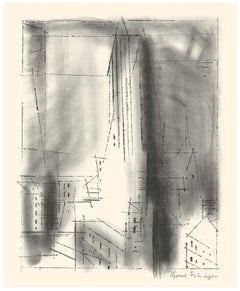
Lyonel Feininger, 'Manhattan 1, stone 2', lithograph, 1951, edition 25. Prasse L 16. Titled 'Manhattan I and Stone II' in pencil, in the bottom right sheet edge. A fine impression on off-white Rives wove paper, with full margins (1 1/2 to 2 3/4 inches), in excellent condition. Scarce. Matted to museum standards, unframed.
Image size 11 1/4 x 8 5/8 inches (286 x 219 mm); 16 x 11 1/2 sheet size: inches (406 x 292 mm). Matted to museum standards, unframed.
ABOUT THIS WORK
Feininger produced only 20 lithographs throughout his prolific career—a handful of much earlier works created from 1906-12 were never editioned, with only a few proofs providing a record of those formative experiments. The success of his signature work, 'Off the Coast, Stone 3' created in 1951 for the Print Club of Cleveland, led the artist to produce five other lithographs from 1951-1955 printed by master lithographer George C. Miller as was the Print Club edition.
Impressions of this work are held in the collections of the Boston Public Library, Cambridge Fine Arts Museum, Cleveland Museum of Art, Bezalel National Art Museum (Jerusalem), Philadelphia Museum of Art, and the Washington Library of Congress.
ABOUT THE ARTIST
Lyonel Feininger (1871-1956) was born in New York City into a musical family—his father was a violinist and composer, his mother was a singer and pianist. He studied violin with his father, and by the age of 12, he was performing in public. Still, he also drew incessantly, most notably the steamboats and sailing ships on the Hudson and East Rivers, and the landscape around Sharon, Conn., where he spent time on a farm owned by a family friend. At the age of 16 he left New York to study music and art in Germany, from where his parents emigrated. Drawn more to the visual arts, he attended schools in Hamburg, Berlin, and Paris from 1887 to 1892.
After completing his studies, Feininger began his artistic career as a cartoonist and illustrator, his originality leading him to great success. In 1906, after working for a dozen years in Germany, he was offered a job as a cartoonist at the Chicago Tribune, the largest circulation newspaper in the Midwest. He worked there for a year, inventing what became the standard design for the comic strip: in the words of John Carlin, “an overall pattern. . . that allowed the page to be read both as a series of elements one after the other, like language and as a group of juxtaposed images, like visual art.” His originality did not end there: he went on to become one of the great abstract painters. Like Kandinsky, music was his model, but Kandinsky only knew music from the outside—as a listener (inspired initially by Wagner, then by Schoenberg)—while Feininger knew it from the inside. He lived in Paris from 1906 to 1908, during which time he met and was influenced by the work of progressive painters Robert Delaunay and Jules Pascin, as well as that of Paul Cezanne and Vincent van Gogh. He began painting full-time, developing his distinctive Iyrical style based on Cubist and Expressionist idioms and a concern for the emotive qualities of light and color. He exhibited with the Der Blaue Reiter group in 1913, and in 1917, he had his first solo exhibition at Galerie Der Sturm in Berlin.
One year after his solo exhibition, in 1918, Feininger began making woodcuts. He became enamored with the medium, producing an impressive 117 in his first year of exploring the printmaking medium. In 1919 at the invitation of the architect Walter Gropius, he was appointed the first master at the newly formed Staatliches Bauhaus in Weimar. His woodcut of a cathedral...
Category
1950s Bauhaus Lyonel Feininger Art
Materials
Lithograph
'Church with Houses' — Artist's Personal Letterhead, Bauhaus Modernism
By Lyonel Feininger
Located in Myrtle Beach, SC
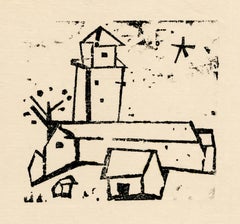
Lyonel Feininger, 'Church with Houses' also 'Tree and Star' ('Kirche mit Hausern', 'Baum und Stern'), woodcut, 1933, one of a small but unknown number of letterhead proofs; Prasse W275. Annotated 'W 275' (Feininger catalogue number) and inventory number '3033' in pencil, in the bottom right sheet corner. A fine, richly-inked impression, on cream, laid letterhead paper, in excellent condition. Very scarce.
Image size 2 7/16 x 2 5/8 inches; sheet size 10 x 6 7/8 inches. Archivally sleeved, unmatted.
Exhibited: 'Lyonel Feininer, Woodcuts Used As Letterheads'; Associated American Artists; Feb 4 - March 2, 1974; New York, NY.
ABOUT THE ARTIST
Lyonel Feininger (1871-1956) was born in New York City into a musical family—his father was a violinist and composer, his mother was a singer and pianist. He studied violin with his father, and by the age of 12, he was performing in public, but he also drew incessantly, most notably the steamboats and sailing ships on the Hudson and East Rivers, and the landscape around Sharon, Conn., where he spent time on a farm owned by a family friend. At the age of 16 he left New York to study music and art in Germany, from where his parents emigrated. Drawn more to the visual arts, he attended schools in Hamburg, Berlin, and Paris from 1887 to 1892.
After completing his studies, Feininger began his artistic career as a cartoonist and illustrator, his originality leading him to great success. In 1906, after working for a dozen years in Germany, he was offered a job as a cartoonist at the Chicago Tribune, the largest circulation newspaper in the Midwest. He worked there for a year, inventing what became the standard design for the comic strip: in the words of John Carlin, “an overall pattern. . . that allowed the page to be read both as a series of elements one after the other, like language and as a group of juxtaposed images, like visual art.” His originality did not end there: he went on to become one of the great abstract painters. Like Kandinsky, music was his model, but Kandinsky only knew music from the outside—as a listener (inspired initially by Wagner, then by Schoenberg)—while Feininger knew it from the inside. He lived in Paris from 1906 to 1908, during which time he met and was influenced by the work of progressive painters Robert Delaunay and Jules Pascin, as well as that of Paul Cezanne and Vincent van Gogh. He began painting full-time, developing his distinctive Iyrical style based on Cubist and Expressionist idioms and a concern for the emotive qualities of light and color. He exhibited with the Der Blaue Reiter group in 1913, and in 1917, he had his first solo exhibition at Galerie Der Sturm in Berlin.
One year after his solo exhibition, in 1918, Feininger began making woodcuts. He became enamored with the medium, producing an impressive 117 in his first year of exploring the printmaking medium. In 1919 at the invitation of the architect Walter Gropius, he was appointed the first master at the newly formed Staatliches Bauhaus in Weimar. His woodcut of a cathedral crowned...
Category
1930s Bauhaus Lyonel Feininger Art
Materials
Woodcut
Buildings with Crescent Moon (Gebaude mit Mondsichel) – Artist's letterhead
By Lyonel Feininger
Located in Myrtle Beach, SC
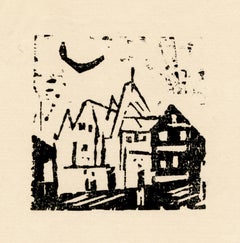
Lyonel Feininger, 'Buildings with Crescent Moon (Gebaude mit Mondsichel)', woodcut, 1936, one of a small but unknown number of letterhead proofs; Prasse W214 III. Annotated 'W 214 II...
Category
1930s Bauhaus Lyonel Feininger Art
Materials
Woodcut
Poster, Israel Museum Collection
By Lyonel Feininger
Located in Chesterfield, MI
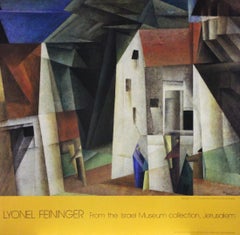
LYONEL FEININGER (American-German, 1871-1956). Poster-From the Israel Museum Collection, Jerusalem, featuring “Mellingen VI 1922." Printed by Hamaker Pre...
Category
Late 20th Century Lyonel Feininger Art
Materials
Lithograph
Ships (Three Sailing Ships)
By Lyonel Feininger
Located in Myrtle Beach, SC
Lyonel Feininger, 'Ships (Three Sailing Ships)', woodcut, 1919, proofs only; posthumous edition 100 (1964), Prasse W151 II. Numbered '55/100' in pencil; F...
Category
1910s Bauhaus Lyonel Feininger Art
Materials
Woodcut
Off the Coast, stone 3 (Vor Der Kuste, Stein 3)
By Lyonel Feininger
Located in Myrtle Beach, SC
Lyonel Feininger, 'Off the Coast, stone 3 (Vor Der Kuste, Stein 3)', lithograph, 1951, edition 250, Prasse L 14 II. Signed in pencil. Printed by master lithographer George C. Miller,...
Category
1950s Bauhaus Lyonel Feininger Art
Materials
Lithograph
Warfleet, 1 ( Kriegsflotte, 1)
By Lyonel Feininger
Located in Myrtle Beach, SC
No. 8 of the portfolio 'Zwolf Holzschnitte von Lyonel Feininger', 1921; Staatliches Bauhaus Weimar, publisher. A fine, black impression, on fibrous cream Japan paper; the full sheet ...
Category
1920s Bauhaus Lyonel Feininger Art
Materials
Woodcut
Off the Coast, Third Stone (Vor der Kuste, Stein 3)
By Lyonel Feininger
Located in Fairlawn, OH
Signed by the artist in pencil lower right; The Print Club of Cleveland stamp verso (Lugt 2049b)
Edition: 250 signed impressions plus 10 for the artist
Exhibitions:
The Prin...
Category
1950s Lyonel Feininger Art
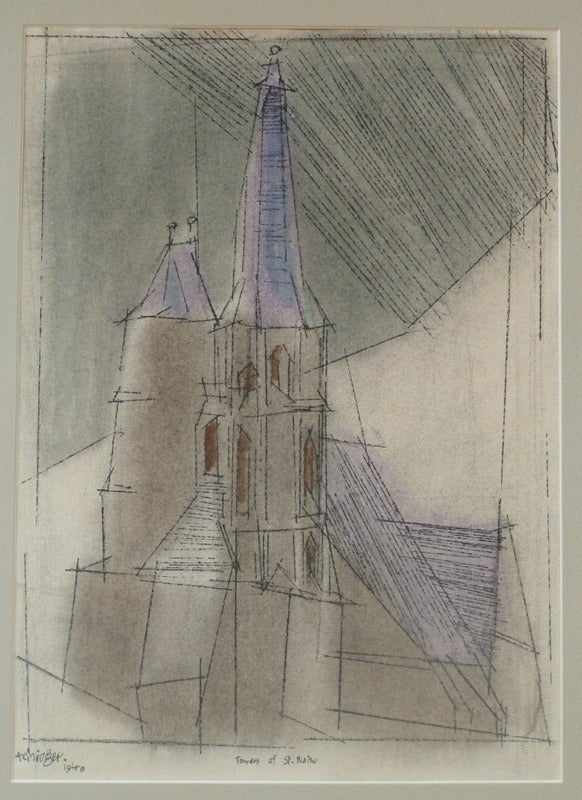
The Towers of Saint Blaise
By Lyonel Feininger
Located in London, GB
This work is hand signed by the artist "Feininger" at the lower left. It is also dated "1940" next to the signature. The work is furthermore titled "Towers of St Blaise...
Category
Lyonel Feininger Art
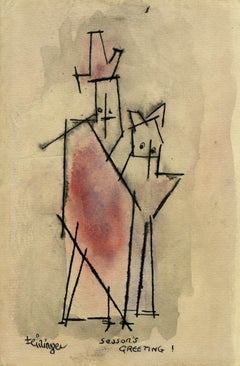
Ghosties
By Lyonel Feininger
Located in Fairlawn, OH
Signed in ink lower left Annotated "Seasons Greetings" in ink lower center.
Ink and Watercolor on paper
Feininger made a series of "Ghosties" watercolor drawings that he sent to fr...
Category
1950s Abstract Lyonel Feininger Art
Materials
Ink, Watercolor
Lyonel Feininger art for sale on 1stDibs.
Find a wide variety of authentic Lyonel Feininger art available for sale on 1stDibs. You can also browse by medium to find art by Lyonel Feininger in woodcut print, lithograph and more. Much of the original work by this artist or collective was created during the 20th century and is mostly associated with the Expressionist style. Not every interior allows for large Lyonel Feininger art, so small editions measuring 3 inches across are available. Customers who are interested in this artist might also find the work of and Guy Georget. Lyonel Feininger art prices can differ depending upon medium, time period and other attributes. On 1stDibs, the price for these items starts at $200 and tops out at $263,300, while the average work can sell for $8,800.
Questions About Lyonel Feininger Art
- 1stDibs ExpertJanuary 19, 2025Lyonel Feininger is famous for his work as an artist. The German-American painter worked in Expressionism, often employing geometric forms and a bold use of color. Some of his best-known works include Gelmeroda, Carnival in Arcueil, The Lady in Mauve and The White Man. Find a selection of Lyonel Feininger art on 1stDibs.