By Mappin & Webb
Located in Miami, FL
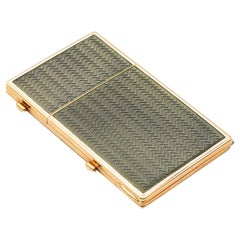
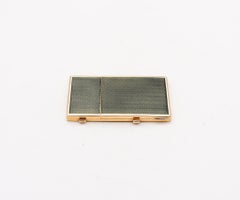
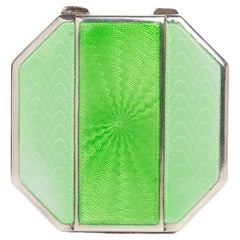
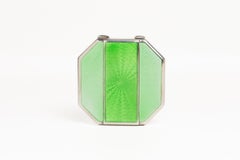
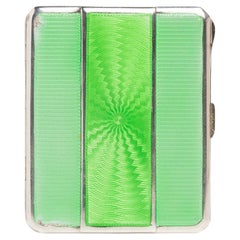
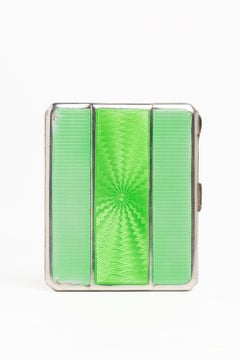
Vesta cigar cutter box designed by Mapping & Webb.
Fabulous matches vesta and cigar cutter case box, created in London England by the goldsmiths Mapping & Webb Limited, back in the 1911. Crafted during the late Edwardian period in solid yellow gold of 18 karats with high polished finish. Embellished with engine turned guilloche, which is topped with gray-green glass enamel all framed with a white enamel border. Fitted with hinged compartments and push buttons; one for the matches and the other for the cigar cutter with a sharp guillotine blade. A superb luxury item in pristine condition with gorgeous craftsmanship. The enamel is extremely well executed with a reminiscence to the Russian enamellers from the same period.
Weight: 47.40 Grams, (30.38 Dwt).
Measurements: 59 mm by 38 mm by 5 mm (2.32 x 1.50 x 0.19Inches).
Hallmarks Stamped with British marks, for the city of London, the maker's mark Mn&Wb associated to Mapping & Webb, the mark for the assay of the gold, the serial number, the letter q for the year 1911 and signed, "MAPPING & WEBB 18KT Q REG NO 582.955". In addition is stamped at the edge, with two French eagle head importation marks.
Mappin & Webb
The company traces its origins to 1775, when Jonathan Mappin opened a silver workshop in Sheffield, then as now a major center of the English silver trade. The business eventually became Mappin Brothers. Mappin House on Oxford Street, as rebuilt in 1906-8. One of Jonathan Mappin's great-grandsons, John Mappin, started his own business in London, Mappin & Company, in 1860, which became Mappin, Webb & Co. in 1862 after John Mappin was joined by his brother-in-law George Webb. The first Mappin & Webb store opened in 1860 at 77–78 Oxford Street, London, and the company's candelabras, fine silverware, and vanity products swiftly gained renown. As a natural progression from silverware, Mappin & Webb began designing jewelry. Mappin, Webb & Co. acquired Mappin Brothers in 1903. Three years later the premises on Oxford Street were rebuilt to designs by Belcher & Joass. Joass also rebuilt the Regent Street store (inherited from Mappin Brothers), in 1914. By the 1950s the latter store was proving more successful than the former, and in 1956 the company moved its headquarters from Oxford Street to Regent Street. Mappin & Webb expanded internationally beginning in the 1890s. Its first overseas store was established in Johannesburg, and stores soon followed in Buenos Aires, Sao Paulo, Biarritz, Hong Kong, Shanghai, Cairo, and Bombay. However, the family lost control of the business in the 1950s, when it was the subject of a hostile takeover (through the acquisition of privately owned shares). Subsequently, all international stores closed in the second half of the 20th century. Since then, it has changed ownership many times. Mappin & Webb has created jewelry for royalty and high society; both in the United Kingdom, and internationally. Patrons have included Queen of France Marie-Antoinette, the Empress of Russia, and Princess Grace of Monaco. The company historically held Royal Warrants to both the Russian Empire and the Japanese Royal Household. Queen Victoria was the first British monarch to commission Mappin & Webb. Victoria's Golden Jubilee necklace was created by the house in 1888, and was designated by the Queen as an heirloom of the Crown. Mappin & Webb has held Royal Warrants in the UK since 1897. Today, Mappin & Webb holds warrants to both Queen Elizabeth II, and the Prince of Wales. Mappin & Webb's master craftsman Martin Swift was appointed in 2012 to the position of Crown Jeweler...
Category
1910s English Edwardian Vintage Mappin & Webb Jewelry
MaterialsGold, 18k Gold, Yellow Gold, Enamel